


ISIS ‘Beatle’ Case Goes to the Jury in Virginia

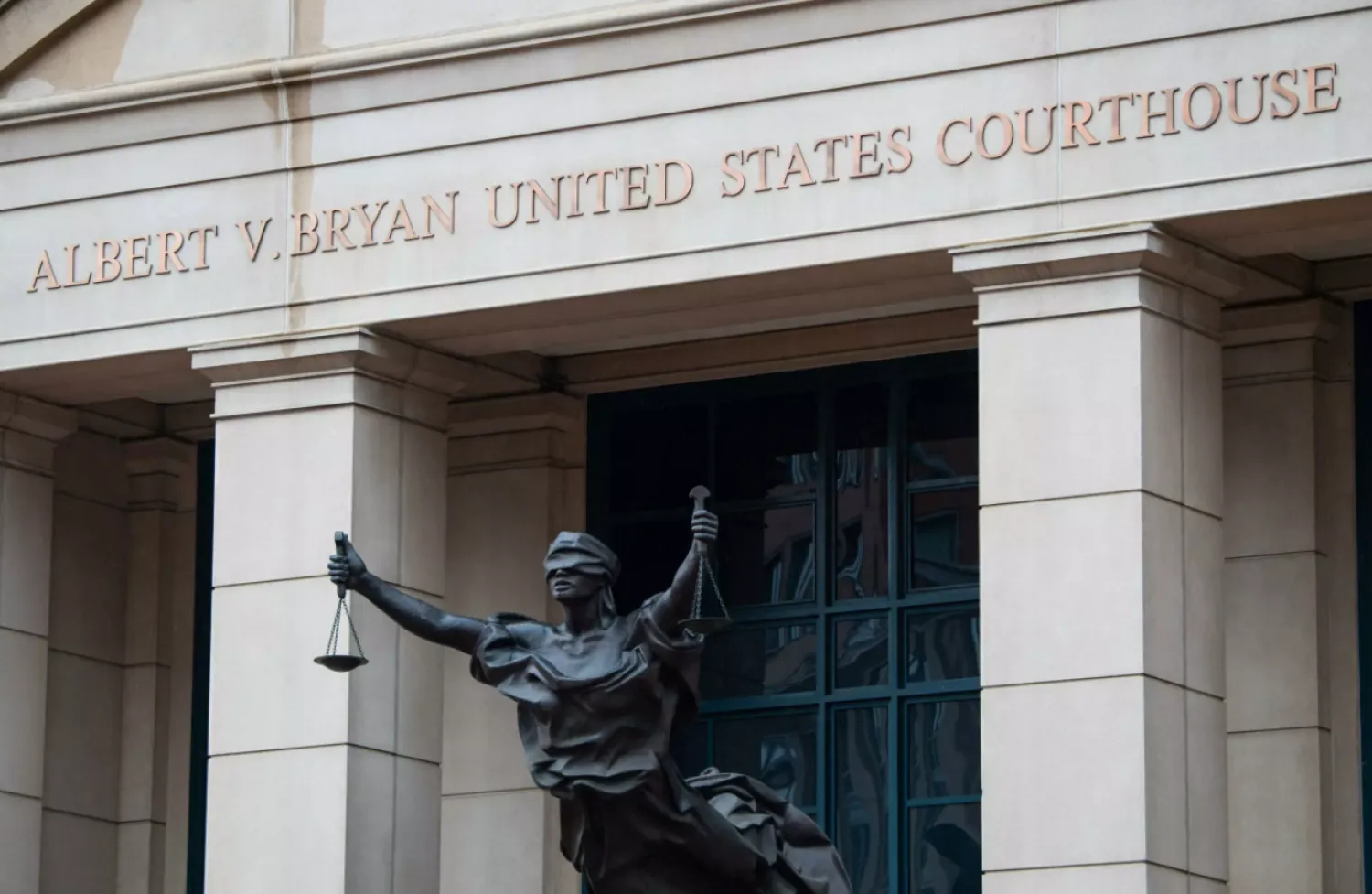
The Albert V. Bryan Federal Courthouse in Alexandria, Virginia, where alleged ISIS 'Beatle' El Shafee Elsheikh is on trial SAUL LOEB AFP/File
TT

ISIS ‘Beatle’ Case Goes to the Jury in Virginia

The Albert V. Bryan Federal Courthouse in Alexandria, Virginia, where alleged ISIS 'Beatle' El Shafee Elsheikh is on trial SAUL LOEB AFP/File

A jury began deliberations Wednesday in the trial of El Shafee Elsheikh, a former British national who went to Syria to join ISIS and allegedly became a member of the notorious kidnap-and-murder cell known as the "Beatles."

Wrapping up the government's case, prosecutor Raj Parekh said it had been proven "beyond any shadow of a doubt" that Elsheikh was one of the hostage-takers dubbed the "Beatles" by their captives because of their British accents.

Defense attorney Nina Ginsberg countered that while the 33-year-old Elsheikh may indeed have been an ISIS militant, prosecutors had not proved he actually was a "Beatle."

Elsheikh, who was stripped of his citizenship by Britain, is charged with the murders of American journalists James Foley and Steven Sotloff and relief workers Kayla Mueller and Peter Kassig, AFP reported.

He and the other "Beatles" are suspected of involvement in the kidnapping in Syria of some 20 other journalists and relief workers from Europe, Russia and Japan.

The question of identification hung heavy over Elsheikh's two-week trial in a US District Court in Alexandria, Virginia.

"There is no forensic evidence linking Mr Elsheikh to any of the locations where the hostages were held," Ginsberg said.

She noted that none of the 10 former European and Syrian hostages who testified about their harrowing treatment was asked to identify the defendant in court.

"Mr Elsheikh was not identified in this courtroom by any of the former hostages," Ginsberg said. "What people would probably call the white elephant in this room."

She said the "Beatles" were responsible for "brutal" and "loathsome" acts but insisted Elsheikh was not one of them.

"You may find him guilty of providing material support to a terrorist organization," Ginsberg said, one of the charges Elsheikh is facing.

"But for the other counts you must find that he was a member of the 'Beatles,'" she said. "We submit you can't."

Parekh, the assistant US attorney, said that on the contrary, the government had "proved beyond any shadow of a doubt that Elsheikh is one of the ISIS 'Beatles.'"

"He brazenly told you so himself," Parekh said in a reference to media interviews played for the 12-person jury during which Elsheikh described his interactions with the hostages.

The interviews with Western media outlets were conducted after Elsheikh and another former British national, Alexanda Amon Kotey, were captured by a Kurdish militia in Syria in January 2018.

They were handed over to US forces in Iraq and flown to the United States in 2020 to face charges of hostage-taking, conspiracy to murder US citizens and supporting a terrorist organization.

Kotey pleaded guilty in September 2021 and is facing life in prison.

In the interviews, Elsheikh made admissions about taking email addresses and proof of life questions from the hostages and to even physically beating them.

Ginsberg said Elsheikh was a "broken man" at that time and only did so to avoid being sent to Iraq, where he would have faced a summary trial and execution.

He wanted to be sent to Britain or the United States "where he could get a fair trial," she said.

Foley, Sotloff and Kassig were beheaded by Mohamed Emwazi, known as "Jihadi John," and videos of their deaths were released by ISIS for propaganda purposes.

Mueller was initially held by the "Beatles" but then was turned over to ISISleader Abu Bakr al-Baghdadi, who reportedly raped her repeatedly.

ISIS announced Mueller's death in February 2015 and said she was killed in a Jordanian airstrike, a claim that was disputed by US authorities.

Baghdadi died during a US special forces raid in 2019. Emwazi was killed by a US drone in Syria in 2015.

In his closing argument, Parekh told the jury the government had proved that Elsheikh, Kotey and Emwazi "grew up together, radicalized together, fought as high-ranking ISIS fighters together and tortured and terrorized hostages together."

"What these horrific crimes left behind is a legacy of brutal killings and shattered families," he said, asking the jury to deliver a verdict of guilty on all counts.



Israel Says it Is Facing an ‘Existential Threat’ as Iran Builds up its Military Capacities  

Israeli defenses intercept Iranian missiles over Tel Aviv on June 22. (AFP)
TT

Israel Says it Is Facing an ‘Existential Threat’ as Iran Builds up its Military Capacities  

Israeli defenses intercept Iranian missiles over Tel Aviv on June 22. (AFP)

Iran is making “hysteric” efforts to produce up to 3,000 ballistic missiles per month, Israel's Maariv newspaper reported on Sunday.

“Although such missiles are considered old-fashioned, imprecise, and can be shot down before they reach their targets, the time they reach their targets is enough to cause serious damage,” the newspaper said quoting Israeli security sources.

In an article published in Maariv, writer Anna Persky said Iran is reviving its nuclear program and is resuming the production of ballistic missiles, but not yet its uranium enrichment.

Quoting Israeli security sources, she wrote: “There has been an ongoing movement in recent weeks around the nuclear reactors that were destroyed in the recent Israeli-US attacks on Iran.”

The sources stressed that the Israeli army’s new military doctrine is based on preemptive strikes to prevent threats before they materialize, but at the same time, they did not rule out a preemptive attack from Tehran.

Persky wrote that Iran is restoring facilities related to the production of ballistic missiles and nuclear facilities damaged by strikes during the 12-day war in June.

For Israel, Iran's nuclear program still remains a serious concern.

“Israeli Prime Minister Benjamin Netanyahu plans to present the Iranian threat during his scheduled meeting with US President Donald Trump” on December 29. “He will try to figure out if Trump is willing to participate in a new war against Iran,” she said.

Persky wrote that Netanyahu will present to the US President with a number of alternatives, including an independent Israeli attack with limited US assistance, a joint strike or a full-scale US operation.

“At the meeting, the main issue will not be what Israel wants to do, but what the United States is willing to offer,” she noted.

In Israel, the “inevitability of a war with Iran” was the headline of all Israeli newspapers over the weekend.

“Iran ramps up missile tests and military drills, renews threats toward Israel,” wrote Yedioth Ahronoth in its headline on Sunday.

It said amid recent reports that Tehran is producing ballistic missiles at a rapid pace and in large quantities, Iran has returned to threatening Israel and showcasing its military capabilities, much as it did before the June war.

But Maariv said the war initiative will rather come from Israel, which perceives Iran’s nuclear program as an existential threat.

Israel is worried about missing the current opportunity. “Today, Iran is still in the midst of reconstruction, but tomorrow it will be more protected, more distributed, and its offensive capability will be more expensive and more dangerous,” Persky wrote.


Moscow Car Blast Kills Russian General 

An investigator works at the scene where Lieutenant General Fanil Sarvarov, head of the Russian General Staff's army operational training directorate, was reportedly killed in a car bomb in Moscow, Russia, December 22, 2025. (Russia's Investigative Committee/Handout via Reuters)
TT

Moscow Car Blast Kills Russian General 

An investigator works at the scene where Lieutenant General Fanil Sarvarov, head of the Russian General Staff's army operational training directorate, was reportedly killed in a car bomb in Moscow, Russia, December 22, 2025. (Russia's Investigative Committee/Handout via Reuters)

A senior Russian general was killed in southern Moscow on Monday after an explosive device placed under his car went off, investigators said in a statement.

Russia's Investigative Committee, which examines major crimes, said it had opened a probe into the "murder" of Lieutenant General Fanil Sarvarov, head of the training department within the General Staff.

The possibility that the attack was "linked" to "Ukrainian special forces" was among the lines of inquiry, it said.

Since Moscow sent troops into Ukraine in February 2022, Kyiv has been blamed for several attacks targeting Russian military officials and pro-Kremlin personalities in Russia and in Russian-controlled Ukrainian regions.

General Yaroslav Moskalik, a deputy of the General Staff, was killed in a car blast near Moscow in April.

In December 2024, Igor Kirillov, the head of the Russian radiological, chemical and biological defense forces, was killed when a booby-trapped electric scooter exploded in Moscow, an attack claimed by Ukraine's SBU security service.

A Russian military blogger, Maxim Fomin, was killed when a statuette exploded in a Saint Petersburg cafe in April 2023.

And in August 2022, a car bomb killed Daria Dugina, the daughter of ultranationalist ideologue Alexander Dugin.


Iran Does Not Rule Out New Israeli Attacks against it

Russian Foreign Minister Sergei Lavrov, right, and Iranian Foreign Minister Abbas Araghchi shake hands after a joint news conference at Zinaida Morozova's Mansion in Moscow, Wednesday, Dec. 17, 2025. (Ramil Sitdikov/Pool Photo via AP)
TT

Iran Does Not Rule Out New Israeli Attacks against it

Russian Foreign Minister Sergei Lavrov, right, and Iranian Foreign Minister Abbas Araghchi shake hands after a joint news conference at Zinaida Morozova's Mansion in Moscow, Wednesday, Dec. 17, 2025. (Ramil Sitdikov/Pool Photo via AP)

Iran's Foreign Minister Abbas Araghchi on Sunday said Tehran “does not rule out” the possibility of a new Israeli or US attack on its nuclear facilities, but remains “fully prepared, even more than before.”

“This doesn't mean that we welcome another war, but it is exactly to prevent a war. And the best way to prevent war is to be prepared for that. And we are fully prepared,” Araghchi said in an interview with Russia Today (RT).

The minister said Iran has rebuilt everything that was damaged by Israeli and US strikes during the 12-day war in June.

“If they want to repeat the same failed experience, they will not achieve a better result,” he stressed.

Araghchi made the remarks during a visit last week to Moscow, where he held political and diplomatic talks with Russian officials, including his counterpart, Sergei Lavrov.

Araghchi said he is no longer in contact with US Special Envoy for the Middle East Steve Witkoff, revealing that their communication channel has been inactive for months.

Iran and the envoy had held five rounds of talks between April and June. A sixth round, scheduled for June 15, was canceled after Israel launched its strikes on Iran.

Araghchi said that following the war, he maintained contacts with Witkoff. He said that while the US insisted on resuming negotiations, it had adopted what he described as a “very wrong” approach.

Commenting on the US strikes on Iran's nuclear facilities in Natanz and Fordow in June, the FM acknowledged: “Our facilities have been damaged, seriously damaged.”

However, he added: “There is also another fact, that our technology is still there, and technology cannot be bombed. And our determination is also there. We have a very legitimate right to peaceful use of nuclear technology, including enrichment.”

Araghchi reiterated that Iran is ready to provide full assurance that its nuclear program is peaceful as it did in 2015 when Tehran agreed to build confidence over the peaceful nature of its program in exchange of the lifting of sanctions.

He noted that military operations have failed to achieve their goals, while diplomacy was a successful experience.

Asked if he expects Israel will maintain its approach in 2026, the FM replied: “They will continue their aggressive behavior in 2026 due to the full impunity which is given to them by the US and Europeans.”

NBC News reported last week that Israeli officials have grown increasingly concerned that Iran is expanding production of its ballistic missile program, which was damaged by Israeli strikes in June, and are preparing to brief President Donald Trump about options for attacking it again, according to a person with direct knowledge of the plans and four former US officials briefed on the plans.

On Iran’s relations with the International Atomic Energy Agency (IAEA), Araghchi said: “We remain a committed member of the Non-Proliferation Treaty (NPT) and are ready to cooperate with the Agency.”

“We have a simple question for the Agency: Please tell us, how should a nuclear facility that has been attacked be inspected? And there is no answer to this question, because there is no precedent to this,” he added.