Palestinians Mourn Israel’s Creation amid Outcry over Funeral Raid
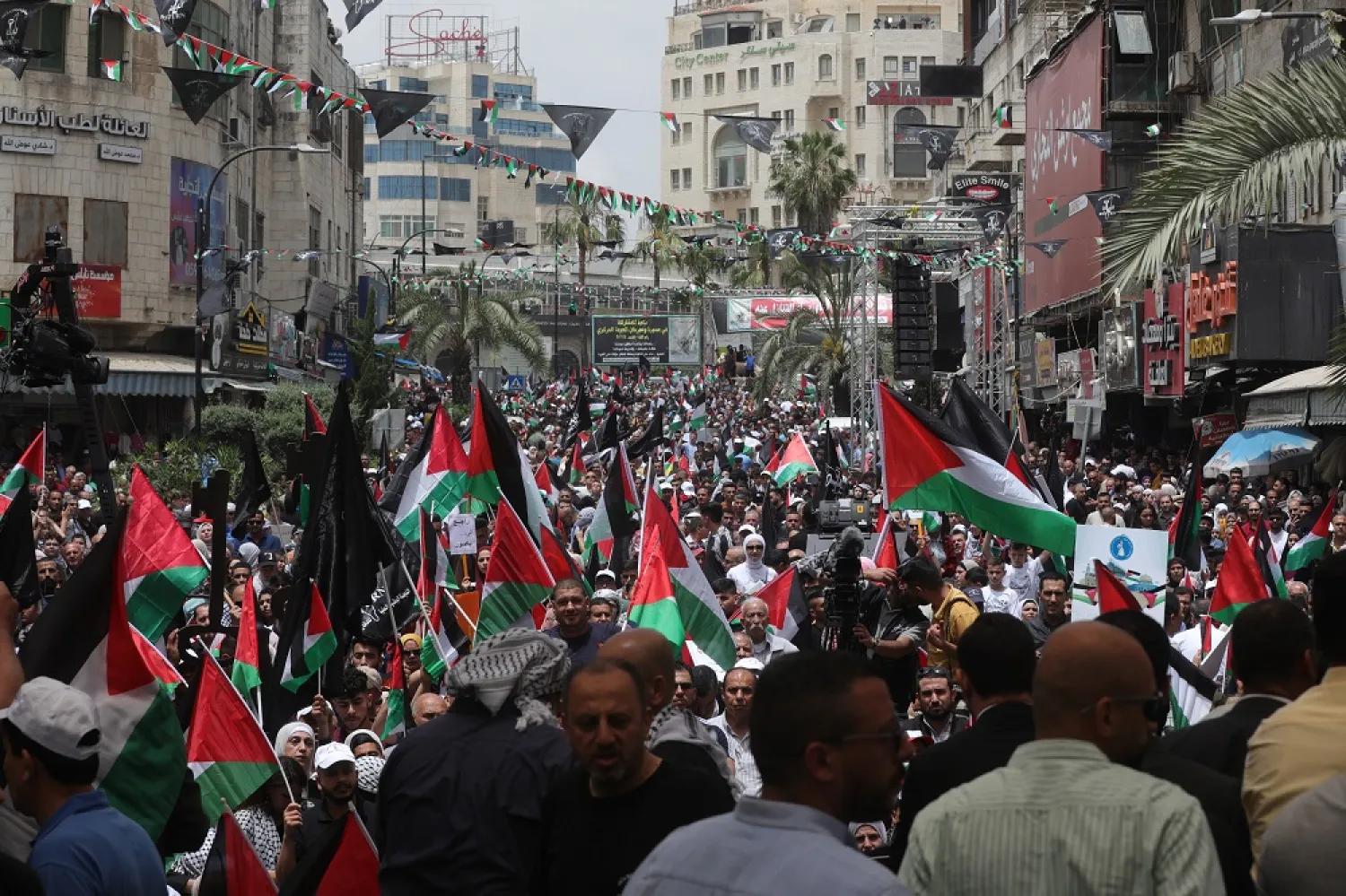
Palestinians participate in a rally marking the 74th anniversary of the Palestinian Nakba, in the West Bank city of Ramallah, 15 May 2022. (EPA)
Palestinians rallied Sunday to mark the "Nakba," or catastrophe, 74 years after Israel's creation, with condemnation spreading over a police raid on the funeral of a slain journalist.
The annual demonstrations across the occupied West Bank, annexed east Jerusalem and inside Israel came with tensions high over the killing of 51-year-old Al Jazeera reporter Shireen Abu Akleh.
The Palestinian-American was shot dead Wednesday during an Israeli raid in Jenin, a West Bank flashpoint. A Palestinian militant wounded in clashes there, Daoud al-Zubaidi, died from his injuries in an Israeli hospital Sunday.
Israeli police have vowed to investigate the chaos that marred the day of Abu Akleh's funeral, after television footage seen worldwide showed pallbearers struggling to stop the casket from toppling to the ground as baton-wielding police descended upon them, grabbing Palestinian flags.
The scenes Friday sparked international condemnation, including from the United States, United Nations and the European Union, with US Secretary of State Antony Blinken on Sunday calling for a "credible" investigation into Abu Akleh's death as he offered condolences to her family.
Late South African Archbishop Desmond Tutu's foundation said Israeli police "attacking pallbearers" was "chillingly reminiscent of the brutality" seen at the funerals of anti-apartheid activists.
'Unbridled brutality'
Israeli commentators joined the chorus lambasting the raid as Abu Akleh's coffin emerged a Jerusalem hospital.
In leading Israeli daily Yediot Ahronot, Oded Shalom said the footage "documented a shocking display of unbridled brutality and violence".
"The Jerusalem District Police decided to come down like a ton of bricks on anyone who dared to hold a Palestinian flag," Shalom wrote.
"As if holding up a flag -- a mere piece of cloth, for God's sake -- at a funeral procession for an hour or two could have had any impact whatsoever" on Israeli claims to control over Jerusalem, he added.
Israeli police regularly crack down on people holding Palestinian flags.
Thousands of Palestinians streamed through central Ramallah for the main Nakba rally, with crowds also turning out in Gaza City, in the Israeli-blocked strip.
At a student Nakba event at Tel Aviv University (TAU), police said three Arabs were arrested "for attacking demonstrators and police officers."
The arrests followed a confrontation with Im Tirtzu, a right-wing Israeli movement holding a counter rally.
Arab TAU student Aline Nasra said that demonstrators were assaulted by police as they moved to protect one of their members from Im Tirtzu threats.
The right-wing Israelis taunted the Arab students, including with calls that Israel is only for "Jewish people," Nasra said.
Posthumous report
Al Jazeera on Sunday posthumously aired a piece produced by Abu Akleh on the Nakba, which marks Israel's 1948 declaration of independence.
A highly respected reporter, she was killed while wearing a helmet and a bulletproof vest marked "Press".
Israel's army said an interim investigation could not determine who fired the fatal bullet, noting that stray Palestinian gunfire or Israeli sniper fire aimed at militants were both possible causes.
The Palestinian public prosecution said an initial probe proved Israeli troops were to blame.
Abu Akleh's posthumously aired piece retraced the fate of the Palestinian people since 1948, with a particular focus on refugees and the displaced.
More than 700,000 Palestinians fled or were forced from their homes during the conflict that surrounded Israel's creation.
One of the latest casualties of the Israeli-Palestinian conflict, Daoud al-Zubaidi, was the brother of Zakaria, who headed the armed wing of Palestinian President Mahmud Abbas's Fatah movement and briefly escaped from an Israeli prison last year.
The most recent Israeli fatality was special forces police officer Noam Raz, 46, who was shot Friday in Jenin. He was being buried on Sunday.
Yemen Interior Minister to Asharq Al-Awsat: Iran Seeking to Militarize Bab al-Mandeb Through the Houthishttps://english.aawsat.com/arab-world/5319145-yemen-interior-minister-asharq-al-awsat-iran-seeking-militarize-bab-al-mandeb
Yemen Interior Minister to Asharq Al-Awsat: Iran Seeking to Militarize Bab al-Mandeb Through the Houthis
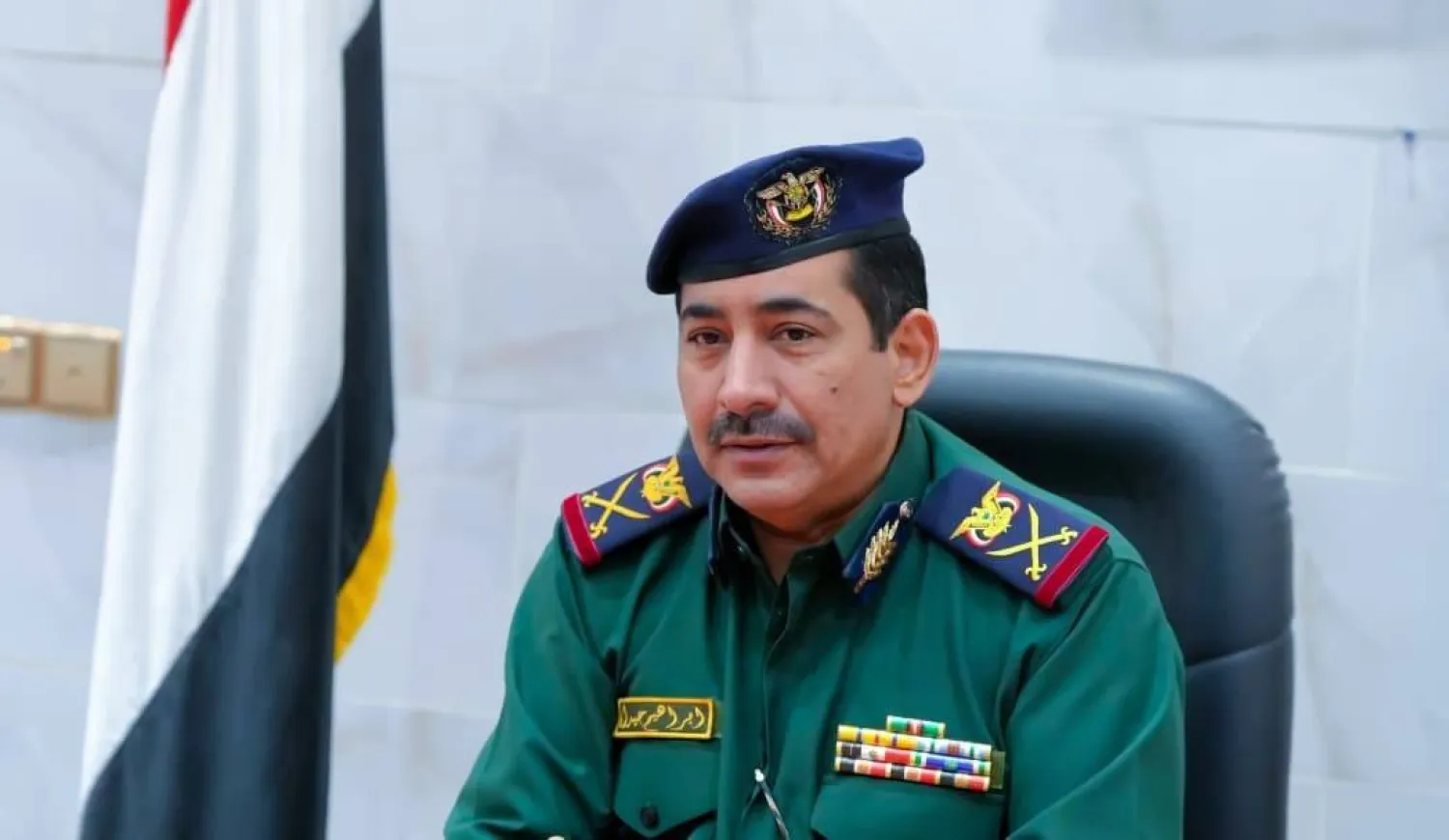
Yemen’s interior minister warned that Iran was seeking to “militarize Bab al-Mandeb” through the Houthis. (Turky Al-Agili)
Yemen’s Interior Minister Major General Ibrahim Haidan warned that Iran is seeking to establish long-term military influence over the Bab al-Mandeb Strait and its surrounding islands and coastlines by exporting to the Red Sea the model it developed to “militarize maritime corridors” in the Strait of Hormuz.
Haidan said experts from Iran’s Revolutionary Guards Corps (IRGC) were helping the Houthis strengthen their capabilities and build fortifications, operations rooms and facilities for missiles, drones and remotely guided boats.
“The danger is not limited to the threats that exist today, but extends to what is being built for the future,” Haidan told Asharq Al-Awsat.
He warned that continued Houthi control of strategic areas could give Iran leverage over one of the world’s most important shipping lanes and help it connect Yemen with the Horn of Africa through smuggling networks and armed groups.
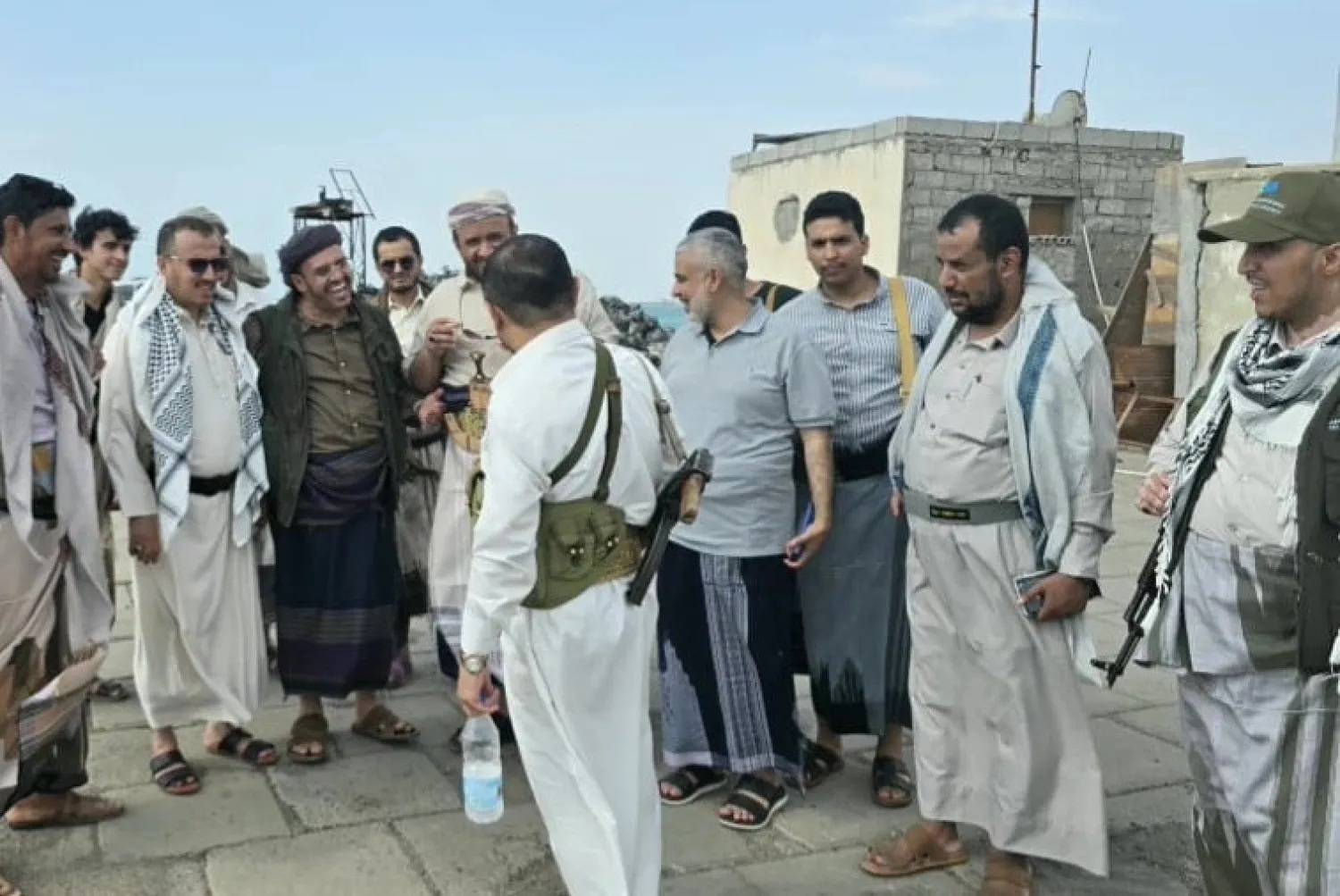
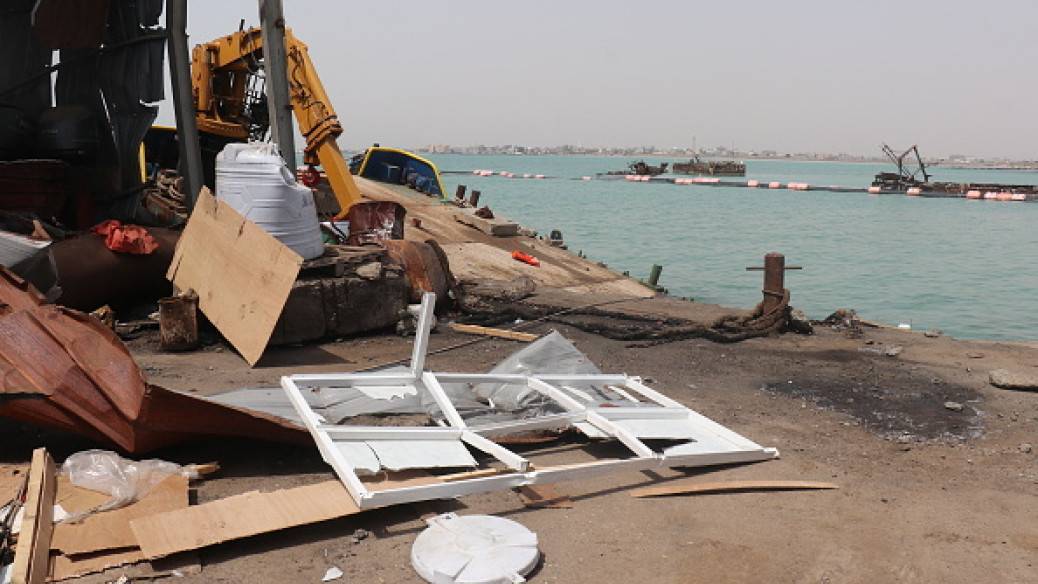
His remarks followed sweeping government losses along Yemen’s western coast. In an offensive from Sept. 3 to 11, the Houthis seized Hays, Al-Khokha, Mokha and its port before advancing to Bab al-Mandeb, Mayyun Island and the remaining Yemeni islands in the southern Red Sea.
Haidan said security readiness had been raised in Aden, Lahj and areas behind the frontlines following the developments in Mokha and along the western coast.
The defense and interior ministries were coordinating through a joint operations room to prevent operatives and cells from infiltrating those areas or exploiting waves of displacement to carry out security breaches, he added.
‘Militarizing’ Bab al-Mandeb
Haidan placed the latest developments in a broader context, saying Yemen was “part of a regional and international security system” and that events there quickly reverberated around the world because of the Bab al-Mandeb Strait.
The gravest danger, he said, was the military infrastructure being built in the area for future use.
Experts linked to the IRGC were providing the Houthis with expertise and guidance to conduct operations and develop their military capabilities, he said.
Those efforts included building “capabilities, fortifications, bases, operations rooms and caves used to manufacture drones and remotely guided boats and to develop missiles” across Bab al-Mandeb and the surrounding islands, coastlines and highlands.
Haidan said Iran aimed to replicate in Bab al-Mandeb its experience of “militarizing maritime corridors” in the Strait of Hormuz.
That could turn an open international waterway into a source of influence and pressure for future use, he warned.
Iranian and Houthi assurances about the safety of navigation should not be treated as sufficient guarantees, he said, arguing that such messages merely gave the Houthis more time to expand their military systems and fortifications.
Houthi leaders at Mokha port after its capture (Houthi media)
Could Mayyun become another Larak?
Haidan outlined a more specific threat to the Red Sea islands, warning that additional time could allow the Houthis to build bases, hideouts and fortified caves, backed by advanced surveillance, tracking and jamming systems.
Mayyun Island, at the heart of Bab al-Mandeb, could take on a military role similar to that of Iran’s Larak Island in the Strait of Hormuz, he said.
Zuqar and the Hanish Islands, as well as the highlands and coastlines along the Red Sea, could also become part of an “integrated military system” if the Houthis consolidated their presence in the strait, he added.
From the Red Sea to the Horn of Africa
The danger extends beyond Bab al-Mandeb, according to Haidan.
Houthi control of the strait could give the Revolutionary Guards greater scope to connect Yemen with the Red Sea and the Horn of Africa, he said.
Smuggling networks and maritime routes could be used to move weapons, equipment and expertise, strengthen Houthi military and logistical capabilities and expand communication with armed groups and terrorist organizations operating in the Horn of Africa, particularly Somalia’s al Shabaab.
Haidan warned that those groups’ capabilities could merge with those of the Houthis and IRGC networks.
Such coordination could turn Bab al-Mandeb into “a foothold for multifaceted Iranian influence across several arenas” and give Tehran a strategic tool to deploy during any regional escalation, he said.
Destruction in Mokha after being attacked by the Houthis. (Getty Images)
Coastguard needs urgent support
Government forces continue to confront the Houthis and work to regain and secure lost territory, Haidan stressed.
He singled out smuggling as one of the main arteries for financing and supplying the Houthis.
Yemen’s coastguard was carrying out its duties despite limited resources, but needed “urgent, specialized support” from allied and friendly countries, he remarked.
That support should include maritime surveillance and reconnaissance capabilities, tracking and monitoring systems, patrol boats and modern equipment. Intelligence capabilities must also be strengthened to uncover smuggling networks, track their routes and intercept their shipments, he added.
Protecting Bab al-Mandeb and combating smuggling were no longer purely domestic Yemeni concerns, Haidan declared.
“The security of navigation and international trade routes begins with the state exercising sovereignty over its territory and waters,” he said.
Confronting the threats required regional and international support for the Yemeni state and stronger state capabilities, he added.
Securing Aden and Lahj
Security deployments have been reinforced at the entrances to Lahj province, the interim capital Aden and surrounding areas as displacement increased following the developments along the western coast, Haidan said.
The Interior Ministry treated the crisis as extending beyond the military frontlines. It acted simultaneously to protect displaced civilians and raise security readiness under plans prepared in advance for different scenarios.
The measures sought to balance the protection of displaced people with the need to stop the Houthis from exploiting their movement “for security purposes or to carry out infiltration and penetration operations,” he said.
Authorities have stepped up coordination and information-sharing among security agencies, local authorities and military units. They have also intensified preemptive intelligence efforts to prevent operatives from entering government-held areas or carrying out acts of sabotage.
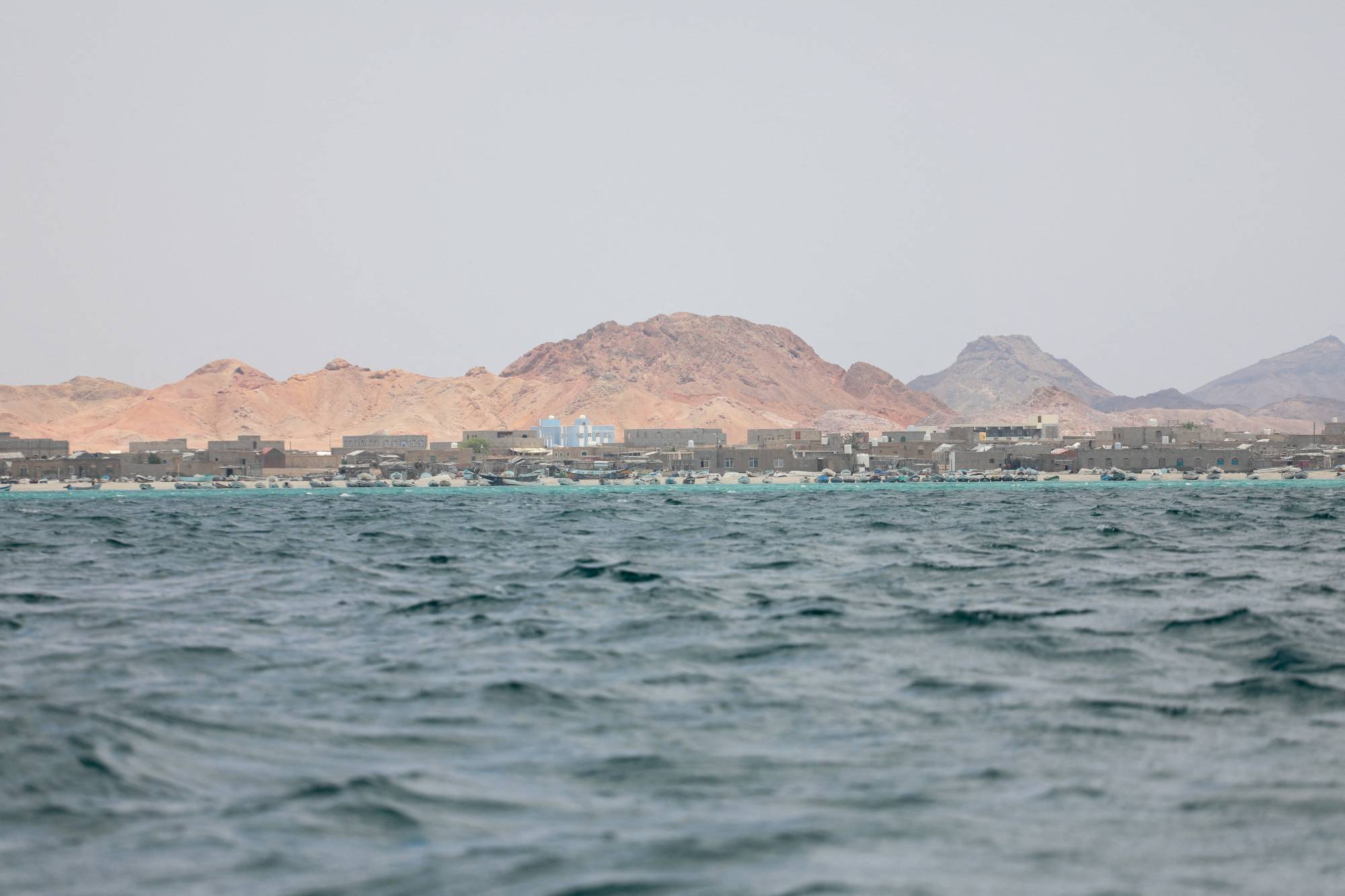
A view of a village on the coast of Bab al-Mandeb, Yemen April 2, 2026. (Reuters)
Joint operations room
The defense and interior ministries were coordinating through a “joint operations room,” Haidan said.
Its work included producing a unified assessment of the situation, assigning responsibilities and speeding up responses to developments on the ground.
Security and military services had also strengthened communication and information-sharing, focusing on frontlines, roads and areas that could be used to infiltrate operatives and cells or transport weapons and explosive devices.
Displacement remained “primarily a humanitarian issue,” Haidan said, but it also required careful security management to prevent it from being used as cover to infiltrate operatives or cells into government-held areas.
Sleeper cells and smuggling
Asked about the threats facing the security services, Haidan cited infiltration attempts and the potential use of displacement movements to conceal operatives or transport information and materials for acts of sabotage.
Sleeper cells, smuggling networks and organized crime also posed risks, he told Asharq Al-Awsat.
The heightened security measures in Aden and Lahj were largely “preventive and preemptive,” Haidan explained. They aimed to stop military pressure on the frontlines from spilling into cities while preserving a humanitarian approach toward displaced people.
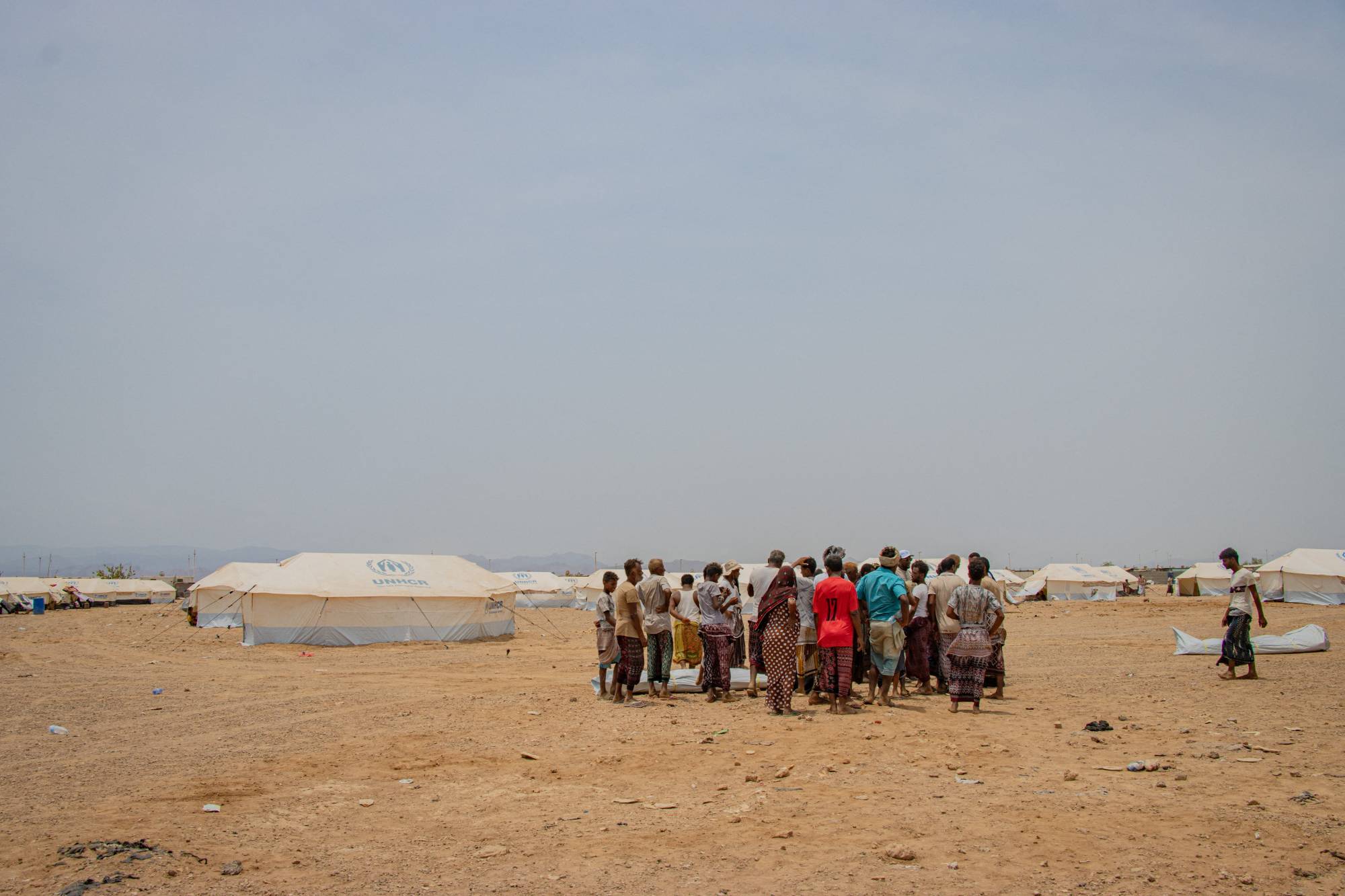
People fleeing clashes between Houthi militants and Yemeni government forces gather at the Markazi refugee camp after arriving in Djibouti, September 15, 2026. (Mylaèle Negga/International Organization for Migration/Handout via Reuters)
Mokha a ‘practical test’
Haidan described the events in Mokha as a “direct and practical test” of the security establishment’s readiness and the Interior Ministry’s contingency plans.
From the outset, those plans accounted for advances and retreats, shifting frontlines, widening displacement and mounting pressure on provinces behind the fronts, he said.
Protecting the home front was not a temporary task tied to a particular military development, but an “integral and permanent” part of the Interior Ministry’s work.
Resources and security deployments had been adjusted to battlefield developments, while information-sharing among security agencies, local authorities and military forces had been strengthened, he added.
‘Collusion’ with terrorist groups
Beyond the Houthi threat, Haidan warned that terrorist organizations, smuggling networks and organized crime groups could exploit the widening war, shifting frontlines and troop redeployments to create security vacuums.
He said there was “collusion” between the Houthis and those groups and networks. The relationship predated the latest developments and included links with Somalia’s al Shabaab.
Security agencies did not treat the Houthi threat, terrorism, organized crime and smuggling as separate files, but as “a single security system,” Haidan said.
That required heightened readiness, stronger deployments in sensitive areas and tighter monitoring of entry points, roads and smuggling routes to prevent the military developments from triggering a broader security crisis.
US Warns Houthis Through Security Channels: We Are Not Negotiating with Youhttps://english.aawsat.com/arab-world/5319133-us-warns-houthis-through-security-channels-we-are-not-negotiating-you
US Warns Houthis Through Security Channels: We Are Not Negotiating with You
A soldier from the Yemeni armed forces in Taiz province. (AFP)
US correspondence reviewed by Asharq Al-Awsat revealed that Washington had issued a warning to the Houthis in Yemen through “security channels.”
The substance of the warning was not disclosed in the messages, but it was followed by a US assertion that Washington was not negotiating with the group.
The Houthis’ outreach suggests that the group is seeking to consolidate its position after weeks of military operations culminated in advances along Yemen’s western coast overlooking the Bab al-Mandab Strait.
The gains pose a fresh threat to international shipping through the strategic waterway, which carries 12% of global trade.
The clarification in the US diplomatic correspondence came after President Donald Trump and Vice President JD Vance said there had been contact with the group, although neither explained the nature of the communication.
Meanwhile, during a UN Security Council session on the Bab al-Mandeb Strait on Tuesday, Washington stated: “The US supports Yemen’s legitimate government in confronting the Iran-backed Houthi militia. We call on the Houthis to halt their advance, withdraw from the territory they have seized and stop launching attacks.”
On the ground, Yemen’s government is raising its level of military readiness as it seeks to regain the initiative following recent setbacks on the Taiz and western coastal fronts. Government forces have made slow but seemingly more sustained progress on other fronts, including in al-Jawf and al-Bayda, while continuing to repel Houthi attacks and military buildups near Marib.
Government forces are engaged in fierce battles with the Houthis, which began escalating their operations in August.
The group’s opponents accuse it of violating de-escalation arrangements under orders intended to ease pressure on Iran and enable Iran’s Revolutionary Guards to use the Houthis as leverage against the United States in the war Washington launched in February 2026, which intensified after Iran threatened to close the Strait of Hormuz.
Why security channels?
Observers who spoke to Asharq Al-Awsat said the mere use of security channels did not indicate that negotiations or a deal were underway, or even that Washington had accepted the Houthis’ assurances.
Assessing the Houthi move and the US response, Baraa Shiban, an associate fellow at Britain’s Royal United Services Institute for Defence and Security Studies, said the group was trying to compensate for its lack of regional and international recognition by exaggerating claims that it had opened channels of communication with the US administration.
Asked about the “security channels,” Shiban said Western governments commonly maintained this type of contact with militias and terrorist groups. Such communication, however, remained limited, took place outside diplomatic or political frameworks and dealt only with sensitive or urgent security matters.
Iranian tactics
News that the Houthis had contacted the United States was not treated as a passing development. Yemenis sought to understand the group’s sudden move, particularly because its slogan calls for “death to America”, raising the question of how it could communicate with Washington.
Mahmoud Shehrah, an associate fellow at Britain’s Chatham House, told Asharq Al-Awsat that the development was “part of a Houthi strategy that represents an extension of Iran’s and the Revolutionary Guards’ conduct and negotiating tactics.”
Shehrah, a former Yemeni diplomat, said the Houthis’ approach was based on gradually escalating tensions, launching a swift offensive and then offering assurances if they made gains, in an effort to avoid becoming embroiled in an all-out war.
That, he said, was what had happened in Bab al-Mandeb. The Houthis had now “taken a big bite” and were trying to digest it. The group was therefore seeking to consolidate its gains and, in the meantime, needed to offer assurances to prevent a swift response. It consequently sought to reassure the US and the international community.
The group also consistently sought to isolate its opponents, a tactic it had repeatedly employed in the past.
Shehrah recalled that when the Houthis captured Sanaa, they began by reassuring all political forces. Once they had consolidated their presence, they met each party separately and told it that the other side was the enemy, until they had eliminated them all.
He said the group now wanted to employ the same approach internationally, regardless of whether it could succeed.
Syria Parliament Votes to Abolish Assad-Era Terrorism Court, Nullify Rulingshttps://english.aawsat.com/arab-world/5319106-syria-parliament-votes-abolish-assad-era-terrorism-court-nullify-rulings
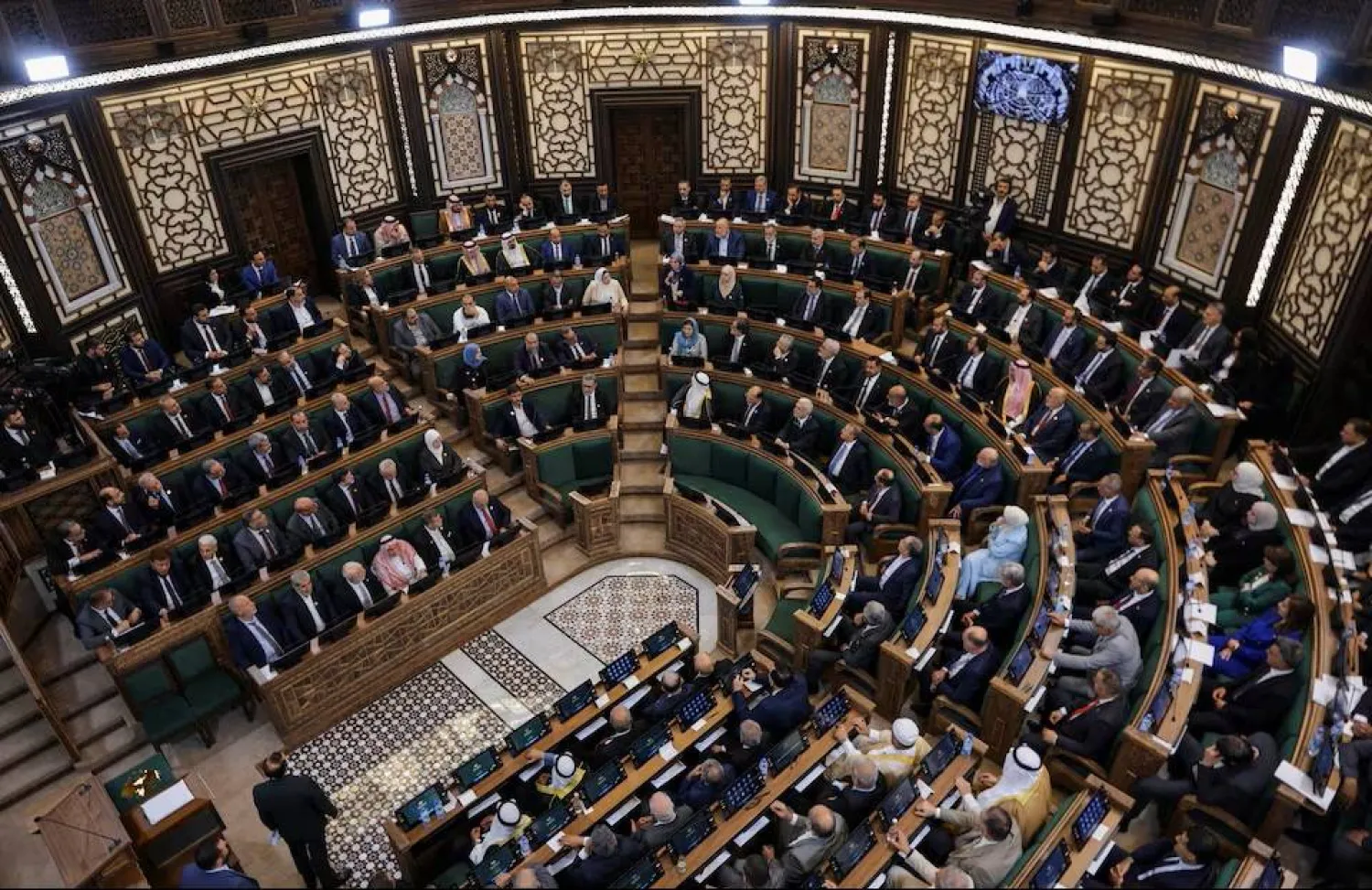
Members of Syria's newly formed People's Assembly attend the body's inaugural session, the first parliament session since the end of the rule of ousted Syrian President Bashar al-Assad, in Damascus, Syria, July 12, 2026. (Reuters)
TT
TT
Syria Parliament Votes to Abolish Assad-Era Terrorism Court, Nullify Rulings
Members of Syria's newly formed People's Assembly attend the body's inaugural session, the first parliament session since the end of the rule of ousted Syrian President Bashar al-Assad, in Damascus, Syria, July 12, 2026. (Reuters)
Syria's parliament voted on Wednesday to abolish an Assad-era terrorism court and nullify the legal effects of its rulings, state-run Al-Ikhbariya TV reported, in one of the first significant legislative moves by the country's new assembly.
The Counter-Terrorism Court was established in 2012 as then-President Bashar al-Assad sought to suppress an uprising against his rule, and it was used to prosecute thousands of Syrians for terrorism-related offences.
The move formalizes the court's abolition after Syria's new authorities had already treated it as defunct. In June 2025, President Ahmad al-Sharaa issued a decree dismissing 67 judges who had served in what he described at the time as the "abolished Counter-Terrorism Court".
Syria's March 2025 constitutional declaration had also called for abolishing the effects of what it described as unjust rulings issued by the court, including returning confiscated property.
The United Nations Human Rights Committee said in 2024 that the 2012 law establishing the court failed to adequately provide key judicial guarantees and raised concerns over arbitrary detention, torture or ill-treatment, and the court's independence. It also noted that the court was permitted to depart from ordinary procedures during prosecution and trial.
The UN's International, Impartial and Independent Mechanism said in a 2024 report that the Counter-Terrorism Court formed part of the judicial system through which detainees held by Assad-era security agencies could be prosecuted. The report documented widespread and systematic torture and ill-treatment across the government's detention system.
Wednesday's vote came during the opening weeks of the first parliament formed since Assad was toppled in December 2024. The chamber convened for the first time in July.
The vote is among the assembly's first major legislative decisions after it spent its initial sessions establishing its internal rules and committees. It held a hearing this week with Education Minister Mohammad Abdul Rahman Tarkou over the state of the country's schools and is due to question the energy minister on Thursday over a sharp rise in fuel prices.
لم تشترك بعد
انشئ حساباً خاصاً بك لتحصل على أخبار مخصصة لك ولتتمتع بخاصية حفظ المقالات وتتلقى نشراتنا البريدية المتنوعة