


Massacre Video Reopens Wounds for Missing Syrians’ Families

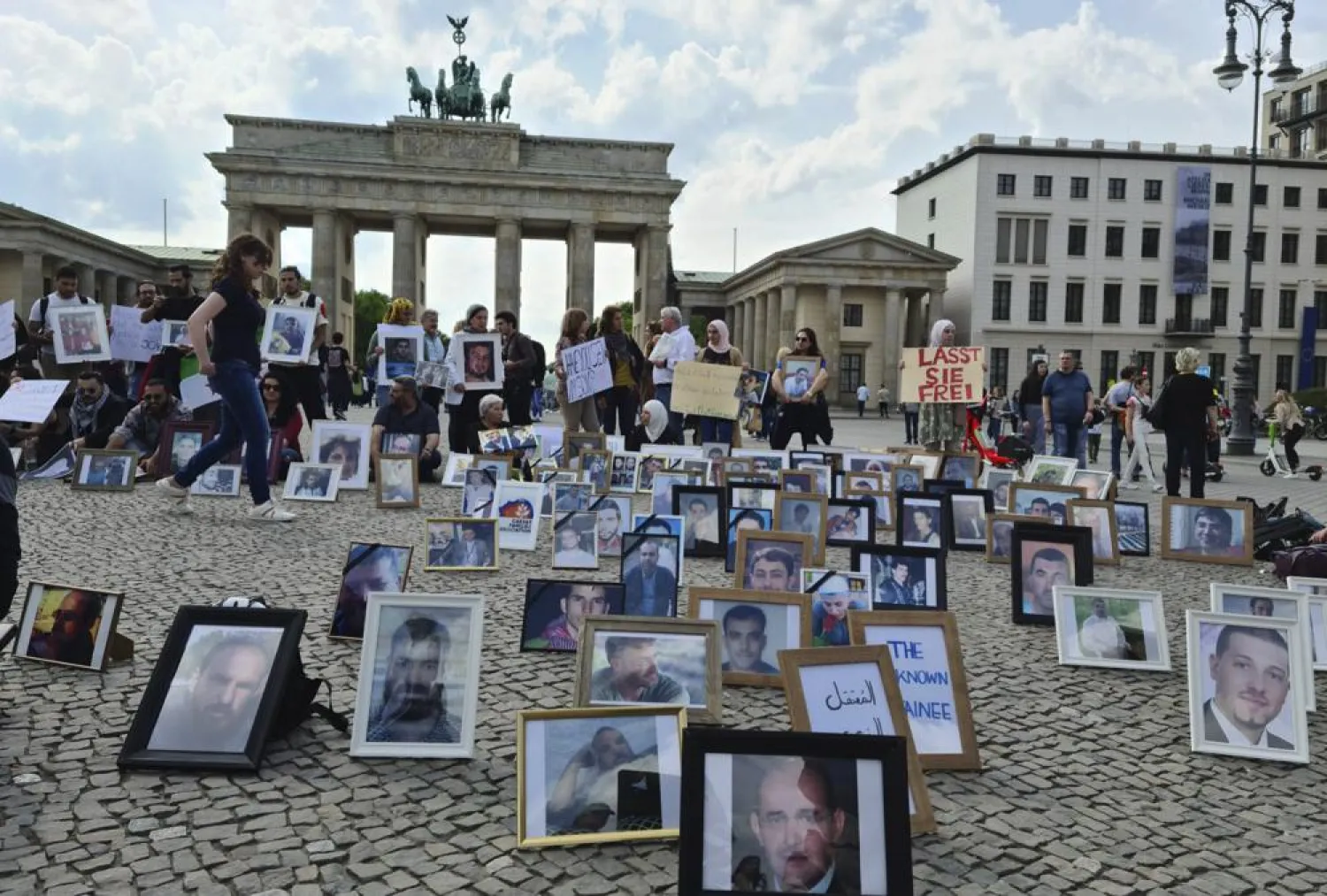
This photo provided by Syrian activist Wafaa Mustafa, shows families of Syrian detainees carrying photos of their detained the missing loved ones, as they demanding their freedom and the revealing of their fate and whereabouts during a sit-in, in Berlin Germany, on Saturday, May, 7, 2022. (Wafaa Mustafa, via AP)
TT

Massacre Video Reopens Wounds for Missing Syrians’ Families

This photo provided by Syrian activist Wafaa Mustafa, shows families of Syrian detainees carrying photos of their detained the missing loved ones, as they demanding their freedom and the revealing of their fate and whereabouts during a sit-in, in Berlin Germany, on Saturday, May, 7, 2022. (Wafaa Mustafa, via AP)

For years, the Siyam family clung to hope they would one day be reunited with their son Wassim, who they believed was being held in a Syrian government prison after he went missing at a checkpoint nearly a decade ago.

That hope evaporated the moment they saw him in a newly leaked video: He was among dozens of blindfolded, bound men who, one by one, were shot and thrown into a trench by Syrian security agents.

"It shocked us to our core," Siham Siyam said of the gruesome video, which was taken in 2013 and emerged late last month.

"They killed him in cold blood ... No mother can accept to see her child being harmed this way," Siham told The Associated Press from Germany, where she now lives with her family.

The video has set off a wave of grief and fear rippling through the families of the tens of thousands of Syrians who disappeared during their country’s long-running war. After the video went online, thousands rushed to painstakingly scan through the footage online for traces of vanished relatives.

Even as similar atrocities take place in Ukraine, the Syrian war’s years-old massacres and disappearances have gone unpunished and largely uninvestigated. Families of the missing who spoke to the AP describe an endless torture inflicted on them daily, not knowing their loved ones’ fate.

The video was allegedly smuggled out of Syria by a pro-government militiaman who gave it to a pair of University of Amsterdam researchers, apparently in hopes it would help him get asylum outside Syria. The researchers worked to verify it and identify the location and some of the perpetrators.

The British newspaper The Guardian first reported on the video in late April, and a fuller version of the video has since circulated widely online.

"Even if the families’ loved ones do not appear in the video, the horrible images will be forever etched into their mind, and they will wonder if they faced the same fate," Mohammad Al Abdallah, the Executive Director of the Washington-based Syria Justice and Accountability Center, told the AP.

He called Syria’s network of prisons the "Black Box," with no information about who is held inside and who has been killed.

Learning the truth brings a new kind of torment.

Siham and her husband vow to watch the video every day, to see their son’s last moments alive and to bid him farewell.

The video was stamped with the date April 16, 2013, two days after Wassim, a father of two who would now be 39, disappeared at a checkpoint near the Palestinian refugee camp of Yarmouk on the outskirts of Damascus.

The 6 minute and 43 second clip shows members of Syria’s notorious Military Intelligence Branch 227 with a line of around 40 prisoners in an abandoned building in Tadamon, a suburb of Damascus near Yarmouk. For much of the war, the district was a front line between government forces and opposition fighters.

The prisoners are blindfolded, with their arms tied behind their backs. One after another, the Branch 227 gunmen stand them at the edge of a trench filled with old tires, then push or kick the men in, shooting them as they fall.

In a cruel game, the agents tell some - including Wassim - that they are going to pass through a sniper’s alley and that they should run. The men tumble onto the bodies of those who went before. As bodies pile up in the trench, some still move, and the gunmen shoot into them.

Then the gunmen set the bodies on fire, presumably to erase all traces of the massacre.

According to the Syrian Network for Human Rights, 102,207 people remain missing, more than 11 years since Syria's conflict began.

The group says the one most responsible for forced disappearances is the Syrian government with 86,792 people missing, an unknown number of whom vanished into the murky labyrinth of prisons. The ISIS group was responsible for 8,648 disappearances, and armed opposition groups for 2,567. The rest were held by the US-backed Kurdish-led Syrian Democratic Forces and al-Qaeda-linked militants.

One man who spoke to the AP said 25 of his relatives were taken from their homes in Tadamon by Branch 227 agents in July 2013.

"We are sure they were killed the same way (as those in the video) because they were taken by the same people who appeared in the video," said the man, who asked that his name not be made public.

He said residents know of multiple pits in Tadamon where people were killed and later burned. Security agents who appear in the video were neighbors of the missing families and had known each other for over 30 years, he said.

Among his missing relatives are children and a sister who went to check on her family two days after they were taken from their home. She never returned.

His family’s tragedy didn’t end there. A few months later, a brother who wasn’t present the day his family disappeared was taken from a checkpoint. Years later, a photo of his tortured body appeared in a large file of photos and documents smuggled out by a dissident known as Caesar.

In a May 9 open letter, 17 human rights and civil society organizations urged the UN Security Council to launch an investigation into the killings to bring to justice the perpetrators of the massacre and those who gave them orders. They also denounced international inaction over Syria, saying it has allowed Assad and his allies to continue to commit crimes against the Syrian people with impunity.

Families of the disappeared described to the AP the years of anguish and fruitless searching, punctuated by waves of false hope.

One man, Maher, said he still hopes his brother, missing since 2013, is alive and will one day be released. It’s a new blow every time a prisoner release is announced, and his brother is not among them.

"One tries to adapt throughout the years, but the wound reopens with every report that comes out," he said, speaking on condition that he be identified only by his first name.

His brother vanished while bringing home food aid from the UN agency that helps Palestinian refugees, known as UNRWA. Maher said hundreds of people were arrested while going to collect food boxes, so many that they became known as "death boxes."

Hoping to avoid arrest, people would send the elderly to collect the boxes, he said. His brother went four times; on the fifth, he was detained.

If confirmation emerges that he is dead, "the wound would be cut wide open, and the real misery would start then," Maher said.

A racket of war profiteers preys on families, extorting large sums of money from them with false promises of an eventual release of missing relatives.

Days after the video showing the killings came to light, Syrian President Bashar al-Assad issued an amnesty for hundreds of prisoners. Families flocked to a Damascus square, holding up pictures of missing relatives and pleading for information, according to videos on pro-government media outlets.

Among them, profiteers circulated, telling families they could get their loved ones’ names on the release list in return for 50 million Syrian pounds - nearly $13,000 - Al Abdullah said.

"These are all lies," he said.

Still, some families pay, desperate for any information.

"How can I say no when my father’s life is on hold? ... How can I say no, even if I know they’re lying?" Wafa Mustafa told the AP from Berlin.

The walls of her room are covered with pictures of her father, missing since he was taken from his home in 2013.

"It’s crazy how after 11 years, and after we have left the country, the regime can still control us and control our mental and physical health," Wafa said. "They control our existence."



Salam Concludes Visit to South Lebanon: Region Must Return to State Authority

Lebanon's Prime Minister Nawaf Salam (L) holds bouquets of flower as he stands next to the mayor of the heavily-damaged southern village of Kfar Shouba, near the border with Israel, during his visit on February 8, 2026. (AFP)
TT

Salam Concludes Visit to South Lebanon: Region Must Return to State Authority

Lebanon's Prime Minister Nawaf Salam (L) holds bouquets of flower as he stands next to the mayor of the heavily-damaged southern village of Kfar Shouba, near the border with Israel, during his visit on February 8, 2026. (AFP)

Lebanese Prime Minister Nawaf Salam vowed on Sunday to work on rebuilding infrastructure in southern villages that were destroyed by Israel during its last war with Hezbollah.

On the second day of a tour of the South, he declared: “We want the region to return to the authority of the state.”

He was warmly received by the locals as he toured a number of border villages that were destroyed by Israel during the conflict. His visit included Kfar Kila, Marjeyoun, Kfar Shouba and Kfar Hamam. He kicked off his tour on Saturday by visiting Tyre and Bint Jbeil.

The visit went above the differences between the government and Hezbollah, which has long held sway over the South. Throughout the tour, Salam was greeted by representatives of the “Shiite duo” of Hezbollah and its ally the Amal movement, as well as MPs from the Change bloc and others opposed to Hezbollah.

In Kfar Kila, the locals raised a banner in welcome of the PM, also offering him flowers and an olive branch. The town was the worst hit during the war with Israel, which destroyed nearly 90 percent of its buildings and its forces regularly carrying out incursions there.

Salam said the town was “suffering more than others because of the daily violations and its close proximity to the border.”

He added that its residents cannot return to their homes without the reconstruction of its infrastructure, which should kick off “within the coming weeks.”

“Our visit underlines that the state and all of its agencies stand by the ruined border villages,” he stressed.

“The government will continue to make Israel commit” to the ceasefire agreement, he vowed. “This does not mean that we will wait until its full withdrawal from occupied areas before working on rehabilitating infrastructure.”

Amal MP Ali Hassan Khalil noted that the people cannot return to their town because it has been razed to the ground by Israel and is still coming under its attacks.

In Marjeyoun, Salam said the “state has long been absent from the South. Today, however, the army has been deployed and we want it to remain so that it can carry out its duties.”

“The state is not limited to the army, but includes laws, institutions, social welfare and services,” he went on to say.

Reconstruction in Marjeyoun will cover roads and electricity and water infrastructure. The process will take months, he revealed, adding: “The state is serious about restoring its authority.”

“We want this region to return to the fold of the state.”

MP Elias Jarade said the government “must regain the trust of the southerners. This begins with the state embracing and defending its people,” and protecting Lebanon’s sovereignty.

MP Firas Hamdan said the PM’s visit reflects his keenness on relations with the South.

Ali Murad, a candidate who ran against Hezbollah and Amal in Marjeyoun, said the warm welcome accorded to Salam demonstrates that the “state needs the South as much as the people of the South need the state.”

“We will always count on the state,” he vowed.

Hezbollah MP Hussein Jishi welcomed Salam’s visit, hoping “it would bolster the southerners’ trust in the state.”

Kataeb leader MP Sami Gemayel remarked that the warm welcome accorded to the PM proves that the people of the South “want the state and its sovereignty. They want legitimate institutions that impose their authority throughout Lebanon, without exception.”


Three Dead After Flooding Hits Northwest Syria

A child watches as civil defense teams open flooded roads in Idlib. (SANA)
TT

Three Dead After Flooding Hits Northwest Syria

A child watches as civil defense teams open flooded roads in Idlib. (SANA)

Two children and a Syrian Red Crescent volunteer have died as a result of flooding in the country's northwest, state media said on Sunday.

The heavy rains in Syria's Idlib region and the coastal province of Latakia have also wreaked havoc in displacement camps, according to authorities, who have launched rescue operations and set up shelters in the areas.

State news agency SANA reported "the death of a Syrian Arab Red Crescent volunteer and the injury of four others as they carried out their humanitarian duties" in Latakia province.

The Syrian Red Crescent said in a statement that the "a mission vehicle veered into a valley", killing a female volunteer and injuring four others, as they went to rescue people stranded by flash floods.

"A fifth volunteer was injured while attempting to rescue a child trapped by the floodwaters," it added.

SANA said two children died on Saturday "due to heavy flooding that swept through the Ain Issa area" in the north of Latakia province.

Authorities said Sunday they were working to clear roads in displacement camps in flooded parts of Idlib province.

The emergencies and disaster management ministry said 14 displacement camps in part of Idlib province were affected, with tents swamped, belongings swept away and around 300 families directly impacted.

Around seven million people remain internally displaced in Syria, according to the United Nations refugee agency, some 1.4 million of them living in camps and sites in the country's northwest and northeast.

The December 2024 ouster of longtime ruler Bashar al-Assad after more than 13 years of civil war revived hopes for many to return home, but the destruction of housing and a lack of basic infrastructure in heavily damaged areas has been a major barrier.


Hamas’s Meshal Rejects Disarmament or 'Foreign Rule'

Boys walk past the rubble of destroyed buildings in the Jabalia camp for Palestinian refugees in the northern Gaza Strip on February 8, 2026. (Photo by Omar AL-QATTAA / AFP)
TT

Hamas’s Meshal Rejects Disarmament or 'Foreign Rule'

Boys walk past the rubble of destroyed buildings in the Jabalia camp for Palestinian refugees in the northern Gaza Strip on February 8, 2026. (Photo by Omar AL-QATTAA / AFP)

A senior Hamas leader said Sunday that the Palestinian movement would not surrender its weapons nor accept foreign intervention in Gaza, pushing back against US and Israeli demands.

"Criminalizing the resistance, its weapons, and those who carried it out is something we should not accept," Khaled Meshal said at a conference in Doha.

"As long as there is occupation, there is resistance. Resistance is a right of peoples under occupation ... something nations take pride in," said Meshal, who previously headed the group.

A US-brokered ceasefire in Gaza is in its second phase, which foresees that demilitarization of the territory -- including the disarmament of Hamas -- along with a gradual withdrawal of Israeli forces.

Hamas has repeatedly said that disarmament is a red line, although it has indicated it could consider handing over its weapons to a future Palestinian governing authority.

Israeli officials say that Hamas still has around 20,000 fighters and about 60,000 Kalashnikovs in Gaza.

A Palestinian technocratic committee has been set up with a goal of taking over the day-to-day governance in the battered Gaza Strip, but it remains unclear whether, or how, it will address the issue of demilitarization.

The committee operates under the so-called "Board of Peace," an initiative launched by US President Donald Trump.

Originally conceived to oversee the Gaza truce and post-war reconstruction, the board's mandate has since expanded, prompting concerns among critics that it could evolve into a rival to the United Nations.

Trump unveiled the board at the World Economic Forum in the Swiss ski resort of Davos last month, where leaders and officials from nearly two dozen countries joined him in signing its founding charter.

Alongside the Board of Peace, Trump also created a Gaza Executive Board - an advisory panel to the Palestinian technocratic committee - comprising international figures including US envoys Steve Witkoff and Jared Kushner, as well as former British prime minister Tony Blair.

On Sunday, Meshal urged the Board of Peace to adopt what he called a "balanced approach" that would allow for Gaza's reconstruction and the flow of aid to its roughly 2.2 million residents, while warning that Hamas would "not accept foreign rule" over Palestinian territory.

"We adhere to our national principles and reject the logic of guardianship, external intervention, or the return of a mandate in any form," Meshal said.
"Palestinians are to govern Palestinians. Gaza belongs to the people of Gaza and to Palestine. We will not accept foreign rule," he added.