UN: Yemen's Warring Sides Resume Talks on Ending Houthi Siege on Taiz

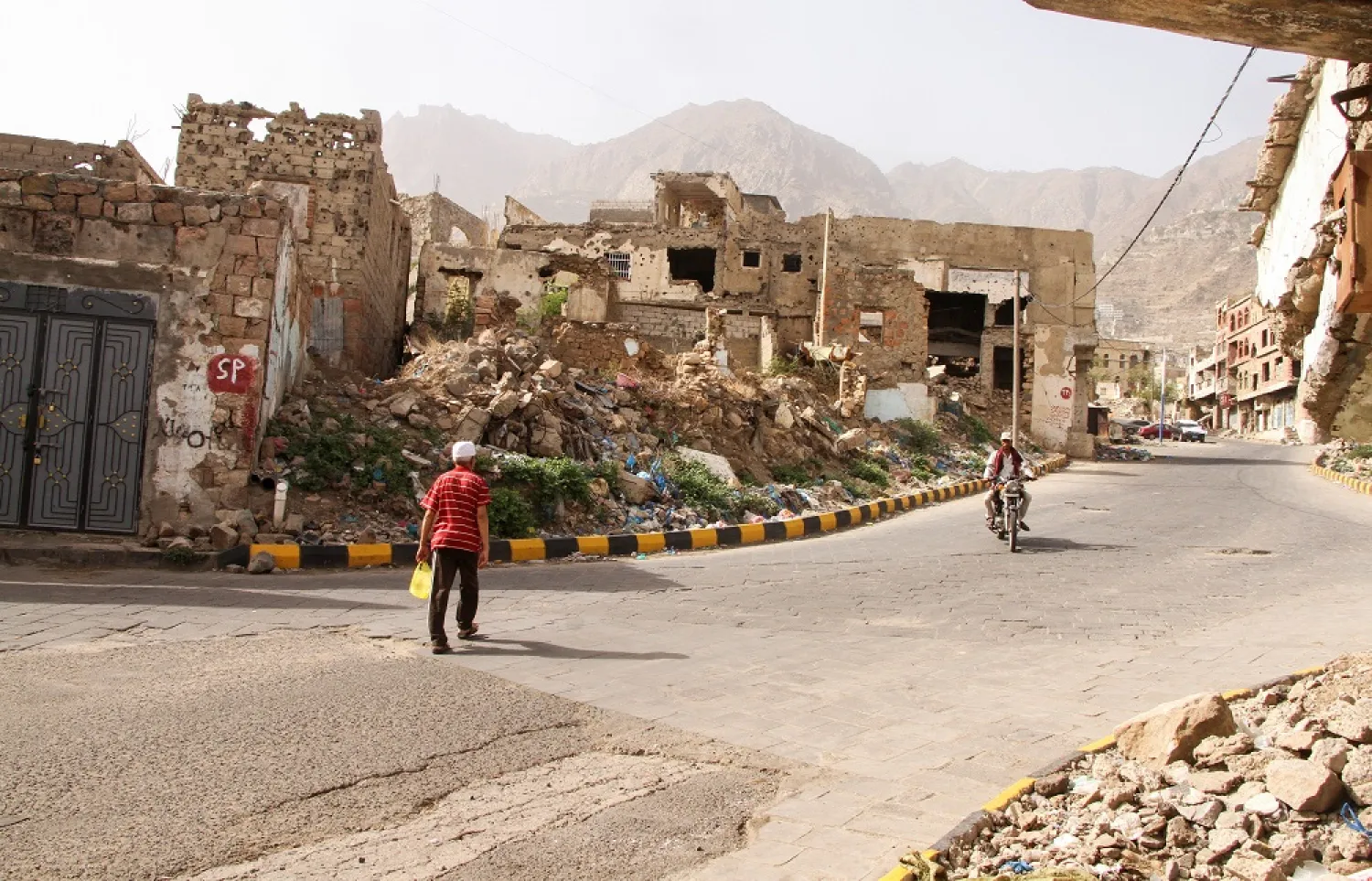
A man walks past buildings damaged by war in Taiz, Yemen May 20, 2022. Picture taken May 20, 2022. (Reuters)
TT

UN: Yemen's Warring Sides Resume Talks on Ending Houthi Siege on Taiz

A man walks past buildings damaged by war in Taiz, Yemen May 20, 2022. Picture taken May 20, 2022. (Reuters)

Yemen’s warring parties resumed talks Sunday on reopening roads in Taiz and other provinces, the United Nations said, after they agreed to renew a nationwide ceasefire.

The UN mission to Yemen said delegations from the legitimate government and Iran-backed Houthi militias began their second round of direct discussion in the Jordanian capital of Amman. The mission did not provide further details.

The two sides did not reach an agreement on lifting the militias' blockade of Taiz, Yemen’s third largest city, in their first round of talks late last month.

Reopening the roads around Taiz and elsewhere in Yemen is part of a truce the UN brokered early in April. It was the first nationwide ceasefire in in six years in Yemen’s conflict, now in its eighth year.

The Houthis have imposed a siege on government-held city of Taiz, the capital of the province by the same name, since March 2016.

The two sides agreed on Thursday to extend the truce for more two months.

The legitimate government warned against "Houthi ploys that would thwart the UN efforts" and attempt to shirk truce commitments.

Head of the government negotiations team at the Amman talks, Abdul Karim Shiban warned that any Houthi attempt to impose a "unilateral vision would be deemed a violation of the essence of the ongoing discussions, impede UN humanitarian efforts and reveal the militias' prior intentions to avoid the truce commitments."

In a statement, he said the government team was "surprised by Houthi media reports that the militias were seeking to open a unknown dirt road" leading to Taiz, "in a flagrant attempt to abort the UN efforts and undermine the ongoing consultations."

A Yemeni official told Asharq Al-Awsat that the Houthis have yet to show any willingness to commit to the truce.

Speaking on condition of anonymity, he added that the Houthis are continuing to hinder the reopening of roads by making "vague suggestions with the aim of buying time."

"The government won't wait long and we expect a clear stance from the UN envoy," he stated.

Shiban called on UN special envoy Hans Grundberg to quickly assume his legal, moral and humanitarian responsibilities and stand against "blatant Houthi games" and pressure the militias to stop such farces and respect the ongoing UN-sponsored discussions.


Syrian Army Tells Kurdish Forces to Withdraw from Area East of Aleppo City

Buses carrying displaced residents drive past a building in ruins as they return to the Achrafieh neighborhood after days of fighting between government forces and Kurdish fighters in the northern city of Aleppo, Syria, Monday, Jan. 12, 2026. (AP)
TT

Syrian Army Tells Kurdish Forces to Withdraw from Area East of Aleppo City

Buses carrying displaced residents drive past a building in ruins as they return to the Achrafieh neighborhood after days of fighting between government forces and Kurdish fighters in the northern city of Aleppo, Syria, Monday, Jan. 12, 2026. (AP)

Syria's army told Kurdish forces on Tuesday to withdraw from an area they control east of Aleppo after dislodging fighters from two neighborhoods in the city in deadly clashes last week.

State television published an army statement with a map declaring a large area a "closed military zone" and said "all armed groups in this area must withdraw to east of the Euphrates" River.

The area begins near Deir Hafer, around 50 kilometers (30 miles) east of Aleppo city and extends to the Euphrates further east, as well as towards the south.

On Monday, Syria accused the US-backed, Kurdish-led Syrian Democratic Forces of sending reinforcements to Deir Hafer and said it sent its own personnel there in response.

The SDF denied any build-up of its forces in the region.

An AFP correspondent saw government forces bringing military reinforcements including artillery to the Deir Hafer area on Tuesday.

On the weekend, Syria's government took full control of Aleppo city after taking over its Kurdish neighborhoods and evacuating fighters there to Kurdish-controlled areas in the country's northeast following days of clashes.

The violence started last Tuesday after negotiations stalled on integrating the Kurds' de facto autonomous administration and forces into the country's new government.

The SDF controls swathes of the country's oil-rich north and northeast, much of which they captured during Syria's civil war and the fight against the ISIS group.


Syrian Interior Ministry Details Results of Security Campaigns in Latakia, Damascus Countrysides

Security personnel inside the Imam Ali bin Abi Talib Mosque in the Wadi al-Dhahab neighborhood of Homs following a bombing . (AFP)
TT

Syrian Interior Ministry Details Results of Security Campaigns in Latakia, Damascus Countrysides

Security personnel inside the Imam Ali bin Abi Talib Mosque in the Wadi al-Dhahab neighborhood of Homs following a bombing . (AFP)

Syria’s Interior Ministry has announced the results of a series of security operations carried out in recent days in Homs, Latakia, and the Damascus countryside, including the arrest of two alleged ISIS members accused of involvement in the bombing of the Imam Ali bin Abi Talib Mosque in Homs last month.

The ministry said the operations led to the arrest of three senior figures in a cell known as “Lieutenant Abbas,” affiliated with the “Coastal Shield Brigade” led by Miqdad Fteiha, a prominent figure loyal to the former regime.

Security forces also detained an armed group in the al-Wuroud neighborhood of Damascus that was allegedly planning “acts of sabotage.”

The operations form part of broader efforts to dismantle armed groups and restore the state’s exclusive authority over weapons.

Interior Minister Anas Khattab vowed to continue pursuing ISIS operatives and bringing them to justice.

In a post on X, he said security and intelligence services had conducted a “highly precise operation” resulting in the arrest of those involved in the December 26 attack on the Imam Ali bin Abi Talib Mosque in the Wadi al-Dhahab district of Homs, which killed eight people and wounded 18 others.

According to the Interior Ministry, security units in Homs, in coordination with the General Intelligence Service, arrested two persons identified as ISIS members. Authorities said explosive devices, various weapons, ammunition, documents, and digital evidence allegedly linking the suspects to terrorist activities were seized.

The two were referred to the Counterterrorism Directorate to complete investigations ahead of prosecution.

In a separate statement earlier Monday, the Interior Ministry said a “valuable catch” was detained by security and intelligence forces in Latakia. It said he was a key figures in the “Lieutenant Abbas” cell. Initial investigations indicated the cell had targeted internal security and army positions in the province.

Meanwhile, in the Damascus countryside, the ministry said security forces carried out a “preemptive operation” in the al-Wuroud neighborhood of Qudsaya city, arresting three individuals accused of planning armed attacks.

The ministry said security services would continue pursuing remaining members of the groups, pledging to “eradicate them completely” to ensure security and stability.


Gaza Deal: Cairo Talks Aim to Settle Sector’s ‘Administrative Committee’

Displaced Palestinians stand beside a pool of rainwater amid makeshift shelters at the Bureij refugee camp in central Gaza (AFP). 
TT

Gaza Deal: Cairo Talks Aim to Settle Sector’s ‘Administrative Committee’

Displaced Palestinians stand beside a pool of rainwater amid makeshift shelters at the Bureij refugee camp in central Gaza (AFP). 

Cairo is hosting renewed consultations on the Gaza ceasefire agreement, which entered into force on Oct. 10, following the arrival of a delegation from Hamas and amid anticipation of an announcement on the committee that will administer the territory.

Experts told Asharq Al-Awsat that the talks provide an important boost at a critical moment for the second phase of the Gaza agreement, which has been stalled for some time. They stressed that moving forward hinges largely on US will and pressure on Israel.

A Palestinian source said Monday that a Hamas delegation headed by the movement’s leader, Khalil al-Hayya, arrived in Cairo to discuss the second phase and push ahead with the ceasefire deal. The source added that indications suggest the Gaza administration committee will be finalized during the Cairo round, with factions briefed on the names, particularly after recent changes prompted by Israeli objections.

Hamas Political Bureau member Mohammed Nazzal said in televised remarks Sunday night that the delegation would discuss follow-up on implementing the ceasefire amid “major difficulties hindering its application and continued Israeli violations.”

He said the delegation would hold meetings with Palestinian factions and forces, as well as with Egyptian officials, to discuss several files linked to the agreement.

These include ways to consolidate the ceasefire and move to subsequent phases, alongside key issues - foremost the formation of a Palestinian technocratic committee to administer Gaza - aimed at preventing Israeli Prime Minister Benjamin Netanyahu from reneging on or delaying the deal.

Former Egyptian assistant foreign minister and member of the Egyptian Council for Foreign Affairs, Ambassador Rakha Ahmed Hassan, said the Cairo consultations are highly significant and could revive the stalled agreement.

He pointed to anticipation surrounding US President Donald Trump’s announcement of a Peace Council, followed by the Gaza administration committee, adding that discussions would also cover approaches to dealing with weapons in Gaza to undercut Netanyahu’s justifications.

He suggested Hamas would press for full implementation of the first phase first, including opening the Rafah crossing from the Palestinian side, increasing aid, maintaining the ceasefire, and Israel’s withdrawal from Gaza in parallel with any later steps.

On the Egyptian front, Foreign Minister Badr Abdelatty stressed, during a Cairo meeting with Irish Minister for Migration, Trade and Defense Helen McEntee, the importance of announcing a temporary Palestinian technocratic committee to manage daily affairs in Gaza and forming an international stabilization force.