


EU Warns it May Act to Defend Spain in Dispute with Algeria

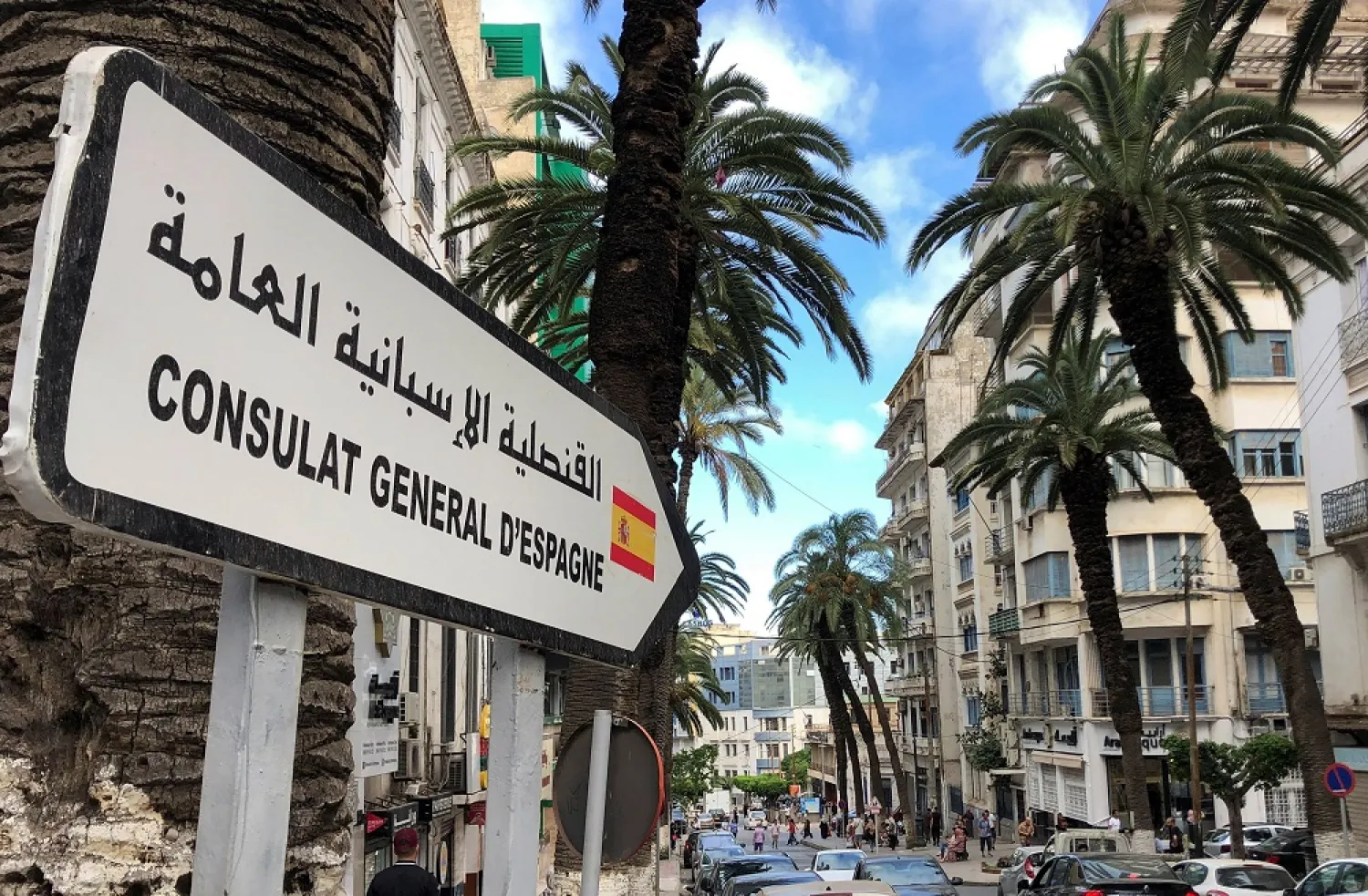
A sign directing to the Consulate General of Spain in Algiers, Algeria June 9, 2022. (Reuters)
TT

EU Warns it May Act to Defend Spain in Dispute with Algeria

A sign directing to the Consulate General of Spain in Algiers, Algeria June 9, 2022. (Reuters)

Top European Union officials said Friday the bloc was treating the crisis between Algeria and Spain with the "utmost concern" and warned it was prepared to take action to defend the interests of its members.

In a joint statement, European Commission executive vice president Valdis Dombrovskis and EU foreign affairs chief Josep Borrell said the decision by Algeria to suspend a two-decade-old friendship treaty with Spain, potentially freezing trade between the two countries, appeared "to be in violation of the EU-Algeria Association Agreement, in particular in the area of trade and investment."

"This would lead to a discriminatory treatment of an EU member state and adversely affect the exercise of the Union’s rights under the Agreement," the statement said.

While urging dialogue to resolve the dispute, the EU officials said "the EU is ready to stand up against any type of coercive measures applied against" an EU nation.

The statement came after Spanish Foreign Minister José Albares traveled to Brussels on Friday to discuss the country's crisis with Algeria.

The treaty suspension was the latest move by Algeria to put pressure on Madrid after the Spanish government changed its long-standing policy regarding the contested territory of Western Sahara. Algeria recalled its ambassador to Spain in March after Madrid came out in support of Morocco’s attempts to keep Western Sahara under its rule. Algeria supports the Polisario Front, the territory’s independence movement.

After the meeting with EU officials, Albares said "the unilateral measure" taken by Algeria violated the accord with the EU.

He sad the EU and Spain agreed "to make a firm defense of our businesses and Spain's interests, which are also European businesses and the interests of the European Union."

Albares insisted that "what we want is dialogue and we're not going to give any excuse for any escalation."

The statement Friday came after the EU on Thursday urged Algeria to reverse its decision.

Spain's chief worry has been that the suspension might affect important gas supplies from Algeria, but the government said that so far this has not happened. Algeria supplies 23% of Spain's gas needs.

Spain and the rest of the 27-nation bloc are hustling now to find alternatives to Russian energy imports to protest Russia’s war in Ukraine.

Industry ministry figures show Spain exported 2 billion euros ($2.1 billion) in goods to Algeria last year while it imports were valued at nearly 5 billion euros.



Report: RSF Drone Strike on School Kills Two Children in Sudan’s Kordofan 

Displaced Sudanese gather near a food distribution point at the Abu al-Naga displacement camp in the Gedaref State, some 420km east of the capital Khartoum on February 6, 2026. (AFP)
TT

Report: RSF Drone Strike on School Kills Two Children in Sudan’s Kordofan 

Displaced Sudanese gather near a food distribution point at the Abu al-Naga displacement camp in the Gedaref State, some 420km east of the capital Khartoum on February 6, 2026. (AFP)

A drone strike blamed on Sudan's paramilitary Rapid Support Forces killed two children and injured 12 others Wednesday in the southern city of El-Rahad, a medical source told AFP.

El-Rahad lies in Sudan's Kordofan region, currently the fiercest battlefield in the war raging between the RSF and the regular army since April 2023.

"I saw a dozen students injured," Ahmed Moussa, an eyewitness to the attack, told AFP, adding that the drone had struck a traditional Quranic school.

El-Rahad, in North Kordofan state, was retaken by the army last February, as part of a rapid offensive that saw it push west to break a long-running siege on state capital El-Obeid.

The RSF has been trying to re-encircle El-Obeid since, including by launching successive drone strikes on the main highway out of the city, which connects the western region of Darfur with the capital Khartoum.

Since it began, the war has killed tens of thousands and left around 11 million people displaced, creating the world's largest hunger and displacement crises.

It has also effectively split the country in two, with the army holding the north, center and east while the RSF and its allies control the west and parts of the south.


Türkiye Signals May Launch ‘Simple’ Military Operation Against PKK in Iraq

PKK fighters in the Qandil Mountains of northern Iraq. (Reuters)
TT

Türkiye Signals May Launch ‘Simple’ Military Operation Against PKK in Iraq

PKK fighters in the Qandil Mountains of northern Iraq. (Reuters)

Türkiye has indicated it may launch a limited military operation against the Kurdistan Workers’ Party (PKK) in the Sinjar region of northern Iraq, while stressing its readiness to work with any government that assumes power in Baghdad.

Turkish Foreign Minister Hakan Fidan said the PKK is set to become a major issue for Iraq, noting that the group does not control any territory inside Türkiye, but “occupies large areas in Iraq”.

“How can a sovereign state allow this?” he asked, adding that “changes could soon take place” in several areas, including Iraq’s Sinjar, Makhmour and the Qandil Mountains.

Fidan outlined what he described as the PKK’s current deployment, saying Makhmour, south of Erbil near the Nineveh province, hosts the group’s civilian structures, while Sinjar, northwest of Mosul near the Syrian border, hosts its armed elements.

He said the leadership and command structures are based in the Qandil Mountains, with other strongholds near Duhok lying outside the area covered by Türkiye’s ongoing Claw Operation.

In a televised interview late Monday, Fidan stated that Sinjar is surrounded by Iraq’s Popular Mobilization Forces (PMF), revealing that Ankara has held around 20 meetings with PMF leader Faleh al-Fayyad to address the issue.

On possible military action against the PKK, he described it as “a simple military operation,” in which PMF forces would advance on the ground while Türkiye conducts air operations, estimating it would take two or three days.

Since 2024, Türkiye has pursued negotiations with imprisoned PKK leader Abdullah Ocalan, which led to his call on February 27, 2025, for the group to dissolve and lay down its arms.

The PKK subsequently announced a ceasefire, declared its dissolution on May 12, 2025, and held symbolic weapons-burning ceremonies in the Qandil Mountains in July. In October, it announced the withdrawal of its fighters from Türkiye to areas in Qandil.

On Baghdad’s position, Fidan said the Iraqi government would be forced to demonstrate genuine political will toward the PKK, insisting that the group cannot remain in Sinjar.

Iraq began addressing the issue during the tenure of former prime minister Mustafa al-Kadhimi and that, under current Prime Minister Mohammed Shia al-Sudani, the PKK has sought to expand its presence in Baghdad, he remarked.

Baghdad is in the process of forming a new government, months after holding parliamentary elections.

Over the past two years, Ankara and Baghdad have established a high-level security coordination mechanism to confront the PKK, holding five meetings in both capitals. The latest took place in April. Following Turkish President Recep Tayyip Erdogan’s visit to Iraq in April 2024, Iraq’s National Security Council formally designated the PKK a banned organization.

Fidan also said the Kurdish issue in Syria has direct implications for Iraq, hoping that Baghdad would draw lessons from recent developments in Syria, including the integration of Kurdish forces into the Syrian army, and take “prudent decisions to ease Iraq’s own transition”.


SDF Starts Withdrawing from Frontlines in Syria’s Hasakah  

Members of the SDF in Hasakah, northeastern Syria, on Tuesday during their withdrawal from frontline positions under an agreement with the Syrian government. (Reuters)
TT

SDF Starts Withdrawing from Frontlines in Syria’s Hasakah  

Members of the SDF in Hasakah, northeastern Syria, on Tuesday during their withdrawal from frontline positions under an agreement with the Syrian government. (Reuters)

The Syrian Democratic Forces (SDF) have begun withdrawing their troops from frontline positions in the city of Hasakah under an agreement reached with the Syrian government, according to news reports and photographs published by Reuters.

Earlier on Tuesday, SDF units started preparations to pull back from southern rural areas of Hasakah. Images circulated by local media showed SDF fighters withdrawing from the Panorama Roundabout checkpoint south of the city, ahead of handing it over to General Security forces.

The move followed a security meeting between the Internal Security Forces (Asayish) and Syrian security services to coordinate the deployment of internal security forces in the city, according to North Press.

Syrian security sources told Asharq Al-Awsat that implementation of the agreement is proceeding smoothly, including steps toward integration.

The SDF has nominated units to be incorporated as brigades within the Ministry of Defense, while some Asayish personnel are expected to join the General Security forces in predominantly Kurdish areas.

On Tuesday, the SDF also began withdrawing its military units and heavy equipment from contact lines inside Hasakah, particularly in southern neighborhoods around the Panorama Roundabout. This step is part of a permanent ceasefire and the launch of a gradual integration process stipulated in the January agreement.

Syrian affairs researcher from the Jusoor Center for Studies Mohammad Suleiman said the withdrawal involves redeploying SDF military forces from inside Hasakah to agreed barracks outside the city, including Dirbasiyah, Amuda, and the outskirts of Qamishli. At the same time, government internal security forces will deploy in the city centers of Hasakah and Qamishli to oversee security integration.

Suleiman noted differing interpretations of the agreement. The SDF considers the withdrawal limited to its military forces, with the Asayish remaining responsible for internal security, while the government views it as a timetable for a full SDF withdrawal from city neighborhoods.

He added that Syrian army units will also pull back to areas around Hasakah, including Shaddadi, while maintaining a ban on military forces entering cities, particularly those with a Kurdish majority.

The current phase marks the second stage of the agreement and includes the transfer of oil wells and Qamishli Airport to state control. A third phase will place border crossings under state control, notably the Nusaybin crossing with Türkiye and the Semalka crossing with the Iraqi Kurdistan Region.

The agreement also calls for the integration of Kurdish autonomous administration institutions into state bodies, stabilization of civilian employees, settlement of Kurdish civil and educational rights, and guarantees for the return of displaced residents to their homes.