



Review: Roberts, Clooney Reunite in ‘Ticket to Paradise’

This image released by Universal Pictures shows George Clooney, left, and Julia Roberts in "Ticket to Paradise." (Universal Pictures via AP)
TT

Review: Roberts, Clooney Reunite in ‘Ticket to Paradise’

This image released by Universal Pictures shows George Clooney, left, and Julia Roberts in "Ticket to Paradise." (Universal Pictures via AP)

It’s often said that the movies that were fun to make never turn out great. Well, George Clooney and Julia Roberts look like they had a grand time making the Bali-set “Ticket to Paradise.”

The film, directed and co-written by Ol Parker (“Mama Mia! Here We Go Again”), isn’t the first movie to star Roberts and Clooney together. But it takes a moment to realize that their screen time together has been mostly limited to some scenes in the “Ocean’s Eleven” movies and Jodie Foster’s not-so-memorable 2016 thriller “Money Monster.”

Given their friendship and natural rapport, you imagine that there must have been half-a-dozen rom-coms in their past. Instead, it’s a reminder that Clooney, so often compared to Cary Grant, has, when dipping into comedy, mostly stuck to an archer, Coen-brothers register. And unlike Grant — whose on-screen romances included the brilliant likes of Irene Dunne, Katharine Hepburn and Rosalind Russell — Clooney has less frequently found a perfect match. Vera Farmiga in “Up in the Air” and Meryl Streep in “Fantastic Mr. Fox” deserve mentioning. But, really, Clooney’s best chemistry was back in 1998′s “Out of Sight” with Jennifer Lopez — a love that bloomed in the dark trunk of a car.

“Ticket to Paradise,” which opens in theaters Thursday, is a more old-fashioned proposition: a movie built strictly — and without apologies — on the charisma of its two stars.

Roberts and Clooney play Georgia and David Cotton, a bitterly divorced set of parents whose daughter, Lily (Kaitlyn Dever), is fresh out of law school. Just before she takes a demanding job with a top firm, Lily and her best friend, Wren (Billie Lourd), set off on a trip to Bali. (Here, Australia doubles for the Indonesian island.) Lily immediately falls in love with a local seaweed farmer named Gede (Maxime Bouttier) and they decide to marry within days.

For Georgia and David, such a wedding is a four-alarm fire. They fly out straight away to sabotage it, a scheme that dredges up plenty of their own unresolved issues about divorce. “Nothing’s forever,” David hisses to his son-in-law-to-be. It’s an unholy alliance. They bicker constantly, so much so that it’s clear that their feelings are still strong for one another. I know this probably comes as a shock. Maybe sit down before reading this next sentence. But, yes, the events of “Ticket to Paradise” will bring them closer again. Don’t say I didn’t warn you.

OK, so Parker’s film, written by him and Daniel Pipski, is not exactly out here to reinvent the wheel. Predictability is part of the appeal of “Ticket to Paradise,” and you can’t say it doesn’t succeed in that. The familiar beats get played with sincerity. A wince-inducing late-night dance floor sequence with House of Pain’s “Jump Around” arrives like a matter of prescribed ritual.

There are other traditions that fill “Ticket to Paradise” as the Cottons wrestle with and inevitably succumb to Balinese culture. But none so much as the customs of the rom-com. For me, “Ticket to Paradise” could have — like a lot of recent entries in the genre — greatly benefited from a funny person taking a pass on the script. There’s not nearly as much to laugh at here as you might expect, as “Ticket to Paradise” remains mostly content, like a dozing beachgoer, to bask in the glow of its stars. Dever, hysterical in “Booksmart,” is also largely wasted in a bland role.

“Ticket to Paradise” goes down as a footnote to the many superior rom-coms Roberts has sparkled in before. And if I wanted to watch Clooney in a tropical locale, I’d choose Alexander Payne’s lovely “The Descendants.” Or for Clooney in divorcee plot, the Coens’ “Intolerable Cruelty,” with Catherine Zeta-Jones, would be the choice.

But if you just want to see Roberts and Clooney together, “Ticket to Paradise” clears that not-very-high bar with just enough charm. And, lest anyone doubt, the end-credits bloopers — which feel about as scripted as those that follow “Toy Story 2” — prove that everyone making “Ticket to Paradise” did, in fact, have a very good time.



‘Outcome’ Film Captures Keanu Reeves’ Character at Center of Image Crisis

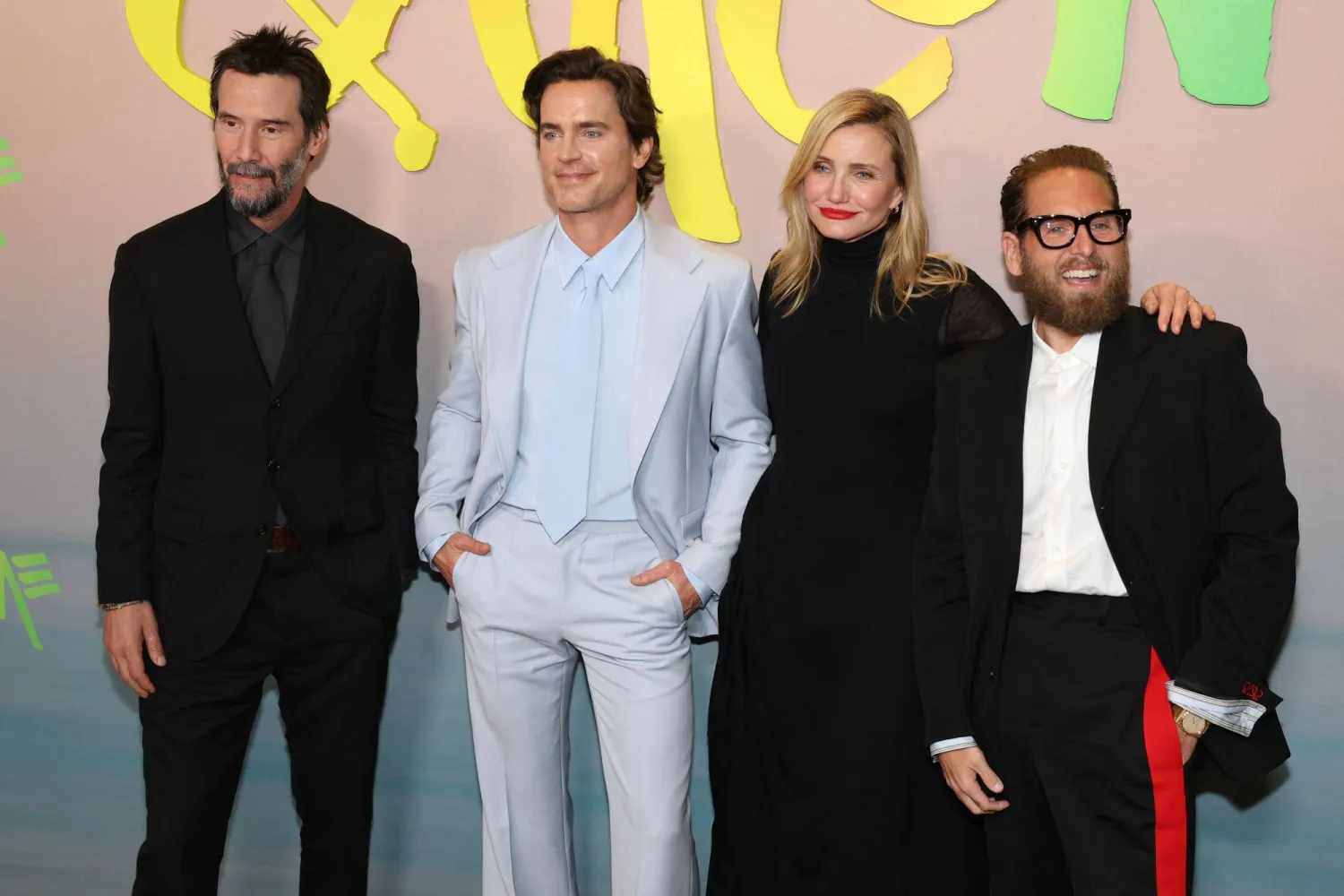
 (From L) Canadian actor Keanu Reeves, US actor Matt Bomer, US actress Cameron Diaz and US actor Jonah Hill attends the premiere of Apple TV's "Outcome" in New York, on April 6, 2026. (AFP)
(From L) Canadian actor Keanu Reeves, US actor Matt Bomer, US actress Cameron Diaz and US actor Jonah Hill attends the premiere of Apple TV's "Outcome" in New York, on April 6, 2026. (AFP)
TT

‘Outcome’ Film Captures Keanu Reeves’ Character at Center of Image Crisis

 (From L) Canadian actor Keanu Reeves, US actor Matt Bomer, US actress Cameron Diaz and US actor Jonah Hill attends the premiere of Apple TV's "Outcome" in New York, on April 6, 2026. (AFP)
(From L) Canadian actor Keanu Reeves, US actor Matt Bomer, US actress Cameron Diaz and US actor Jonah Hill attends the premiere of Apple TV's "Outcome" in New York, on April 6, 2026. (AFP)

In the dark comedy film “Outcome,” Keanu Reeves plays a Hollywood movie star whose carefully crafted public image begins to unravel when he is blackmailed with a mysterious video that threatens his career.

Reeves portrays Reef Hawk, a beloved film icon who turns to his closest circle - including lifelong friends Kyle and Xander, played by Cameron Diaz and Matt Bomer, and ‌his crisis ‌lawyer Ira, portrayed by Jonah Hill - ‌to ⁠contain the fallout. ⁠Hill also directed the film and co-wrote it with Ezra Woods.

As pressure mounts, Reef launches an unconventional apology tour, revisiting people he believes he may have wronged in hopes of uncovering the identity of the extorter.

Hill balances heightened ⁠comedy with moments of emotional reflection, using ‌the premise to ‌explore accountability and authenticity in an era defined by ‌public scrutiny. Reeves said working with Hill on ‌the Apple TV movie brought a distinctive energy to the set.

“Energy, vibrancy, creative yummy,” he described.

Diaz said the film probes what makes an apology ‌meaningful.

“It’s really about the person receiving it,” she said. “Whether it matters is ⁠relative ⁠to their experience."

For Bomer, the story’s focus on friendship resonated during production.

“It made me realize the value of deep friendships that transcend public perception,” he said, adding that the set encouraged creative freedom.

Laverne Cox, who appears as part of Reef’s crisis-management team, said the film poses pointed questions about accountability, highlighting a line delivered by Martin Scorsese in the trailer: “What are you sorry for?”

“Outcome” premieres globally on Apple TV on April 10.


Now It’s All Come Together: Forgotten Beatles Photos Released

The Beatles in New York in 1968. (AFP)
TT

Now It’s All Come Together: Forgotten Beatles Photos Released

The Beatles in New York in 1968. (AFP)

The venue that hosted The Beatles' only concerts in Japan has released long-forgotten photos of the legendary British band six decades after the gigs.

At the height of Beatlemania in 1966, when the quartet was the world's most famous pop group, the Beatles staged five summer performances in Tokyo in front of screaming fans.

Crowds reportedly thronged their hotel, where they stayed in the finest suite.

Then in 2009, more than 100 photos shot during the gigs "were discovered on a shelf" inside an office at the concert venue Nippon Budokan, the arena's operator told AFP.

But the 19 rolls of negative film -- reportedly wrapped in paper and labelled in such a way that it suggested they belonged to Japanese newspaper the Yomiuri Shimbun -- remained "stored as they were" until recently, the operator in a statement.

However, as the 60th anniversary of the Japan tour approached, the venue operator asked a Beatles expert to examine the negatives, and "his assessment revealed that the photos appear to have never been published" in newspapers or other media.

Among the photos released by the concert venue is a shot of John Lennon smiling beside a Japanese doll that resembles a figurine featuring on the album cover of the 1967 album "Sgt. Pepper's Lonely Hearts Club Band".

The global stars were under tight security during their visit, but the doll may have been purchased during a hurried shopping trip, the Yomiuri Shimbun daily said.

The newspaper is investigating who took the photos and why the negatives had been kept in Nippon Budokan despite being wrapped in paper labelled "The Yomiuri Shimbun archives room", it said.

The photos capture "the atmosphere of that one and only Japan tour -- now remembered as a historic event -- as well as various moments from their stay in Japan," the Nippon Budokan statement said.


AI-generated Artists Break Through in Country Music

"Whiskey & Water," a song by Cain Walker featuring Cade Winslow, is one of many AI-generated country music tunes. TIMOTHY A. CLARY / AFP
TT

AI-generated Artists Break Through in Country Music

"Whiskey & Water," a song by Cain Walker featuring Cade Winslow, is one of many AI-generated country music tunes. TIMOTHY A. CLARY / AFP

AI-generated singers routinely rank among the top-streamed country music artists in the United States -- a trend that for now is limited to a genre that industry observers fear is becoming too formulaic.

Breaking Rust, Cain Walker, Aventhis, and Outlaw Gospel have more in common that cowboy hats, denim and leather. They are all completely computer-generated, from their faces to their melodies, said AFP.

And they are all hitmakers.

"That's a phenomenon I didn't see coming," said Jennie Hayes Kurtz of the country music band Brother and The Hayes.

"I thought AI was going to be curing cancer or something."

Many of the AI country tunes tap into the genre's archetype of the lone cowboy: a rugged, taciturn, plain-spoken man who, above all, refuses to apologize for simply existing.

Lyrics are delivered in raspy, gravelly voices that sound as authentic as the real thing.

"It's scary as songwriters," said Kassie Jordan, who forms the singing duo Blue Honey with her husband Troy Brooks.

"We are starting to see a lot of people just putting words into these chatbots and it is writing songs for them," she said. "As a songwriter, it's kind of like, is anyone going to even think I really wrote this?"

Berklee College of Music professor Joe Bennett noted that a sampling of AI singers suggests that the words used to "prompt" AI songs were "not particularly detailed."

None of the producers behind AI-generated music projects responded to AFP's requests for comment.

So how did AI find a place in a genre that is fundamentally rooted in the human experience and storytelling, blending folk, blues, and even gospel influences?

For Bennett, the emergence of modern country music in the early 2000s -- with a highly polished, more pop sound and repeated "melodic shapes" -- is key.

AI models could become adept at replicating such a sound, when fueled with those elements, he explained.

- 'Superficial' -

Once overshadowed by rap and Latin music, and hindered by the industry's shift to digital music formats, country music has nevertheless staged a comeback thanks to a generation of artists with stronger pop, not folk, sensibilities.

Following in the footsteps of country-turned-pop megastar Taylor Swift, today's headliners are more likely to sport baseball caps than wide Stetsons.

Their music breaks genre boundaries, while artists such as Beyonce and Post Malone win fans and sell albums with their crossover efforts.

Last year, country stars Morgan Wallen and Zach Bryan were both in the top 10 most streamed artists on Spotify.

Some in the industry believe country's rebirth signifies a dulled-down formula designed to appeal to the widest possible audience.

"The lyrics aren't as deep as they used to be," Jordan said.

"A big portion of popular country music has become kind of shallow, so that is pretty easy to duplicate."

Bennett says the industry must do a better job of identifying AI-generated music, noting that Deezer is the only major streaming platform to clearly label such material.

"We need AI detection," Bennett maintained.

"It will happen, and there is a consumer demand for it."

Hayes Kurtz said there is a large audience of "passive" listeners who don't care whether music is made by AI, but there are also "active listeners" who attend concerts, buy band merchandise, and deeply respect the integrity of the artists.

"That audience seems to really care it the music is made by the actual humans they are going to see," Hayes Kurtz said.

Jordan says she remains optimistic about the future.

"There's another wave of country artists that are coming that is really into doing it the old school way and showing emotion," she said.

"That will be harder for AI to duplicate. That might save the genre."