


US-Iran Match Reflects a Regional Rivalry for Many Arab Fans 

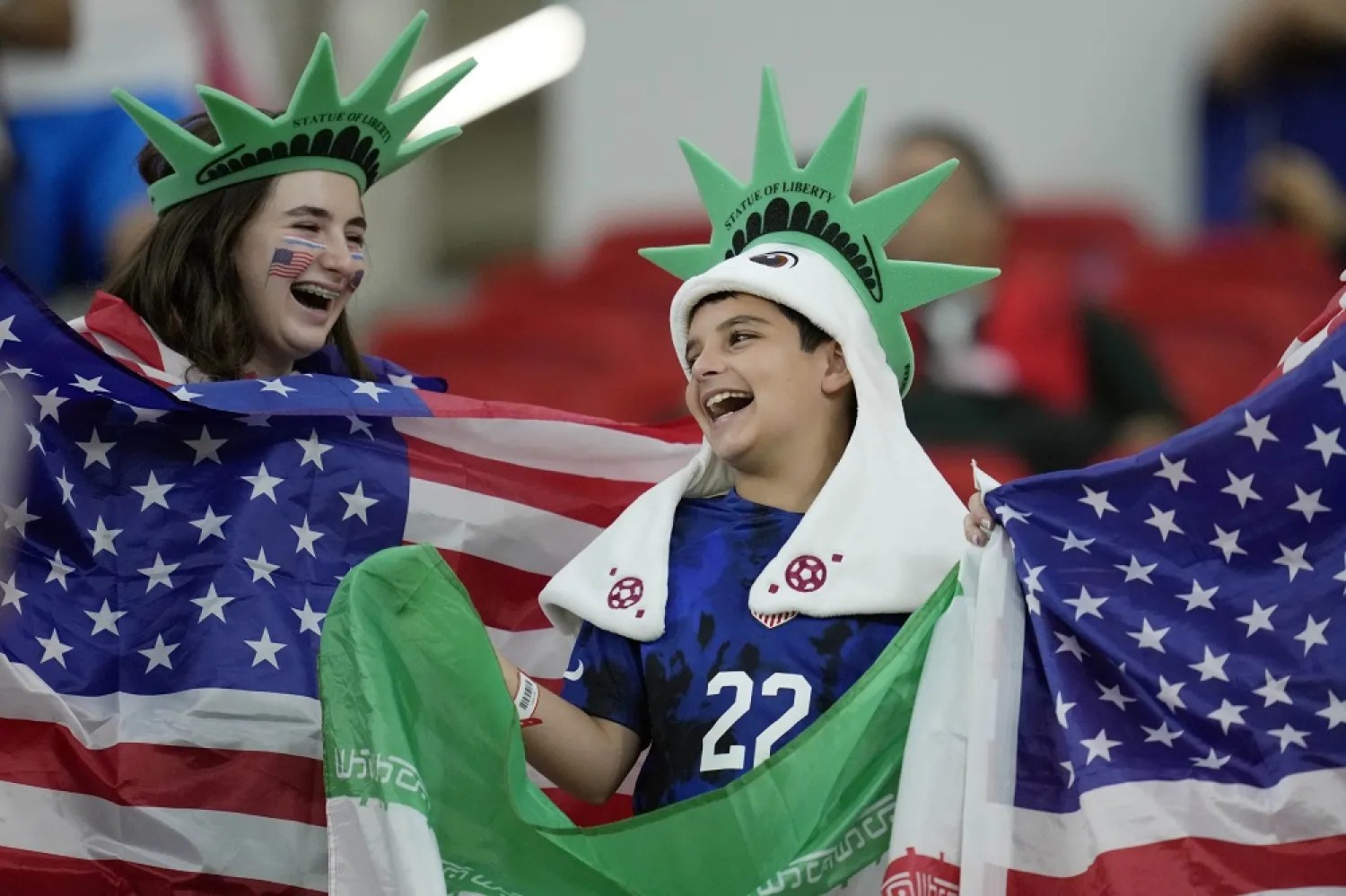
United States football fans hold up American and Iranian flags before the World Cup group B soccer match between Iran and the United States at the Al Thumama Stadium in Doha, Qatar, Tuesday, Nov. 29, 2022. (AP)
TT

US-Iran Match Reflects a Regional Rivalry for Many Arab Fans 

United States football fans hold up American and Iranian flags before the World Cup group B soccer match between Iran and the United States at the Al Thumama Stadium in Doha, Qatar, Tuesday, Nov. 29, 2022. (AP)

The US team’s must-win World Cup match against Iran will be closely watched across the Middle East, where the two nations have been engaged in a cold war for over four decades and where many blame one or both for the region’s woes. 

Critics of Iran say it has fomented war and unrest across the Arab world by supporting armed groups in Lebanon, Syria, Iraq, Yemen and the Palestinian territories. Supporters view it as the leader of an “axis of resistance” against what they see as US imperialism, corrupt corruption and Israel's oppression of the Palestinians. 

The divide is especially intense in Lebanon and Iraq, where heavily armed Iran-backed political factions vie for political influence with opponents more oriented toward the West. In those countries, many believe Iran or the US are due for comeuppance — even if only on the pitch. 

Others wish a plague on both their houses. 

“Both are adversaries of Iraq and played a negative role in the country,” Haydar Shakar said, in the Karada neighborhood of downtown Baghdad, where a cafe displayed the flags of both countries hanging outside. “It’s a sports tournament, and they’re both taking part in it. That’s all it is to us.” 

A meme widely circulated ahead of Tuesday’s match between the US and Iran jokingly referred to it as “the first time they will play outside of Lebanon.” Another Twitter user joked that whoever wins the group stage “takes Iraq.” 

The Iran-backed Hezbollah was the only armed group to keep its weapons after Lebanon's 1975-1990 civil war. It says its arms are needed to defend the country from Israel and blames Lebanon's economic crisis in part on US sanctions. Opponents decry Hezbollah as an “Iranian occupation,” while many Lebanese accuse both the US and Iran of meddling in their internal affairs. 

In Iraq, the 2003 US-led invasion led to years of intense violence and sectarian strife, and Iran-backed political factions and militias largely filled the vacuum. While US forces and Iran-backed militias found themselves on the same side against the ISIS extremist group, they have traded fire on several occasions since its defeat. 

Both Lebanon and Iraq have had to contend with years of political gridlock, with the main dividing line running between Iran's allies and opponents. 

In Yemen, the Iran-backed Houthi militias captured the capital and much of the country's north in 2014.  

In Syria's war, Iran supported President Bashar Assad's government against opposition groups, including those supported by the West. In the Palestinian territories, it backs Hamas and Islamic Jihad, militant factions that do not recognize Israel and have carried out scores of attacks over the years. 

Interviews with football fans in Beirut and Baghdad revealed mixed emotions ahead of the match. 

“Of course, I’m not with Iran after all the disasters they made,” Beirut resident Aline Noueyhed said. "Definitely, I’m with America,” though she added that the US also was “not 100% helping us.” 

In Baghdad, Ali Fadel plans to cheer for Iran, because “it’s a neighboring country, an Asian country.” 

“There are many linkages between us and them,” he added. 

Nour Sabah plans to root for the US because “they are a strong team, and (the US) controls the world." 

Regional politics hovered over the last matchup between the US and Iran, at the 1998 World Cup. That came less than two decades after Iran's revolution toppled the US-backed shah and protesters overran the US Embassy, leading to a prolonged hostage crisis. 

French riot police were on site at the stadium in Lyon that year, but they weren’t needed. The teams posed together in a group photo, and Iran’s players even brought white roses for their opponents. 

In this year's matchup, allegiances have been scrambled by the nationwide protests gripping Iran, with some Iranians openly rooting against their own team. The players declined to sing along to their national anthem ahead of their opening match, in what was seen as an expression of sympathy for the protests, but reversed course and sang ahead of their next one. 

Danyel Reiche, a visiting associate professor at Georgetown University Qatar who has researched the politics of sports, said World Cup fandom is not necessarily an indicator of political affiliation, even in countries with deep divisions. 

In Lebanon, for instance, he noted that local sports are “highly politicized,” with all the major basketball and football clubs having political and sectarian affiliations. But when it comes to choosing a favorite national team in the World Cup — where Lebanon has never qualified to play — fans latch on to any number of federations. 

That's true across the region, where fans sporting Lionel Messi or Cristiano Ronaldo jerseys can be found from Gaza to Afghanistan. 

“This is one of the few spheres where people have the liberty and freedom to choose a country that they simply like and not the country where they think there’s an obligation for them to be affiliated with it,” Reiche said. 


European Leaders See Trump’s Troop Drawdown from Germany as New Proof They Must Go it Alone

An AH-64 Apache attack helicopter stands in front of a Galaxy C-5 transport plane at the US Air Base in Ramstein, western Germany, on February 22, 2017. (dpa/AFP)
TT

European Leaders See Trump’s Troop Drawdown from Germany as New Proof They Must Go it Alone

An AH-64 Apache attack helicopter stands in front of a Galaxy C-5 transport plane at the US Air Base in Ramstein, western Germany, on February 22, 2017. (dpa/AFP)

European leaders on Monday said that US President Donald Trump’s snap decision to pull thousands of US troops out of Germany came as a surprise but is a fresh sign that Europe must take care of its own security.

The Pentagon announced last week that it would pull some 5,000 troops out of Germany, but Trump told reporters on Saturday that “we’re going to cut way down. And we’re cutting a lot further than 5,000.”

He offered no reason for the move, which blindsided NATO, but his decision came amid an escalating dispute with German Chancellor Friedrich Merz over the US-Israeli war on Iran, and Trump’s anger that European allies have been reluctant to get involved in the conflict in the Middle East.

Asked about the decision to pull out 5,000 troops from Germany, Norwegian Prime Minister Jonas Gahr Støre said: “I wouldn’t exaggerate that because I think we are expecting that Europe is taking more charge of its own security.

“I do not see those figures as dramatic, but I think they should be handled in a harmonious way inside the framework of NATO,” he told reporters in Yerevan, Armenia, where European leaders are holding a summit.

The European Union’s foreign policy chief, Kaja Kallas, said “there has been a talk about withdrawal of US troops for a long time from Europe. But of course, the timing of this announcement comes as a surprise.”

“I think it shows that we have to really strengthen the European pillar in NATO,” she said.

Asked whether she believes that Trump is trying to punish Merz, who said that the US has been humiliated by Iran in talks to end the war, Kallas said: “I don’t see into the head of President Trump, so he has to explain it himself.”

Over the weekend, NATO spokesperson Allison Hart said that officials at the 32-nation military alliance “are working with the US to understand the details of their decision on force posture in Germany.”

European allies and Canada have known since just after he came to office again last year that Trump would pull troops out of Europe — indeed some left Romania in October — but US officials had pledged to coordinate any moves with their NATO allies to avoid creating a security vacuum.

NATO Secretary-General Mark Rutte played down the move, saying that “there has been at this point disappointment on the US side” about European support for the war on Iran.

Notably France, Spain and the UK have declined to give US forces free rein to use bases on their territory to attack Iran. Spain has denied them the use of its airspace and bases there for the war.

But Rutte, who has championed Trump’s leadership at NATO despite the US president's criticism of the majority of the allies, said: “I would say the Europeans have heard a message. They are now making sure that all the bilateral basing agreements are being implemented.”

Rutte added that European nations “have decided to pre-position assets, key assets, close to the theater for the next phase.”

He provided no details, but the Europeans have insisted they would not help police the Strait of Hormuz, a key energy trade route, until the war is over.

French President Emmanuel Macron said “if the United States is ready to reopen Hormuz, that’s great. That’s what we’ve been asking for since the beginning.” But he underlined that the Europeans are not ready to get involved in any operation “that does not seem clear to us.”

In another sign of friction with Merz, Trump has accused the EU of not complying with its US trade deal and announced plans to increase tariffs next week on cars and trucks produced in the bloc to 25%, a move that would be particularly damaging to Germany, a major automobile manufacturer.

Without mentioning Trump or the United States, European Commission President Ursula von der Leyen listed recent trade deals that the bloc has sealed with Australia and India, and is now working on with Mexico.

“With like-minded friends, you have stable, reliable supply chains and Europe has the biggest network of free trade agreements,” von der Leyen, who is from Germany, told reporters.


What to Know about Hantavirus, the Illness Suspected in a Cruise Ship Outbreak

This aerial picture shows a general view of the cruise ship MV Hondius stationary off the port of Praia, the capital of Cape Verde, on May 3, 2025. (AFP)
TT

What to Know about Hantavirus, the Illness Suspected in a Cruise Ship Outbreak

This aerial picture shows a general view of the cruise ship MV Hondius stationary off the port of Praia, the capital of Cape Verde, on May 3, 2025. (AFP)

A hantavirus is suspected of causing an outbreak aboard a cruise ship that has killed three people and sickened others.

Studies indicate hantaviruses have been around for centuries, with outbreaks documented in Asia and Europe. In the Eastern Hemisphere, it has been linked with hemorrhagic fever and kidney failure. It wasn’t until the early 1990s that a previously unknown group of hantaviruses emerged in the southwestern United States as the cause of an acute respiratory disease now known hantavirus pulmonary syndrome.

The disease gained attention last year after late actor Gene Hackman ’s wife, Betsy Arakawa, died from a hantavirus infection in New Mexico.

The World Health Organization said in a statement Sunday that detailed investigations of the cruise ship outbreak are ongoing, including further laboratory testing and epidemiological investigations. Sequencing of the virus also is ongoing.

The virus is spread by rodents and more rarely, people

Hantavirus is mainly spread by contact with rodents or their urine, saliva or droppings, particularly when the material is disturbed and becomes airborne, posing risk of inhalation. People are typically exposed to hantavirus around their homes, cabins or sheds, especially when cleaning out enclosed spaces with little ventilation or exploring areas where there are mouse droppings.

The WHO says that while rare, hantaviruses may spread between people.

The US Centers for Disease Control and Prevention began tracking the virus after a 1993 outbreak in the Four Corners region — the area where Arizona, Colorado, New Mexico and Utah meet.

It was an astute physician with the Indian Health Service who first noticed a pattern of deaths among young patients, said Michelle Harkins, a pulmonologist with the University of New Mexico Health Sciences Center who for years has been studying the disease and helping patients.

Most US cases are in Western states. New Mexico and Arizona are hotspots, Harkins said, likely because the odds are greater for mouse-human encounters in rural areas.

The illness starts with flu-like symptoms

An infection can rapidly progress and become life-threatening. Experts say it can start with symptoms that include a fever, chills, muscle aches and maybe a headache.

“Early in the illness, you really may not be able to tell the difference between hantavirus and having the flu,” said Dr. Sonja Bartolome of UT Southwestern Medical Center in Dallas.

Symptoms of hantavirus pulmonary syndrome usually show between one to eight weeks after contact with an infected rodent. As the infection progresses, patients might experience tightness in the chest, as the lungs fill with fluid.

The other syndrome caused by hantavirus — hemorrhagic fever with renal syndrome — usually develops within a week or two after exposure.

Death rates vary by which hantavirus causes the illness. Hantavirus pulmonary syndrome is fatal in about 35% of people infected, while the death rate for hemorrhagic fever with renal syndrome varies from 1% to 15% of patients, according to the CDC.

A lot of unknowns

There is no specific treatment or cure, but early medical attention can increase the chance of survival.

Despite years of research, Harkins said many questions have yet to be answered, including why it can be mild for some people and very severe for others and how antibodies are developed.

She and other researchers have been following patients over long periods of time in hopes of finding a treatment.

“A lot of mysteries,” she said, noting that what researchers do know is that rodent exposure is a key.

The best way to avoid the germ is to minimize contact with rodents and their droppings. Use protective gloves and a bleach solution for cleaning up rodent droppings. Public health experts caution against sweeping or vacuuming, which can cause the virus to get into the air.


Why Israel Fears Military Rapprochement Between Egypt and Türkiye

Egyptian Abdel Fattah al-Sisi meets Turkish Recep Tayyip Erdogan on the sidelines of the D-8 Organization for Economic Cooperation summit in Egypt’s New Administrative Capital in December 2024. (Egyptian Presidency)
TT

Why Israel Fears Military Rapprochement Between Egypt and Türkiye

Egyptian Abdel Fattah al-Sisi meets Turkish Recep Tayyip Erdogan on the sidelines of the D-8 Organization for Economic Cooperation summit in Egypt’s New Administrative Capital in December 2024. (Egyptian Presidency)

The growing rapprochement between Egypt and Türkiye is raising concern in Israel, particularly as military cooperation expands through joint training and exercises between two of the region’s largest and most strategically significant armed forces.

Those concerns resurfaced after international military drills involving Egyptian and Turkish forces concluded in the Libyan city of Sirte.

Experts who spoke to Asharq Al-Awsat said the unease stems from several factors, including the two countries’ military weight and their growing alignment on regional issues and defense manufacturing.

They expect the rapprochement could evolve into a regional alliance with expanding influence, while ruling out any imminent military confrontation.

Israeli concerns

The Israeli newspaper Maariv published an article by retired general Yitzhak Brik warning that Tel Aviv could face a “difficult war” against a potential Egyptian-Turkish alliance as both countries strengthen their military capabilities.

Brik warned that strategic cooperation between Cairo and Ankara could extend to joint military production and defense integration.

Any military rapprochement between Egypt and Türkiye, he said, could reshape deterrence dynamics in the region and pose new security challenges for Israel, requiring a comprehensive reassessment of its military doctrine and defense strategies.

Israeli channel i24NEWS reported on April 18 that talks between Egypt and Türkiye were accelerating, noting that in-depth discussions had been referred to Turkish parliamentary committees on security, defense, and intelligence.

Turkish President Recep Tayyip Erdogan visited Cairo in February, where several agreements were signed, including in the defense sector. During a joint press conference, Egyptian President Abdel Fattah al-Sisi said the two countries share converging views on regional and international issues, particularly Gaza, Sudan, Libya and the Horn of Africa.

Israel has also expressed reservations about the possibility of Ankara participating in international stabilization forces in Gaza, after Türkiye became involved in mediation and guarantees for implementing a ceasefire agreement in October. Media reports have also pointed to the possibility of a future military confrontation between Israel and Türkiye following tensions linked to Iran.

‘Cold peace’

Egyptian military and strategic expert Samir Ragheb said Türkiye’s direct presence in the region, combined with its rapprochement with Egypt, reinforces what he described as a “cold peace” with Israel.

He told Asharq Al-Awsat that Cairo and Ankara command the region’s two largest armies and maintain strong ties with key regional powers, something Israel views with concern.

One of the most sensitive issues for Israel, he said, is cooperation in drone manufacturing.

Both Egypt and Türkiye have significant capabilities in this field, and joint production could meet their domestic needs while positioning them as strong competitors to Israeli drones in regional markets, particularly as negative perceptions of Israeli products grow due to ongoing conflicts, making Egyptian-Turkish alternatives more appealing.

Coordination between Egypt and Türkiye spans a broad geographic arc from Somalia to Syria, including Libya. This, Ragheb said, adds to Israeli concerns, particularly as Türkiye seeks to expand its footprint in Africa through Egypt, the continent’s main gateway.

Turkish affairs researcher Taha Ouda Oglu told Asharq Al-Awsat that cooperation between Egypt and Türkiye on Gaza, Libya and Africa is further raising Israeli concerns.

Rising military cooperation

Military cooperation between Egypt and Türkiye has accelerated in recent months. In late 2025, for the first time in 13 years, Egyptian forces took part in joint naval exercises on Turkish soil, involving Turkish frigates, attack boats, a submarine and F-16 fighter jets, alongside Egyptian naval units.

Türkiye’s Defense Ministry said on Thursday that the “Flintlock 2026” exercises, which were in Sirte from April 13 to 30, had concluded. The drills, which included Egyptian forces, aimed to enhance military cooperation and combat readiness through integrated land, air and naval scenarios.

In September, Turkish Foreign Minister Hakan Fidan said in a televised interview that Ankara is seeking to strengthen cooperation with Egypt in defense industries and joint security, noting that regional threats are driving deeper discussions on security as ties develop.

Egypt and Türkiye also signed an agreement in late August to locally produce the “Turkha” drone in Egypt, a step aimed at localizing drone technology and boosting domestic defense industries. The aircraft features advanced surveillance and reconnaissance systems and vertical takeoff and landing capabilities.

Ragheb ruled out the possibility of Israel waging a military confrontation against either Egypt or Türkiye, saying Israeli military doctrine does not allow for fighting on multiple fronts simultaneously against major powers.

He added that the United States would be unlikely to support Israel in a war against countries the size of Egypt or Türkiye, noting both nations rely on deterrence through strength rather than rhetoric.

He said the rapprochement, while not directed against Israel, could evolve into a broader regional alliance that may include major countries, such as Pakistan.

Oglu said military cooperation between Egypt and Türkiye is likely to deepen further and expand across multiple arenas, increasing their influence in the region, without leading to a direct confrontation with Israel.
