

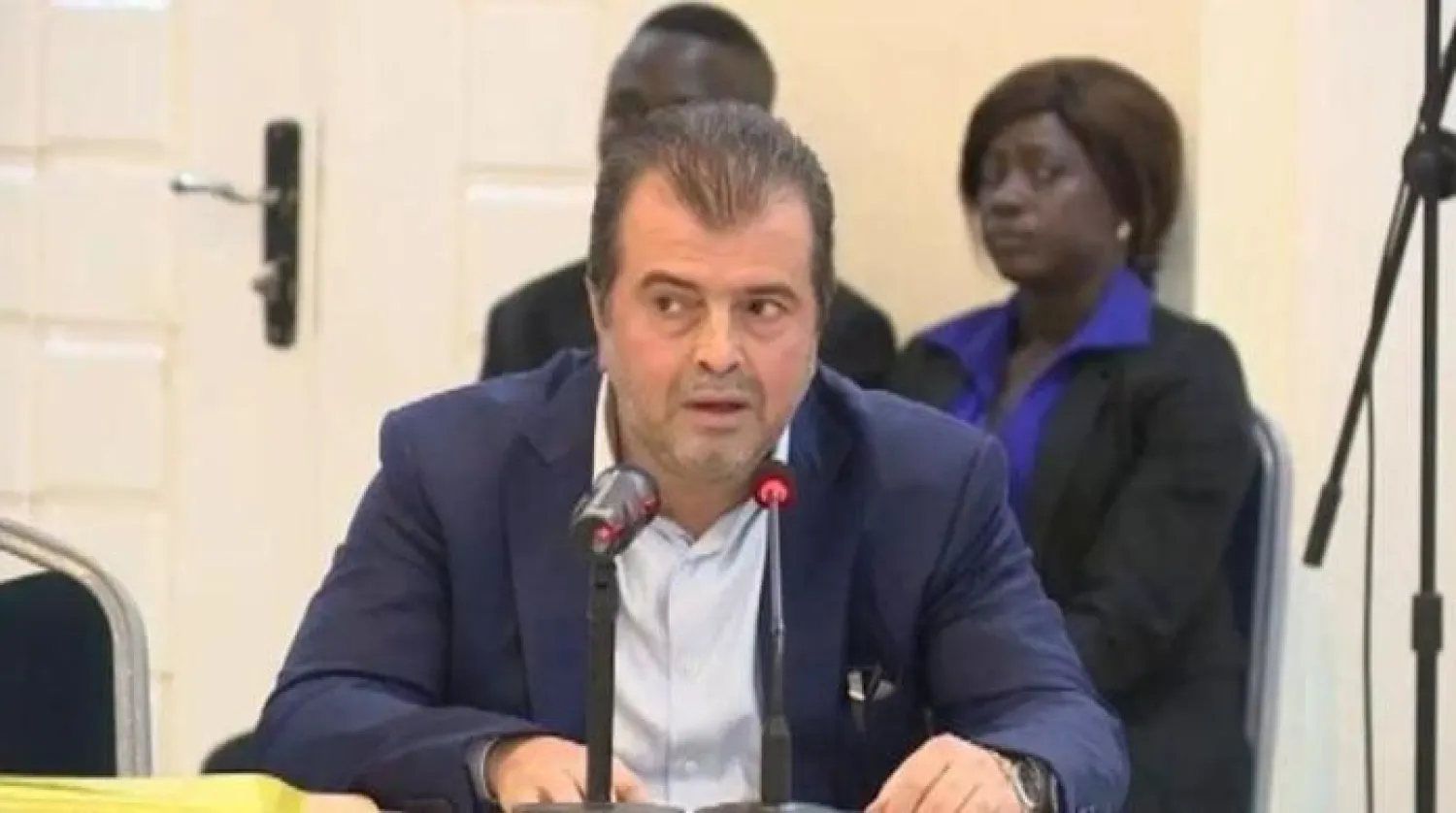

Key Hezbollah Financier Faces 20 Years in Prison

Mohammad Ibrahim Bazzi. (Twitter)
TT

Key Hezbollah Financier Faces 20 Years in Prison

Mohammad Ibrahim Bazzi. (Twitter)

A US federal prosecutor announced the arrest of a Lebanese-Belgian citizen considered a major financier of Iran-backed Hezbollah in the Romanian capital, Bucharest.

US Attorney Breon Peace in Brooklyn said that Mohammed Ibrahim Bazzi, 58, designated by the US as a “global terrorist” in 2018, when it offered $10 million for information about his whereabouts, transferred millions of dollars to Hezbollah over the years.

Peace added that Bazzi and another Lebanese citizen named Talal Chahine, 78, are scheduled to be handed over to the US federal authorities on charges contained in an indictment returned last month to the Brooklyn Federal Court.

“Mohammad Bazzi thought that he could secretly move hundreds of thousands of dollars from the United States to Lebanon without detection by law enforcement,” Peace said in a release.

“Today’s arrest proves that Bazzi was wrong,” said the prosecutor.

According to the statement announcing his arrest, Romanian law enforcement authorities detained Bazzi after he arrived in Bucharest on Friday.

Charges brought against Bazzi and Chahine included conspiracy to make US individuals conduct unlawful transactions with a global terrorist and money laundering conspiracy.

Each count in the indictment is punishable by up to 20 years imprisonment. It is yet to be determined who would represent the men when they arrived in the United States.

The acting head of the Drug Enforcement Administration in New Jersey, Daniel Kafafian, said the defendants “attempted to provide continued financial assistance to Hezbollah, a foreign terrorist organization responsible for death and destruction.”

“The men and women of DEA are committed to working with our law enforcement and foreign counterparts to disrupt and dismantle the operations of these organizations and those who choose to support them financially,” he added.

In May 2018, the United States Department of the Treasury, Office of Foreign Assets Control (OFAC) designated Bazzi as a Specially Designated Global Terrorist for assisting in, sponsoring, and providing financial, material, and technological support and financial services to Hezbollah.

According to the OFAC designation, Bazzi is a key Hezbollah financier who has provided millions of dollars to the party over the years, generated from his business activities in Belgium, Lebanon, Iraq, and West Africa.

As a result of the designation, Bazzi’s interest in any property in the United States was blocked. All US persons were generally prohibited from transacting business with, or for the benefit of, Bazzi.

After his classification, Bazzi and Chahine conspired to force or induce individuals in the US to liquidate their interests in certain real estate assets in Michigan and covertly transfer hundreds of thousands of dollars in proceeds of the liquidation to Bazzi and Chahine in Lebanon.

During recorded communications, Bazzi and Chahine proposed numerous methods to conceal from OFAC and law enforcement officials, suggesting that Bazzi was both the source and destination of the sale proceeds and creating the false appearance that the US Person was conducting legitimate arms-length transactions unrelated to Bazzi and Chahine.

For example, Bazzi and Chahine proposed that the funds be transferred through a third party in China as part of a fictitious purchase of restaurant equipment from a Chinese manufacturer or a third party in Lebanon as part of a fictitious real estate purchase.

They also suggested using Chahine’s family members in Kuwait as part of fictitious intra-family loans and a notional franchising agreement as payment for the rights to operate a Lebanese-based restaurant chain throughout the United States.



Hamas’s Meshal Rejects Disarmament or 'Foreign Rule'

Boys walk past the rubble of destroyed buildings in the Jabalia camp for Palestinian refugees in the northern Gaza Strip on February 8, 2026. (Photo by Omar AL-QATTAA / AFP)
TT

Hamas’s Meshal Rejects Disarmament or 'Foreign Rule'

Boys walk past the rubble of destroyed buildings in the Jabalia camp for Palestinian refugees in the northern Gaza Strip on February 8, 2026. (Photo by Omar AL-QATTAA / AFP)

A senior Hamas leader said Sunday that the Palestinian movement would not surrender its weapons nor accept foreign intervention in Gaza, pushing back against US and Israeli demands.

"Criminalizing the resistance, its weapons, and those who carried it out is something we should not accept," Khaled Meshal said at a conference in Doha.

"As long as there is occupation, there is resistance. Resistance is a right of peoples under occupation ... something nations take pride in," said Meshal, who previously headed the group.

A US-brokered ceasefire in Gaza is in its second phase, which foresees that demilitarization of the territory -- including the disarmament of Hamas -- along with a gradual withdrawal of Israeli forces.

Hamas has repeatedly said that disarmament is a red line, although it has indicated it could consider handing over its weapons to a future Palestinian governing authority.

Israeli officials say that Hamas still has around 20,000 fighters and about 60,000 Kalashnikovs in Gaza.

A Palestinian technocratic committee has been set up with a goal of taking over the day-to-day governance in the battered Gaza Strip, but it remains unclear whether, or how, it will address the issue of demilitarization.

The committee operates under the so-called "Board of Peace," an initiative launched by US President Donald Trump.

Originally conceived to oversee the Gaza truce and post-war reconstruction, the board's mandate has since expanded, prompting concerns among critics that it could evolve into a rival to the United Nations.

Trump unveiled the board at the World Economic Forum in the Swiss ski resort of Davos last month, where leaders and officials from nearly two dozen countries joined him in signing its founding charter.

Alongside the Board of Peace, Trump also created a Gaza Executive Board - an advisory panel to the Palestinian technocratic committee - comprising international figures including US envoys Steve Witkoff and Jared Kushner, as well as former British prime minister Tony Blair.

On Sunday, Meshal urged the Board of Peace to adopt what he called a "balanced approach" that would allow for Gaza's reconstruction and the flow of aid to its roughly 2.2 million residents, while warning that Hamas would "not accept foreign rule" over Palestinian territory.

"We adhere to our national principles and reject the logic of guardianship, external intervention, or the return of a mandate in any form," Meshal said.
"Palestinians are to govern Palestinians. Gaza belongs to the people of Gaza and to Palestine. We will not accept foreign rule," he added.


Rescue Teams Search for Survivors in Building Collapse that Killed at Least 2 in Northern Lebanon

A Lebanese flag is pictured, in the aftermath of a massive explosion, in Beirut's damaged port area, Lebanon August 17, 2020. REUTERS/Hannah McKay
TT

Rescue Teams Search for Survivors in Building Collapse that Killed at Least 2 in Northern Lebanon

A Lebanese flag is pictured, in the aftermath of a massive explosion, in Beirut's damaged port area, Lebanon August 17, 2020. REUTERS/Hannah McKay

At least two people were killed and four rescued from the rubble of a multistory apartment building that collapsed Sunday in the city of Tripoli in northern Lebanon, state media reported.

Rescue teams were continuing to dig through the rubble. It was not immediately clear how many people were in the building when it fell.

The bodies pulled out were of a child and a woman, the state-run National News Agency reported.

Dozens of people crowded around the site of the crater left by the collapsed building, with some shooting in the air.

The building was in the neighborhood of Bab Tabbaneh, one of the poorest areas in Lebanon’s second largest city, where residents have long complained of government neglect and shoddy infrastructure. Building collapses are not uncommon in Tripoli due to poor building standards, according to The AP news.

Lebanon’s Health Ministry announced that those injured in the collapse would receive treatment at the state’s expense.

The national syndicate for property owners in a statement called the collapse the result of “blatant negligence and shortcomings of the Lebanese state toward the safety of citizens and their housing security,” and said it is “not an isolated incident.”

The syndicate called for the government to launch a comprehensive national survey of buildings at risk of collapse.


Israel to Take More West Bank Powers and Relax Settler Land Buys

A view of Israeli settlement of Maale Adumim, in the West Bank, Sunday, June 18, 2023. (AP)
TT

Israel to Take More West Bank Powers and Relax Settler Land Buys

A view of Israeli settlement of Maale Adumim, in the West Bank, Sunday, June 18, 2023. (AP)

Israel's security cabinet approved a series of steps on Sunday that would make it easier for settlers in the occupied West Bank to buy land while granting Israeli authorities more enforcement powers over Palestinians, Israeli media reported.

The West Bank is among the territories that the Palestinians seek for a future independent state. Much of it is under Israeli military control, with limited Palestinian self-rule in some areas run by the Western-backed Palestinian Authority (PA).

Citing statements by Finance Minister Bezalel Smotrich and Defense Minister Israel Katz, Israeli news sites Ynet and Haaretz said the measures included scrapping decades-old regulations that prevent Jewish private citizens buying land in the West Bank, The AP news reported.

They were also reported to include allowing Israeli authorities to administer some religious sites, and expand supervision and enforcement in areas under PA administration in matters of environmental hazards, water offences and damage to archaeological sites.

Palestinian President Mahmoud Abbas said the new measures were dangerous, illegal and tantamount to de-facto annexation.

The Israeli ministers did not immediately respond to requests for comment.

The new measures come three days before Prime Minister Benjamin Netanyahu is scheduled to meet in Washington with US President Donald Trump.

Trump has ruled out Israeli annexation of the West Bank but his administration has not sought to curb Israel's accelerated settlement building, which the Palestinians say denies them a potential state by eating away at its territory.

Netanyahu, who is facing an election later this year, deems the establishment of any Palestinian state a security threat.

His ruling coalition includes many pro-settler members who want Israel to annex the West Bank, land captured in the 1967 Middle East war to which Israel cites biblical and historical ties.

The United Nations' highest court said in a non-binding advisory opinion in 2024 that Israel's occupation of Palestinian territories and settlements there is illegal and should be ended as soon as possible. Israel disputes this view.