


Nile-Side Egypt Town Heralds Spring with Pungent Delicacy

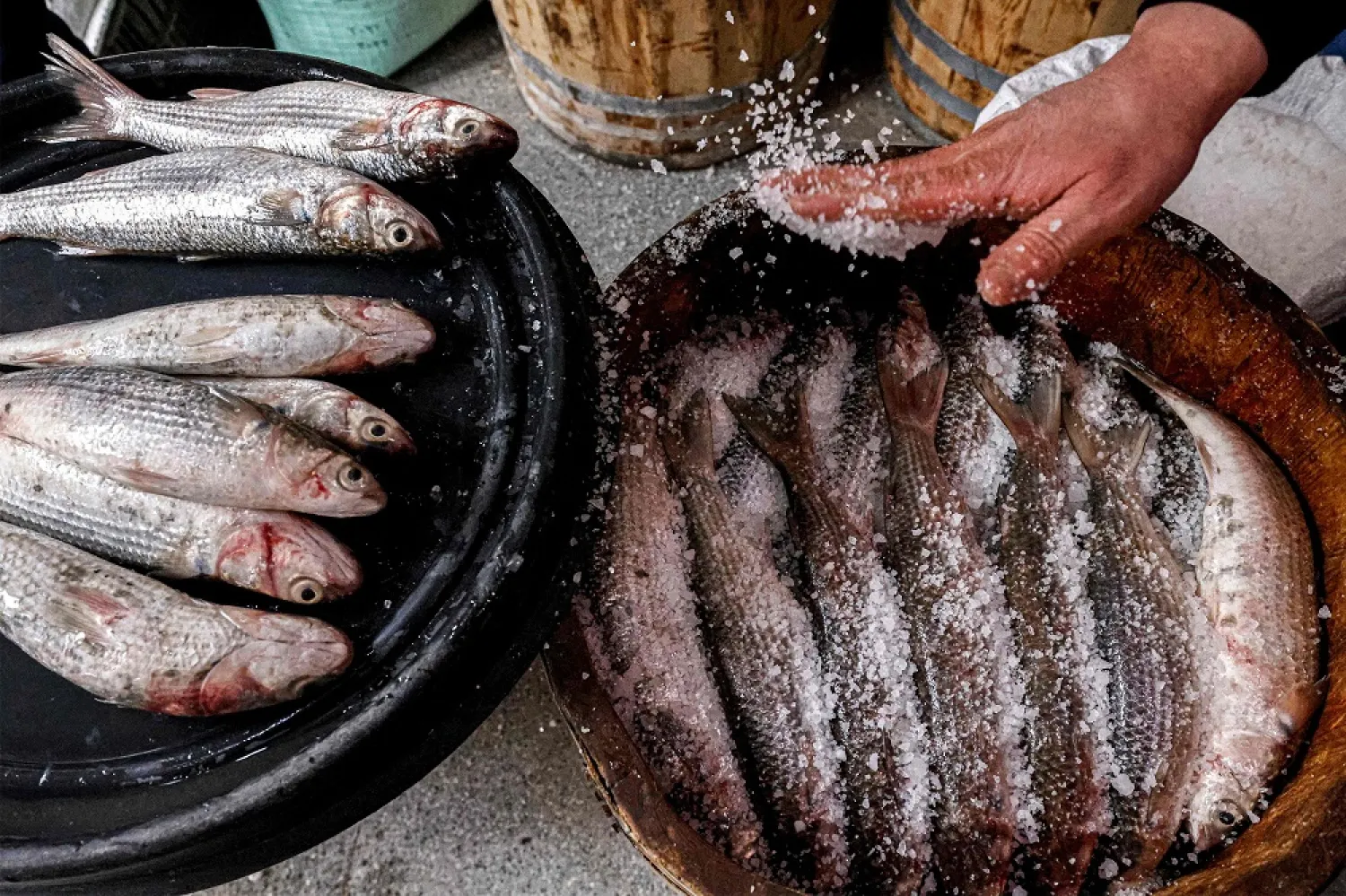
In this picture taken on April 11, 2023, a fish monger prepares to salt and barrel mullet fish known in Egypt as "feseekh" at a shop in the town of Nabarah, near Egypt's northern Nile Delta city of Mansoura, ahead of the traditional secular holiday of Sham el-Nessim (celebrated on Easter Monday). (AFP)
TT

Nile-Side Egypt Town Heralds Spring with Pungent Delicacy

In this picture taken on April 11, 2023, a fish monger prepares to salt and barrel mullet fish known in Egypt as "feseekh" at a shop in the town of Nabarah, near Egypt's northern Nile Delta city of Mansoura, ahead of the traditional secular holiday of Sham el-Nessim (celebrated on Easter Monday). (AFP)

The overwhelming smell may be misleading, but the Egyptian town of Nabaruh, its streets lined with shops selling salty, fermented fish called feseekh, is far from the seaside.

Landlocked in the Nile Delta, "Nabaruh is the capital of feseekh," boasted 44-year-old Sherif al-Yamani, owner of one of the town's famed shops.

The millennia-old delicacy of saltwater fish, buried in salt for weeks at a time, remains a staple as Egyptians celebrate on Monday the ancient spring festival of Sham al-Nessim.

But it is as acclaimed as it is divisive, pitting those who complain of the pungent odor against others gleefully marrying feseekh with flatbread and spring onion.

The traditional dish dates back more than 4,000 years and has been found in archaeological sites in Egypt, said former antiquities minister Zahi Hawass.

"Ancient Egyptians used to salt fish to extend its shelf life so workers could continue to eat it as they built the pyramids," he said.

Karim Abdel Gawad drove from a neighboring province, Gharbia, to buy the fish in Nabaruh where "it's really something else", he told AFP.

"There's no room for experimenting with feseekh, you need to get it from somewhere you trust."

Yamani takes pride in coming from one of a handful of feseekh-making families that began curing fish a century ago, making a name for their town.

"Whether or not it's the holiday season, we're always getting customers from all over Egypt," he told AFP, serving a client who had come from the capital Cairo, some 120 kilometers (75 miles) to the south.

Smell of success

The ancient craft is delicate. One wrong move -- too much moisture in the fish, not enough salt in the barrel -- and a bad feseekh might cause botulism, as Egypt's health ministry annually warns ahead of Sham al-Nessim.

"It all comes down to how the fish is prepared," which is why it should never be bought from open-air markets or street vendors, Yamani said.

With a careful eye to catch any error, he supervised his workers as they piled fish into large wooden barrels, each layer separated by a thick coat of coarse salt.

After each barrel is sealed with plastic, a fresh heap of salt is piled on top, locking everything in for the pungent smell to brew for weeks.

The spring festival, celebrated on the Monday after Easter in the Coptic Orthodox calendar, falls this year during the Muslim fasting month of Ramadan.

For those fasting from sunrise to sunset, consuming the salty dish could make them unbearably thirsty the following day. Many got their fill the week before Ramadan, Yamani said.

But love for feseekh seems to transcend hydration concerns, as clients continued to come in and out of the small shop even during the holy month, which is set to end next week.

And even a sharp economic crisis impacting every facet of Egyptian life over the past year -- with inflation hitting 33.9 percent in March -- has not stopped locals from getting feseekh at a price of about 220-240 pounds ($7-8) per kilo.

"We didn't imagine we'd be selling this much, but it seems like feseekh purchases haven't been affected," the fishmonger said.


Denmark Performs Autopsy on 'Timmy' the Whale

FILE - Beluga whales swim in a tank at Marineland amusement park in Niagara Falls, Ontario, Canada, June 9, 2023. (Chris Young/The Canadian Press via AP, File)
TT

Denmark Performs Autopsy on 'Timmy' the Whale

FILE - Beluga whales swim in a tank at Marineland amusement park in Niagara Falls, Ontario, Canada, June 9, 2023. (Chris Young/The Canadian Press via AP, File)

Scientists will on Thursday conduct an autopsy on "Timmy", the humpback whale whose ordeal to return to the open seas captured Germany's hearts and sparked a media frenzy, Danish officials said.

The whale, which had struggled since beaching near the German coast, died after being transported into the North Sea off Denmark aboard a barge and released on May 2 in a last-ditch rescue operation.

"The necropsy is expected to take place this afternoon as planned," the Danish Environmental Protection Agency told AFP in an email.

The results of the examination are to be released later, it added.

"Timmy", as he was dubbed in Germany, was moved on Saturday to the shore of the island of Anholt, near where the animal had been found.

After Timmy was first spotted stricken on a sandbank on March 23, the marine mammal's travails gripped Germany for weeks, with media flocking to the Baltic coast to follow the various attempts to get the whale swimming again.

But after several failed attempts, some experts criticized the continued rescues -- privately financed by wealthy entrepreneurs -- as pointless.


Genome Study Shows What Made the Extinct Ice Age Cave Lion Unique

The remains of a frozen female cave lion cub named Sparta, about 32,000 years old and recovered in northeastern Siberia, are pictured in Yakutsk, Russia, in this photograph from 2018, obtained on June 3, 2026. Love Dalen/Handout via REUTERS
TT

Genome Study Shows What Made the Extinct Ice Age Cave Lion Unique

The remains of a frozen female cave lion cub named Sparta, about 32,000 years old and recovered in northeastern Siberia, are pictured in Yakutsk, Russia, in this photograph from 2018, obtained on June 3, 2026. Love Dalen/Handout via REUTERS

The cave lion was one of the biggest cats to ever live, prowling a huge swathe of territory from Western Europe across Siberia and into North America and hunting large prey - and perhaps even people - before going extinct around the end of the Ice Age.

New genome research reveals what made this big cat unique and how it differed from the modern lion, its smaller cousin, though the two species did sporadically interbreed. The cave lion, whose scientific name is Panthera spelaea, died out roughly 14,000 years ago.

The researchers compared the genomes of 12 cave lions that lived from 17,000 to 148,000 years ago in places such as Russia, Austria and Canada's Yukon territory with the genomes of 20 modern lions. Cave lion DNA was extracted mostly from bones and teeth, but also from soft tissue in well-preserved frozen cubs from Siberia, where cold conditions helped preserve ancient genetic material. One of these, a female called Sparta, is among the best Ice Age specimens ever found.

"We show that cave lions were not simply Ice Age versions of modern ⁠lions, but ⁠instead represented a highly distinct evolutionary lineage," said evolutionary geneticist Love Dalén of the Centre for Palaeogenetics, a collaboration between Stockholm University and the Swedish Museum of Natural History, senior author of the study published in the journal Cell.

According to Reuters, the study showed that the evolutionary lineages of the two species diverged probably around 1.7 million years ago during the Pleistocene Epoch. Each species possessed unique genetic variants that likely adapted them to their different habitats and behaviors. These genetic differences related to growth, vision, brain function and circulatory development.

The cave lion, which despite its name did not actually live in caves, was significantly larger and built more robustly than the modern lion. It dwelled in colder ⁠climes, favoring the open grasslands and tundras of northern Eurasia and northwestern North America. This vanished ecosystem, called the mammoth steppe in a nod to its most prominent inhabitant, resembled today's African savanna but with frigid temperatures.

"The cave lion was absolutely an apex predator, and as such filled an incredibly important and impactful ecological role," said evolutionary geneticist and study lead author David Stanton of Cardiff University in Wales. "They were one of the most widespread carnivores to ever live."

Among its probable prey were woolly mammoths - most likely young or elderly individuals - as well as woolly rhinoceroses, antelope, reindeer, horses and bison. Humans also dwelled in these regions in the Ice Age's later stages.

"While there is no clear evidence that cave lions preyed on humans, it seems highly likely that they occasionally did so. Cave paintings show that Ice Age people were highly familiar with these animals. They are often depicted with remarkable accuracy, and are usually shown without the large mane characteristic of modern male lions," Dalén said.

Other predators sharing the landscape included wolves, cave hyenas, ⁠brown bears, cave bears and ⁠the scimitar-toothed cat Homotherium. The powerful saber-toothed cat Smilodon was a more southern species, but may have come into contact with cave lions in the Yukon and Alaska regions during brief periods of Pleistocene climate warming.

The modern lion did not venture as far north as the cave lion's usual domain. But the study showed that the two species came into contact at particularly cold stretches of the Ice Age when growing continental ice sheets and expansion of the steppe tundra brought cave lions southward, causing their ranges to overlap.

"Climate appears to dictate the level of interbreeding that we see between these species," Stanton said.

The researchers said this interbreeding may have occurred in places like modern-day Iran. That region once was home to a sizable population of modern lions, though they are now largely restricted to Africa.

The warming at the end of the Ice Age contributed to the extinctions of many of the large Pleistocene animals, or megafauna, with human hunting presenting another destabilizing factor.

"Cave lions, like the rest of the megafauna at the end of the Pleistocene, were under a huge amount of pressure due to rapid changes in climate combined with increasing human population densities. The extinction of cave lions falls into the general pattern that we see of mass extinction of megafauna at this time, but for reasons that we don't completely understand," Stanton said.


From Poplars to Pistachios, Afghans Rediscover the Value of Trees

A forest near Qargha lake in Paghman district, Kabul province. Wakil KOHSAR / AFP
TT

From Poplars to Pistachios, Afghans Rediscover the Value of Trees

A forest near Qargha lake in Paghman district, Kabul province. Wakil KOHSAR / AFP

Under the shade of recently planted poplars in northeastern Afghanistan, village leader Ghulam Ali Poya is proud to see residents rediscover the value of trees after years of wartime deforestation.

"There were forests of pistachio trees," he told AFP, gesturing to the bare mountains that surround Char Bagh's mud homes.

"During the conflicts and the civil war, they were destroyed; no one could stop the logging."

From the 1979 Soviet invasion until the fall of the first Taliban government in the early 2000s, "around 50 percent of Afghanistan's forest cover was lost", said Mohammad Nasir Shalizi, a researcher at North Carolina State University.

In eastern Afghanistan, timber smuggling to Pakistan drove massive logging, while in the more arid central and northern "pistachio belt", residents used wood for heating and cooking.

But in the last two decades, deforestation has slowed "substantially", Shalizi said.

Forest cover has increased 35 percent nationwide since 2011, according to the National Statistics and Information Authority, though just 2.5 percent of Afghanistan was forested in 2025 and cover is still shrinking in some areas.

But experts say communities are working to improve forest cover. Both the US-backed government, in place until 2021, and the current Taliban administration have supported tree-planting campaigns.

In Char Bagh, the Aga Khan Development Network funded a kilometer-square grove which includes poplars, paulownias, pomegranates and persimmons.

- 'A model' -

The land belongs to farmer Bas Begum Ahmadi, who hopes to sell fruit and homemade jam, but it is also open to the community of 350 families.

"Having these trees makes me feel good; my environment is green, and we breathe fresh air," said the 45-year-old, who tends the trees with her husband to support their four children.

This "micro-forest" follows Japanese botanist Akira Miyawaki's principles: dense planting of mostly local species of varying heights.

It is noticeably cooler than the surrounding bare fields and offers twigs for stove fuel and leaves that feed livestock.

Micro-forests "restore ecosystems, improve soil fertility, help climate resilience, and support community livelihood," said Parisa Malikzada, Afghanistan agriculture coordinator for the organization, which has planted 500 micro-forests in seven provinces.

Poya said the forest, next to a river, prevents soil erosion during flooding and offers "a model for people".

"Everyone comes to have a look, and they'd like to have one too," he told AFP.

In Afghanistan, where many places are hard to reach and the state has limited funds, community-based forest management is the most effective approach to reforestation, experts told AFP.

- Penalties for tree cutting -

Afghan authorities have set a goal of planting 200 million trees between 2023 and 2030, relying partly on NGOs, the United Nations and the private sector.

"Last year, the target was eight million, but in the end, 17 million were planted," said Rohullah Amin, head of climate change at the General Environmental Protection Agency, where he has worked for more than a decade.

This year's goal is nine million.

Challenges include selecting native, climate-adapted species, water scarcity, and livestock damaging saplings.

Some forests have struggled with "lack of care or water", Amin acknowledged, including one site where drought killed 70 percent of the planted pines.

In some places, tribal councils protect forests and penalize residents who damage them. Elsewhere, "forest management associations" run by elected villagers and farmers have been set up.

The UN Food and Agriculture Organization has helped them plant five million trees since 2019, according to its climate change chief, Muhammad Safi.

- Birds coming back -

The government created nurseries to grow local species in places such as Paghman on state land on Kabul's outskirts.

Head gardener Mahmood Khwajazada carefully tends almond, pine nut and walnut trees, as well as deodar cedars, for distribution nationwide.

"Our Prophet said, 'Even if you have only one day left, plant a tree," he told AFP.

In Charikar, northeastern Afghanistan, where thousands of saplings were planted this year along streets, in parks and on hillsides, the municipality sees "a change" in people's attitude towards trees.

Ahmad Khalid Sabiri, a resident, said he volunteered to help plant "because it's beneficial for the environment".

Experts said more work is needed to protect the remaining old growth, as well as planting in forests rather than just in urban areas.

"There's good work happening, but far more needs to be done" to address the impact of global warming, according to Apoorva Oza, head of climate change at the Aga Khan Foundation.

In Char Bagh, Poya sees a beneficial effect of trees in biodiversity, with the return of long-absent birds.

"Don't build a cage for a bird; plant a tree near your house," he said.