


In New York City, Scuba Divers’ Passion for Sport Becomes Mission to Collect Undersea Litter

Atlantic goliath grouper fish swim near Boynton Beach, Florida on September 10, 2023. (AFP)
TT

In New York City, Scuba Divers’ Passion for Sport Becomes Mission to Collect Undersea Litter

Atlantic goliath grouper fish swim near Boynton Beach, Florida on September 10, 2023. (AFP)

On a recent Sunday afternoon, the divers arrived on a thin strip of sand at the furthest, watery edge of New York City. Oxygen tanks strapped to their backs, they waded into the sea and descended into an environment far different from their usual terrestrial surroundings of concrete, traffic and trash-strewn sidewalks.

Horseshoe crabs and other crustaceans crawl on a seabed encrusted with barnacles and colonies of coral. Spiny-finned sea robin, blackfish and wayward angelfish swim in the murky ocean tinted green by sheets of algae.

Not all is pretty. Plastic bottles, candy wrappers and miles and miles of fishing line drift with the tides, endangering sea life.

The undersea litter isn't always visible from the shore. But it has long been a concern of Nicole Zelek, a diving instructor who four years ago launched monthly cleanups at this small cove in the community of Far Rockaway, where New York City meets the Atlantic Ocean, about 4 miles (6.4 kilometers) south of John F. Kennedy International Airport in Queens.

A throwaway culture of single-use plastics and other hard-to-degrade material has sullied the world's waters over the decades, posing a danger to marine life such as seals and seabirds. By 2025, some 250 million tons (226.7 million metric tons) of plastic will have found its way into the oceans, according to the PADI AWARE Foundation, a conservation group sponsoring a global project called Dive Against Debris.

Dive by dive, small groups like Zelek's have been trying to undo some of the damage.

“Every month we have a prize for the weirdest find,” she said. They have included the occasional goat skull, perhaps used as part of some ritual, Zelek surmises.

“The best find of all time was an actual ATM machine. Unfortunately, it was empty,” she said.

The divers' haul one late-summer Sunday wasn’t much, but there were clumps and clumps of fishing line untangled from underwater objects. What the divers can’t pull away by hand is cut with scissors.

“Unfortunately, tons of crabs and horseshoe crabs — which are under threat — get tangled in the fishing line and then they die,” Zelek said.

While more ambitious projects are underway to scoop up huge accumulations of floating debris in deeper waters, small-scale coastal cleanups like Zelek's are an important part of the battle against ocean pollution, said Nick Mallos, vice president of conservation for Ocean Conservancy.

“The science is very clear and that’s to tackle our global plastic pollution crisis,” he said. “We have to do it all.”

Every September, the conservancy holds monthlong international coastal cleanups. Since its inception nearly four decades ago, the cleanups have retrieved about 400 million pounds (181.4 million kilograms) of trash from coastal areas around the world.

The best way to combat plastics going into the oceans, Mallos said, is to reduce the globe's dependence on them, particularly in packaging consumer products. But human-powered cleanup is the least costly of all cleanup options.

The Dive Against Debris project invites what organizers call “citizen scientists” to survey their diving sites to help catalog the myriad items that don’t belong in oceans, lakes and other bodies of water. By the group’s count, more than 90,000 participants have conducted more than 21,000 such surveys and removed 2.2 million pieces of junk, big and small.

Zelek and her fellow divers have contributed their finds to the project.

Surface trash might be easy enough to clear with a rake, but the task is more challenging beneath the water. Over the years, the layers of monofilament fishing line have accumulated. And until a few years ago, no one was scooping out the line, hooks and lead weights.

Untangled, a pound of medium-weight fishing filament would stretch to a bit more than 4 miles (6.4 kilometers). It’s anybody’s guess how many miles of fishing line remain on the channel’s bottom.

“Those small things are really what start to accumulate and become a much larger and bigger problem,” said Tanasia Swift, who has been with the group for a year and works for an environmental nonprofit focused on restoring the health of New York City’s waters.

“If there’s anything that we see that doesn’t belong in the water, we take it out,” she said.

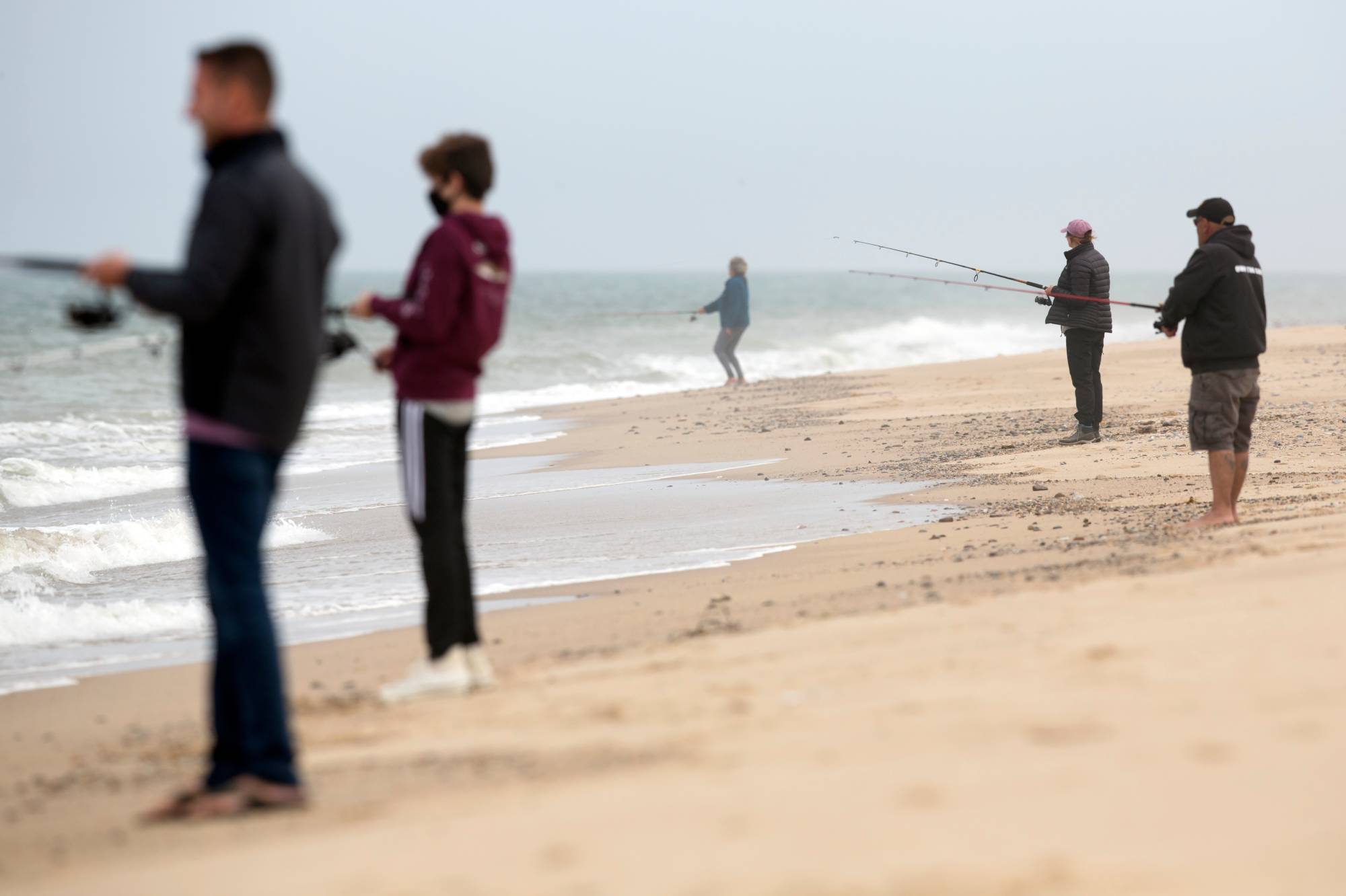
While the drivers work, fishermen cast their lines from a ledge where the city's concrete stops. The beach is frequented mostly by residents who live nearby.

Raquel Gonzalez is one such resident, and she's been coming to the beach for years. She and a neighbor brought a rake with them on the same Sunday the divers were there.

“Needs a lot of cleanup here. There's nobody that does any cleanup around here. We have to clean it up ourselves," she said.

“I love this spot, I love the scuba divers," Gonzalez said. “Look at all the good people here.”



The Year's First Meteor Shower and Supermoon Clash in January Skies

People look up to the sky from an observatory near the village of Avren, Bulgaria, Aug. 12, 2009. (AP Photo/Petar Petrov, File)
TT

The Year's First Meteor Shower and Supermoon Clash in January Skies

People look up to the sky from an observatory near the village of Avren, Bulgaria, Aug. 12, 2009. (AP Photo/Petar Petrov, File)

The year's first supermoon and meteor shower will sync up in January skies, but the light from one may dim the other.

The Quadrantid meteor shower peaks Friday night into Saturday morning, according to the American Meteor Society. In dark skies during the peak, skygazers typically see around 25 meteors per hour, but this time they'll likely glimpse less than 10 per hour due to light from Saturday's supermoon, The AP news reported.

“The biggest enemy of enjoying a meteor shower is the full moon,” said Mike Shanahan, planetarium director at Liberty Science Center in New Jersey.

Meteor showers happen when speedy space rocks collide with Earth’s atmosphere, burning up and leaving fiery tails in their wake — the end of a “shooting star.” A handful of meteors are visible on any given night, but predictable showers appear annually when Earth passes through dense streams of cosmic debris.

Supermoons occur when a full moon is closer to Earth in its orbit. That makes it appear up to 14% bigger and 30% brighter than the faintest moon of the year, according to NASA. That difference can be tough to notice with the naked eye.

Supermoons, like all full moons, are visible in clear skies everywhere that it's night. The Quadrantids, on the other hand, can be seen mainly from the Northern Hemisphere. Both can be glimpsed without any special equipment.

To spot the Quadrantids, venture out in the early evening away from city lights and watch for fireballs before the moon crashes the party, said Jacque Benitez with the Morrison Planetarium at the California Academy of Sciences. Skygazers can also try looking during early dawn hours on Sunday.

Wait for your eyes to get used to the darkness, and don’t look at your phone. The space rocks will look like fast-moving white dots and appear over the whole sky.

Meteor showers are named for the constellation where the fireballs appear to come from. The Quadrantids — space debris from the asteroid 2003 EH1 — are named for a constellation that's no longer recognized.

The next major meteor shower, called the Lyrids, is slotted for April.

Supermoons happen a few times a year and come in groups, taking advantage of the sweet spot in the moon’s elliptical orbit. Saturday night’s event ends a four-month streak that started in October. There won't be another supermoon until the end of 2026.


New Maritime Theater in Jazan to Host the City's Festival Opening

The site also includes various amenities, such as shopping zones, kiosks for dining, an art gallery - SPA
TT

New Maritime Theater in Jazan to Host the City's Festival Opening

The site also includes various amenities, such as shopping zones, kiosks for dining, an art gallery - SPA

The Jazan city theater on the southern corniche will host the opening ceremony of the Jazan Festival 2026 on Friday. This event will take place at a 35-square-kilometer site that features the Kingdom's largest maritime theater, SPA reported.

The theater accommodates more than 10,000 spectators and features five VIP areas. To ensure a smooth experience, the venue offers parking for over 9,000 vehicles, providing easy access during peak times.

Built specifically for the festival, the stage meets stringent safety and technical standards, providing a high-quality audiovisual experience against the stunning backdrop of the Red Sea.

The site also includes various amenities, such as shopping zones, kiosks for dining, an art gallery, a play area for children, a bird garden, and a regional museum, showcasing the region's history and culture.

This temporary maritime theater aims to provide a cohesive experience, integrating entertainment, culture, shopping, and services in one location, further establishing Jazan as a year-round destination for tourism and entertainment.


Saudi Post Issues Commemorative Stamp for Riyadh Air

Saudi Post Issues Commemorative Stamp for Riyadh Air
TT

Saudi Post Issues Commemorative Stamp for Riyadh Air

Saudi Post Issues Commemorative Stamp for Riyadh Air

Saudi Post, in collaboration with Riyadh Air, has launched a commemorative stamp set priced at SAR3 to celebrate the airline’s inaugural flights on October 26, 2025, coinciding with the start of its operational phase.

This issuance marks the beginning of operational activities for Riyadh Air as a new national carrier, aiming to serve over 100 destinations worldwide, SPA reported.

Saudi Post's stamps commemorate major national and international events, preserving important moments in Saudi history and appealing to collectors and historians alike.
