Saudi Arabia's PIF Raises $5Bn from Syndicated Loan
In March 2022, Saudi Arabia’s Public Investment Fund (PIF) and K-SURE signed a memorandum of understanding (MoU) expressing mutual intention to strengthen their partnership and cooperation (Asharq Al-Awsat)
Saudi Arabia's PIF Raises $5Bn from Syndicated Loan
In March 2022, Saudi Arabia’s Public Investment Fund (PIF) and K-SURE signed a memorandum of understanding (MoU) expressing mutual intention to strengthen their partnership and cooperation (Asharq Al-Awsat)
Saudi Arabia’s Public Investment Fund (PIF) and Korea Trade Insurance Corporation (K-SURE) signed on Nov. 28 a financing agreement through which PIF has secured a term loan, from a syndicate of nine top international lenders.
The financing carries a door-to-door tenor of 13 years and will initially be set at $3 billion (nearly SAR 11.2 billion), with an option to increase to $5 billion (nearly SAR 18.7 billion), subject to pre-agreed terms and conditions.
The transaction will mark PIF’s first financing covered by an export credit agency, as it continues to diversify its sources of funding.
In March 2022, PIF and K-SURE signed a memorandum of understanding (MoU) expressing mutual intention to strengthen their partnership and cooperation. This resulted in achieving, among other matters, the K-SURE covered term loan.
The collaboration between PIF and K-SURE aims to promote the export of Korean goods and services into various projects and subsidiaries either partially or fully owned by PIF while strengthening economic partnerships.
“This collaboration with K-SURE underscores PIF's commitment to foster institutional partnerships as we continue to deliver on our medium-term capital raising strategy,” said Fahad AlSaif, Head of the Global Capital Finance Division at PIF.
“The financing is part of PIF’s four primary sources of funding and strengthens economic ties between Saudi Arabian and South Korean businesses,” he added.
“Through this financial support, Korean companies have not only gained technological competitiveness but also financial competitiveness to increase orders,” said Inho Lee, President of K-SURE.
“We trust this support will contribute to strengthening the future-focused partnership between the two countries,” he added.
This financial agreement marks a continuation of PIF’s efforts to diversify its funding sources.
Recently, it successfully issued international bonds totaling $3.5 billion.
SpaceX CEO Elon Musk, displayed on a screen remotely from SpaceX headquarters in Starbase, Texas, speaks before the launch of SpaceX's initial public offering (IPO) at the Nasdaq MarketSite in New York on June 12, 2026. (Photo by TIMOTHY A. CLARY / AFP)
SpaceX CEO Elon Musk, displayed on a screen remotely from SpaceX headquarters in Starbase, Texas, speaks before the launch of SpaceX's initial public offering (IPO) at the Nasdaq MarketSite in New York on June 12, 2026. (Photo by TIMOTHY A. CLARY / AFP)
SpaceX shares began trading on Nasdaq at a market value of $1.78 trillion, turning Gulf capital's role from market speculation into a documented fact.
Last-minute disclosures and the IPO prospectus revealed a striking economic reality: sovereign wealth funds and investors from Gulf Cooperation Council countries were not peripheral participants.
They were the backbone of the largest fundraising exercise in financial market history. This $75 billion deal made the Gulf a historic partner in shaping the future of space and artificial intelligence.
Global hedge funds saw their orders sharply cut after demand topped $250 billion. But Britain’s Financial Times, citing people familiar with the order book, reported that sovereign funds and family offices were given priority. SpaceX placed Gulf funds at the front of its list of strategic subscribers.
According to the newspaper, the official Gulf allocation put the region among the biggest subscribers.
Saudi Arabia’s Public Investment Fund, the Qatar Investment Authority and the Kuwait Investment Authority each received final allocations worth more than $1 billion. Those figures approached the scale of the $5 billion stake sought by US asset management giant BlackRock.
The rush was also driven by “fast-entry” rules approved by global index providers such as Nasdaq and FTSE Russell.
These rules allow shares to be added to major indexes, including the Nasdaq 100, within five to 15 trading days. For funds, securing stock from the first book became a preemptive fight.
The rise of the Kingdom’s stake
The case of Prince Alwaleed bin Talal and Kingdom Holding Co. offers the clearest example of how Gulf investors booked historic paper gains through long-standing strategic ties with Elon Musk.
It also gave practical meaning to Musk’s 2024 pledge, when he wrote on his platform: “Loyalty deserves loyalty,” promising priority to long-term investors.
The relationship began in 2011, when Prince Alwaleed invested $300 million in Twitter, now X. When Musk acquired the platform in 2022, Kingdom Holding and its chairman, Prince Alwaleed bin Talal, made a decisive call: they rolled over the stake instead of cashing out.
Later, as Musk merged X with his artificial intelligence startup xAI and then folded the combined entity under SpaceX, that historic holding was converted into direct equity in the rocket and satellite communications company, according to IPO documents.
The result was a dramatic paper gain. Kingdom Holding said in a separate official filing to the Saudi stock exchange that the estimated value of its joint stake with Prince Alwaleed had risen to more than $10.6 billion, based on the final IPO price of $135 a share.
The effect was not confined to the company’s books. The valuation quickly moved into the market, sparking a rally that sent Kingdom Holding shares on Saudi Arabia’s Tadawul exchange to their highest level in a decade.
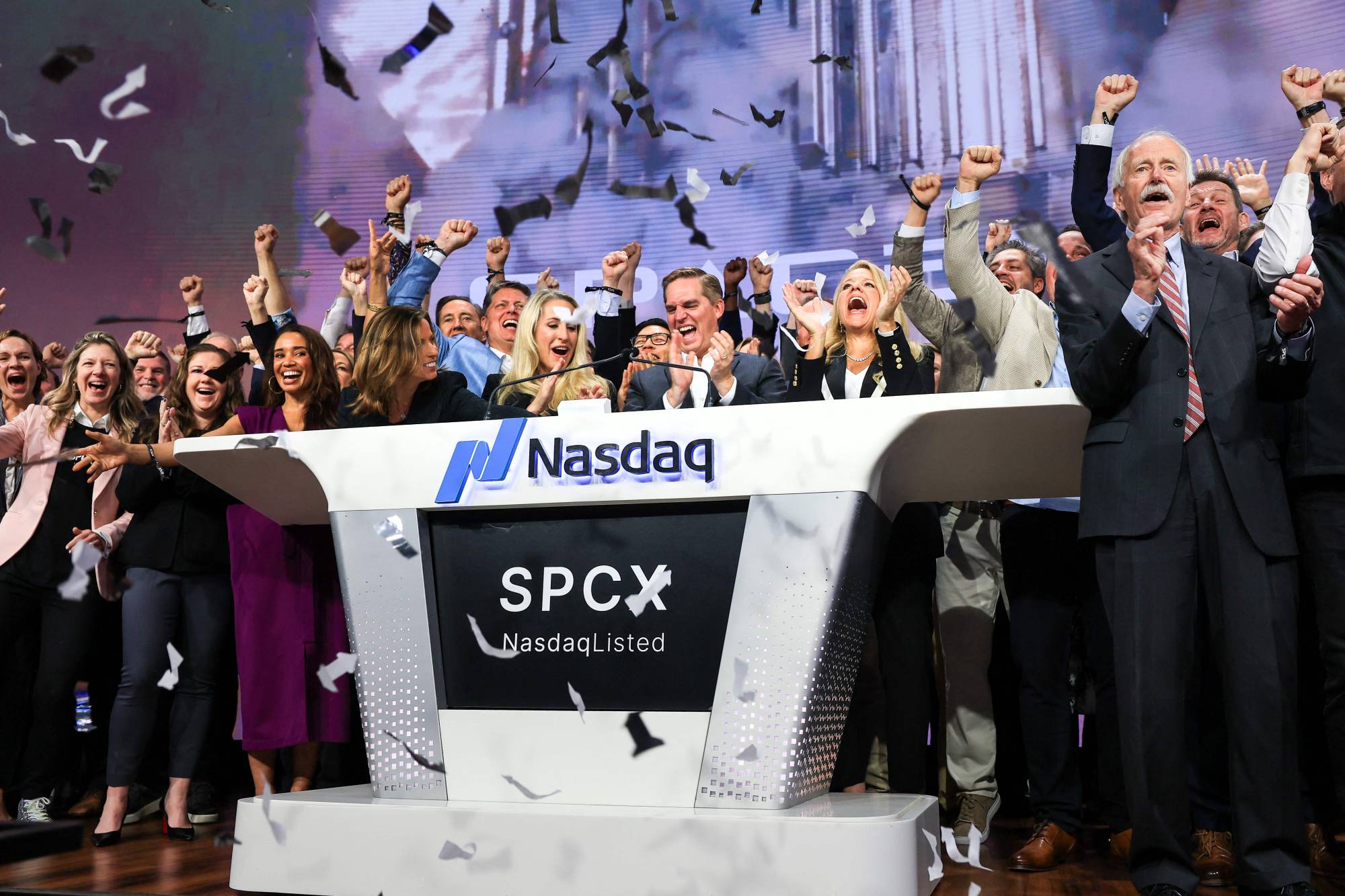
Bret Johnsen (C), SpaceX Chief Financial Officer, and Gwynne Shotwell (center R), SpaceX President and Chief Operating Officer, celebrate as they ring the opening bell at the Nasdaq MarketSite to celebrate the launch of SpaceX's initial public offering (IPO) in New York on June 12, 2026. (Photo by TIMOTHY A. CLARY / AFP)
The AI equation
The gains tell only part of the story. Published operating data and SpaceX’s combined deals show Gulf investors have shifted the rules of the traditional investment game.
Regional capital is no longer silent money waiting for dividends. It has become a strategic force, demanding the localization of advanced technology and the construction of computing and artificial intelligence infrastructure on Arab soil. The goal is knowledge transfer and digital sovereignty, not merely returns captured in Silicon Valley.
HUMAIN enters the picture
That strategy is clearest in the moves of Saudi Arabia’s HUMAIN, a company wholly owned by the Public Investment Fund and focused on providing comprehensive artificial intelligence capabilities globally.
According to the company’s official statement, HUMAIN invested $3 billion in xAI’s Series E funding round. The investment came just before SpaceX’s larger acquisition and merger in early February.
Under that transaction, HUMAIN’s stake was converted into declared, direct equity in the parent company, SpaceX, making it a significant minority shareholder with strategic weight.
The statement shows the partnership was not improvised. It followed a broad agreement signed in November 2025 during the US-Saudi Investment Forum.
Under the agreement, HUMAIN and xAI committed to jointly developing next-generation artificial intelligence infrastructure and data centers with more than 500 megawatts of computing capacity, while localizing and deploying advanced Grok models in Saudi Arabia.
At the time, HUMAIN Chief Executive Tareq Amin said the investment showed the company’s ability to deploy major capital behind exceptional technology platforms that combine technical excellence with long-term vision.
He said the merger of xAI with SpaceX’s vast infrastructure created a unique platform for accelerated growth and long-term investment value across four areas: next-generation technology centers, hyperscale cloud, advanced models and transformative AI solutions.
The United Arab Emirates built its own technology alliance along similar lines. Abu Dhabi secured a strategic seat through its specialized technology arm, MGX, in Musk's merged entities, in cooperation with G42.
At the same time, it moved ahead with a large data center complex in Abu Dhabi, supported by parallel strategic partnerships, including a $15.2 billion investment commitment from Microsoft for Khazna, the group’s data center company.
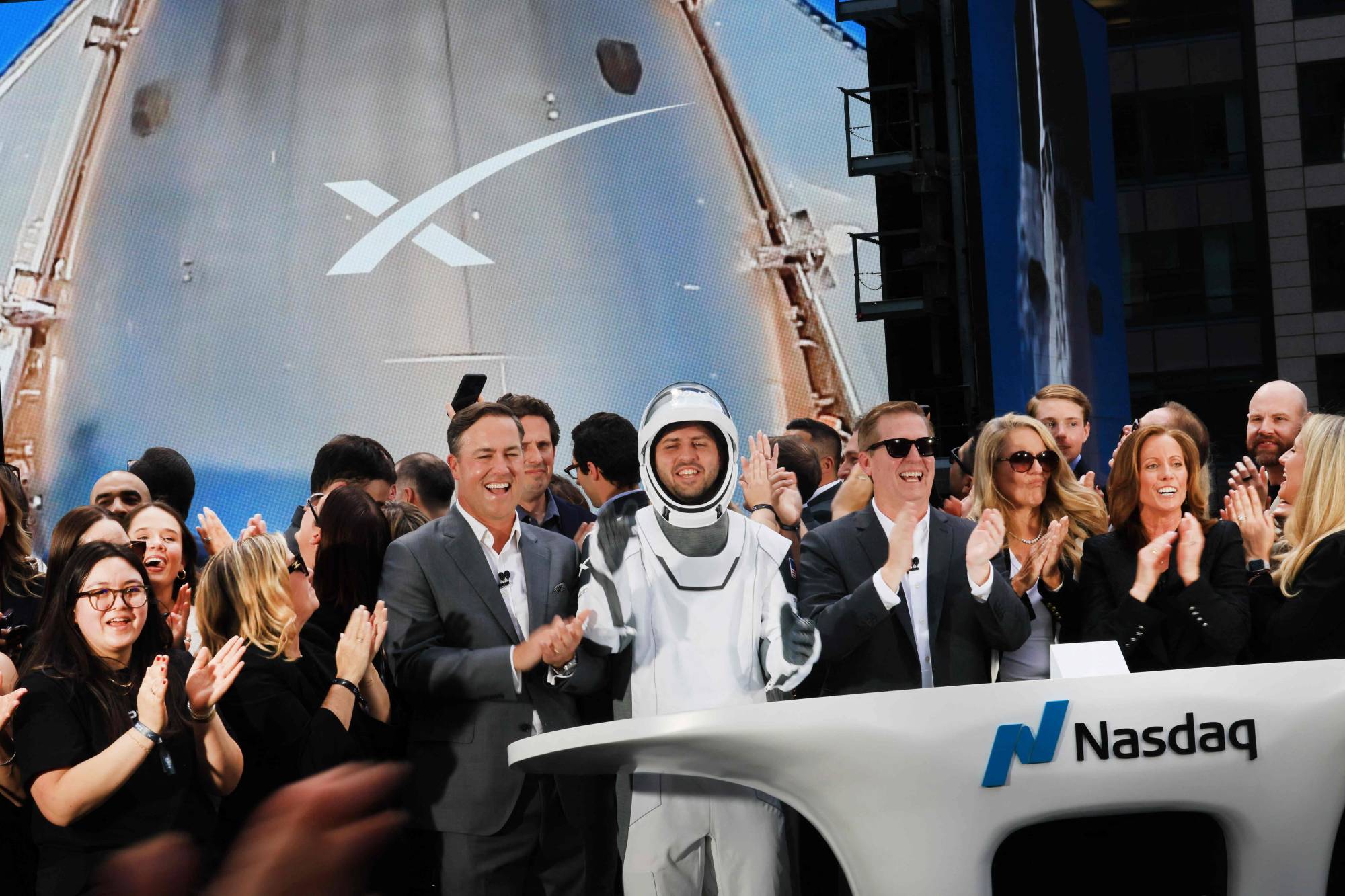
NEW YORK, NEW YORK - JUNE 12: SpaceX employees celebrate the market close of the SpaceX initial public offering (IPO) at the Nasdaq Marketsite on June 12, 2026, in New York City. Spencer Platt/Getty Images/AFP
Financial engineering and the space bet
Official data cited by Britain’s Financial Times set out the spending plan for the IPO proceeds. SpaceX will immediately use $20 billion of the gross proceeds to repay a bridge loan the group drew in March.
The loan covered debt tied to the integration of Musk’s artificial intelligence and social media businesses, xAI and X, under SpaceX’s financial umbrella.
The remaining liquidity, backed significantly by cash flows and Gulf billions from the top of the order book, will fund the next stage of growth.
At the center of those plans is a project Musk disclosed to the head of JPMorgan during the IPO roadshow and which the British newspaper reported: building artificial intelligence data centers in outer space.
The plan involves launching giant satellites with 70-meter wingspans as a strategic solution to the limits of Earth's electricity resources.
Steel-like confidence
The scale of the Gulf position has drawn attention on Wall Street because SpaceX’s current numbers defy traditional market equations.
The company went public with a financial commitment that included repaying a $20 billion loan before the offering to cover obligations from the merged xAI and X businesses under SpaceX’s unified structure.
Its valuation was even more striking: 92 times annual revenue of $19 billion. In simple terms, standard market practice usually ties large-company valuations to current revenue. SpaceX’s market value therefore places it in a rare position among the world’s largest technology groups relative to the size of its existing business.
Even so, banking circles described the approach of Gulf sovereign wealth funds and family offices as a strategic vision that looked past conventional market concerns. Investment managers told the Financial Times they had offered Gulf clients financial hedging options as a standard precaution when trading began. All rejected hedging outright.
That stance reflects a more mature regional investment mindset. Gulf investors are no longer relying only on immediate readings and short-term indicators. They are trying to seize future monopolistic opportunities.
That view draws on forecasts by Goldman Sachs, the lead IPO manager, which predicted a 100-fold jump in SpaceX’s artificial intelligence revenue to $322 billion by 2030, allowing it to dominate a targeted global market worth $28.5 trillion.
In the end, SpaceX’s historic IPO showed that the region’s funds have become strategic partners with the power to impose operational conditions, localize future technology and shape a new financial geopolitical landscape stretching from the deserts of the Middle East to outer space.
Saudi Industry Minister Discusses Digital Transformation, Industrial Cooperation with Kazakh Ministershttps://english.aawsat.com/business/5283689-saudi-industry-minister-discusses-digital-transformation-industrial-cooperation
Minister of Industry and Mineral Resources Bandar Alkhorayef and the Saudi delegation are seen during the meeting in Astana. (SPA)
TT
TT
Saudi Industry Minister Discusses Digital Transformation, Industrial Cooperation with Kazakh Ministers
Minister of Industry and Mineral Resources Bandar Alkhorayef and the Saudi delegation are seen during the meeting in Astana. (SPA)
Saudi Minister of Industry and Mineral Resources Bandar Alkhorayef held two bilateral meetings in Astana with Kazakhstan’s Deputy Prime Minister and Minister of Artificial Intelligence and Digital Development Zhaslan Madiyev and Foreign Minister Yermek Kosherbayev focusing on strengthening economic ties and expanding cooperation in digital transformation, artificial intelligence, and industrial and mining innovation, reported the Saudi Press Agency on Saturday.
Attended by Saudi Vice Industry Minister for Mining Affairs Eng. Khalid Al-Mudaifer, the meeting also tackled strengthening economic ties and expanding cooperation in digital transformation, artificial intelligence, and industrial and mining innovation.
During his meeting with Madiyev, the officials explored opportunities to exchange expertise in digital technologies and AI, emphasizing the role of advanced technologies in enhancing efficiency and competitiveness in the industrial and mining sectors.
Alkhorayef highlighted the Kingdom’s efforts to develop its digital infrastructure and build an integrated innovation ecosystem that accelerates the adoption of advanced technologies.
Alkhorayef and Kosherbayev discussed ways to deepen economic cooperation, expand investment partnerships in industry and mining, and facilitate the access of Saudi exports to Kazakh markets.
The meetings were held as part of Alkhorayef’s official visit to Kazakhstan that is aimed at strengthening bilateral cooperation in industry and mining, promoting knowledge exchange in digital transformation and advanced technologies, and supporting the objectives of Saudi Vision 2030.
US Refiners Can Still Absorb More Venezuelan Oil, Energy Secretary Wright Sayshttps://english.aawsat.com/business/5283579-us-refiners-can-still-absorb-more-venezuelan-oil-energy-secretary-wright-says
US Secretary of Energy Chris Wright attends the 2026 Infrastructure Summit of government officials, corporate executives, and labor leaders, in Washington, DC, US, March 11, 2026. (Reuters)
TT
TT
US Refiners Can Still Absorb More Venezuelan Oil, Energy Secretary Wright Says
US Secretary of Energy Chris Wright attends the 2026 Infrastructure Summit of government officials, corporate executives, and labor leaders, in Washington, DC, US, March 11, 2026. (Reuters)
US refiners can still absorb more Venezuelan crude, Energy Secretary Chris Wright said on Friday, as the South American country's output bounces following the US capture of President Nicolas Maduro in January and facilities on the Gulf Coast make adjustments to process higher volumes of heavy oil.
Venezuela is sending about half of its total exports of 1.25 million barrels a day to the US, with the remaining volumes going mainly to India and Europe, according to figures based on tanker monitoring. Wright said the exports are expected to increase in the coming months.
The country's oil ministry forecast crude output of 1.37 million bpd by year-end, which would imply a 22% increase from the 1.12 million bpd produced in late 2025.
"It takes time because you buy your crude mixes by month from slates. It's a blend from everywhere. So you don't just flip on a switch, but you'll see more and more Venezuelan crude demanded by US refineries," Wright said at an event in Port Houston, Texas.
US oil output also is expected to continue rising, with production of shale oil and gas growing modestly and stronger crude growth off the US Gulf Coast and in Alaska, according to Wright.
US crude production increased 3% last year, setting a new annual record of 13.6 million bpd. The country has become the world's largest exporter of oil and fuel, sending out 10.5 million bpd.
STRAIT OF HORMUZ FLOWS
Earlier in the day, Wright said 7 million bpd of oil were getting out of the Gulf with US military help. Flows through the Strait of Hormuz have been largely choked off since the US-Israeli war on Iran began in late February.
Asked about those comments, Wright said Iran is not currently exporting any oil or products and that the US is stepping up to fill the oil export void amid the Middle East conflict.
The International Energy Agency had estimated that Gulf supply was down by 14 million bpd, around 14% of world supply. But the figure could be closer to 5 million to 6 million bpd as producers find ways to keep cargoes moving.
Some 136 million barrels of non-Iranian crude moved through the Strait of Hormuz and the Gulf of Oman between early April and June 10, or about 1.9 million bpd, shipping data firm Kpler estimates.
"We have had days where we've exported well above the number I gave," Wright said when asked about the 7 million bpd passing through. "If you look at our trend right now, we'll be past replacing more than half of the lost oil."
Flows passing through Hormuz are coming from all oil exporters in the Arabian Gulf except Iran, Wright said.
Asked about gasoline prices in the US, which have climbed since the start of the Middle East conflict, Wright said President Donald Trump has been a champion of low energy prices.
"He has not changed that desire for low energy prices across the board, but he was simply unwilling to kick a 47-year conflict and a nuclear-armed Iran down to the next administration," Wright said, adding that allowing Iran to obtain nuclear weapons would lead to "massively higher" energy prices in future.
لم تشترك بعد
انشئ حساباً خاصاً بك لتحصل على أخبار مخصصة لك ولتتمتع بخاصية حفظ المقالات وتتلقى نشراتنا البريدية المتنوعة