Israel Pursues Hamas in and Around Gaza's Biggest Cities

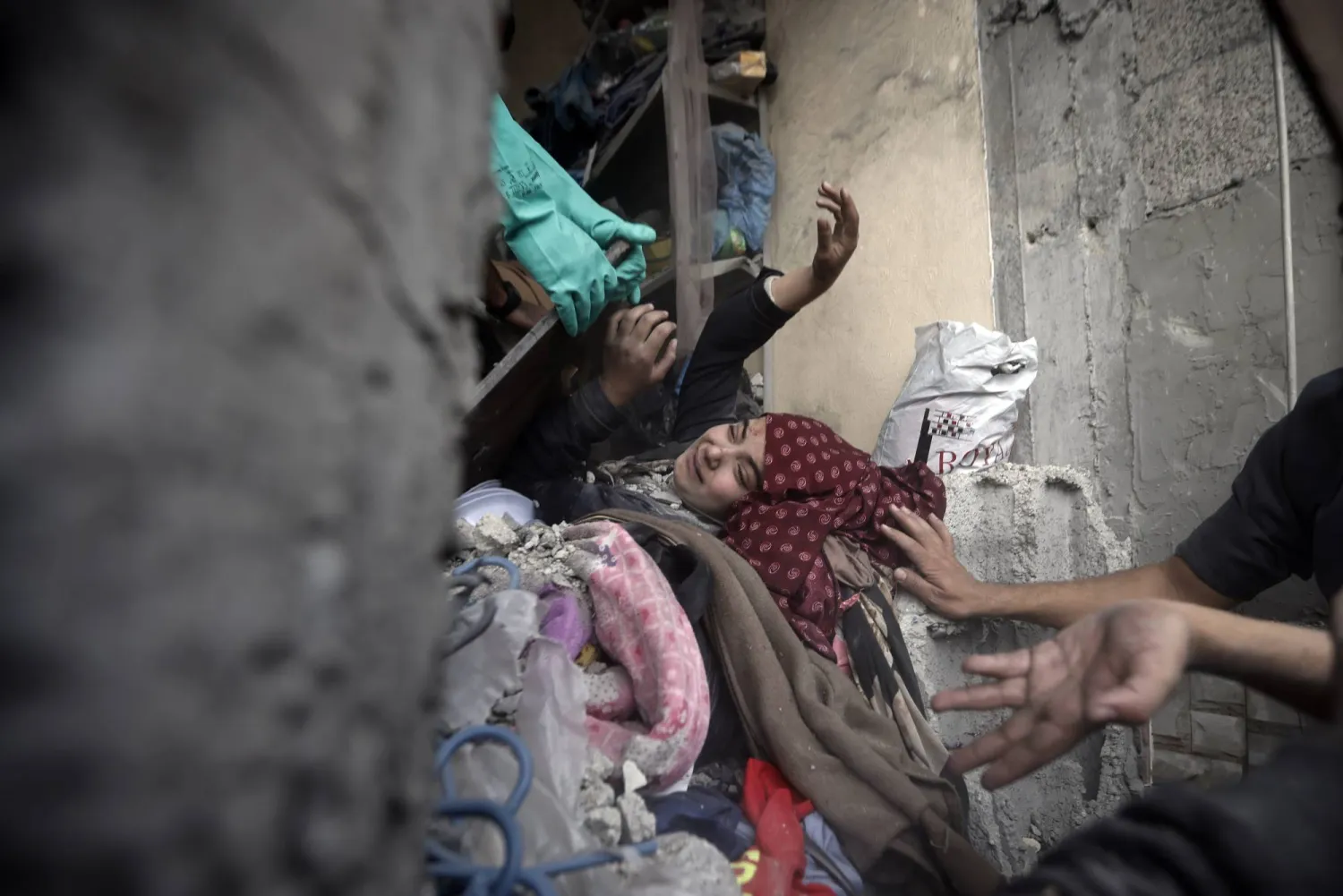
Palestinians try to rescue a woman stuck under the rubble of a destroyed building following Israeli airstrikes in Khan Younis refugee camp, southern Gaza Strip, Thursday, Dec. 7, 2023. (AP Photo/Mohammed Dahman)
TT

Israel Pursues Hamas in and Around Gaza's Biggest Cities

Palestinians try to rescue a woman stuck under the rubble of a destroyed building following Israeli airstrikes in Khan Younis refugee camp, southern Gaza Strip, Thursday, Dec. 7, 2023. (AP Photo/Mohammed Dahman)

Israel pressed on with its offensive in and around Gaza's main cities on Friday, more than two months after Hamas's deadly attack sparked a war that has claimed thousands of lives and left the Palestinian territory in ruins.
The death toll in Gaza has soared above 17,000, mostly women and children, the Hamas-run health ministry said, and vast areas of the besieged territory have been reduced to a rubble-strewn wasteland of bombed-out and bullet-scarred buildings.
Early Friday, the health ministry reported another 40 dead in strikes near Gaza City, and "dozens" more in Jabalia and Khan Yunis, reported AFP.
Israeli forces have encircled major urban centers as they seek to destroy Hamas over its unprecedented attack on October 7, when militants broke through Gaza's militarized border to kill around 1,200 people and seize hostages, 138 of whom remain captive, according to Israeli figures.
In a Thursday phone call with Israeli Prime Minister Benjamin Netanyahu, US President Joe Biden "emphasized the critical need to protect civilians and to separate the civilian population from Hamas", the White House said in a statement.
Biden also called for "corridors that allow people to move safely from defined areas of hostilities".
Backed by air power, tanks and armored bulldozers, Israeli troops are fighting in Khan Yunis, the biggest city in southern Gaza, as well as in Gaza City and Jabalia district in the north.
Prime Minister Benjamin Netanyahu said troops had closed in on the Khan Yunis home of Hamas's Gaza chief Yahya Sinwar, 61, vowing "it is only a matter of time until we find him".
Israeli television stations aired footage Thursday of tens of blindfolded Palestinian men wearing only underwear, guarded by Israeli soldiers in Gaza, setting off strong reactions on social media.
"We are investigating to see who is linked to Hamas and who is not," Israeli army spokesman Daniel Hagari said at a press conference.
London-based news outlet Al-Araby Al-Jadeed said one of its journalists was among them.
'We are dead already'
The fighting has pushed Gazans south, turning Rafah near the Egyptian border into a vast camp for many of the 1.9 million displaced by the conflict -- 80 percent of Gaza's population.
"Two months on the road, moving from one place to another. These are the hardest two months we have experienced in our lives," said Abdallah Abu Daqqa, displaced from Khan Yunis to Rafah.
Air strikes have followed them.
Eight more hit Rafah overnight. AFP journalists saw around 20 corpses in white body bags, including a child, at its Nasser hospital, while men gathered nearby to pray.
The mass civilian casualties in the conflict have sparked global concern, heightened by dire shortages caused by an Israeli siege that has seen only limited access for food, water, fuel and medicines.
Israel has approved a "minimal" increase in fuel supplies to prevent a "humanitarian collapse and the outbreak of epidemics", and called on the international community to "increase its capabilities" to distribute aid.
UN humanitarian chief Martin Griffiths said there were "promising signs" Israel may open the southern Kerem Shalom crossing to aid deliveries.
But Hamas has declared a "state of famine" in northern Gaza, saying no aid has arrived there since December 1.
And Israeli rights group B'Tselem said the "minuscule amount of aid" allowed into the territory was "tantamount to deliberately starving the population".
"We are dying here, without even the need for rockets and bomb strikes. We are dead already, dead from hunger, dead from displacement," said Abdelkader al-Haddad, a Gaza City resident now in Rafah.
Intense fighting
The Netanyahu government has responded angrily to United Nations Secretary-General Antonio Guterres invoking the rarely used Article 99 of the world body's charter, calling on the Security Council to push for a ceasefire.
The Security Council will hold an emergency at 1500 GMT Friday to discuss the crisis.
The fighting in Gaza has killed 89 Israeli soldiers so far, including Gal -- the son of war cabinet minister Gadi Eisenkot -- on Thursday.
In a Thursday briefing, the Israeli military said troops had "killed Hamas terrorists and struck dozens of terror targets" in Khan Yunis, and raided a military compound of Hamas's Central Jabalia Battalion.
Hamas released footage of its fighters firing AK-47 assault rifles and grenade launchers from abandoned buildings in what it said was Gaza City, and said it was battling Israeli troops "on all axes of the incursion into the Gaza Strip".
The militant group said it had destroyed two dozen military vehicles in Khan Yunis and Beit Lahia in the territory's north, and its rockets continue to target Israel, though they have been intercepted by air defenses.
Lebanon tensions
Israelis remained deeply traumatized by the horror of the Hamas attack and fearful for the fate of hostages as they headed into the Jewish festival of lights, Hanukkah, from Thursday evening.
One of the worst-hit sites on October 7, the Supernova music festival, was recreated in a Tel Aviv exhibition hall to remember those killed and abducted by Hamas, complete with victims' tents and recovered belongings.
"My brother Idan Dor, 25, was murdered at this festival and it took eight days for us to be told he was dead," said Daniela Dor-Levin.
"He loved to dance, he had just started his life. He wanted peace."
Meanwhile on Thursday, an anti-tank missile fired from Lebanon killed a civilian in Israel, the Israeli army said.
Netanyahu warned Hezbollah that if it "chooses to start a global war, then it will turn Beirut and South Lebanon... into Gaza and Khan Yunis with its own hands".
An investigation by Agence France-Presse into an October 13 strike in southern Lebanon that killed a Reuters journalist and injured six others, including two from AFP, concluded that it involved a tank shell only used by the Israeli army in this region.



Rubio Says Immediate US Goal on Sudan is Cessation of Hostilities into New Year

US Secretary of State Marco Rubio whispers in the ear of President Donald Trump during a roundtable about Antifa in the State Dining Room of the White House in Washington, DC, on October 8, 2025. (Photo by Jim WATSON / AFP) / AFP PICTURES OF THE YEAR 2025
TT

Rubio Says Immediate US Goal on Sudan is Cessation of Hostilities into New Year

US Secretary of State Marco Rubio whispers in the ear of President Donald Trump during a roundtable about Antifa in the State Dining Room of the White House in Washington, DC, on October 8, 2025. (Photo by Jim WATSON / AFP) / AFP PICTURES OF THE YEAR 2025

US Secretary of State Marco Rubio on Friday said Washington's immediate goal on Sudan is a cessation of hostilities going into the new year that allows humanitarian organizations to deliver assistance.

Rubio, speaking to reporters at a news conference, said that Washington was engaging with the parties involved. "We've had the right and appropriate conversations with ‌all sides of this ‌conflict, because that is their ‌leverage. ⁠Without their support, ‌neither side can continue. So that's why we need to engage, and that's why we've engaged the parties involved in all of this," Rubio said.
"We think that outside actors have the leverage and the influence over the players on the ground to bring about this humanitarian truce, and we are very focused ⁠on it.

I had a conversation on it yesterday. We have spoken to ‌the UAE, we've spoken to Saudi, we've ‍spoken to Egypt," he added.
US ‍President Donald Trump said last week he would intervene ‍to stop the conflict between the army and the RSF, which erupted in April 2023 out of a power struggle and has triggered famine, ethnic killings and mass displacement in Sudan, Reuters said.
Previous efforts led by the US, Saudi Arabia, Egypt, and the United Arab Emirates have failed to bear fruit. The group submitted ⁠a proposal to the two forces in September.
Sudan this month once again topped a watchlist of global humanitarian crises released by the International Rescue Committee aid organization, as warring sides press on with the conflict that has killed tens of thousands of people.
More than 12 million people have already been displaced by the ongoing war in the African nation, where humanitarian workers lack resources to help those ‌fleeing, many of whom have been raped, robbed or bereaved by the violence.


Armed Groups Opposed to Hamas in Gaza Seen with New Weapons

Armed Hamas members are seen in Gaza. (Reuters file)
TT

Armed Groups Opposed to Hamas in Gaza Seen with New Weapons

Armed Hamas members are seen in Gaza. (Reuters file)

Images circulated on social media of armed groups opposed to Hamas in Gaza brandishing new weapons.

The factions have been presenting themselves as replacements to Hamas in ruling the enclave and have been developing new means to oust the movement.

The factions are active in areas in Gaza that are controlled by Israel and have acknowledged working with Israel.

Debate on social media revolved around whether the groups had acquired the new weapons from Israel or if they were seized by Israeli forces from Hamas and handed over to them. Speculation also centered on whether the groups had seized the weapons from Hamas tunnels.

One video on social media showed Ghassan al-Dahini, who took over the Popular Forces after the killing of Yasser Abu Shabab weeks ago, as he brandished a Tandem modern RPG that Hamas had often used in recent years and during the Gaza war.

Dahini was seen with several other gunmen as he inspected a box of new weapons.

Dahini’s group is deployed mainly in Rafah in southern Gaza.

Another video showed members of the so-called “Popular Army”, led by Ashraf al-Mansi, brandishing RPGs. The Popular Army is deployed in Jabaliya and Beit Lahia in northern Gaza.

None of the groups opposed to Hamas have denied that they receive support from Israel. Prime Minister Benjamin Netanyahu acknowledged in June that his government was backing these factions.

Shawqi Abu Nasira, a former Palestinian security officer and now leader of one of these factions deployed east of Khan Younis, recently told Israeli television that Tel Aviv had supplied his group and others with weapons, funds and food.

He said “great security coordination” was underway between them.


Two Warnings, Arab and Western, ‘Tip the Balance’ in Iraq

Members of the Popular Mobilization Forces during the funeral of comrades killed in a US strike (AFP). 
TT

Two Warnings, Arab and Western, ‘Tip the Balance’ in Iraq

Members of the Popular Mobilization Forces during the funeral of comrades killed in a US strike (AFP). 

In an unusual development, informed sources told Asharq Al-Awsat that the Iraqi government and influential political actors received two extraordinary warning messages over the past two weeks — one from an Arab country and another from a Western intelligence service — containing what were described as “serious” indications of impending, wide-ranging military strikes inside Iraq.

An Iraqi official confirmed that a “friendly state” had briefed Baghdad on the substance of the threat, prompting Shiite factions to move swiftly toward concessions.

According to the sources, potential targets could have included government institutions linked to Shiite factions and the Popular Mobilization Forces (PMF), powerful financial and military figures, sites and depots for drones and missiles, and training camps.

The two warnings are widely believed to have accelerated a recent wave of political statements by factions calling to “confine weapons to the state,” while simultaneously requesting time and freedom of action, within what they termed a “national framework”, to dismantle their military capabilities. This position remains a point of contention among leaders of the Coordination Framework.

A Message from a “Friendly State”

The threat level first rose with a message from an Arab country that maintains good relations with both Washington and Tehran. The message warned that Baghdad was perilously close to a swift military strike, likened to the targeting of Hamas’ political office in Doha in September 2025.

The message, delivered to Iraqi officials and politicians, stressed that the threat was “extremely serious” and that Israelis were now speaking openly of having received a green light from the United States to act unilaterally in the Iraqi theater.

Iraq has been among the arenas Israel has contemplated striking since the Oct. 7, 2023 attacks. Iraqi politicians told Asharq Al-Awsat in recent months that Washington had restrained Israel from operating in Iraq, while pressing Baghdad to remove the risks posed by weapons outside state control.

A Western diplomat said US officials felt Iraqi leaders did not fully grasp the gravity of the situation and had grown frustrated with what they saw as a weak response.

An Iraqi government official acknowledged receiving multiple warnings about armed groups from friendly states and Western embassies in Baghdad.

“A Massive File”

Days after the Arab message, Iraqi officials received what sources described as a “massive file” from a Western intelligence service. The file included Israeli-prepared lists packed with detailed information on Iraqi armed factions.

The breadth, precision, and depth of the intelligence stunned Iraqi officials. One told Asharq Al-Awsat that the timing of revealing the extent of Israel’s knowledge was critical. The lists reportedly detailed faction leaders, covert operatives within their inner circles, financiers and business figures tied to the groups, and government institutions serving as fronts for factional influence.

The Western service warned that Israel was on the verge of a broad operation now that the factions’ operational and financial capabilities and the deep networks underpinning their military structures had been exposed. After reviewing parts of the file, Shiite politicians reportedly recalled the pager explosions in Lebanon as a cautionary precedent.

“What Now?”

A senior Shiite leader within the Coordination Framework revealed that the two messages “changed the equation,” pushing party leaders to accelerate steps related to factional arms. Many are now grappling with a single question: what to do next? Disagreements persist over the method and the trusted authority to oversee a transitional phase of weapons consolidation.

The leader noted the first phase would involve handing over ballistic missiles and drones and dismantling and surrendering strategic camps north and south of Baghdad. A second phase, he claimed, would include removing faction-affiliated officials from the PMF, pending the US response.

An official in the State of Law Coalition said an agreement to remove heavy weapons had already existed within the Coordination Framework, even before US pressure intensified. Current disputes center on which state body would take custody of the weapons, amid US distrust of security institutions seen as influenced by factions.

Complicating matters, factions fear implementing disarmament amid fraught negotiations to form a new government. Caretaker Prime Minister Mohammad Shia al-Sudani is seeking a second term after winning the largest bloc within the Coordination Framework, a bid opposed by his rival Nouri al-Maliki, who favors a compromise candidate.

US Pressure

The Western intelligence message coincided with the arrival in Iraq of Senior Defense Official Colonel Stephanie Bagley. US defense funding will hinge on three conditions set out in the 2025 National Defense Authorization Act, passed on Dec. 11, 2025.

The law conditions assistance on Iraq’s ability to publicly and verifiably reduce the operational capacity of Iran-aligned armed groups not integrated into the security forces through disarmament, demobilization, and reintegration. It also requires strengthening the Iraqi prime minister’s authority as commander-in-chief and investigating and prosecuting militia members or security personnel operating outside the official chain of command if involved in attacks or destabilizing acts.

Western diplomatic sources said Bagley is expected to seek a clear, enforceable timeline from Iraqi officials. She met twice in one week with Army Chief of Staff Lt. Gen. Abdul Amir Yarallah in October 2025.

A former Iraqi official noted that Washington has repeatedly pressed Baghdad for a timeline to dismantle militia influence, especially ahead of 2026, when the US-led coalition is set to complete its mission. A US State Department spokesperson reaffirmed that Washington will continue to press for the disarmament of Iran-backed militias that undermine Iraq’s sovereignty and threaten Iraqis and Americans alike.