


Gaza Ceasefire Talks Have Ended without a Breakthrough with Ramadan Days Away, Egypt Says

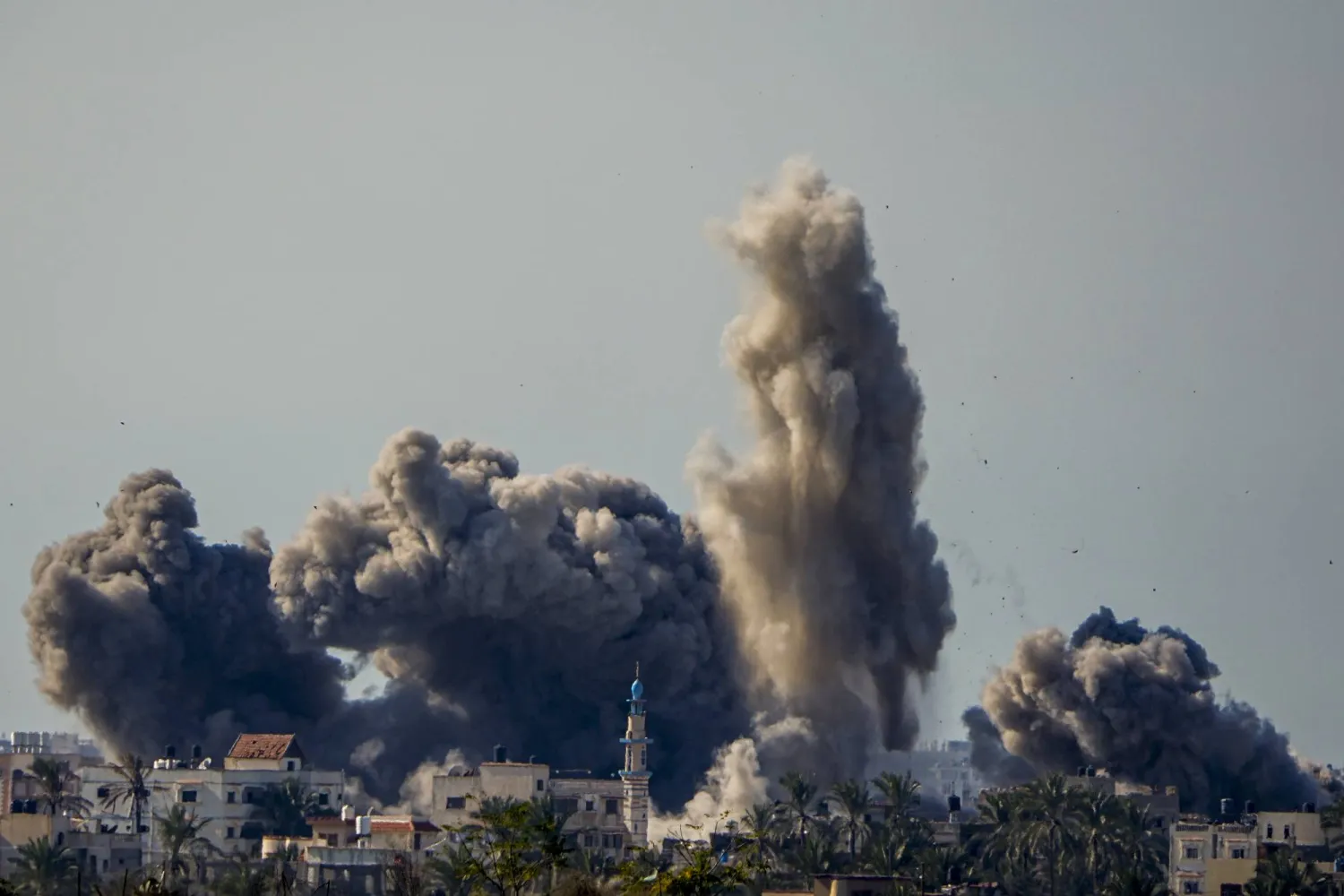
Smoke and explosion following Israeli bombardment inside the Gaza Strip, as seen from southern Israel, Sunday, Feb. 11, 2024. (AP Photo/Ariel Schalit)
TT

Gaza Ceasefire Talks Have Ended without a Breakthrough with Ramadan Days Away, Egypt Says

Smoke and explosion following Israeli bombardment inside the Gaza Strip, as seen from southern Israel, Sunday, Feb. 11, 2024. (AP Photo/Ariel Schalit)

Three days of negotiations with Hamas over a ceasefire in Gaza and the release of Israeli hostages ended Tuesday without a breakthrough, Egyptian officials said, less than a week before the start of the Muslim holy month of Ramadan, the informal deadline for a deal.

The United States, Qatar and Egypt have spent weeks trying to broker an agreement in which Hamas would release up to 40 hostages in return for a six-week ceasefire, the release of some Palestinian prisoners and an influx of aid to address the humanitarian catastrophe in the isolated territory.

Two Egyptian officials said the latest round of discussions had ended. They said Hamas presented a proposal that mediators would discuss with Israel in the coming days.

Hamas has refused to release all of the estimated 100 hostages it holds, and the remains of around 30 more, unless Israel ends its offensive, withdraws from Gaza and releases a large number of Palestinian prisoners, including senior militants serving life sentences.

US officials have said they are skeptical that Hamas actually wants a deal because the group has balked at a number of what the US and others believe are legitimate requests, including giving the names of hostages to be released.

“It is on Hamas to make decisions about whether it is prepared to engage,” US Secretary of State Antony Blinken said Tuesday.

“We have an opportunity for an immediate cease-fire that can bring hostages home, that can dramatically increase the amount of humanitarian aid getting in to Palestinians who so desperately need it, and can set the conditions for an enduring resolution,” Blinken said.

Jihad Taha, a Hamas spokesperson, said the negotiations were ongoing but “the ball is in the Israeli court.” He said Israel had thus far refused Hamas' demands for people who fled northern Gaza to be allowed to return and for guarantees of a long-term cease-fire and full Israeli withdrawal from Gaza.

“Hamas is open to proposals and initiatives that are consistent with its position calling for a ceasefire, withdrawal, the return of the displaced, the entry of relief convoys and reconstruction,” Taha said.

Israeli Prime Minister Benjamin Netanyahu has publicly rejected Hamas' demands and repeatedly vowed to continue the war until Hamas is dismantled and all the hostages are returned. Israel did not send a delegation to the latest round of talks.

An Israeli official said Israel was still waiting for Hamas to hand over a list of hostages who are alive as well the hostage-to-prisoner ratio it seeks in any release deal. It was not clear if that information was included in the latest proposal.

The Israeli and Egyptian officials spoke on condition of anonymity because they were not authorized to brief media on the negotiations.

Benny Gantz, a member of Netanyahu's War Cabinet and his main political rival, met with senior US officials in Washington on a visit that drew a rebuke from the prime minister, the latest sign of a growing rift within Israel's leadership.

Mediators had hoped to broker an agreement ahead of Ramadan, the month of dawn-to-dusk fasting that often sees heightened Israeli-Palestinian tensions linked to access to a major holy site in Jerusalem. The month is expected to begin around March 10, depending on the sighting of the moon.

“The negotiations are sensitive. I can’t say there is optimism or pessimism, but we haven’t yet reached a point at which we can achieve a ceasefire,” Egyptian Foreign Minister Sameh Shoukry said Monday.

The war began with a Hamas attack into southern Israel on Oct. 7 in which Palestinian militants killed some 1,200 people and took around 250 hostages. More than 100 of them were released during a weeklong cease-fire in November.

The attack sparked an Israeli invasion of the enclave of 2.3 million people that Gaza's Health Ministry says has killed more than 30,000 Palestinians. Aid groups say the fighting has displaced most of the territory’s population and pushed a quarter of the population to the brink of famine.

The UN children’s agency said Monday that at least 10 children have reportedly died in isolated northern Gaza because of dehydration and malnutrition.

“There are likely more children fighting for their lives somewhere in one of Gaza’s few remaining hospitals, and likely even more children in the north unable to obtain care at all,” Adele Khodr, the UNICEF regional director for the Middle East and North Africa, said in a statement.

“These tragic and horrific deaths are man-made, predictable and entirely preventable," she added.

The Gaza Health Ministry said Sunday that 15 children have starved to death at the Kamal Adwan Hospital in northern Gaza and another six were at risk of dying from malnutrition and dehydration. It was not clear if the children had underlying medical conditions that increased their vulnerability.

Northern Gaza, the first target of Israel’s offensive, has suffered mass devastation. The World Food Program recently suspended aid shipments to the north, citing the breakdown of security. An attempt by the Israeli military to bring in aid ended in tragedy last week when over 100 Palestinians were fatally shot by Israeli forces or trampled to death in a melee.

Up to 300,000 Palestinians are believed to remain in northern Gaza after Israel ordered the evacuation of the entire region, including Gaza City, in October. Many have been reduced to eating animal fodder to survive. The UN says one in six children under 2 in the north suffer from acute malnutrition.

The United States and other countries have carried out air drops in recent days, but aid groups say the expensive, last-ditch measure is not enough to address the soaring needs.

Israel is still carrying out strikes in all parts of Gaza and has threatened to expand its ground offensive to the southernmost city of Rafah, where around half of Gaza's population has sought refuge. Gantz has said the Rafah operation could begin as soon as Ramadan if there is no deal on the hostages.

Gaza’s Health Ministry said 97 people had been killed over the last 24 hours. bringing the overall Palestinian death toll to 30,631. The ministry does not differentiate between civilians and combatants in its figures, but says women and children make up around two-thirds of the total casualties.

Israel says it tries to avoid harming civilians and blames the high toll on Hamas because the militants operate in dense, residential areas. But the army rarely accounts for individual strikes, which often kill women and children.


Rescue Teams Search for Survivors in Building Collapse that Killed at Least 2 in Northern Lebanon

A Lebanese flag is pictured, in the aftermath of a massive explosion, in Beirut's damaged port area, Lebanon August 17, 2020. REUTERS/Hannah McKay
TT

Rescue Teams Search for Survivors in Building Collapse that Killed at Least 2 in Northern Lebanon

A Lebanese flag is pictured, in the aftermath of a massive explosion, in Beirut's damaged port area, Lebanon August 17, 2020. REUTERS/Hannah McKay

At least two people were killed and four rescued from the rubble of a multistory apartment building that collapsed Sunday in the city of Tripoli in northern Lebanon, state media reported.

Rescue teams were continuing to dig through the rubble. It was not immediately clear how many people were in the building when it fell.

The bodies pulled out were of a child and a woman, the state-run National News Agency reported.

Dozens of people crowded around the site of the crater left by the collapsed building, with some shooting in the air.

The building was in the neighborhood of Bab Tabbaneh, one of the poorest areas in Lebanon’s second largest city, where residents have long complained of government neglect and shoddy infrastructure. Building collapses are not uncommon in Tripoli due to poor building standards, according to The AP news.

Lebanon’s Health Ministry announced that those injured in the collapse would receive treatment at the state’s expense.

The national syndicate for property owners in a statement called the collapse the result of “blatant negligence and shortcomings of the Lebanese state toward the safety of citizens and their housing security,” and said it is “not an isolated incident.”

The syndicate called for the government to launch a comprehensive national survey of buildings at risk of collapse.


Israel to Take More West Bank Powers and Relax Settler Land Buys

A view of Israeli settlement of Maale Adumim, in the West Bank, Sunday, June 18, 2023. (AP)
TT

Israel to Take More West Bank Powers and Relax Settler Land Buys

A view of Israeli settlement of Maale Adumim, in the West Bank, Sunday, June 18, 2023. (AP)

Israel's security cabinet approved a series of steps on Sunday that would make it easier for settlers in the occupied West Bank to buy land while granting Israeli authorities more enforcement powers over Palestinians, Israeli media reported.

The West Bank is among the territories that the Palestinians seek for a future independent state. Much of it is under Israeli military control, with limited Palestinian self-rule in some areas run by the Western-backed Palestinian Authority (PA).

Citing statements by Finance Minister Bezalel Smotrich and Defense Minister Israel Katz, Israeli news sites Ynet and Haaretz said the measures included scrapping decades-old regulations that prevent Jewish private citizens buying land in the West Bank, The AP news reported.

They were also reported to include allowing Israeli authorities to administer some religious sites, and expand supervision and enforcement in areas under PA administration in matters of environmental hazards, water offences and damage to archaeological sites.

Palestinian President Mahmoud Abbas said the new measures were dangerous, illegal and tantamount to de-facto annexation.

The Israeli ministers did not immediately respond to requests for comment.

The new measures come three days before Prime Minister Benjamin Netanyahu is scheduled to meet in Washington with US President Donald Trump.

Trump has ruled out Israeli annexation of the West Bank but his administration has not sought to curb Israel's accelerated settlement building, which the Palestinians say denies them a potential state by eating away at its territory.

Netanyahu, who is facing an election later this year, deems the establishment of any Palestinian state a security threat.

His ruling coalition includes many pro-settler members who want Israel to annex the West Bank, land captured in the 1967 Middle East war to which Israel cites biblical and historical ties.

The United Nations' highest court said in a non-binding advisory opinion in 2024 that Israel's occupation of Palestinian territories and settlements there is illegal and should be ended as soon as possible. Israel disputes this view.


Arab League Condemns Attack on Aid Convoys in Sudan

A general view shows the opening session of the meeting of Arab foreign ministers at the Arab League Headquarters (Reuters)
TT

Arab League Condemns Attack on Aid Convoys in Sudan

A general view shows the opening session of the meeting of Arab foreign ministers at the Arab League Headquarters (Reuters)

Arab League Secretary-General Ahmed Aboul Gheit strongly condemned the attack by the Rapid Support Forces on humanitarian aid convoys and relief workers in North Kordofan State, Sudan.

In a statement reported by SPA, secretary-general's spokesperson Jamal Rushdi quoted Aboul Gheit as saying the attack constitutes a war crime under international humanitarian law, which prohibits the deliberate targeting of civilians and depriving them of their means of survival.

Aboul Gheit stressed the need to hold those responsible accountable, end impunity, and ensure the full protection of civilians, humanitarian workers, and relief facilities in Sudan.
