Ramadan Culinary Traditions Defy Crisis to Bring Libyans Together

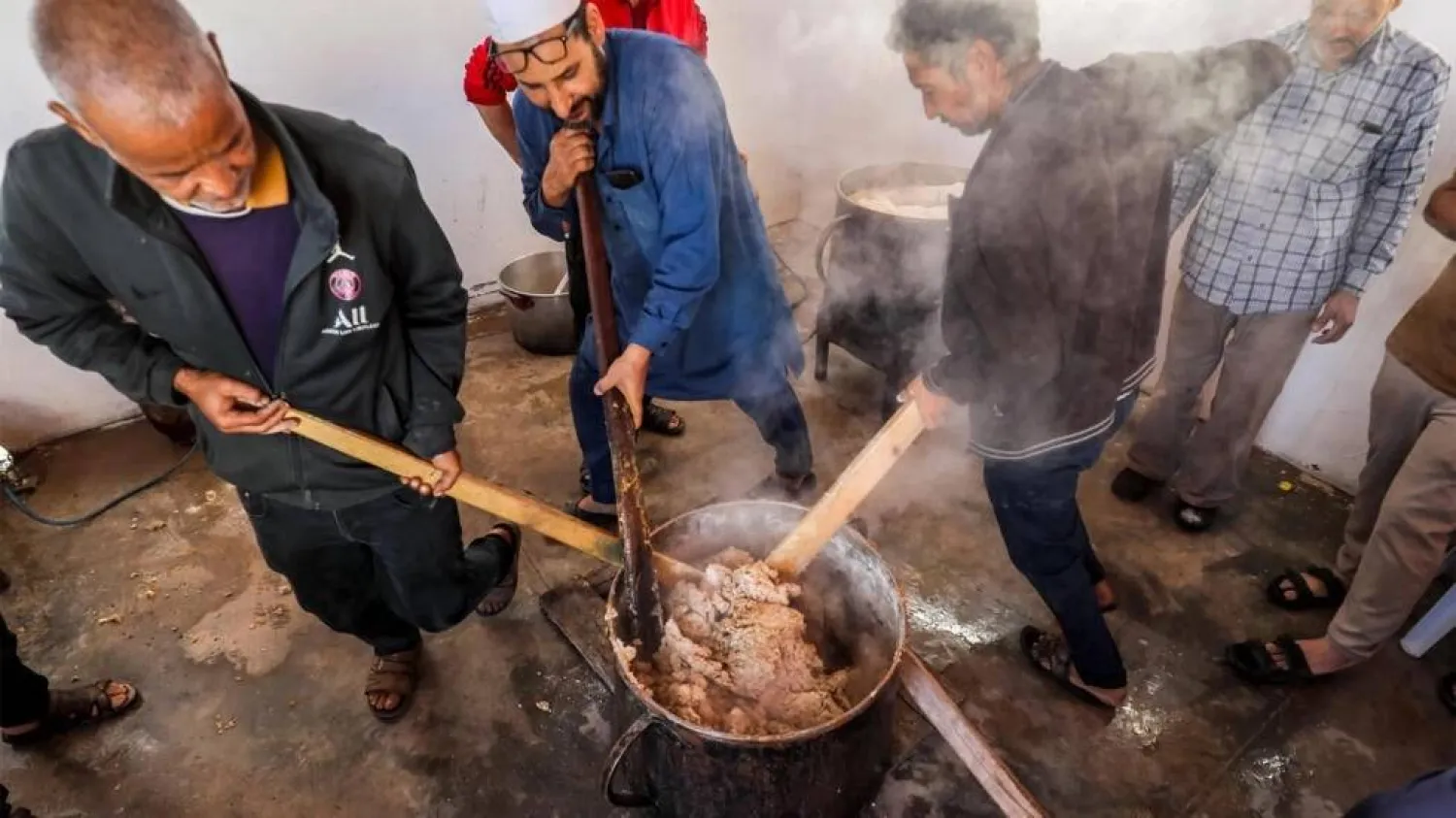
Bazin was traditionally cooked at home in Libya, but these volunteers make it for their community during Ramadan. Mahmud Turkia / AFP
TT

Ramadan Culinary Traditions Defy Crisis to Bring Libyans Together

Bazin was traditionally cooked at home in Libya, but these volunteers make it for their community during Ramadan. Mahmud Turkia / AFP

Dressed in tracksuits with their sleeves rolled up, about 30 residents in Tajura, a suburb east of Libya's capital, volunteer every day to cook and give away some 300 meals during Ramadan.
The men of all ages join efforts to make Bazin -- a Libyan barley-based dough served with a stew -- as part of a campaign coupling social solidarity with culinary tradition to provide free meals for people fasting during the Muslim holy month.
Akin to Italian polenta or West African fufu, bazin, an originally Berber dish, is a classic family meal from Tripolitania, the historic northwestern region of Libya.
It is also a symbol of sharing for Libyans, typically eaten by hand from a shared platter around which guests sit on the ground.
"In the old days, this dish was limited to the homes" where it was prepared by women and served "to relatives and neighbors," said Salem Omrane, a chef at the initiative which took shape after the 2011 uprising that overthrew longtime dictator Moamer Kadhafi.
"We offer these meals to everyone who comes," the 60-year-old told AFP.
Next to him, men in groups of three revolve around a large pot with long sticks in hand, mixing the barley flour in boiling salted water.
Once cooked, for at least an hour, the steaming-hot dough is kneaded and divided into smaller pieces, which are turned into dome-like shapes, then placed in a bowl with a stew of beans, tomatoes and spices.
Meat, once essential, is absent due to its soaring prices. But the volunteers make do.
"We went from a saucepan to a pot, then from a pot to two, and now we serve between 300 and 400 meals per day," said Issam al-Tayeb, a 57-year-old resident of Tajura who came to help.
Doughnuts
In the capital Tripoli, around 22 kilometers (14 miles) away, another culinary delicacy is making a resurgence this Ramadan: sfinz, a deep-fried, soft doughnut made with leavened dough, usually filled with an egg or dipped in honey.
Once an affordable street food eaten on the go, sfinz has become a luxury for many Libyans amid the soaring cost of living.
The country is still struggling to recover from the years of war that followed the death of Kadhafi in 2011.
The North African country remains split between two rival administrations in Tripoli, in the west, and Benghazi in the east.
Despite having the continent's largest oil reserves and abundant natural gas deposits, enduring instability has undermined the economy and weighed heavily on the standard of living in Libya.
"Customers buy within their means," said Mohamad Saber, who runs a sfinz shop on the outskirts of Tripoli.
"Today, a tray of eggs costs 20 dinars (around $4), which has raised the price of egg sfinz to 3.5 dinars" from just a few pennies, he said.
Saber, a Tunisian who has lived and worked long enough in Libya to master its dialect, said "life for Libyans is hard now".
Sfinz merchants like Saber have traditionally come from neighboring Tunisia, home of the popular bambalouni doughnut, but in recent years they have become scarce in Libya.
Now they are staging a comeback, despite competition from hamburger and shawarma vendors, for those who can afford it.
Young and old queue up in front of Saber's small shop.
"It smells very good," Mohamad al-Bouechi, a 69-year-old customer, said with a playfully remorseful tone.
"But to be honest with you, it's not ideal for your health."



Parisians Will to Get a New Chance of Seine Swimming

People gather on the banks of the Seine River as the sun sets amid a severe heat wave in Paris, France, May 26, 2026. (Reuters)
TT

Parisians Will to Get a New Chance of Seine Swimming

People gather on the banks of the Seine River as the sun sets amid a severe heat wave in Paris, France, May 26, 2026. (Reuters)

Swimmers will for the second year be able to cool off at designated points along the Seine River in Paris this summer, authorities said Friday, as well as along the Marne River in the suburbs.

In Paris, the swimming season was to open at three official bathing sites on July 4, the mayor's office said.

The Seine reopened to swimmers last summer for the first time in a century, after Paris poured more than a billion euros ($1.15 billion) into a years-long effort to making the waters clean enough to use in the 2024 Olympics.

Sites this year will again include the Bras de Grenelle near the Eiffel Tower, the Bras Marie -- a short walk from Notre-Dame -- and Bercy, on the eastern side.

Some 100,000 people last year queued to jump in, the city said, despite a slow start to the season with rain disrupting the water quality.

Some 50,000 swimmers jumped into the Marne River in the eastern suburbs last year.

The bathing spots in Joinville-le-Pont, Champigny-sur-Marne, Saint-Maur-des-Fosses and Maison-Alfort would again welcome swimmers. A fifth spot would be added this year at Neuilly-sur-Marne northeast of Paris.

French authorities warned against swimming in parts of the rivers without lifeguards.


Independent Researcher Exposes Basic Blunder in Scores of Cancer Studies

Researchers at the laboratory. (Cancer Research UK, Cambridge Institute)
TT

Independent Researcher Exposes Basic Blunder in Scores of Cancer Studies

Researchers at the laboratory. (Cancer Research UK, Cambridge Institute)

An independent researcher has uncovered potential blunder in scores of scientific studies, including cancer-related research, as a result of inappropriate antibody use in laboratory experiments, raising questions about the reliability of some of the results published in prestigious scientific journals.

The researcher found that scientists at Cambridge, Oxford, Stanford and other universities appear to have accidentally used the wrong ingredient in their experiments, muddling two proteins with similar names but entirely different sequences and functions.

Several British media outlets said researcher Sholto David reviewed the full text of 334 research papers to determine whether the antibody used in the studies was correctly intended for p16-ARC or incorrectly used to try and bind p16-INK4a.

P16-INK4a acts as a tumor suppressor by halting the cell cycle and is widely studied in cancer biology and is considered a key biomarker of ageing.

He found astonishing result: 95% of these papers have got it wrong.

“The vast majority of researchers who purchased antibodies have tried to use them to investigate p16-INK4a expression. Only 17 used these p16-ARC antibodies correctly,” he said in his research.

David said the implications are not good, to put it mildly.

“And these are not just insignificant papers. There are papers with hundreds of citations in high impact journals claiming to probe for p16-INK4a with antibodies which do not bind p16-INK4a,” he noted.


Indonesia Volcano Erupts, Forcing Airport to Close

Journalists photograph a screen showing the movement of volcanic ash from Mount Lewotobi Laki-laki at the Meteorology, Climatology and Geophysics Agency (BMKG) office in Maumere, East Nusa Tenggara, Indonesia, on June 5, 2026. (AFP)
TT

Indonesia Volcano Erupts, Forcing Airport to Close

Journalists photograph a screen showing the movement of volcanic ash from Mount Lewotobi Laki-laki at the Meteorology, Climatology and Geophysics Agency (BMKG) office in Maumere, East Nusa Tenggara, Indonesia, on June 5, 2026. (AFP)

A highly active volcano in eastern Indonesia erupted several times on Friday, spewing towering ash columns into the sky and forcing a local airport to close, authorities said.

Mount Lewotobi Laki-Laki on Flores Island erupted at 11:15 am (0315 GMT), sending volcanic material 2.5 kilometers (1.6 miles) into the air, the national volcanology agency said in a statement.

It came after several other eruptions earlier on Friday.

Lewotobi Laki-Laki falls under Indonesia's second-highest alert level for volcanic activity, with a five-kilometer exclusion zone in force around its crater.

The volcanology agency said residents near rivers should also remain on alert for hazardous floods of volcanic material, known as lahar, if heavy rain occurs.

Authorities have suspended operations at a local airport in the town of Maumere, about 60 kilometers west of Lewotobi Laki-Laki, affecting five domestic flights, airport head Partahian Panjaitan told AFP.

Laki-Laki means "man" in Indonesian, and the 1,584-meter (5,197-foot) volcano is twinned with a calmer 1,703-meter one named Perempuan after the Indonesian word for "woman".

Last July, Lewotobi Laki-Laki spewed a colossal 18-kilometer tower of ash, forcing the cancellation of 24 flights at the international airport on the resort island of Bali.

Indonesia, a vast archipelago nation, experiences frequent seismic and volcanic activity due to its position on the Pacific "Ring of Fire".