Expansion Plans, High Returns Raise Profits of Saudi Real Estate Companieshttps://english.aawsat.com/business/4973791-expansion-plans-high-returns-raise-profits-saudi-real-estate-companies
Expansion Plans, High Returns Raise Profits of Saudi Real Estate Companies
The real estate sector in Saudi Arabia is heading towards recovery. (Photo: SPA)
Experts said that the real estate sector in Saudi Arabia is heading towards recovery thanks to the implementation of expansion plans, improved operating profits, and high investment returns and revenues.
They added that the sector continues to maintain annual growth levels due to the high volume of demand, compared to the supply.
Real estate companies listed on the Saudi Stock Exchange (Tadawul) achieved a significant 258 percent jump in their net profits by the end of 2023, reaching about SAR 3 billion ($800 million) during the past year, compared to SAR 831 million ($221 million) during 2022.
In this context, the CEO of Menassat Realty Co, Khaled Almobid, said that the real estate sector in Saudi Arabia is witnessing a state of recovery in terms of price as an asset value, as well as the high demand for various real estate products.
He added that the upcoming indicators are positive, especially with expectations of a cut in interest rates during the coming period and the giant projects announced in a number of cities, as well as Riyadh’s hosting the Expo 2030 exhibition and two important football tournaments, the Asia Cup 2027 and the World Cup 2034.
For his part, Financial Analyst Tariq Al-Ateeq told Asharq Al-Awsat that the most important factors that contributed to achieving a significant jump in the profits of real estate sector companies were represented by the implementation of strong expansion plans, the increase in profit margins, and improved operating profits, as well as the high fair value gains from investment properties.
He added that the real estate market in Saudi Arabia is promising for investment and profitability, given its potential as the largest among the Gulf Cooperation Council countries.
JOINT BASE ANDREWS, MARYLAND - AUGUST 21: US President Donald Trump speaks with reporters before boarding Air Force One on August 21, 2026 in Joint Base Andrews, Maryland. Win McNamee/Getty Images/AFP
JOINT BASE ANDREWS, MARYLAND - AUGUST 21: US President Donald Trump speaks with reporters before boarding Air Force One on August 21, 2026 in Joint Base Andrews, Maryland. Win McNamee/Getty Images/AFP
Trump threatened Monday to impose a 50% tariff on Canadian automobiles, car parts and steel starting next year as the trade rift with Ottawa deepens.
Trade talks between the otherwise allies and reliable trading partners collapsed last week. Long-planned US tariffs on various Canadian goods went into effect after the talks broke off, and Canada has vowed to retaliate.
“Canada has been ripping off the United States of America for years,” Trump posted on social media Monday morning. Criticizing Canada’s “ridiculously high tariffs” on American farmers, Trump wrote: “Not sustainable, and NOT ANYMORE!”
Ontario Premier Doug Ford said Monday that Ronald Reagan would be “throwing up” over President Donald Trump’s trade policies and threatened to cut off electricity and critical minerals to the United States.
Ford, speaking in an interview with The Associated Press, said Trump has underestimated Canadians’ willingness to endure economic pain rather than give in to US pressure.
“He underestimates Canada. We’re all in,” Ford said. “Up here, we’re at a fever pitch, everyone’s in for an economic war. They know they’re going to have to sacrifice.”
$19 Billion as a Starting Point: Paris-Riyadh Roundtable Seeks to Expand Investment in the Sectors of the Futurehttps://english.aawsat.com/business/5310566-19-billion-starting-point-paris-riyadh-roundtable-seeks-expand-investment-sectors
$19 Billion as a Starting Point: Paris-Riyadh Roundtable Seeks to Expand Investment in the Sectors of the Future
A view of the Saudi-French Business Forum held last year in Riyadh. SPA
An investment base worth €16.3 billion, equivalent to approximately $19 billion (SAR71.5 billion), is serving as a new starting point for Monday’s French-Saudi Roundtable in Paris, where participants are exploring ways to expand economic cooperation into the industries of the future.
This foundation comes at a time when Saudi-French economic relations are broadening beyond traditional investments into sectors more closely aligned with economic transformation goals, particularly technology, artificial intelligence, energy, advanced manufacturing, and infrastructure.
Against this backdrop, both countries have an opportunity to leverage existing investments as a platform for new deals and projects that will strengthen the presence of French companies in Saudi Arabia while simultaneously creating opportunities for Saudi capital to expand into promising sectors in France and across Europe.
French investment in the Kingdom is increasingly targeting new strategic sectors, with French companies entering fields such as artificial intelligence, digital infrastructure, culture and creative industries, and mining.
This expansion builds on a long-established French presence in Saudi Arabia’s energy and industrial sectors, where manufacturing accounts for roughly 60 percent of French foreign direct investment.
A Trillion-Euro Economy
Saudi Arabia combines policy clarity, a stable economic environment, and strong economic fundamentals with a large and rapidly growing market. It is the region’s largest economy, with a GDP of around €1.1 trillion, and is developing new industries as part of its national economic diversification program under Vision 2030.
Its expanding industrial base and growing domestic demand provide significant opportunities for French investors to strengthen their presence in sectors where they already have an established foothold while also entering fast-growing new industries.
French companies continue to deepen their involvement in long-standing sectors ranging from energy and industry to transport, construction, and engineering, while simultaneously moving into emerging fields such as artificial intelligence, digital infrastructure, culture, and mining as the Saudi economy accelerates its growth.
One of the most significant recent milestones in bilateral relations was the signing of the Comprehensive Strategic Partnership at the end of 2024, opening broader avenues for cooperation in new sectors. Bilateral trade reached approximately €10.1 billion in 2025, up 7.2 percent from the previous year.
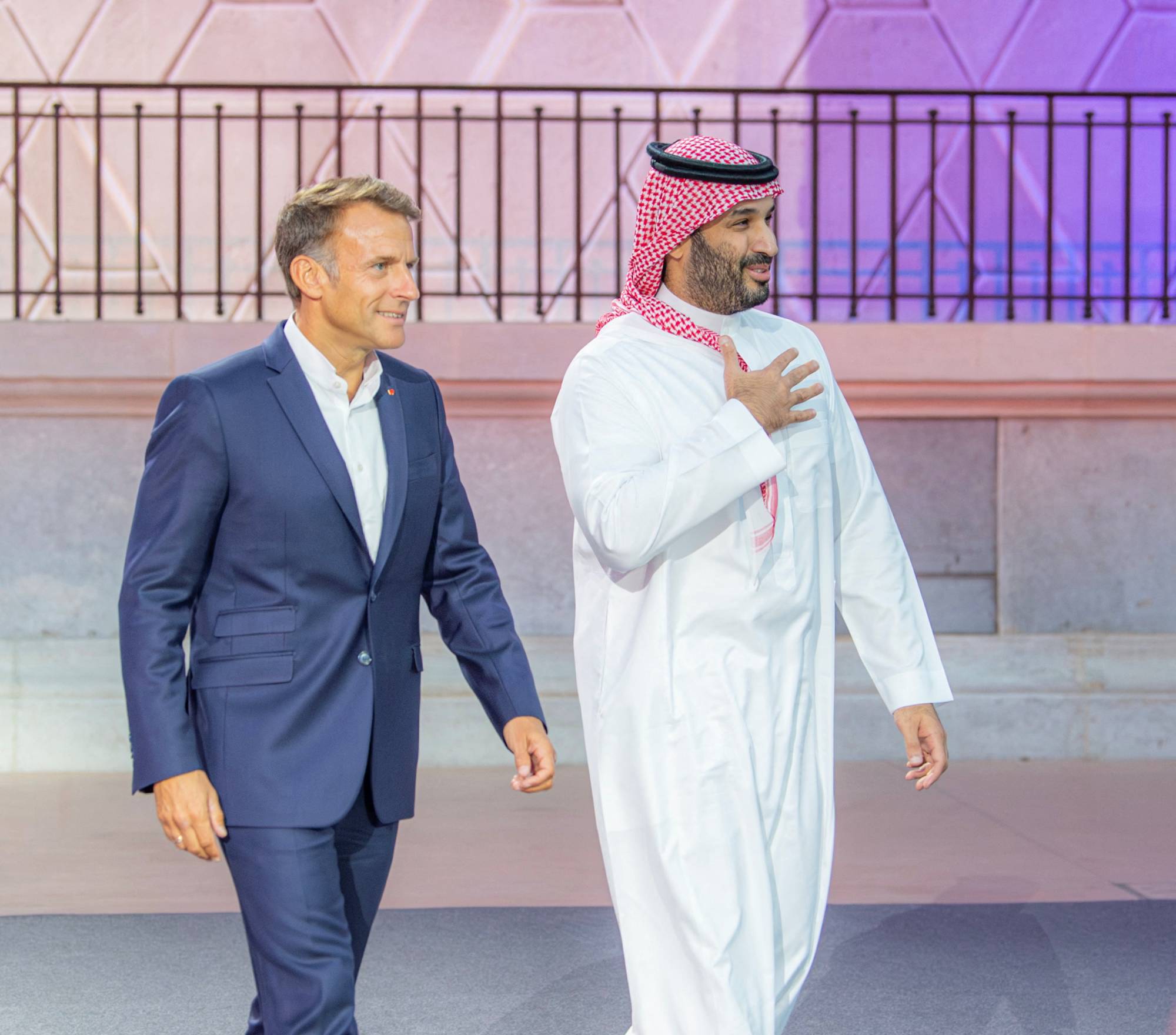
French President Emmanuel Macron and Saudi Crown Prince Mohammed bin Salman attend the closing ceremony of the Esports World Cup at the Grand Palais in Paris, France, August 23, 2026. Bandar Algaloud/Courtesy of Saudi Royal Court/Handout via REUTERS
Foreign Direct Investment
France ranks as the fourth-largest source of foreign direct investment in Saudi Arabia, with an investment valued at approximately €16.3 billion in 2024. French businesses hold 651 investment licenses across 18 sectors in the Kingdom.
Manufacturing represents around 60 percent of French FDI, highlighting the industrial strength of the relationship. French companies operating in Saudi Arabia include major investors such as TotalEnergies, Sanofi, Veolia, Suez, Accor, and Schneider Electric, among others.
Growing Saudi Presence in France
Saudi Arabia’s Public Investment Fund (PIF) invested approximately €7.36 billion in France between 2017 and 2024, supporting nearly 29,000 jobs.
In addition, a financing memorandum of understanding between the Saudi sovereign fund and Bpifrance, worth around €8.56 billion, provides a framework for expanded investment cooperation.
The partnership is also taking on a new dimension, as Qiddiya Investment Company and the French government explore a cooperation framework to develop a global destination that combines entertainment, sports, and culture in France.
The initiative would extend Saudi expertise in destination development internationally and reflects the increasingly reciprocal nature of the partnership.
French firms maintain established positions in energy, industry, transport, and hospitality, while simultaneously expanding into new sectors as Saudi Arabia’s economy evolves.
New Agreements Expected
New agreements and memoranda of understanding are expected to reinforce the French presence in sectors where French companies already enjoy a strong foothold.
In energy, companies such as TotalEnergies, EDF, SLB, and Schneider Electric have significant operations in the Kingdom across oil and gas, power generation, and energy infrastructure.
French firms also play major roles in water and environmental services, transport and logistics, construction and consulting, hospitality, and healthcare.
Saudi Arabia offers a stable regulatory, economic, and financial environment that supports major capital commitments. Clear development strategies provide investors with greater visibility regarding the economy’s future direction, while strong fundamentals support long-term implementation.
Meanwhile, Vision 2030 firmly positions economic diversification as a long-term national priority. The National Investment Strategy seeks to stimulate investment, while sector-specific strategies create opportunities throughout value chains.
Ongoing regulatory reforms continue to open new opportunities and improve the investment climate. Updated investment laws provide equal treatment for investors and strengthen investor protections, including safeguards against expropriation and clear mechanisms for the repatriation of funds.
Creditworthiness and Economic Stability
Saudi Arabia holds an A+ sovereign credit rating with a stable outlook, reaffirmed by S&P Global Ratings in March. The Kingdom’s total reserve assets reached approximately €421.5 billion in June 2026.
Over several decades, Saudi Arabia has invested heavily in infrastructure and operational capabilities that support sustained economic and commercial activity.
The International Monetary Fund has cited low government debt, substantial reserves, and the size of the sovereign wealth fund as key strengths, while identifying the fixed exchange-rate regime as a reliable anchor of monetary stability.
Opportunities are no longer limited to individual projects. Saudi Arabia is expanding integrated economic sectors, generating growing demand across value chains, and building the infrastructure, financing systems, and operating environment companies need to grow.
Investment opportunities now span more than 15 sectors, many of which already feature strong French participation.
The Saudi Industrial Development Fund provides financing of up to 75 percent of eligible project costs, alongside industrial incentives of up to 35 percent. Special Economic Zones offer targeted incentives in strategic industries, while the Regional Headquarters Program provides companies with a platform for regional expansion.
Artificial Intelligence
Saudi Arabia continues to strengthen its position as a regional hub for artificial intelligence and technology through substantial investments in digital infrastructure. The Kingdom ranked first globally in the 2025 ICT Development Index issued by the International Telecommunication Union.
The ICT market grew by 89 percent compared with 2017, while the digital economy accounted for approximately 16 percent of GDP in 2024.
Saudi Arabia aims to develop 3 gigawatts of AI infrastructure capacity by 2030. Data center capacity has reached 440 megawatts, nearly six times the 2017 baseline, supported by investments exceeding €3.85 billion.
Announced AI partnerships exceed €19.7 billion in value. Cloud regions operated by Oracle and Google Cloud are already operational, while cloud regions developed by AWS and Microsoft are expected to become operational during 2026.
Energy
The energy sector remains one of the most important pillars of French investment in the Kingdom and offers significant growth prospects. French companies are involved in energy projects in Saudi Arabia worth more than €16.3 billion, while consortia led by French firms participate in solar projects with a combined capacity of 11 gigawatts.
Opportunities span renewable energy, energy storage, hydrogen, and grid infrastructure.
In tourism, French companies enjoy a strong presence in a rapidly expanding market. Saudi Arabia recorded approximately 123 million visits in 2025, generating nearly €69.3 billion in tourism spending. The Kingdom aims to attract 150 million visits annually by 2030.
A Platform for Regional Growth
More than 750 companies have established regional headquarters in Riyadh under Saudi Arabia’s Regional Headquarters Program, including 39 French companies operating across eight sectors.
The program offers qualifying companies a 30-year exemption from corporate income tax and withholding tax, giving French firms with extensive operations in the Kingdom a strategic base from which to manage and expand their activities across the region.
Saudi Investment Minister: Our Economy Offers Major Opportunities for French Companieshttps://english.aawsat.com/business/5310554-saudi-investment-minister-our-economy-offers-major-opportunities-french-companies
Saudi Minister of Investment Fahad Al-Saif and France’s Minister of Economy, Finance and Industrial, Energy and Digital Sovereignty, Roland Lescure. Asharq Al-Awsat
Saudi Investment Minister: Our Economy Offers Major Opportunities for French Companies
Saudi Minister of Investment Fahad Al-Saif and France’s Minister of Economy, Finance and Industrial, Energy and Digital Sovereignty, Roland Lescure. Asharq Al-Awsat
Saudi Minister of Investment Fahad Al-Saif said Monday that French foreign direct investment in Saudi Arabia has reached €16.3 billion, noting that France is the Kingdom’s fourth-largest source of FDI.
He added that the presence of French companies in Saudi Arabia now spans more than 18 sectors.
Speaking at the opening of the French-Saudi Investment Roundtable hosted in Paris, which was also attended by Roland Lescure, France’s Minister of Economy, Finance and Industrial, Energy and Digital Sovereignty, Al-Saif said French companies hold around 650 investment licenses in the Kingdom.
This, he said, reflects the extent of French business activity and the growing opportunities available within the Saudi economy.
The meeting is being held as part of the official visit of Crown Prince and Prime Minister Mohammed bin Salman to France. Organized by the Ministry of Investment, it brings together government officials, business leaders, and chief executives from major companies in both countries.
Discussions focus on opportunities to expand partnerships in sectors including industry, transport and logistics, artificial intelligence, and digital infrastructure, among others. New agreements and memoranda of understanding are also expected to be signed.
Energy Tops Areas of Cooperation
The Investment Minister noted that the oil and gas sector is among the industries most likely to benefit from strengthened Saudi-French relations, given the long-standing presence of French companies in the Kingdom’s energy sector.
Cooperation also extends across the broader energy landscape, including renewable energy, hydrogen, and grid infrastructure, while French firms continue to expand their footprint in energy, industry, transport, construction, water, and services.
Energy remains one of the most prominent areas of French involvement in Saudi Arabia, alongside growing opportunities in new sectors closely linked to the Kingdom’s economic diversification drive under Vision 2030.
From Energy and Industry to Artificial Intelligence
The investment partnership between the two countries is increasingly expanding beyond traditional sectors into the new economy, particularly artificial intelligence, digital infrastructure, culture, creative industries, and mining.
The inclusion of these sectors on the roundtable agenda reflects both sides’ efforts to transform established economic ties into investment partnerships in some of the fastest-growing industries, capitalizing on rising demand in the Saudi market and the technological and industrial capabilities of French companies.
French firms are already active in sectors such as transport and logistics, water and environmental services, hospitality, and healthcare. As the Saudi economy continues to expand, additional opportunities are emerging in advanced technology and manufacturing.
لم تشترك بعد
انشئ حساباً خاصاً بك لتحصل على أخبار مخصصة لك ولتتمتع بخاصية حفظ المقالات وتتلقى نشراتنا البريدية المتنوعة