Israel Amends Retaliation against Iran after US Intelligence Leak

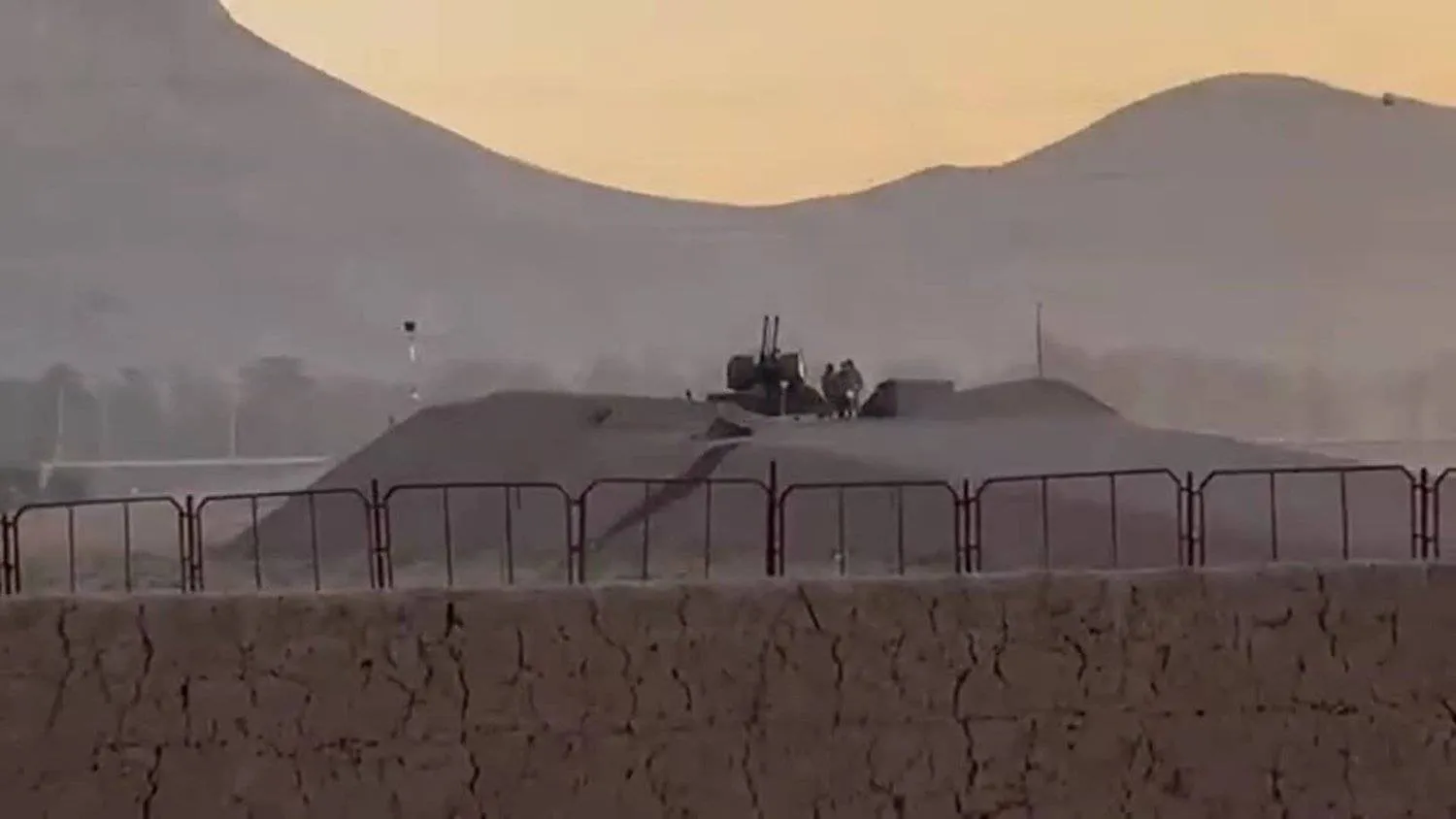
Military personnel stand guard at a nuclear facility in the Zardanjan area of Isfahan, Iran, April 19, 2024, in this screengrab taken from video (Reuters)
TT

Israel Amends Retaliation against Iran after US Intelligence Leak

Military personnel stand guard at a nuclear facility in the Zardanjan area of Isfahan, Iran, April 19, 2024, in this screengrab taken from video (Reuters)

Western intelligence sources revealed on Thursday that Israel has modified its plan and postponed its retaliation to Iran’s massed ballistic missile attack on Israel on 1 October.
“Israel has delayed its retaliatory strike against Iran because of a leak last week of potentially sensitive military information from the US,” The Times reported on Thursday.
Last Friday, a pro-Iranian Telegram channel published two top-secret documents which detailed surveillance by US intelligence of Israel's preparations for an attack on Iran, including the use of satellites to spy on operations carried out at Israeli Air Force bases.
The leak revealed Israel’s well-advanced plans to respond to a salvo of nearly 200 Iranian ballistic missiles fired against it earlier this month.
The Times quoted an intelligence source as saying that Israel has been forced to develop an alternative plan, one that requires detailed war gaming before any order is given.
“The leak of the American documents delayed the attack due to the need to change certain strategies and components,” the source said. “There will be a retaliation, but it has taken longer than it was supposed to take.”
The original leaked documents indicate that the Israeli Air Force is planning to carry out a similar but greatly expanded version of its ABLM attack on an Iranian radar site near Isfahan in April.
By launching these weapons from long range and far from Iran’s borders it would avoid the need for Israeli warplanes to overfly certain countries in the region.
During the Iranian attack on October 1, Tehran was at least partially successful in hitting the Nevatim airbase in southern Israel, satellite images show, despite shooting down the vast majority of the missiles.
In April, Israel responded to a previous barrage of Iranian ballistic missiles, cruise missiles and drones by destroying a radar station outside Isfahan.
In anticipation of the Israeli attack, Iranian Foreign Minister Abbas Araghchi toured the Middle East and visited countries such as Jordan, Iraq and the Gulf countries, trying to convince them to close their airspace to Israeli planes.
Iraqi sources revealed that Iranian officials informed leaders in the ruling Shiite coalition in Iraq that Israel would retaliate to the October 1 attacks within a week.
The sources said the new assessments came after reviewing the outcome of Araghchi’s talks in the region. But they said the Iranians will not stop their mediation efforts despite its difficulties.
Meanwhile, concerns over a wider conflict in the Middle East have prompted international airlines to suspend flights to Iran.
Qatar Airways said on Thursday it has temporarily suspended two regional routes.
“Due to the current situation in the Middle East region, Qatar Airways has temporarily suspended flights to and from Iran, Iraq and Lebanon until further notice,” it said in a travel alert.
Turkish-owned carriers Turkish Airlines and Pegasus have suspended flights to Iran until November 1.
The Lufthansa Group said its flights to Tehran will be suspended up to and including Jan. 31, 2025.
Meanwhile in Tehran, the Iranian Revolutionary Guard Corps chief Hossein Salami warned that an advanced US missile defense system recently stationed in Israel won’t be able to ward off future attacks from Tehran, according to Tasnim.
“Do not rely on THAAD, they have limited capabilities,” Salami was quoted as saying.
Speaking at the National Congress from Kermanshah province, Salami mainly lashed out at Israel saying the regime could head towards collapse instantly if it makes unwise decisions.
Salami said Israel is gradually digging a graveyard in which it will be buried.


Netanyahu Vows to Eliminate Iran Threat ‘Once and for All’

10 November 2026, Israel, Jerusalem: Caretaker Israeli Prime Minister Benjamin Netanyahu delivers a speech on the sidelines of the opening session of the new Knesset. (dpa)
TT

Netanyahu Vows to Eliminate Iran Threat ‘Once and for All’

10 November 2026, Israel, Jerusalem: Caretaker Israeli Prime Minister Benjamin Netanyahu delivers a speech on the sidelines of the opening session of the new Knesset. (dpa)

Israel's caretaker prime minister Benjamin Netanyahu on Saturday reiterated his calls for a national unity government with his opponent Gadi Eisenkot, as well as his vow to eliminate the threat from Iran.

A meeting with Eisenkot on Thursday "only strengthened the conviction that it is essential to form a national unity government" to guarantee Israel's security, Netanyahu said in a video statement, adding that such a government could "eliminate the Iranian threat once and for all".


Ukraine’s Zelenskiy Escalates Criticism of SpaceX Over Speed Caps

Ukraine's President Volodymyr Zelenskiy holds a press briefing in Copenhagen November 10, 2026. (AFP)
TT

Ukraine’s Zelenskiy Escalates Criticism of SpaceX Over Speed Caps

Ukraine's President Volodymyr Zelenskiy holds a press briefing in Copenhagen November 10, 2026. (AFP)

Ukraine's President Volodymyr Zelenskiy ‌escalated his criticism of SpaceX on Saturday, saying speed restrictions on its military-grade Starshield satellite terminals had dangerous political implications and undermined critical air defenses.

Zelenskiy said Starshield terminals operating in temporarily Russian-occupied territories of Ukraine had been limited to a maximum speed of 161 kph for the past five days, hampering Ukraine's military capabilities.

The Ukrainian Defense Ministry has raised the issue with SpaceX at the ‌institutional level, ‌Zelenskiy said.

"The restrictions have now ‌been ⁠in place for ⁠five days. They say it is some kind of technical issue. We do not believe that is the case," Zelenskiy told reporters in remarks released by his office on Saturday.

"If you impose restrictions there, you are already partially recognizing the temporarily ⁠occupied territories as not ours. And ‌that is why I ‌believe we have the right to raise this ‌issue and restore the speed – so that there ‌are no restrictions at all."

Zelenskiy said the speed restrictions made it more difficult for Ukrainian air defense units to intercept Russian jet-powered drones and made Ukrainian cities ‌more vulnerable. He said he had ordered his top military and foreign ministry ⁠officials ⁠to address the issue and seek clarification.

SpaceX has pushed back against the allegations, denying that it introduced new restrictions or made any changes to its satellite operations.

It is the second such outage in recent weeks. In mid-October, Ukrainian officials said that SpaceX limited the speed of Starlink and its Starshield communication systems to about 160 kph (100 mph) amid tensions with US President Donald Trump's administration over Ukrainian attacks on Russian oil refineries. Service was then restored on October 24.


UN Official Urges Iran, US to Let Fertilizers Through Hormuz Strait

Jorge Moreira da Silva, Executive Director of UNOPS (United Nations Office for Project Services), and coordinator of the UN Strait of Hormuz Task Force established by the UN Secretary-General, speaks during an interview with AFP on the sidelines of the 31st United Climate Change Conference (COP31), at the media center located on the Antalya Expo Center in Antalya on November 14, 2026. (AFP)
TT

UN Official Urges Iran, US to Let Fertilizers Through Hormuz Strait

Jorge Moreira da Silva, Executive Director of UNOPS (United Nations Office for Project Services), and coordinator of the UN Strait of Hormuz Task Force established by the UN Secretary-General, speaks during an interview with AFP on the sidelines of the 31st United Climate Change Conference (COP31), at the media center located on the Antalya Expo Center in Antalya on November 14, 2026. (AFP)

Iran and the United States should "immediately" allow fertilizer shipments through the Strait of Hormuz to ease the crisis in some of the most vulnerable countries, a senior UN official said Saturday.

Jorge Moreira da Silva, head of the UN Office for Project Services, told the COP31 climate talks in the Turkish resort city of Antalya that the lack of fertilizers could push millions into poverty.

The Iranian blockade of the vital waterway, which started after the joint US-Israeli attack against Iran in late February, has choked shipping in the region and beyond. The US blockade of Iranian ports has further complicated matters.

While Iran and the United States are still trying to negotiate an end to the conflict, Moreira da Silva said he had the same message for both countries.

"They should continue their negotiations about the comprehensive deal -- but that deal should not avoid an immediate, exceptional, limited, and time-bound solution for the fertilizers," he said.

"Basically, what we need is five vessels a day with fertilizers," he added.

- Millions at risk -

Moreira da Silva heads up the UN task force dedicated to facilitating the safe passage of fertilizers during the crisis.

Before the conflict, a third of the world's fertilizers passed through the Strait of Hormuz, and since the blockades, their prices had risen by 30 percent, he said.

"But what I think is not sufficiently recognized is the disproportionate impact on the most vulnerable countries," he added.

Sudan's finance minister recently told him that the price of food there had doubled in six months, he added. In Nepal, they had told him that farmers could no longer afford to buy fertilizers.

"So, it's very important that we are aware that countries such as Mozambique, Kenya, Sudan, Somalia, Nepal, Bangladesh, Sri Lanka are facing very significant impact."

The effects of this shortage could be catastrophic, he warned.

"If we continue missing the planting seasons in different parts of the world we may have 45 million people facing severe and acute food insecurity," he said.

"We may have 30 million people being forced into poverty."

The UN had a system ready to get fertilizer shipments moving within seven to 10 days, he said.