


Villagers in Southern Lebanon Begin to Return Home as Israeli Army Withdraws Under Ceasefire Deal

Destroyed houses caused by the Israeli air and ground offensive, in the town of Kfar Kila, southern Lebanon, today, Feb. 18, 2025. (AP Photo/Hassan Ammar)
TT

Villagers in Southern Lebanon Begin to Return Home as Israeli Army Withdraws Under Ceasefire Deal

Destroyed houses caused by the Israeli air and ground offensive, in the town of Kfar Kila, southern Lebanon, today, Feb. 18, 2025. (AP Photo/Hassan Ammar)

Israeli forces withdrew Tuesday from border villages in southern Lebanon under a deadline spelled out in a US-brokered ceasefire agreement that ended the latest Israel-Hezbollah war, but stayed in five strategic overlook locations inside Lebanon.

Top Lebanese leaders denounced the continued presence of the Israeli troops as an occupation and a violation of the deal, maintaining that Israel was required to make a full withdrawal by Tuesday. The troops' presence is also a sore point with the Hezbollah group, which has demanded action from the authorities.

Lebanese soldiers moved into the areas from which the Israeli troops withdrew and began clearing roadblocks set up by Israeli forces and checking for unexploded ordnance. They blocked the main road leading to villages, preventing anyone from entering while the military was looking for any explosives left behind.

Most of the villagers waited by the roadside for permission to go and check on their homes but scores pushed aside the roadblocks to march in. Elsewhere, the army allowed the residents to enter.

Many of their houses were demolished during the more than yearlong conflict or in the two months after November’s ceasefire agreement when Israeli forces were still occupying the area.

In the border village of Kfar Kila, people were stunned by the amount of destruction, with entire sections of houses wiped out. Some knelt on the ground and prayed in the village's main square.

“What I’m seeing is beyond belief. I am in a state of shock,” said Khodor Suleiman, a construction contractor, pointing to his destroyed home on a hilltop. “I am feeling a mixture of happiness and pain." said Suleiman, who had last been in Kfar Kila six months ago.

In Kfar Kila's main square, Lebanese troops deployed as a military bulldozer removed rubble from the street. As people gathered in the square, a young man ran in, screaming that he had found two men alive on the edge of the village.

An ambulance rushed to the distant area and then quickly drove away from the village, preventing anyone from looking inside. Residents said later the two young men were members of Hezbollah and had been hiding out inside a grocery shop for three months until they were found on Tuesday.

Abbas Fadallah from Kfar Kila said that his family’s house that was built 105 years ago was now a pile of debris. Fadallah said he is happy to return but sad because “many civilians were martyred.”

Kfar Kila’s mayor, Hassan Sheet, told The Associated Press that 90% of the village homes are completely destroyed while the remaining 10% are damaged. “There are no homes nor buildings standing,” he said, adding that rebuilding will start from scratch.

Also Tuesday, Ayman Jaber entered Mhaibib, a village perched on a hill close to the Israeli border that was leveled by a series of explosions on Oct. 16. The Israeli army had released a video showing blasts ripping through the village in the Marjayoun region.

The Associated Press interviewed Jaber and his family early November when Jaber said he worried Israel would again set up a permanent presence in southern Lebanon and that the home he had built over the past six years for himself, his wife and their two sons, would be gone.

That worry, at least, turned out to be well-founded. “Not a single house in the village is still standing,” Jaber said. “It is like an earthquake wiped out the village.”

“The situation breaks my heart,” Jaber said, as he stood inside the village’s cemetery. “They dug up the graves and opened the vaults. I don’t understand what security threat the dead posed to them.”

Israeli Defense Minister Israel Katz said the Israeli army “will stay in a buffer zone in Lebanon in five control posts" to guard against any ceasefire violations by Hezbollah. He also said the army had erected new posts on the Israeli side of the border, and sent reinforcements there.

“We are determined to provide full security to every northern community,” Katz said.

However, Lebanon's three top officials — the country's president, prime minister and parliament speaker — in a joint statement said that Israel’s continued presence at the five locations was in violation of the ceasefire agreement. They called on the UN Security Council to take action to force a complete Israeli withdrawal.

“The continued Israeli presence in any inch of Lebanese territory is an occupation, with all the legal consequences that result from that according to international legitimacy,” the statement said.

The Israeli military presence was also criticized in a joint statement by the UN special coordinator for Lebanon, Jeanine Hennis-Plasschaert, and the head of the UN peacekeeping force in the country, Lt. Gen. Aroldo Lázaro.

The two, however, warned that this should not “overshadow the tangible progress that has been made” since the ceasefire agreement.

Hezbollah began firing rockets across the border on Oct. 8, 2023, one day after a deadly Hamas-led incursion into southern Israel that sparked the war in Gaza. Israel responded with shelling and airstrikes in Lebanon, and the two sides became locked in an escalating conflict that became a full-blown war in late September.

More than 4,000 people were killed in Lebanon and more than 1 million were displaced at the height of the conflict, more than 100,000 of whom have not been able to return home. On the Israeli side, dozens of people were killed and some 60,000 are displaced.

Hussein Fares left Kfar Kila in October 2023 for the southern city of Nabatiyeh. When the fighting intensified in September he moved with his family to the city of Sidon, where they were given a room in a school housing displaced people.

“I have been waiting for a year and a half to return,” said Fares who has a pickup truck and works as a laborer. He said he understands that the reconstruction process will take time.



Hezbollah Chief Accuses Lebanese Authorities of Working ‘in the Interest of What Israel Wants’

Hezbollah leader Naim Qassem
TT

Hezbollah Chief Accuses Lebanese Authorities of Working ‘in the Interest of What Israel Wants’

Hezbollah leader Naim Qassem

Hezbollah leader Naim Qassem on Sunday said moves to disarm the group in Lebanon are an "Israeli-American plan,” accusing Israel of failing to abide by a ceasefire agreement sealed last year.

Under heavy US pressure and fears of expanded Israeli strikes, the Lebanese military is expected to complete Hezbollah's disarmament south of the Litani River -- located about 30 kilometers from the border with Israel -- by the end of the year.

It will then tackle disarming the Iran-backed movement in the rest of the country.

"Disarmament is an Israeli-American plan," Qassem said.

"To demand exclusive arms control while Israel is committing aggression and America is imposing its will on Lebanon, stripping it of its power, means that you are not working in Lebanon's interest, but rather in the interest of what Israel wants."

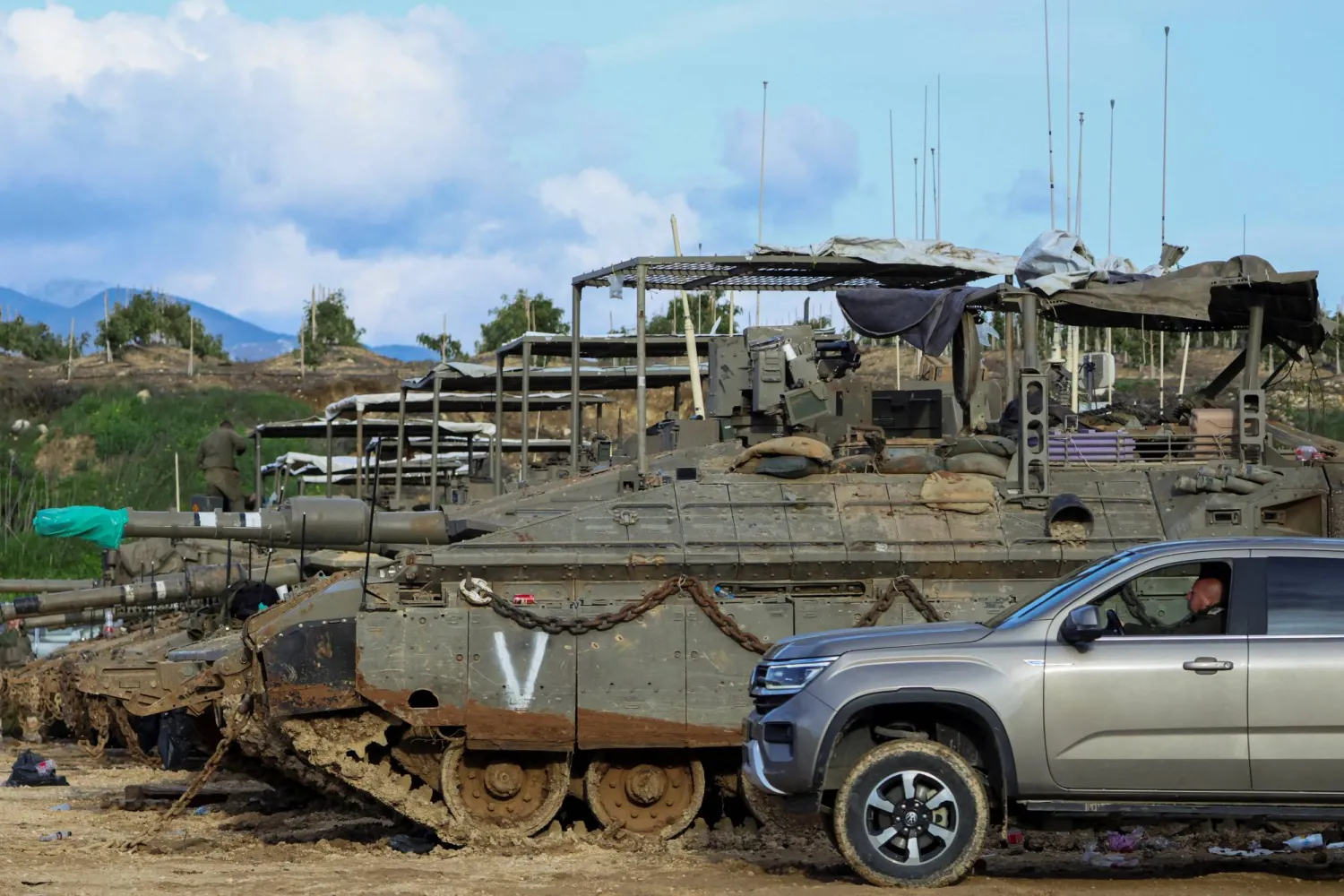
Despite a November 2024 ceasefire that was supposed to end more than a year of hostilities between Israel and Hezbollah, Israel has kept up strikes on Lebanon and has maintained troops in five areas it deems strategic.

According to the agreement, Hezbollah was required to pull its forces north of the Litani River and have its military infrastructure in the vacated area dismantled.

Israel has questioned the Lebanese military's effectiveness and has accused Hezbollah of rearming, while the group itself has rejected calls to surrender its weapons.

"The deployment of the Lebanese army south of the Litani River was required only if Israel had adhered to its commitments... to halting the aggression, withdrawing, releasing prisoners, and having reconstruction commence," Qassem said in a televised address.

"With the Israeli enemy not implementing any of the steps of the agreement... Lebanon is no longer required to take any action on any level before the Israelis commit to what they are obligated to do."

Lebanese army chief Rodolphe Haykal told a military meeting on Tuesday "the army is in the process of finishing the first phase of its plan.”

He said the army is carefully planning "for the subsequent phases" of disarmament.


Israel Army Ends Crackdown on West Bank Town after Attack

Smoke rises following an explosion detonated by the Israeli army, which said it was destroying buildings used by Palestinian militants in the West Bank Jenin refugee camp, Sunday, February 2, 2025. © Majdi Mohammed, AP
TT

Israel Army Ends Crackdown on West Bank Town after Attack

Smoke rises following an explosion detonated by the Israeli army, which said it was destroying buildings used by Palestinian militants in the West Bank Jenin refugee camp, Sunday, February 2, 2025. © Majdi Mohammed, AP

The Israeli military said on Sunday it had ended its operation in a town in the occupied West Bank that it had sealed off after a Palestinian from the area killed two Israelis.

Around 50 residents of Qabatiya were briefly detained during the two-day operation, the official Palestinian news agency Wafa reported, quoting the town's mayor Ahmed Zakarneh.

The attacker's father and two brothers remained in custody, it added.

The military launched the operation on Friday, shortly after a 34-year-old Palestinian fatally stabbed an 18-year-old Israeli woman and ran over a man in his sixties with his vehicle.

When contacted by AFP on Sunday morning, the military confirmed the end of its operation in the area.

Defense Minister Israel Katz previously said the army had completely sealed off the town.

Wafa also reported that Israeli troops had withdrawn from Qabatiya, near the city of Jenin.

Zakarneh said the town had been in a state of "total paralysis" during the military activity.

Israeli army bulldozers tore up pavement on several streets and erected roadblocks to halt traffic, he said, adding that around 50 houses were searched.

Wafa reported that a school had been turned into a detention and interrogation center.

AFPTV footage filmed on Saturday showed Israeli soldiers carrying automatic rifles and patrolling the streets, where several armoured vehicles were deployed.

Shops were closed, though men and children were seen walking through the village.

On Sunday, the Israeli army said it had sealed off the assailant's home and was finalising "the procedures required for its demolition".

Israeli authorities argue that demolishing the homes of Palestinians who carry out attacks against Israelis has a deterrent effect.

Critics, however, condemn the practice as collective punishment that leaves families homeless.


Arab League Council Holds Extraordinary Session on Latest Developments in Somalia

A general view shows the opening session of the meeting of Arab foreign ministers at the Arab League Headquarters (Reuters)
TT

Arab League Council Holds Extraordinary Session on Latest Developments in Somalia

A general view shows the opening session of the meeting of Arab foreign ministers at the Arab League Headquarters (Reuters)

At the request of the Federal Republic of Somalia and with the support of Arab League member states, the Arab League Council on Sunday began its extraordinary session at the league’s General Secretariat, at the level of permanent representatives and under the chairmanship of the United Arab Emirates, to discuss developments regarding the Israeli occupation authorities’ declaration on mutual recognition with the Somaliland region.

The Kingdom’s delegation to the meeting was headed by its Permanent Representative to the Arab League Ambassador Abdulaziz bin Abdullah Al-Matar, SPA reported.

The meeting is discussing ways to strengthen the unified Arab position in addressing this step, to affirm full solidarity with Somalia, and to support its legitimate institutions in a manner that contributes to preserving security and stability in the region.

The meeting also aims to reaffirm the Arab League’s categorical rejection of any unilateral measures or decisions that could undermine Somalia’s sovereignty and territorial integrity, and to emphasize commitment to the principles of international law and the relevant resolutions of the Arab League and the African Union.