


500 Billion Euros in Funding to Lebanon Depends on Banking Restructure

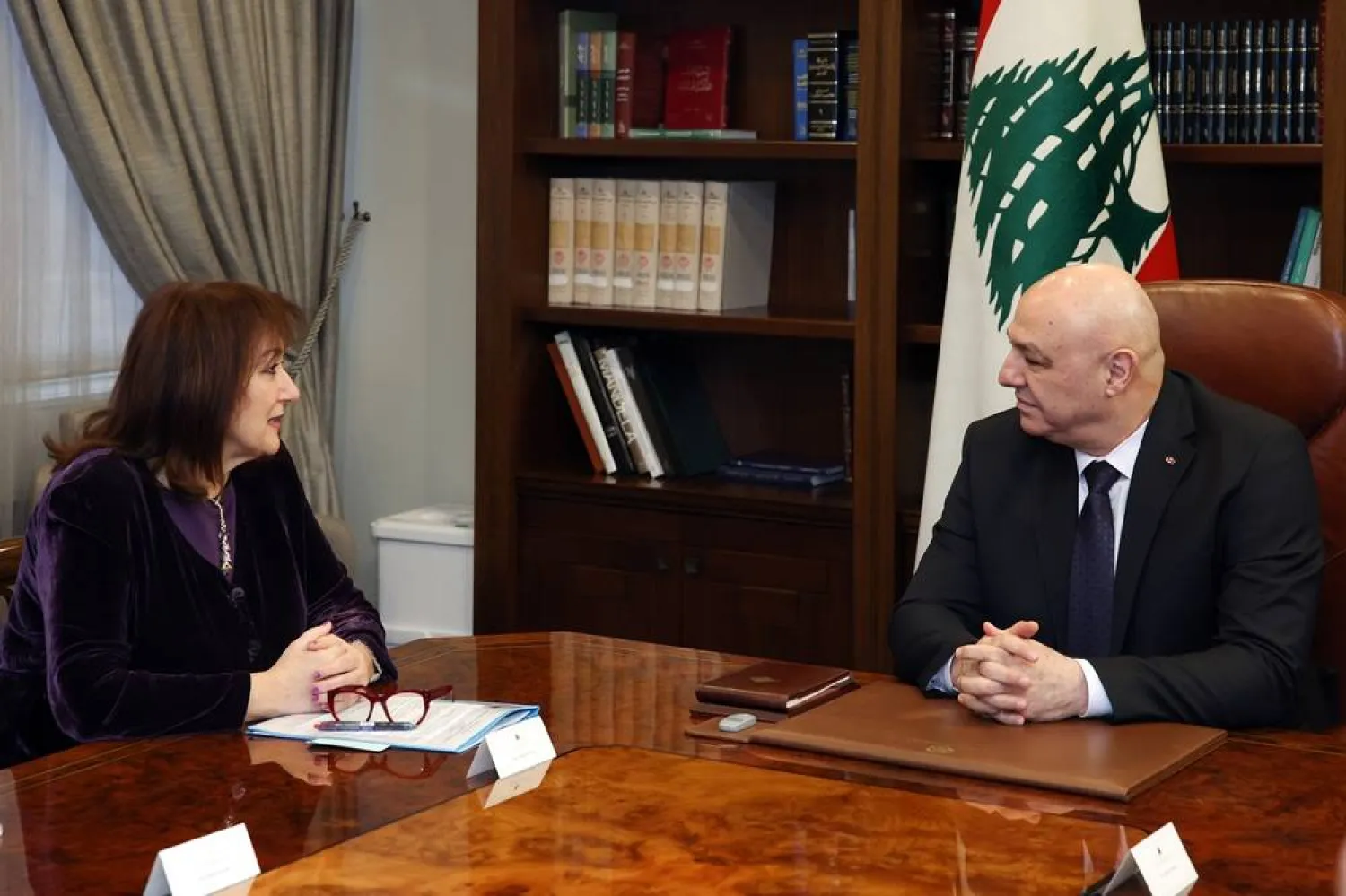
A handout photo made available by Press Office of the Lebanese Presidency shows Lebanese President Joseph Aoun (R) during a meeting with European Commissioner for the Mediterranean Dubravka Suica (L) at the presidential palace in Baabda, east of Beirut, Lebanon, 21 February 2025. (EPA/ Lebanese Presidency Press Office)
TT

500 Billion Euros in Funding to Lebanon Depends on Banking Restructure

A handout photo made available by Press Office of the Lebanese Presidency shows Lebanese President Joseph Aoun (R) during a meeting with European Commissioner for the Mediterranean Dubravka Suica (L) at the presidential palace in Baabda, east of Beirut, Lebanon, 21 February 2025. (EPA/ Lebanese Presidency Press Office)

A visiting EU official said Friday that disbursing half a billion euros in funding to Lebanon was conditional on a banking sector restructure and reaching an agreement with the International Monetary Fund.

In May last year, the European Union announced one billion euros ($1 billion) in aid for Lebanon to help stem irregular migration to the bloc, with the assistance designed to strengthen basic services including education and health, after five years into an economic and financial crisis in the country.

The EU Commissioner for the Mediterranean Dubravka Suica on Friday said that of the allocated funds, “500 million (euros) was already adopted in August last year, and another 500 million will come soon, but there are some conditions,” according to AFP.

“The main precondition is the restructure of the banking sector... and a good agreement with the International Monetary Fund,” she told a press conference after meeting with President Joseph Aoun.

“Once these conditions are fulfilled, we will continue of course with disbursing” the funds, she added.

The international community has long demanded Lebanon enact reforms to unlock billions of dollars to boost the economy after a financial crisis widely blamed on mismanagement and corruption took hold in 2019.

Lebanon last month elected a new president after a more than two-year vacuum. This month it formed a government, replacing the previous administration that had been operating in a caretaker capacity.

This week, the IMF said it was open to a new loan agreement with Lebanon following discussions with its recently appointed finance minister.

Suica also said she discussed with Aoun a “new pact for the Mediterranean” which means “we will start bilateral comprehensive strategic partnership agreements with countries including Lebanon,” without providing details.

She and Aoun also discussed issues including a ceasefire in the recent war between Israel and Hezbollah, as well as Lebanon's army and the Syria crisis, she added.

During her visit to Beirut, Suica also met with other senior officials, including Prime Minister Nawaf Salam and parliament Speaker Nabih Berri.

The EU is desperate for stability in the Middle East and the Mediterranean region as it hopes to avoid major flows of migrants to Europe.

Lebanon says it hosts some two million Syrians, the world's highest number of refugees per capita, and has also been a launchpad for Europe-bound migrants.



India, Malaysia Renew Pledges to Boost Trade and Collaboration

Malaysia's Prime Minister Anwar Ibrahim shakes hands with India's Prime Minister Narendra Modi in Putrajaya on February 8, 2026. (Photo by Hasnoor Hussain / POOL / AFP)
TT

India, Malaysia Renew Pledges to Boost Trade and Collaboration

Malaysia's Prime Minister Anwar Ibrahim shakes hands with India's Prime Minister Narendra Modi in Putrajaya on February 8, 2026. (Photo by Hasnoor Hussain / POOL / AFP)

India's Prime Minister Narendra Modi and his Malaysian counterpart Anwar Ibrahim renewed pledges on Sunday to bolster trade and explore potential collaborations in semiconductors, defense and other fields.

Modi is on a two-day visit to the Southeast Asian nation, his first since the two countries elevated ties to ⁠a comprehensive strategic partnership in August 2024.

Anwar said the partnership included deep collaborations in multiple fields, including trade and investments, food security, defense, healthcare and tourism.

"It's really comprehensive, and we believe ⁠that we can advance this and execute in a speedy manner with the commitment of our both governments," he told a press conference after hosting Modi at his official residence in the administrative capital Putrajaya.

Following their meeting, Anwar and Modi also witnessed the exchange of 11 cooperation agreements, including ⁠on semiconductors, disaster management and peacekeeping, Reuters reported.

Anwar said India and Malaysia would continue efforts to promote the use of local-currency settlement for cross-border activities and expressed hope that bilateral trade would surpass last year's $18.6 billion.

Malaysia will also support India's efforts to open a consulate in Malaysia's Sabah state on Borneo island, Anwar said.


Saudi Arabia, Syria Sign Joint Airline and Telecoms Deals

Officials pose after signing a framework agreement for developmental cooperation and the launch of 45 development initiatives between the Syrian Development Fund and Saudi Arabia's Development Committee at the People's Palace in Damascus, Syria, Saturday, Feb. 7, 2026. (AP)
TT

Saudi Arabia, Syria Sign Joint Airline and Telecoms Deals

Officials pose after signing a framework agreement for developmental cooperation and the launch of 45 development initiatives between the Syrian Development Fund and Saudi Arabia's Development Committee at the People's Palace in Damascus, Syria, Saturday, Feb. 7, 2026. (AP)

Syria and Saudi Arabia signed deals Saturday that include a joint airline and a $1-billion project to develop telecommunications, officials said, as Syria seeks to rebuild after years of war.

The new authorities in Damascus have worked to attract investment and have signed major agreements with several companies and governments.

Syrian Investment Authority chief Talal al-Hilali announced a series of deals including "a low-cost Syrian-Saudi airline aimed at strengthening regional and international air links".

The agreement also includes the development of a new international airport in the northern city of Aleppo, and redeveloping the existing facility.

Hilali also announced an agreement for a project called SilkLink to develop Syria's "telecommunications infrastructure and digital connectivity".

Syrian Telecommunications Minister Abdulsalam Haykal told the signing ceremony that the project would be implemented "with an investment of around $1 billion".

For decades, Syria was unable to secure significant investments because of Assad-era sanctions.

But the United States fully removed its remaining sanctions on Damascus late last year, paving the way for the full return of investments.

Syria and Saudi Arabia also inked an agreement on water desalination and development cooperation on Saturday.

At the ceremony, Saudi Investment Minister Khalid Al-Falih announced the launch of an investment fund for "major projects in Syria with the participation of the (Saudi) private sector".

The deals are part of "building a strategic partnership" between the two countries, he said.

Syria's Hilali said the agreements targeted "vital sectors that impact people's lives and form essential pillars for rebuilding the Syrian economy".

Syria has begun the mammoth task of trying to rebuild its shattered infrastructure and economy.

In July last year, Riyadh signed investment and partnership deals with Damascus valued at $6.4 billion to help rebuild the country's infrastructure, telecommunications and other major sectors.

A month later, Syria signed agreements worth more than $14 billion, including investments in Damascus airport and other transport and real estate projects.

This week, Syria signed a preliminary deal with US energy giant Chevron and Qatari firm Power International to explore for oil and gas offshore.


India’s Modi Lauds Interim Trade Pact After US Tariff Rollback

Indian Prime Minister Narendra Modi addresses the media before the budget session of Parliament at Parliament House in New Delhi, India, 29 January 2026. (EPA)
TT

India’s Modi Lauds Interim Trade Pact After US Tariff Rollback

Indian Prime Minister Narendra Modi addresses the media before the budget session of Parliament at Parliament House in New Delhi, India, 29 January 2026. (EPA)

Indian Prime Minister Narendra Modi on Saturday hailed an interim trade agreement with the United States, saying it would bolster global growth and deepen economic ties between the two countries.

The pact cuts US "reciprocal" duties on Indian products to 18 percent from 25 percent, and commits India to large purchases of US energy and industrial goods.

US President Donald Trump, while announcing the deal Tuesday, had said Modi promised to stop buying Russian oil over the war in Ukraine.

The deal eases months of tensions over India's oil purchases -- which Washington says fund a conflict it is trying to end -- and restores the close ties between Trump and the man he describes as "one of my greatest friends."

"Great news for India and USA!" Modi said on X on Saturday, praising US President Donald Trump's "personal commitment" to strengthening bilateral ties.

The agreement, he said, reflected "the growing depth, trust and dynamism" of their partnership.

Modi's remarks came hours after Trump issued an executive order scrapping an additional 25 percent levy imposed over New Delhi's purchases of Russian oil, in a step to implement the trade deal announced this week.

Modi, who has faced criticism at home about opening access of Indian agricultural markets to the United States and terms on oil imports, did not mention Russian oil in his statement.

"This framework will also strengthen resilient and trusted supply chains and contribute to global growth," he said.

It would also create fresh opportunities for Indian farmers, entrepreneurs and fishermen under the "Make in India" initiative.

In a separate statement, Commerce Minister Piyush Goyal said the pact would "open a $30 trillion market for Indian exporters".

Goyal also said the deal protects India's sensitive agricultural and dairy products, including maize, wheat, rice, soya, poultry and milk.

Other terms of the agreement include the removal of tariffs on certain aircraft and parts, according to a separate joint statement released Friday by the White House.

The statement added that India intends to purchase $500 billion of US energy products, aircraft and parts, precious metals, tech products and coking coal over the next five years.

The shift marks a significant reduction in US tariffs on Indian products, down from a rate of 50 percent late last year.

Washington and New Delhi are expected to sign a formal trade deal in March.