

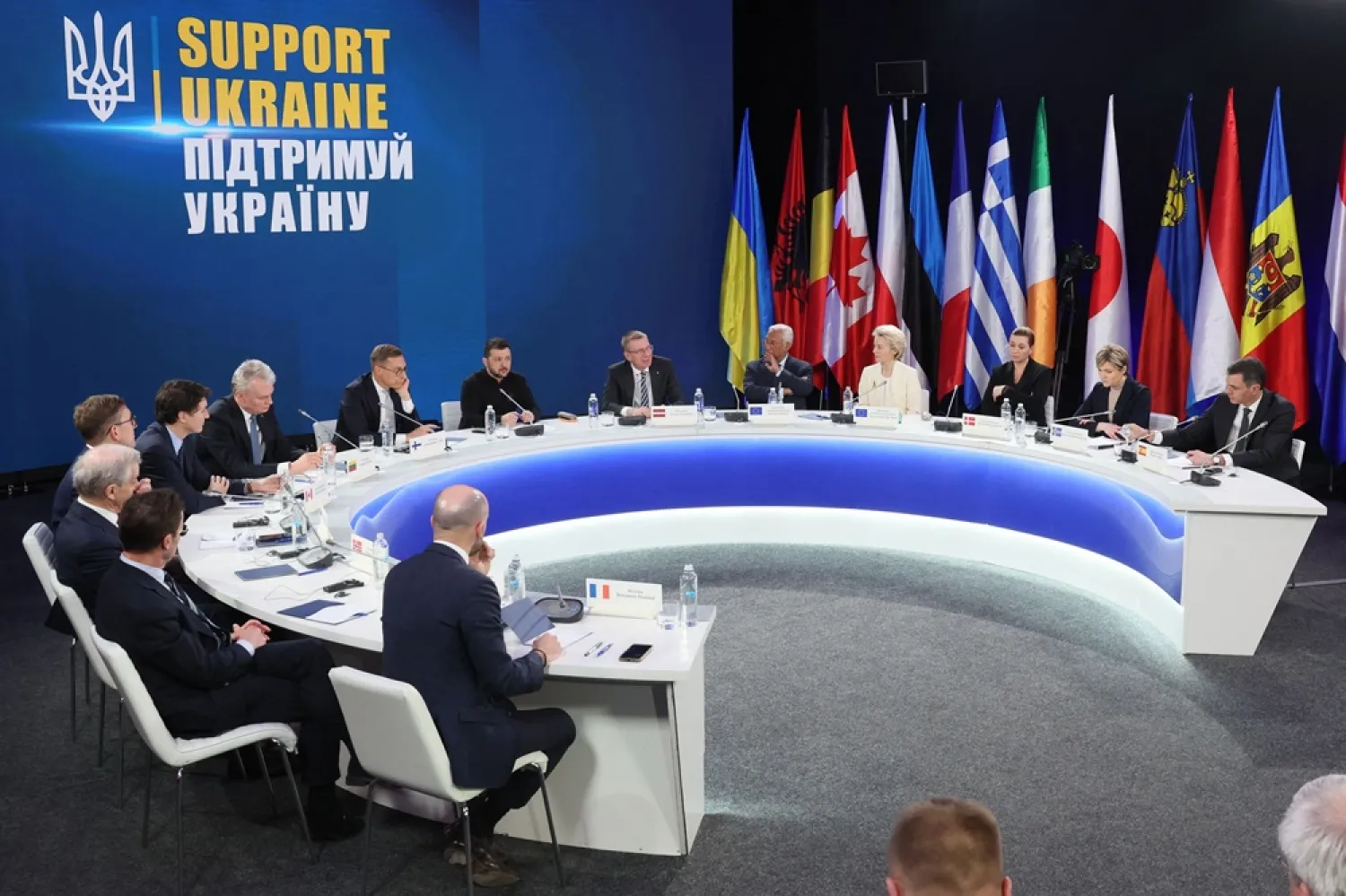

European Leaders in Kyiv to Mark Three Years of War, but Top US Officials Stay Away

(From L at table) France's Minister for Europe and Foreign Affairs Jean-Noel Barrot, Sweden's Prime Minister Ulf Kristersson, Norway's Prime Minister Jonas Gahr Stoere, Estonia's Prime Minister Kristen Michal, Canada's Prime Minister Justin Trudeau, Lithuania's President Gitanas Nauseda, Finland's President Alexander Stubb, Ukrainian President Volodymyr Zelenskiy, Latvia's President Edgars Rinkevics, European Council President Antonio Costa, European Commission President Ursula von der Leyen, Denmark's Prime Minister Mette Frederiksen, Minister Kristrun Frostadottir and Spain's Prime Minister Pedro Sanchez, attend a press conference after the “Support Ukraine” summit, marking the third anniversary of the Russian invasion, in Kyiv, Ukraine, on February 24, 2025. (AFP)
TT

European Leaders in Kyiv to Mark Three Years of War, but Top US Officials Stay Away

(From L at table) France's Minister for Europe and Foreign Affairs Jean-Noel Barrot, Sweden's Prime Minister Ulf Kristersson, Norway's Prime Minister Jonas Gahr Stoere, Estonia's Prime Minister Kristen Michal, Canada's Prime Minister Justin Trudeau, Lithuania's President Gitanas Nauseda, Finland's President Alexander Stubb, Ukrainian President Volodymyr Zelenskiy, Latvia's President Edgars Rinkevics, European Council President Antonio Costa, European Commission President Ursula von der Leyen, Denmark's Prime Minister Mette Frederiksen, Minister Kristrun Frostadottir and Spain's Prime Minister Pedro Sanchez, attend a press conference after the “Support Ukraine” summit, marking the third anniversary of the Russian invasion, in Kyiv, Ukraine, on February 24, 2025. (AFP)

Ukraine hosted European leaders on Monday to mark three years of all-out war with Russia, while top US officials stayed away in a clear illustration of President Donald Trump's lurch towards Moscow since returning to power.

Still reeling from Trump calling President Volodymyr Zelenskiy a "dictator" and seeking elections that are banned by martial law, Kyiv said it was in the final stages of agreeing a deal with Washington to provide access to its mineral wealth.

"We hope both US and UA leaders might sign and endorse it in Washington the soonest to showcase our commitment for decades to come," Deputy Prime Minister Olha Stefanishyna wrote on X, suggesting Kyiv is angling for a meeting with Trump soon.

The deal is at the heart of Kyiv's bid to win US support, but officials have wrangled over its wording in the shadow of an extraordinary war of words between Trump and Zelenskiy, who said the US leader was living in a "disinformation bubble".

Zelenskiy refused to sign an earlier draft as Washington sought $500 billion in natural wealth, protesting that Kyiv had received nowhere near that much US aid and that the draft lacked the security guarantees Ukraine needs.

A Ukrainian government source told Reuters that Kyiv awaited US feedback on the "final changes" it had sent. The source said the US did not like the idea of including wording about providing security guarantees in the text.

"We see the issue of guarantees for the talks between Presidents," the source said.

Beyond the barbs, US officials opened direct talks with the Russian side in Saudi Arabia last week, shutting out Kyiv and Europe in a stunning change of policy on the war.

Zelenskiy, who has told Europe to create its own army while urging Washington to be pragmatic, welcomed a slew of European and other leaders to a summit in Kyiv to commemorate the start in 2022 of the biggest conflict in Europe since World War Two.

"This year should be the year of the beginning of a real, lasting peace. Putin will not gift us this peace, nor will he give it to us in exchange for anything. We have to win peace with strength, wisdom and unity - with our cooperation," he said.

The visitors included European Commission President Ursula von der Leyen, European Council President Antonio Costa and the leaders of Canada, Denmark, Iceland, Latvia, Lithuania, Finland, Norway, Spain and Sweden.

Leaders of Albania, Britain, Croatia, Czech Republic, Germany, Japan, Moldova, the Netherlands, Poland, Switzerland and Türkiye spoke by video link. There was no sign of US representation.

"In this fight for survival, it is not only the destiny of Ukraine that is at stake. It's Europe's destiny," von der Leyen wrote on X.

She said Ukraine could join the European Union before 2030 if it continues the speed and quality of its reforms.

The European leaders rallied around Zelenskiy in speeches, calling for countries on the continent to step up support for Kyiv, while some spoke of the urgent need to increase defense spending.

"We have to scale up as Europeans, we have to speed up ... My guess is that we have a couple of months to take all necessary decisions. Otherwise, we'll be too late," Danish Prime Minister Mette Frederiksen told the summit.

'NO STRENGTH LEFT'

Washington has made clear it will not send troops as a security guarantee coveted by Kyiv if a peace deal emerges, placing the burden on European powers that are likely to struggle without US backing.

The visitors paid their respects to Ukrainian soldiers killed in the war, standing in silence before a memorial made up of flags on Kyiv's central square. Air raid sirens sounded as they met for talks later, though no missile strike followed.

Thousands of Ukrainian citizens have died and more than six million live as refugees abroad since Russian President Vladimir Putin ordered the invasion by land, sea and air.

Military losses have been catastrophic, although they remain closely guarded secrets. Public Western estimates based on intelligence reports vary widely, but most say hundreds of thousands have been killed or wounded on each side.

Kyiv residents spoke of defiance and exhaustion.

"For 300 years they (the Russians) couldn't break us - they tried, but they couldn't," said Yevheniia Bondini, 34.

Inna Zaitseva, also 34, said: "It's our state, it's our land, our territory. We want the war to end as soon as possible, because we have no strength left."

Tragedy has touched families in every corner of Ukraine, where military funerals are commonplace in major cities and far-flung villages. People are exhausted by sleepless nights of air raid sirens.

Russia launched 185 drones against Ukraine overnight but caused no significant damage, the Ukrainian air force said. Kyiv said it had hit Russia's Ryazan refinery, continuing its campaign to degrade its enemy's oil infrastructure.

Kyiv's troops face a numerically superior foe as questions swirl over the future of vital US military assistance. It is unclear how much European allies could fill the gap if US support slows or stops.

Pavlo Klimkin, Ukraine's foreign minister from 2014 to 2019, said Zelenskiy needed to try to preserve strategic ties with Washington while enhancing relations with Europe, as well as reaching out to countries like China and India.

He said he did not think relations with Washington had reached crisis point yet, despite Trump's outbursts.

"A tornado is not sustainable, it will pass, but it is very important not to feed it in any way."



UN Condemns ‘Dangerous Escalation’ in Ukraine War

Commuters sit in a bus driving past a heavily damaged building following Russian strikes near the Lukianivska metro station in Kyiv on May 27, 2026, amid the Russian invasion of Ukraine. (AFP)
TT

UN Condemns ‘Dangerous Escalation’ in Ukraine War

Commuters sit in a bus driving past a heavily damaged building following Russian strikes near the Lukianivska metro station in Kyiv on May 27, 2026, amid the Russian invasion of Ukraine. (AFP)

The United Nations rights chief warned Thursday against a "dangerous escalation" in Ukraine, and Russia's threats to ramp up attacks, urging both sides to return to the negotiating table.

"I strongly urge restraint. Resume negotiations and end the suffering," Volker Turk said in a statement.

His appeal comes days after one of the worst combined missile and drone attacks on Kyiv since Russia launched its full-scale invasion of Ukraine more than four years ago.

It was the latest in a string of large-scale attacks by Russia in recent weeks.

The UN rights office said 815 civilians had been killed and 4,174 injured in Ukraine in the first four months of 2026 -- a 21-percent increase in civilian casualties over the same period last year.

"As if all these casualty figures weren't horrifying enough on their own, following these attacks, Russian officials have publicly threatened to increase attacks across Kyiv," Turk said.

"International humanitarian law demands that parties to a conflict take all feasible precautions to avoid civilian harm," he said.

"These are not simply suggestions or recommendations, but binding obligations carrying legal responsibility for those involved."

His office also pointed to an attack by Ukrainian armed forces on an educational complex in the occupied city of Starobilsk on May 21-22, in which Russian authorities say 21 people were killed and 44 injured.

"The UN Human Rights Office has conducted a thorough review of publicly-available information, which indicates that the educational facilities were operational at the time of the attack and that civilians -- many of them students -- were killed or injured," it said.

Eighteen of those killed were women, it said, adding that attacks by Ukrainian armed forces had also killed and injured civilians within Russia itself.

Turk called on both Russian and Ukrainian authorities to conduct "prompt, independent, and effective investigations and hold those responsible accountable".


Iranians Are Back Online After a Monthslong Shutdown but Still Face Heavy Restrictions

An Iranian man uses his phone, after a reported reopening of international internet access, in Tehran, Iran, May 27, 2026. Majid Asgaripour/WANA (West Asia News Agency) via Reuters
TT

Iranians Are Back Online After a Monthslong Shutdown but Still Face Heavy Restrictions

An Iranian man uses his phone, after a reported reopening of international internet access, in Tehran, Iran, May 27, 2026. Majid Asgaripour/WANA (West Asia News Agency) via Reuters

Iranians began to regain internet access on Wednesday after authorities ended a monthslong shutdown. But users said service was slow and spotty in some areas, with apps like YouTube and Instagram heavily restricted, as they were before the cutoff began during nationwide protests in January.

Authorities justified the outage as a military imperative after the United States and Israel attacked Iran on Feb. 28. Their decision to lift some restrictions this week came as negotiators appeared to be closing in on a more permanent truce. But many Iranians feared access could be cut off again at a moment's notice.

Internet tracking company Netblocks said Iran’s connectivity, which measures the ability of devices to connect to the internet, is at around 86% of capacity from before the cutoff. Internet analysis firm Kentik said internet traffic, which measures the amount of data transferred and is a good illustration of usage, was at around 40%.

Amir Rashidi, an Iranian cybersecurity analyst, said there were still widespread disruptions. "It's too early to say the shutdown is over," he wrote on X.

An unprecedented shutdown

Iran’s roughly 90 million people have been cut off from the internet for most of 2026, one of the world’s longest and strictest national shutdowns. Young people with online careers saw their incomes evaporate. Job losses and the closure of online businesses added to the war's steep economic costs.

The cutoff made it difficult for Iranian families to communicate through months of unrest and war. At some points, phone lines were also cut off, though they were later restored.

A woman living in Tehran said that for months she was barely able to speak to her sons living abroad. She couldn't believe authorities had restored access, saying she had assumed they would find some justification to prolong the outage.

A taxi driver said service was restored but weak. He expressed hope it would improve so he could use messaging apps with family and friends. Both spoke on condition of anonymity for security reasons.

Prices spiked during the shutdown, with residents in Tehran at times paying around $7.50 per gigabyte. Prices are back down to around $2.25 for 30 gigabytes, roughly where they were before the protests.

Even then, Iran tightly controlled access to popular social media sites, leading many to rely on virtual private networks, or VPNs. The cost of those workarounds soared during the shutdown, making them unaffordable for many as the economy was battered.

A slow return to service

Businesses have started reappearing online, announcing their return with posts on sites like Instagram and Telegram.

A gamer and tech influencer in the central city of Isfahan said the shutdown had caused him to lose a lot of his audience on YouTube and Instagram, where he had spent years building up a large following.

"All my views and interactions are way down. I’ve been erased from the algorithm," he said in a voice note sent by WhatsApp, adding that his internet connection was still slower than before the shutdown.

"The situation is such that many content producers have had their income reduced to zero, have moved on to other jobs, or have been forced to sell their equipment to survive," he said. He spoke on condition of anonymity for fear of reprisal.

Iran claimed the shutdown was a wartime necessity

Iranian authorities first shut down the internet in January during mass anti-government protests that were eventually stamped out in a violent crackdown. Thousands of people were killed and tens of thousands detained.

That cutoff was just starting to ease when the government imposed a complete internet blackout after the start of the war, when US and Israeli strikes killed Iran's supreme leader and other top officials.

The government faced criticism for the prolonged shutdown, which caused even more harm to an economy devastated by inflation, strikes on key industries and a US blockade on Iranian ports.

The internet cutoff cost an estimated $30-40 million daily, with indirect losses likely twice that much, a member of Iran’s Chamber of Commerce, Afshin Kolahi, told a local newspaper last month. About 10 million people have jobs that depend on internet connectivity, according to Communications Minister Sattar Hashemi.

Iranians still had access to a national net, but that has a far narrower reach, and users complained of poor service and heavy censorship. Senior government officials are given SIM cards granting them access to the global internet. Under pressure, the government expanded access to SIM cards to some professions during the shutdown.


China’s Military Says Drove Away Dutch Warship in South China Sea

Vessels from Chinese and Vietnamese navies take part in a joint patrol in the Gulf of Tonkin in November last year. (Xinhua)
TT

China’s Military Says Drove Away Dutch Warship in South China Sea

Vessels from Chinese and Vietnamese navies take part in a joint patrol in the Gulf of Tonkin in November last year. (Xinhua)

China's military said on Wednesday it drove away a Dutch navy vessel it accused of "illegally intruding" into the area around the Paracel Islands in the contested South China Sea.

Beijing claims the South China Sea in nearly its entirety despite a 2016 international ruling rejecting its assertion, fueling tensions with its regional neighbors.

The Dutch navy frigate De Ruyter "repeatedly launched its shipborne helicopter" to "violate China's airspace", the Chinese military's Southern Theater Command said in a statement.

Chinese forces took measures such as verbal warnings and "electronic jamming" to force the vessel away, it added.

"The Dutch side's actions seriously violated China's territorial sovereignty and maritime and air security, seriously breached international law and the basic norms of international relations," the statement said.

China "firmly opposes" the acts and has warned the Dutch side to immediately stop its "provocative" actions, it added.

The United States, India, Japan and Australia jointly voiced concern on Tuesday over the South and East China Seas, warning against any assertive moves.

Without referring to Beijing by name, the nations' foreign ministers criticized "dangerous maneuvers by military aircraft" and "ramming and blocking actions in the South China Sea".