


Latest North Korean Ship Can Carry Dozens of Missiles, Analysts Say 

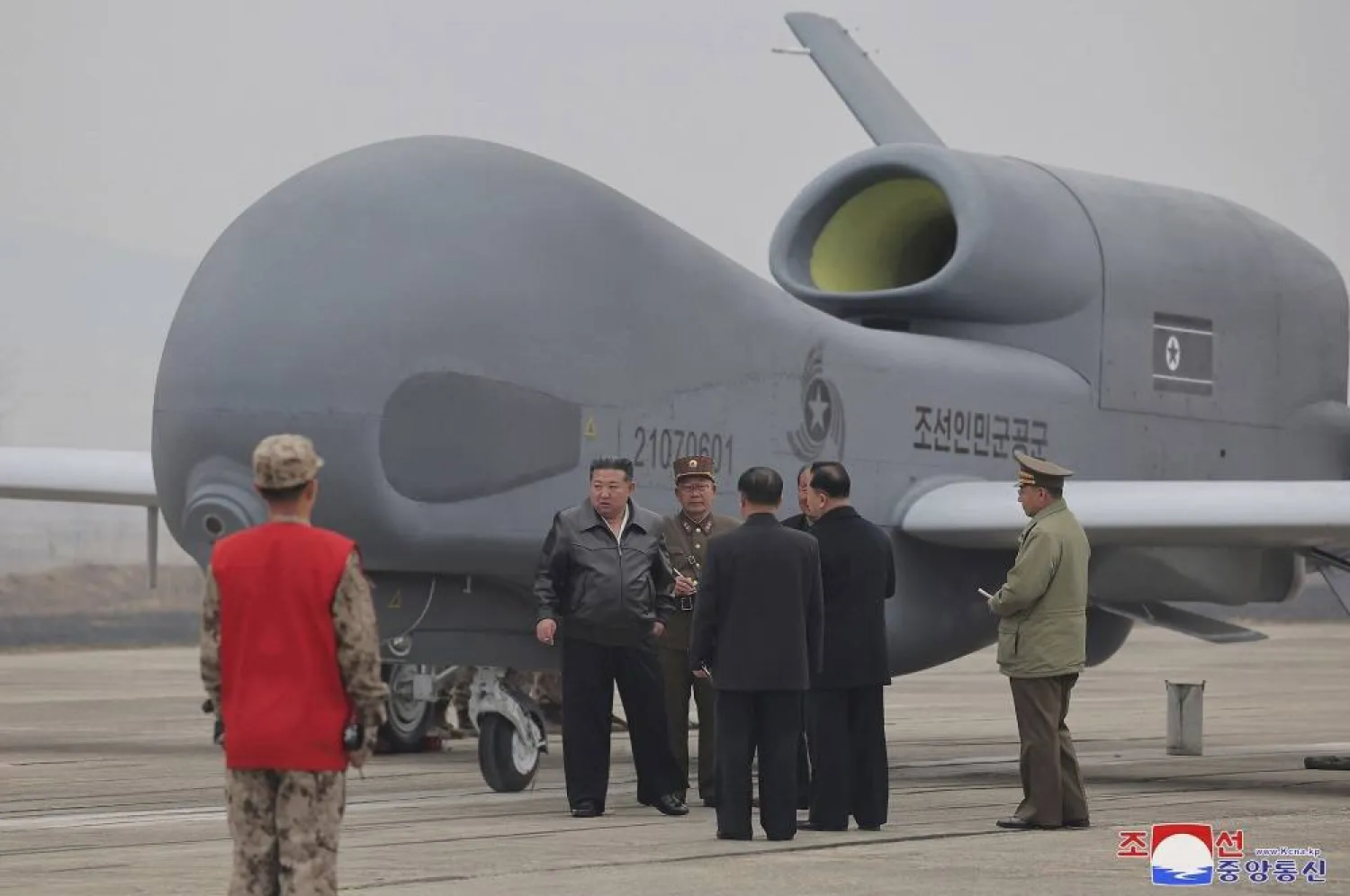
In this photo provided Thursday, March 27, 2025, by the North Korean government, its leader Kim Jong Un, center left in a black jacket, stands by what appeared to be a large reconnaissance drone at an undisclosed location in North Korea, earlier this week. (Korean Central News Agency/Korea News Service via AP)
TT

Latest North Korean Ship Can Carry Dozens of Missiles, Analysts Say 

In this photo provided Thursday, March 27, 2025, by the North Korean government, its leader Kim Jong Un, center left in a black jacket, stands by what appeared to be a large reconnaissance drone at an undisclosed location in North Korea, earlier this week. (Korean Central News Agency/Korea News Service via AP)

North Korea's new class of warship can accommodate dozens of vertical launch cells to carry missiles its military has already developed, analysis of a satellite image showed, a step that would give its navy more punch and create an export opportunity.

Little is known about the unnamed class of ships being built in the Chongjin and Nampo shipyards. In December, South Korea's military said they would displace about 4,000 tons, somewhat less than half the size of a US Arleigh Burke-class destroyer.

Images captured of the ship in Nampo in the last week of March, however, show cavities on its deck large enough to hold more than 50 missiles, depending on their type, said researcher Jeffrey Lewis.

"They're pretty big cavities," said Lewis, director of the East Asia Nonproliferation Program at the James Martin Center for Nonproliferation Studies at the Middlebury Institute of International Studies in California.

"I would think 32 (missiles) in front and a few fewer in the back would be a very reasonable number. Or it could be a much smaller number of ballistic missiles."

Vertical launch systems (VLS) allow ships to carry more missiles, and make launching and reloading easier.

Lewis said North Korea had developed several different types of missile that would be compatible with VLS cells, which Pyongyang had not fielded on any previous surface ship.

Such types include anti-ship cruise missiles, land attack cruise missiles, air defense missiles and submarine-launched ballistic missiles, he added.

The new ships' armament seemed to hew close to South Korean navy standards, said Euan Graham, a senior analyst at the Australian Strategic Policy Institute.

"I think we have to take conventional enhancements seriously, because North Korea has limited resources and has invested in nuclear weapons to close the deterrence gap with the Republic of Korea and United States," he added.

"So it must fit within their concept of operations, even if the concept appears odd to us."

North Korean state media released first photos of the ship in December, when leader Kim Jong Un conducted an inspection.

He later made several more visits to the shipyards, where the country said as recently as early March it was also building its first nuclear-powered submarine.

"Overwhelmingly powerful warships must serve as a strong nuclear deterrent against hostile forces' habitual 'gunboat diplomacy,'" state media reported Kim as saying.

South Korea's national defense ministry did not immediately respond to requests for comment.

Lewis said compatibility with a VLS would make the weapons even more attractive as exports for countries that are cut off from, or cannot afford, other arms suppliers.

"If you were interested in buying North Korean anti-ship missiles because they were cheap, it would be awfully nice if they came in a tested VLS system," he said.

"Quantity has a quality all its own. Those North Korean missiles might not be as good as their Russian counterparts, but they are much, much cheaper."

The new ships, although more advanced than others in the North Korean fleet, may not make much of a difference in conflict, said Collin Koh of the S. Rajaratnam School of International Studies in Singapore.

Their locations are well-known, they cannot operate far from North Korean shores and are decades behind the technology in South Korean and US warships.

But they show Pyongyang is serious about investments to improve its navy, he said.

"The North Korean navy is largely traditionally a coastal defense navy," he said. "So they are likely trying to reinvigorate the fleet."

Last year Kim stressed the importance of strengthening North Korea's navy. It recently finished fitting out its latest Sinpo-C ballistic missile submarine, according to 38 North, a Washington-based North Korea monitoring program.



Top Trump Iran Negotiator Says Visits US Aircraft Carrier in Middle East

US Special Envoy Steve Witkoff delivers a press conference upon the signing of the declaration on deploying post-ceasefire force in Ukraine, during the so-called "Coalition of the Willing" summit, at the Elysee Palace in Paris, France, January 6, 2026. (Reuters)
TT

Top Trump Iran Negotiator Says Visits US Aircraft Carrier in Middle East

US Special Envoy Steve Witkoff delivers a press conference upon the signing of the declaration on deploying post-ceasefire force in Ukraine, during the so-called "Coalition of the Willing" summit, at the Elysee Palace in Paris, France, January 6, 2026. (Reuters)

US President Donald Trump's lead Iran negotiator Steve Witkoff on Saturday said he visited the USS Abraham Lincoln aircraft carrier currently in the Arabian Sea, with Washington and Tehran due to hold further talks soon.

"Today, Adm. Brad Cooper, Commander of US Naval Forces Central Command, Jared Kushner, and I met with the brave sailors and Marines aboard the USS Abraham Lincoln, her strike group, and Carrier Air Wing 9 who are keeping us safe and upholding President Trump's message of peace through strength," said Witkoff in a social media post.

Iranian Foreign Minister Abbas Araghchi said on Saturday he hoped talks with the United States would resume soon, while reiterating Tehran's red lines and warning against any American attack.


Israel’s Netanyahu Expected to Meet Trump in US on Wednesday and Discuss Iran

Israeli Prime Minister Benjamin Netanyahu delivers a speech during a special session to mark the 77th anniversary of the Knesset's establishment and the 60th anniversary of the dedication of the current building at the Knesset, the Israeli parliament, in Jerusalem, 02 February 2026. (EPA)
TT

Israel’s Netanyahu Expected to Meet Trump in US on Wednesday and Discuss Iran

Israeli Prime Minister Benjamin Netanyahu delivers a speech during a special session to mark the 77th anniversary of the Knesset's establishment and the 60th anniversary of the dedication of the current building at the Knesset, the Israeli parliament, in Jerusalem, 02 February 2026. (EPA)

Israeli Prime Minister Benjamin Netanyahu is expected to meet US President Donald Trump on Wednesday in Washington, where they will discuss negotiations with Iran, Netanyahu's office said on Saturday.

Iranian and US officials held indirect nuclear ‌talks in the ‌Omani capital ‌Muscat ⁠on Friday. ‌Both sides said more talks were expected to be held again soon.

A regional diplomat briefed by Tehran on the talks told Reuters Iran insisted ⁠on its "right to enrich uranium" ‌during the negotiations with ‍the US, ‍and that Tehran's missile capabilities ‍were not raised in the discussions.

Iranian officials have ruled out putting Iran's missiles - one of the largest such arsenals in the region - up ⁠for discussion, and have said Tehran wants recognition of its right to enrich uranium.

"The Prime Minister believes that any negotiations must include limiting ballistic missiles and halting support for the Iranian axis," Netanyahu's office said in a ‌statement.


Italy FM Rules Out Joining Trump’s ‘Board of Peace’

Italy's Minister for Foreign Affairs Antonio Tajani speaks to the press during the EPP Leaders’ meeting, in Zagreb, Croatia, 30 January 2026. (EPA)
TT

Italy FM Rules Out Joining Trump’s ‘Board of Peace’

Italy's Minister for Foreign Affairs Antonio Tajani speaks to the press during the EPP Leaders’ meeting, in Zagreb, Croatia, 30 January 2026. (EPA)

Italy will not take part in US President Donald Trump's "Board of Peace", Italian Foreign Minister Antonio Tajani said Saturday, citing "insurmountable" constitutional issues.

Trump launched his "Board of Peace" at the World Economic Forum in Davos in January and some 19 countries have signed its founding charter.

But Italy's constitution bars the country from joining an organization led by a single foreign leader.

Prime Minister Giorgia Meloni, a Trump ally, last month noted "constitutional problems" with joining, but suggested Trump could perhaps reopen the framework "to meet the needs not only of Italy, but also of other European countries".

Tajani appeared Saturday to rule that out.

"We cannot participate in the Board of Peace because there is a constitutional limit," he told the ANSA news agency.

"This is insurmountable from a legal standpoint," he said, the day after meeting US Secretary of State Marco Rubio and US Vice President JD Vance at the Olympics in Milan.

Although originally meant to oversee Gaza's rebuilding, the board's charter does not limit its role to the Palestinian territory and appears to want to rival the United Nations.
