


UK and France Accuse Putin of Delaying Ukraine Ceasefire Efforts

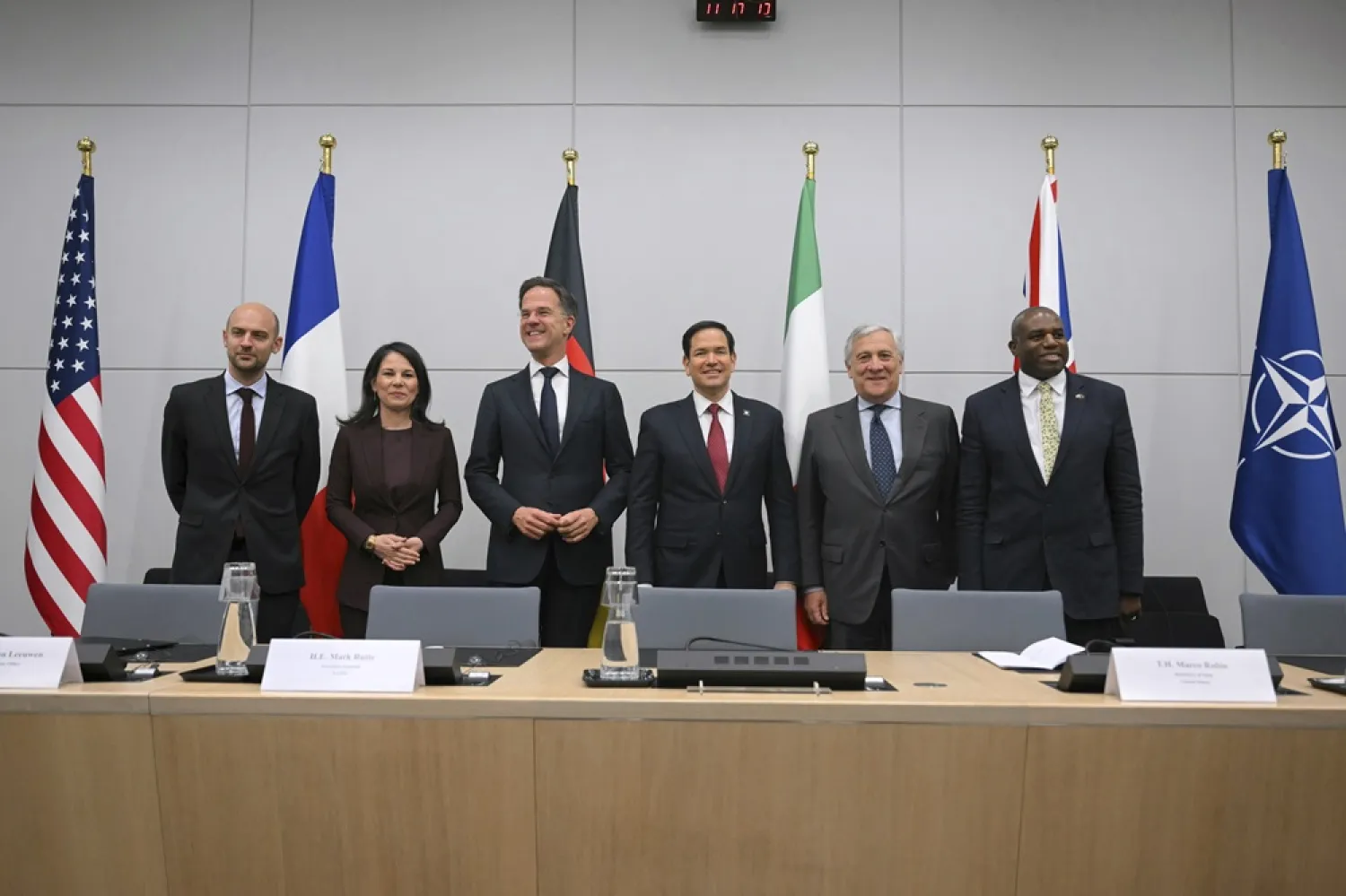
From left, French Foreign Minister Jean-Noel Barrot, Germany's Foreign Minister Annalena Baerbock, NATO Secretary General Mark Rutte, United States Secretary of State Marco Rubio, Italy's Foreign Minister Antonio Tajani and Britain's Foreign Secretary David Lammy pose for a group photo during a meeting on the sidelines of the NATO foreign ministers at NATO headquarters in Brussels, Friday, April 4, 2025. (Nicolas Tucat, Pool Photo via AP)
TT

UK and France Accuse Putin of Delaying Ukraine Ceasefire Efforts

From left, French Foreign Minister Jean-Noel Barrot, Germany's Foreign Minister Annalena Baerbock, NATO Secretary General Mark Rutte, United States Secretary of State Marco Rubio, Italy's Foreign Minister Antonio Tajani and Britain's Foreign Secretary David Lammy pose for a group photo during a meeting on the sidelines of the NATO foreign ministers at NATO headquarters in Brussels, Friday, April 4, 2025. (Nicolas Tucat, Pool Photo via AP)

The UK and French foreign ministers on Friday accused Russian President Vladimir Putin of dragging his feet in ceasefire talks aimed at halting Moscow's all-out invasion of Ukraine and demanded a swift response from Russia after weeks of US efforts to secure a truce.

A Russian drone attack late Thursday on Kharkiv, Ukraine's second-largest city, killed five civilians and dramatized the diplomatic insistence on a ceasefire. Emergency crews carried black body bags from a burning apartment building as onlookers wept and hugged in the dark.

Some of the 32 wounded, bloodied and in shock, limped out into the street or were carried on stretchers as flames shot from the windows of their homes.

“Now, I think it is obvious who wants peace and who wants war,” Ukrainian Foreign Minister Andrii Sybiha said at a NATO meeting in Brussels, referring to the Kharkiv strike. “We must get Russia serious about peace. We must pressure Russia into peace.”

Russia has effectively rejected a US proposal for a full and immediate 30-day halt in the fighting.

“Our judgment is that Putin continues to obfuscate, continues to drag his feet,” UK Foreign Secretary David Lammy told reporters at NATO headquarters, standing alongside French counterpart Jean-Noel Barrot in a symbolic show of unity.

US Secretary of State Marco Rubio said that Russia’s real intentions in the negotiations will become clear within weeks.

“We will know from their answers very soon whether they are serious about proceeding with real peace or whether it’s a delay tactic,” Rubio told reporters. “Now we’ve reached the stage where we need to make progress.”

A Kremlin envoy who visited Washington this week for talks with Trump administration officials said Friday that further meetings would be needed to resolve outstanding issues.

Kirill Dmitriev told Russian reporters that “the dialogue will take some time, but it’s proceeding positively and constructively.”

He criticized what he called a “well-coordinated media campaign and attempts by various politicians to spoil Russia-US relations, distort what Russia says, and cast Russia and its leaders in a negative way.”

Dmitriev, the head of Russia’s sovereign wealth fund, was sanctioned by the Biden administration after Moscow launched the full-scale invasion of Ukraine on Feb. 24, 2022. The US had to temporarily lift the restrictions to allow him to travel to Washington this week.

Civilian areas in three other Ukrainian regions were also hit in Russian attacks overnight, officials said. The Ukrainian air force said that Russia fired 78 strike and decoy drones. Russia’s Defense Ministry said that its air defenses destroyed 107 Ukrainian drones.

"We see you, Vladimir Putin. We know what you are doing,” Lammy said.

Plans for ground offensive  

Russian forces are preparing to launch a new military offensive in the coming weeks to maximize pressure on Ukraine, and strengthen the Kremlin’s negotiating position in the ceasefire talks, according to Ukrainian government and Western military analysts.

The planned multipronged ground offensive along the 1,000-kilometer (620-mile) front line comes as muddy fields dry out, which will allow tanks, armored vehicles and other heavy equipment to roll into key positions across the countryside.

The United Kingdom and France are helping to lead a multinational effort known as the “coalition of the willing” to set up a force that might police any future peace agreement in Ukraine. A senior Ukrainian official said earlier this week that between 10 and 12 countries have said they are ready to join the coalition.

‘Russia has been flip-flopping’  

Barrot said that Ukraine had accepted ceasefire terms three weeks ago, and that Russia now "owes an answer to the United States.”

US President Donald Trump has expressed frustration with Putin and Ukrainian President Volodymyr Zelenskyy, after he promised last year to bring the war to a swift conclusion.

“Russia has been flip-flopping, continuing its strikes on energy infrastructure, continuing its war crimes,” Barrot said. “It has to be ‘yes.’ It has to be ‘no.’ It has to be a quick answer.”

He said that Russia shows no intention of halting its military campaign, noting that Putin on Monday ordered a call-up intended to draft 160,000 conscripts for a one-year tour of compulsory military service.

The two foreign ministers pledged to continue helping to build up Ukraine’s armed forces — the country’s best security guarantee since the US took any prospect of NATO membership off the table.

Moscow’s measured approach to the ceasefire negotiations hasn't surprised Western observers, because its army has momentum on the battlefield.

A US intelligence community annual threat assessment, published last month, noted that for Russia, “positive battlefield trends allow for some strategic patience.”

“Russia in the past year has seized the upper hand in … Ukraine and is on a path to accrue greater leverage to press Kyiv and its Western backers to negotiate an end to the war that grants Moscow concessions it seeks,” the report said.

Coalition army chiefs were due to meet in Kyiv on Friday. Defense ministers from the group will meet at NATO headquarters next Thursday.

Russia rebuilds its military  

Gen. Christopher Cavoli, the top US general in Europe, said at a hearing before the US Senate Armed Services Committee in Washington on Thursday that Russia is also rebuilding its military strength.

Russian forces on the front line in Ukraine now number more than 600,000 troops, he said. That is the highest number in the war and almost double the size of the initial invasion force, he said, and Russia is on track to replace all the tanks, armored vehicles, artillery and air defense systems it has lost so far.

In addition, Cavoli said, Russia is set to produce 250,000 artillery shells a month, allowing it to build a stockpile three times bigger than those of the US and Europe combined.


Maduro Elusive on US Attack, Open to Dialogue

Venezuela's President Nicolas Maduro says the door is open to dialogue with Washington. STRINGER / AFP/File
TT

Maduro Elusive on US Attack, Open to Dialogue

Venezuela's President Nicolas Maduro says the door is open to dialogue with Washington. STRINGER / AFP/File

President Nicolas Maduro Thursday dodged a question about an alleged US attack on a dock in Venezuela but said he was open to cooperation with Washington after weeks of American military pressure.

"Wherever they want and whenever they want," Maduro said of the idea of dialogue with the United States on drug trafficking, oil and migration in an interview on state TV.

Maduro's government has neither confirmed nor denied what President Donald Trump announced Monday: a US attack on a docking facility that served Venezuelan drug trafficking boats.

Asked point-blank if he confirmed or denied the attack, Maduro said Thursday "this could be something we talk about in a few days."

The attack would amount to the first known land strike of the US military campaign against drug trafficking from Latin America.

Trump on Monday said the United States hit and destroyed a docking area for alleged Venezuelan drug boats.

Trump would not say if it was a military or CIA operation or where the strike occurred, noting only that it was "along the shore."

"There was a major explosion in the dock area where they load the boats up with drugs," he told reporters at his Mar-a-Lago resort in Florida.

"So we hit all the boats and now we hit the area, it's the implementation area, that's where they implement. And that is no longer around."

In the interview, Maduro insisted that Venezuela has defended itself well as the US carried out its military campaign at sea.

"Our people are safe and in peace," he said.

Colombian President Gustavo Petro fueled rumors about the location of the attack, saying "Trump bombed a factory in Maracaibo" where "they mix coca paste to make cocaine."

That led some to speculate on social media that a fire at wholesale chemical distributor Primazol's warehouses in Maracaibo may have been related to the attack.

Primazol chief Carlos Eduardo Siu denied those rumors, saying "President Petro, not here -- we neither package nor manufacture any kind of narcotics."

Unpleasant evolution

Maduro said he has not spoken to Trump since a conversation they had on November 12, which he described as cordial and respectful.

"I think that conversation was even pleasant, but since then the evolution has not been pleasant. Let's wait," he said.

"If they want to talk seriously about an agreement to fight drug trafficking, we are ready," the Venezuelan leader said.

The Trump administration has accused Maduro of heading a drug cartel and says it is cracking down on trafficking, but the leftist leader denies any involvement in the narcotics trade, saying the US seeks a coup because Venezuela has the largest known reserves of oil on Earth.

Washington has ramped up pressure on Caracas by informally closing Venezuela's airspace, imposing more sanctions and ordering the seizure of tankers loaded with Venezuelan oil.

For weeks Trump has threatened ground strikes on drug cartels in the region, saying they would start "soon," but this is the first apparent example.

US forces have also carried out numerous strikes on boats in both the Caribbean Sea and eastern Pacific Ocean since September, targeting what Washington says are drug smugglers.

The deadly maritime campaign has killed at least 107 people in at least 30 strikes, according to information released by the US military.

The administration has provided no evidence that the targeted boats were involved in drug trafficking, however, prompting debate about the legality of these operations.

International law experts and rights groups say the strikes likely amount to extrajudicial killings, a charge that Washington denies.


Swiss Investigators Rush to Identify Victims of New Year's Fire

Investigators are racing to identify the victims of a fire at a New Year's celebration in the Swiss Alps town of Crans-Montana. MAXIME SCHMID / AFP
TT

Swiss Investigators Rush to Identify Victims of New Year's Fire

Investigators are racing to identify the victims of a fire at a New Year's celebration in the Swiss Alps town of Crans-Montana. MAXIME SCHMID / AFP

Investigators raced on Friday to identify the victims of a fire that ripped through a bar in the Swiss Alps town of Crans-Montana, turning a New Year's celebration into one of the country's worst tragedies.

It is not yet clear what set off the blaze at Le Constellation, killing around 40 people and injuring about 115 others, many seriously.

Bystanders described scenes of panic and chaos as people tried to break the windows to escape and others, covered in burns, poured into the street, reported AFP.

Swiss police warned it could take days or even weeks to identify everyone who perished, an agonizing wait for family and friends.

"We've tried to reach our friends. We took loads of photos and posted them on Instagram, Facebook, all possible social networks to try to find them," said Eleonore, 17. "But there's nothing. No response."

"Even the parents don't know," she added.

The exact number of people who were at the bar when it went up in flames remains unclear, and police have not specified how many are still missing.

Le Constellation had a capacity of 300 people, plus another 40 people on its terrace, according to the Crans-Montana website.

Swiss President Guy Parmelin, who took over on Thursday, called the fire "a calamity of unprecedented, terrifying proportions", and announced that flags would be flown at half mast for five days.

"Behind these figures are faces, names, families, lives brutally cut short, completely interrupted, or forever changed," Parmelin said at a press conference.

"Given the international nature of the Crans resort, we can expect foreign nationals to be among the victims," local police commander Frederic Gisler said.

'The apocalypse'

The fire broke out around 1:30 am (0030 GMT) Thursday at Le Constellation, a bar popular with young tourists.

"We thought it was just a small fire -- but when we got there, it was war," Mathys, from neighboring Chermignon-d'en-Bas, told AFP. "That's the only word I can use to describe it: the apocalypse."

Nathan, who was in the bar before the blaze, saw burned people streaming out of the site.

"They were asking for help, crying out for help," he said.

Authorities have declined to speculate on what caused the tragedy, saying only that it was not an attack.

Several witness accounts, broadcast by Swiss, French and Italian media, pointed to sparklers apparently mounted on champagne bottles and held aloft by restaurant staff as part of a regular "show" for patrons who made special orders to their tables.

There were "waitresses with champagne bottles and little sparklers. They got too close to the ceiling, and suddenly it all caught fire", Axel, a witness, told the Italian media outlet Local Team.

The canton's chief prosecutor, Beatrice Pilloud said investigators would look into whether the bar met safety standards and had the required number of exits.

Red and white caution tape, flowers and candles adorned the street where the tragedy occurred, while police shielded the site with white screens.

The European Union said it has been in contact with Swiss authorities about providing medical assistance, while French President Emmanuel Macron said some of the injured were being cared for in French hospitals.

Italian Foreign Minister Antonio Tajani told Italian broadcaster Rete 4 that around 15 Italians had been injured in the fire, and a similar number remained missing.

The French foreign ministry said nine French citizens figured among the injured, and eight others remained unaccounted for.

Multiple sources told AFP that the bar owners are French nationals: a couple originally from Corsica who, according to a relative, are safe, but have been unreachable since the tragedy.


Somaliland Denies It Will Host Palestinians, Israeli Base

This picture taken on November 7, 2024 shows a general view of the city of Hargeisa, capital and largest city of the self-proclaimed Republic of Somaliland. (AFP)
TT

Somaliland Denies It Will Host Palestinians, Israeli Base

This picture taken on November 7, 2024 shows a general view of the city of Hargeisa, capital and largest city of the self-proclaimed Republic of Somaliland. (AFP)

The breakaway region of Somaliland on Thursday denied allegations by the Somali president that it would take resettled Palestinians or host an Israeli military base in exchange for Israel recognizing its independence.

Israel last week became the first country to recognize Somaliland as an "independent and sovereign state", triggering protests across Somalia.

On Wednesday, Somali President Hassan Sheikh Mohamud, citing intelligence reports, told Al Jazeera that Somaliland had accepted three conditions from Israel: the resettlement of Palestinians, the establishment of a military base on the Gulf of Aden, and joining the Abraham Accords to normalize ties with Israel.

Somaliland's foreign ministry denied the first two conditions.

"The Government of the Republic of Somaliland firmly rejects false claims made by the President of Somalia alleging the resettlement of Palestinians or the establishment of military bases in Somaliland," it said in a statement on X.

It said the deal was "purely diplomatic".

"These baseless allegations are intended to mislead the international community and undermine Somaliland's diplomatic progress," it added.

But analysts say an alliance with Somaliland is especially useful to Israel for its strategic position on the Bab el-Mandeb Strait, close to the Iran-backed Houthi in Yemen, who have struck Israel repeatedly since the start of the Gaza war.

Somaliland unilaterally declared independence in 1991 and has enjoyed far more peace than the rest of conflict-hit Somalia, establishing its own elections, currency and army.

Its location alongside one of the world's busiest shipping lanes has made it a key partner for foreign countries.
