


Israel Controls 50% of Gaza as Palestinians Get Squeezed into Shrinking Wedges of Land 

Destroyed buildings are seen inside the Gaza Strip from southern Israel, Jan. 13, 2025. (AP)
TT

Israel Controls 50% of Gaza as Palestinians Get Squeezed into Shrinking Wedges of Land 

Destroyed buildings are seen inside the Gaza Strip from southern Israel, Jan. 13, 2025. (AP)

Israel has dramatically expanded its footprint in the Gaza Strip since relaunching its war against Hamas last month. It now controls more than 50% of the territory and is squeezing Palestinians into shrinking wedges of land.

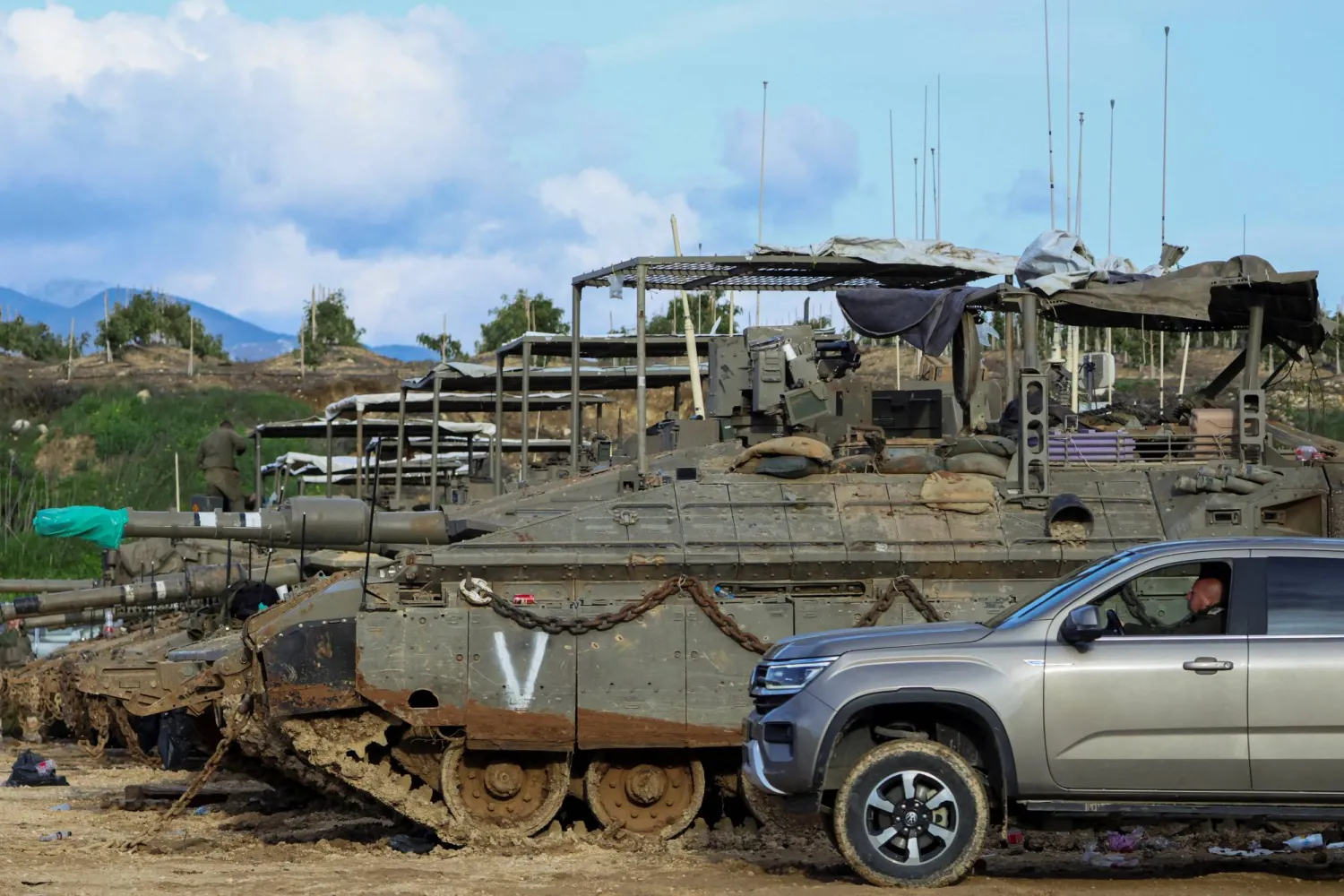
The largest contiguous area the army controls is around the Gaza border, where the military has razed Palestinian homes, farmland and infrastructure to the point of uninhabitability, according to Israeli soldiers and rights groups. This military buffer zone has doubled in size in recent weeks.

Israel has depicted its tightening grip as a temporary necessity to pressure Hamas into releasing the remaining hostages taken during the Oct. 7, 2023, attack that started the war. But the land Israel holds, which includes a corridor that divides the territory's north from south, could be used for wielding long-term control, human rights groups and Gaza experts say.

Prime Minister Benjamin Netanyahu said last week that even after Hamas is defeated, Israel will keep security control in Gaza and push Palestinians to leave.

The demolition close to the Israeli border and the systematic expansion of the buffer zone has been going on since the war began 18 months ago, five Israeli soldiers told The Associated Press.

“They destroyed everything they could, they shot everything that looks functioning ... (the Palestinians) will have nothing to come back, they will not come back, never,” a soldier deployed with a tank squad guarding the demolition teams said. He and four other soldiers spoke to the AP on condition of anonymity for fear of reprisals.

A report documenting the accounts of soldiers who were in the buffer zone was released Monday by Breaking The Silence, an anti-occupation veterans group. A handful of soldiers -- including some who also spoke to AP -- described watching the army turn the zone into a vast wasteland.

“Through widespread, deliberate destruction, the military laid the groundwork for future Israeli control of the area,” said the group.

Asked about the soldiers' accounts, the Israeli army said it is acting to protect its country and especially to improve security in southern communities devastated by the Oct. 7 attack, in which some 1,200 people were killed and 251 taken hostage. The army said it does not seek to harm civilians in Gaza, and that it abides by international law.

This satellite photo from Planet Labs PBC shows an Israeli army outpost near the town of Khuzaa, east of Khan Younis in the southern Gaza Strip in March, 2025. (Planet Labs PBC via AP)

Carving Gaza into sections

In the early days of the war, Israeli troops forced Palestinians from communities near the border and destroyed the land to create a buffer zone more than a kilometer (0.62 miles) deep, according to Breaking The Silence.

Its troops also seized a swath of land across Gaza known as the Netzarim Corridor that isolated the north, including Gaza City, from the rest of the narrow, coastal strip, home to more than 2 million people.

When Israel resumed the war last month, it doubled the size of the buffer zone, pushing it as far as 3 kilometers (1.8 miles) into Gaza in some places, according to a map issued by the military.

The buffer zone and the Netzarim Corridor make up at least 50% of the strip, said Yaakov Garb, a professor of environmental studies at Ben Gurion University, who has been examining Israeli-Palestinian land use patterns for decades.

Last week, Netanyahu said Israel intends to create another corridor that slices across southern Gaza, cutting off the city of Rafah from the rest of the territory. Israel's control of Gaza is even greater taking into account areas where it recently ordered civilians to evacuate ahead of planned attacks.

Neighborhoods turned into rubble

Hundreds of thousands of Palestinians used to live in the land that now makes up Israel's buffer zone, an area that was key to Gaza's agricultural output.

Satellite images show once dense neighborhoods turned to rubble, as well as nearly a dozen new Israeli army outposts since the ceasefire ended.

When the ceasefire was announced in January, Nidal Alzaanin went back to his home in Beit Hanoun in northern Gaza. His property stood on the edge of the buffer zone and lay in ruins.

All that remains is a photo of him and his wife on their wedding day, a drawing of his son's face on a porcelain plate and the carcass of a 150-year-old sycamore tree planted by his great-grandfather. His greenhouse was reduced to twisted scraps of metal.

The 55-year-old farmer pitched a tent in the rubble, hoping to rebuild his life. But when Israel resumed its campaign and seized his land, he was again uprooted.

“It took 20 years to build a house and within five minutes they destroyed all my dreams and my children's dreams,” he said from Gaza City, where he now shelters.

Israel's bombardment and ground offensives throughout the war have left vast swaths of Gaza's cities and towns destroyed. But the razing of property inside the buffer zone has been more methodical and extensive, soldiers said.

The five soldiers who spoke to the AP said Israeli troops were ordered to destroy farmland, irrigation pipes, crops and trees as well as thousands of buildings, including residential and public structures, so that gunmen had nowhere to hide.

Several soldiers said their units demolished more buildings than they could count, including large industrial complexes. A soda factory was leveled, leaving shards of glass and solar panels strewn on the ground.

Israeli military vehicles move inside the Gaza Strip, as seen from southern Israel, Tuesday, Jan. 7, 2025. (AP)

Soldier says buffer zone was a 'kill' zone

The soldiers said the buffer zone had no marked boundaries, but that Palestinians who entered were shot at.

The soldier with the tank squad said an armored bulldozer flattened land creating a “kill zone” and that anyone who came within 500 meters of the tanks would be shot, including women and children.

Visibly shaken, he said many of the soldiers acted out of vengeance for the Oct. 7 attack.

“I came there because they kill us and now we're going to kill them. And I found out that we're not only killing them. We're killing them, we're killing their wives, their children, their cats, their dogs, and we destroyed their houses,” he said.

The army said its attacks are based on intelligence and that it avoids “as much as possible, harm to non-combatants.”

Long-term hold?

It is unclear how long Israel intends to hold the buffer zone and other territory inside Gaza.

In announcing the new corridor across southern Gaza, Netanyahu said Israel aims to pressure Hamas to release the remaining 59 hostages, of whom 35 are believed dead. He also said the war can only end when Hamas is destroyed and its leaders leave Gaza, at which point Israel would take control of security in the territory.

Then, Netanyahu said, Israel would implement US President Donald Trump's call to move Palestinians from Gaza, what Israel calls “voluntary emigration.”

Some Israel analysts say the purpose of the buffer zone isn't to occupy Gaza, but to secure it until Hamas is dismantled. “This is something that any sane country will do with regard to its borders when the state borders a hostile entity,” said Kobi Michael, a senior researcher at two Israeli think tanks, the Institute for National Security Studies and the Misgav Institute.

But rights group say forcibly displacing people is a potential war crime and crime against humanity. Within Gaza's buffer zones, specifically, it amounts to “ethnic cleansing,” because it was clear people would never be allowed to return, said Nadia Hardman, a researcher at Human Rights Watch.

Israel called the accusations baseless and said it evacuates civilians from combat areas to protect them.



Sudan Drone Attack on Darfur Market Kills 10

Sudanese refugee girls carry water supplies near a polling station in the refugee camp of Zamzam, on the outskirts of el-Fasher, Darfur, Sudan, on April 13, 2010. (AP)
TT

Sudan Drone Attack on Darfur Market Kills 10

Sudanese refugee girls carry water supplies near a polling station in the refugee camp of Zamzam, on the outskirts of el-Fasher, Darfur, Sudan, on April 13, 2010. (AP)

A drone attack on a busy market in Sudan's North Darfur state killed 10 people over the weekend, first responders said on Sunday, without saying who was responsible.

The attack comes as fighting intensified elsewhere in the country, leading aid workers to be evacuated on Sunday from Kadugli, a besieged, famine-hit city in the south.

Since April 2023, Sudan's army and the paramilitary Rapid Support Forces have been locked in a conflict which has killed tens of thousands of people, displaced nearly 12 million and created the world's largest displacement and hunger crisis.

The North Darfur Emergency Rooms Council, one of hundreds of volunteer groups coordinating aid across Sudan, said a drone strike hit Al-Harra market in the RSF-controlled town of Malha on Saturday.

The attack killed 10 people, it said.

The council did not identify who carried out the attack, which it said had also sparked "fire in shops and caused extensive material damage".

There was no immediate comment from either the Sudanese army or the RSF.

The war's current focal point is now South Kordofan and clashes have escalated in Kadugli, the state capital, where a drone attack last week killed eight people as they attempted to flee the army-controlled city.

A source from a humanitarian organization operating in Kadugli told AFP on Sunday that humanitarian groups had "evacuated all their workers" from the city because of the security conditions.

The evacuation followed the United Nations' decision to relocate its logistics hub from Kadugli, the source said on condition of anonymity, without specifying where the staff had gone.

- Measles outbreak -

Kadugli and nearby Dilling have been besieged by paramilitary forces since the war erupted.

Last week, the RSF claimed control of the Brno area, a key defensive line on the road between Kadugli and Dilling.

After dislodging the army in October from the western city of el-Fasher -- its last stronghold in the Darfur region -- the RSF has shifted its focus to resource-rich Kordofan, a strategic crossroads linking army-held northern and eastern territories with RSF-held Darfur in the west.

Like Darfur, Kordofan is home to numerous non-Sudanese Arab ethnic groups. Much of the violence that followed the fall of el-Fasher was reportedly ethnically targeted.

Communications in Kordofan have been cut, and the United Nations declared a famine in Kadugli last month.

According to the UN's International Organization for Migration, more than 50,000 civilians have fled the region since the end of October.

Residents have been forced to forage for food in nearby forests, according to accounts gathered by AFP.

Doctors without Borders (MSF) said on Sunday that measles was spreading in three of the four states in Darfur, a vast region covering much of western Sudan.

"A preventable measles outbreak is spreading across Central, South and West Darfur," the organization said in a statement.

"Since September 2025, MSF teams have treated more than 1,300 cases. Delays in vaccine transport, approvals and coordination, by authorities and key partners are leaving children unprotected."


Foreign Press Group Welcomes Israel Court Deadline on Gaza Access

A Palestinian man carries the body of his 5-month-old brother, Ahmed Al-Nader, who was reportedly killed the previous day along with other family members in an Israeli shelling on a school-turned-shelter in the Tuffah neighborhood of Gaza City, ahead of his funeral on December 20, 2025. (AFP)
TT

Foreign Press Group Welcomes Israel Court Deadline on Gaza Access

A Palestinian man carries the body of his 5-month-old brother, Ahmed Al-Nader, who was reportedly killed the previous day along with other family members in an Israeli shelling on a school-turned-shelter in the Tuffah neighborhood of Gaza City, ahead of his funeral on December 20, 2025. (AFP)

The Foreign Press Association in Jerusalem on Sunday welcomed the Israeli Supreme Court's decision to set January 4 as the deadline for Israel to respond to its petition seeking media access to Gaza.

Since the start of the Gaza war in October 2023, sparked by Palestinian group Hamas's attack on Israel, Israeli authorities have prevented foreign journalists from independently entering the devastated territory.

Israel has instead allowed, on a case-by-case basis, a handful of reporters to accompany its troops into the blockaded Palestinian territory.

The Foreign Press Association (FPA), which represents hundreds of foreign journalists in Israel and the Palestinian territories, filed a petition to the supreme court last year, seeking immediate access for international journalists to the Gaza Strip.

On October 23, the court held a first hearing on the case, and decided to give Israeli authorities one month to develop a plan for granting access.

Since then, the court has given several extensions to the Israeli authorities to come up with their plan, but on Saturday it set January 4 as a final deadline.

"If the respondents (Israeli authorities) do not inform us of their position by that date, a decision on the request for a conditional order will be made on the basis of the material in the case file," the court said.

The FPA welcomed the court's latest directive.

"After two years of the state's delay tactics, we are pleased that the court's patience has finally run out," the association said in a statement.

"We renew our call for the state of Israel to immediately grant journalists free and unfettered access to the Gaza Strip.

"And should the government continue to obstruct press freedoms, we hope that the supreme court will recognize and uphold those freedoms," it added.


One Dead in Israeli Strikes on South Lebanon

Smoke rises from the site of a series of Israeli airstrikes that targeted the outskirts of the southern Lebanese village of al-Katrani on December 18, 2025. (AFP)
TT

One Dead in Israeli Strikes on South Lebanon

Smoke rises from the site of a series of Israeli airstrikes that targeted the outskirts of the southern Lebanese village of al-Katrani on December 18, 2025. (AFP)

Israeli strikes in south Lebanon on Sunday killed one person and wounded another, the Lebanese health ministry said, as Israel's military said it targeted Hezbollah members.

Israel has kept up regular strikes on Lebanon, usually saying it is targeting Hezbollah infrastructure or operatives, despite a November 2024 ceasefire that sought to end more than a year of hostilities with the Iran-backed group that erupted over the Gaza war.

It has also kept troops in five south Lebanon areas that it deems strategic.

The health ministry in Beirut said "two Israeli enemy strikes today, on a vehicle and a motorbike in the town of Yater" killed one person and wounded another.

Yater is around five kilometers (three miles) from the border with Israel.

In separate statements, the Israeli military said it "struck a Hezbollah terrorist in the area of Yater", adding shortly afterwards that it "struck an additional Hezbollah terrorist" in the same area.

Also on Sunday, Lebanon's army said in a statement that troops had discovered and dismantled "an Israeli spy device" in Yaroun, elsewhere in south Lebanon near the border.

Under heavy US pressure and amid fears of expanded Israeli strikes, Lebanon has committed to disarming Hezbollah and plans to do so south of the Litani River, about 30 kilometers from the border with Israel, by year end.

Israel has questioned the Lebanese military's effectiveness and has accused Hezbollah of rearming, while the group itself has rejected calls to surrender its weapons.

During a visit to Israel on Sunday, US Senator Lindsey Graham also accused Hezbollah of rearming.

"My impression is that Hezbollah is trying to make more weapons... That's not an acceptable outcome," Graham said in a video statement issued by Israeli Prime Minister Benjamin Netanyahu's office.

More than 340 people have been killed by Israeli fire in Lebanon since the ceasefire, according to an AFP tally of Lebanese health ministry reports.

This week at talks in Paris, Lebanon's army chief agreed to document the military's progress in disarming Hezbollah, the French foreign ministry said.

On Friday, Lebanese and Israeli civilian representatives took part in a meeting of the ceasefire monitoring committee for a second time, after holding their first direct talks in decades earlier this month under the committee's auspices.

Israel said Friday's meeting was part of broader efforts to ensure Hezbollah's disarmament and strengthen security in border areas.