


Sisi, Burhan Discuss Nile Water Security, Post-War Reconstruction in Sudan

Sisi meets Al-Burhan at Al-Ittihadiya Palace in Cairo on April 28, 2025 (Egyptian Presidency). 
TT

Sisi, Burhan Discuss Nile Water Security, Post-War Reconstruction in Sudan

Sisi meets Al-Burhan at Al-Ittihadiya Palace in Cairo on April 28, 2025 (Egyptian Presidency). 

Egyptian President Abdel Fattah al-Sisi held high-level talks in Cairo on Monday with Sudanese Sovereignty Council Chairman General Abdel Fattah al-Burhan, focusing on regional water security and Egypt’s role in rebuilding war-torn Sudan.

The meeting, held at Al-Ittihadiya Palace, underscored Egypt’s commitment to supporting Sudan amid its ongoing internal conflict, which has ravaged the country since April 2023. Sisi reaffirmed his country’s readiness to contribute to reconstruction efforts and help restore infrastructure destroyed by the civil war.

In a joint statement, the two leaders emphasized their continued coordination to preserve the water security of both nations and rejected unilateral measures concerning the Nile River. Egyptian presidential spokesperson Mohamed al-Shennawy said the talks also covered broader regional issues, particularly developments in the Nile Basin and the Horn of Africa.

“There is complete alignment between Egypt and Sudan on the strategic importance of shared water resources and the need for regional stability,” al-Shennawy said.

The two sides reiterated their opposition to unilateral actions related to the Blue Nile—Ethiopia’s main tributary for the Grand Ethiopian Renaissance Dam (GERD). Egypt and Sudan have long called for a binding legal agreement with Ethiopia on the dam’s operation to safeguard their downstream water rights.

Al-Burhan’s visit came at the invitation of Sisi and follows a series of diplomatic contacts aimed at bolstering bilateral cooperation. Sisi personally welcomed the Sudanese leader at Cairo Airport before accompanying him to the palace for official reception ceremonies.

Talks included the recent battlefield developments in Sudan, where the Sudanese Armed Forces have reportedly regained control of the capital, Khartoum. Both leaders discussed coordinating efforts to support civilians in conflict zones and advance political and economic integration between the two countries.

In expanded discussions involving ministers and senior officials from both sides, Egypt and Sudan agreed to accelerate joint projects in key sectors such as electricity interconnection, rail infrastructure, trade, agriculture, health, industry, mining, and cultural exchange.

Sudan has been mired in civil war since mid-2023, pitting the national army against the paramilitary Rapid Support Forces (RSF). The conflict has displaced over 14 million people, with more than 1.2 million seeking refuge in Egypt, according to UN figures.

Sisi has consistently called for a ceasefire and stressed the importance of maintaining Sudan’s territorial integrity and institutional stability. He recently condemned plans by the RSF to announce a parallel government in areas under its control, calling the move a direct threat to Sudan’s unity and sovereignty.

Sudanese Ambassador to Cairo Imad-Eddin Adawi hailed the summit as a testament to the “depth and resilience” of Egyptian-Sudanese ties. “There is a shared political will to move forward together,” he said, adding that Egypt plays a pivotal role in mediating regional stability and facilitating dialogue among Sudanese factions.

Hossam Issa, Egypt’s former assistant foreign minister for Sudan, described al-Burhan’s visit as a “milestone” in efforts to end the conflict. “The recent military gains on the ground could pave the way for restoring governance in Khartoum and beginning the process of reconstruction,” he told Asharq Al-Awsat.



France, Iraq Deepen Energy, Defense Ties During Al-Zaidi Visit

 France's President Emmanuel Macron (R) shakes hand with Iraq's Prime Minister Ali al-Zaidi (L) during an agreement signing ceremony at the Elysee Palace in Paris on September 14, 2026. (AFP)
France's President Emmanuel Macron (R) shakes hand with Iraq's Prime Minister Ali al-Zaidi (L) during an agreement signing ceremony at the Elysee Palace in Paris on September 14, 2026. (AFP)
TT

France, Iraq Deepen Energy, Defense Ties During Al-Zaidi Visit

 France's President Emmanuel Macron (R) shakes hand with Iraq's Prime Minister Ali al-Zaidi (L) during an agreement signing ceremony at the Elysee Palace in Paris on September 14, 2026. (AFP)
France's President Emmanuel Macron (R) shakes hand with Iraq's Prime Minister Ali al-Zaidi (L) during an agreement signing ceremony at the Elysee Palace in Paris on September 14, 2026. (AFP)

France and Iraq on Monday called for a "diversification of export routes" for oil and gas in the Middle East in response to the instability generated by the conflict between the United States and Iran, following talks in Paris.

French President Emmanuel Macron and Iraq's Prime Minister Ali al-Zaidi stressed the importance of "regional interconnections" and export route diversification to "ensure regional energy security", in a joint statement.

Zaidi visited the Elysee Paris on his first trip to Europe since taking office in May and is also expected in Berlin on Tuesday.

The visit comes as the situation in the Middle East continues to deteriorate, with the Iran-backed Houthi militants cementing their hold on the Bab al-Mandeb Strait on Friday, adding to the crisis of Iran's effective closure of the Strait of Hormuz, and driving oil prices up.

On Monday, French energy giant TotalEnergies signed a memorandum of understanding with Iraq on liquefied natural gas supplies and agreed to discuss further energy projects.

TotalEnergies chief Patrick Pouyanne "affirmed the company's readiness to cooperate with Iraq in the oil and energy sectors", noting the company planned to increase its investments in Iraq to $16 billion from $12 billion, during a meeting with Zaidi.

The two countries, which in recent years have been involved in the fight against the ISIS extremist group, also agreed to deepen defense cooperation.

They signed a strategic roadmap on the acquisition of French military equipment as Iraq seeks to modernize its armed forces and strengthen its sovereignty capabilities.

French drone company Harmattan AI separately signed a letter of intent with Iraq's defense ministry concerning autonomous air-defense systems.

Several other agreements were signed in areas including development assistance, education, civil aviation and electricity infrastructure.


Taiz on Alert to Confront the Houthi Threat

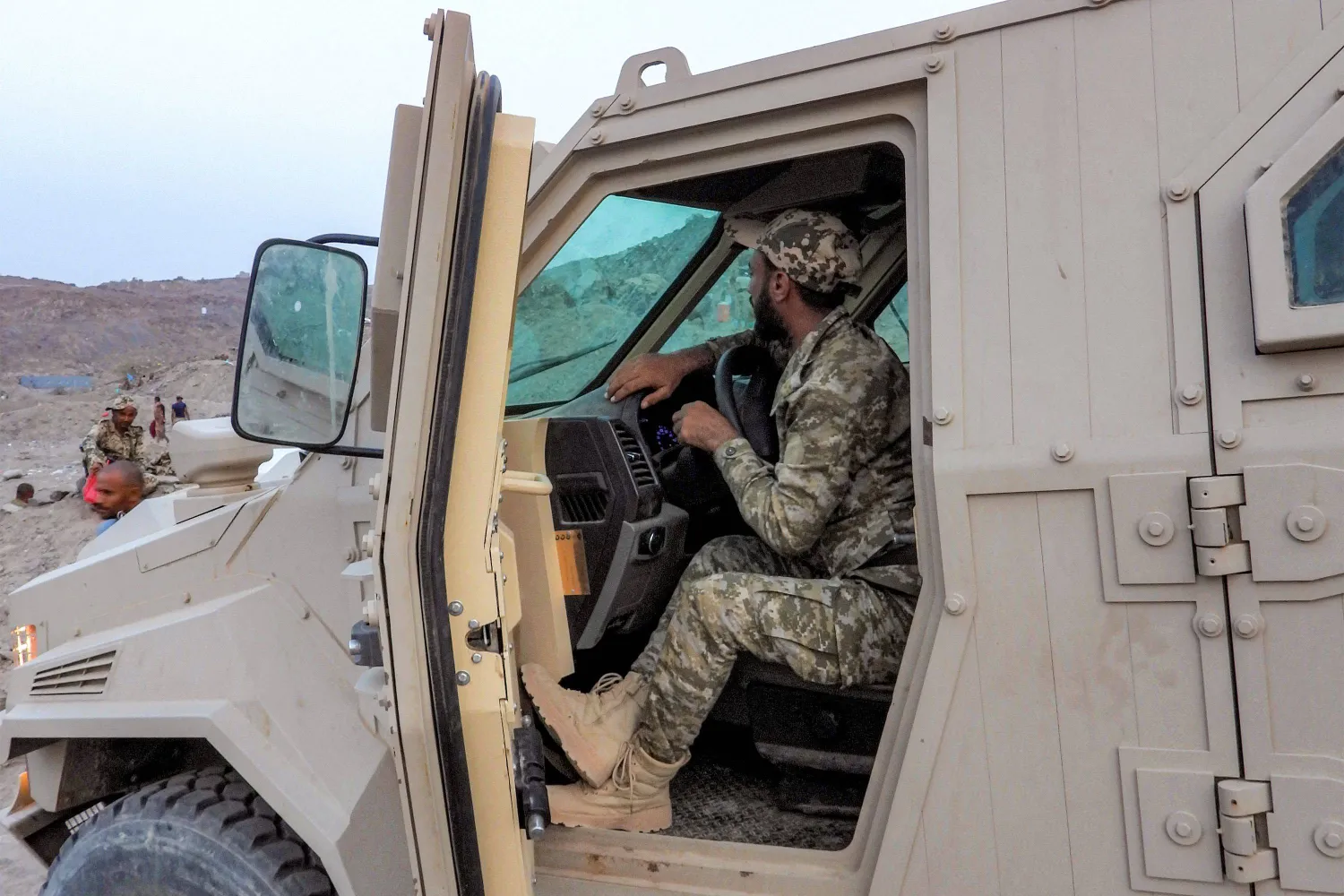
A member of the Yemeni government forces, including National Army and Taiz Axis forces, sits in an armored vehicle at a position along the Kadha frontline west of Taiz in western Yemen on September 13, 2026. (AFP)
TT

Taiz on Alert to Confront the Houthi Threat

A member of the Yemeni government forces, including National Army and Taiz Axis forces, sits in an armored vehicle at a position along the Kadha frontline west of Taiz in western Yemen on September 13, 2026. (AFP)

Yemen’s Taiz governorate has raised its readiness to counter threats from the Houthi militia as the group intensifies its movements across the province's western, northern, and southern fronts in an attempt to achieve field breakthroughs.

These advances aim to tighten the siege on Taiz city and its liberated countryside, while threatening supply lines connecting the city to its western rural areas.

The mobilization coincided with fierce battles fought by government forces across several locations, during which they managed to recapture positions that the Houthis had infiltrated in the western part of the governorate.

Government troops also advanced toward new areas, while airstrikes targeted Houthi positions, reinforcements, and vehicles across multiple fronts.

The group has been attempting, since the start of the escalation in early September, to exploit the widening scope of confrontations along the western coast, southern Hodeidah, and western Taiz. These maneuvers aim to redraw the lines of contact around the governorate, allowing the militia to pressure Taiz city from several directions and sever supply and movement routes leading to the coastal areas.

During the past few hours, government forces announced the recapture of positions overlooking the Jurdad area in al-Shamayatayn district, as well as an advance toward the Ghail Bani Omar region.

These developments followed clashes with Houthi fighters who had infiltrated several locations in the western part of the governorate.

Official military sources said that government forces managed to seize Houthi military equipment during the operations, while inflicting casualties among Houthi ranks.

The government also intensified airstrikes on Houthi positions and movements in various parts of the governorate. According to military sources, the strikes targeted military vehicles and gatherings in the districts of Dhubab, al-Waziyah, and Hayfan, as well as a gathering of militants in the Al-Afeerah area of Jabal Habashi district, killing at least ten militants and destroying several vehicles and a medium-weapons ammunition cache.

Meanwhile, the local authority in Taiz moved to mobilize the internal front to counter the escalation.

Governor of Taiz Nabil Shamsan met with sheikhs, notables, dignitaries, and social figures in the al-Shamayatayn, as part of efforts to strengthen internal cohesion and unify the local stance behind government forces.

Shamsan stressed that Taiz will continue to stand firm against the Houthis, praising the role the governorate has played during the years of war in preserving state institutions, as well as the Saudi support provided to the government and the Yemeni people in confronting the group.

The Human Rights Ministry said 150 civilians have been killed and over 200 wounded between September 3 and 13 since the escalation intensified. Some 85,000 have been displaced.


Portugal Says Israel Undermining Palestinian State Through Settlement Expansion

Palestinian Foreign Affairs and Expatriates Minister Varsin Aghabekian Shahin (L) and Portuguese Foreign Minister Paulo Rangel (R) attend a press conference after a meeting at Necessidades Palace in Lisbon, Portugal, 14 September 2026. (EPA)
TT

Portugal Says Israel Undermining Palestinian State Through Settlement Expansion

Palestinian Foreign Affairs and Expatriates Minister Varsin Aghabekian Shahin (L) and Portuguese Foreign Minister Paulo Rangel (R) attend a press conference after a meeting at Necessidades Palace in Lisbon, Portugal, 14 September 2026. (EPA)

Portugal's ‌foreign minister said on Monday that Israeli settlement expansion and economic pressure in the occupied West Bank and East Jerusalem were undermining prospects for a viable Palestinian state.

Foreign Minister Paulo Rangel said Israel's E1 settlement plan was "extremely pernicious" because ‌it would ‌divide the West Bank, ‌isolate ⁠East Jerusalem and ⁠was incompatible with a two-state solution.

Israel's withholding of Palestinian tax revenues amounted to a "brutal strangulation" of the Palestinian Authority's finances, preventing the economy from ⁠functioning, he said after meeting ‌Palestinian Foreign ‌Minister Varsen Aghabekian Shahin in Lisbon.

‌Rangel also cited the closure ‌of Christian schools in East Jerusalem as evidence of worsening conditions there.

Portugal recognized the State ‌of Palestine a year ago.

Rangel said the two-state ⁠solution ⁠was the only way to guarantee peaceful coexistence between Israelis and Palestinians.

Israel said last week it was closing Britain's consulate in East Jerusalem in response to plans by the UK, France and Canada to block imports from Israeli settlements in the West Bank.
