

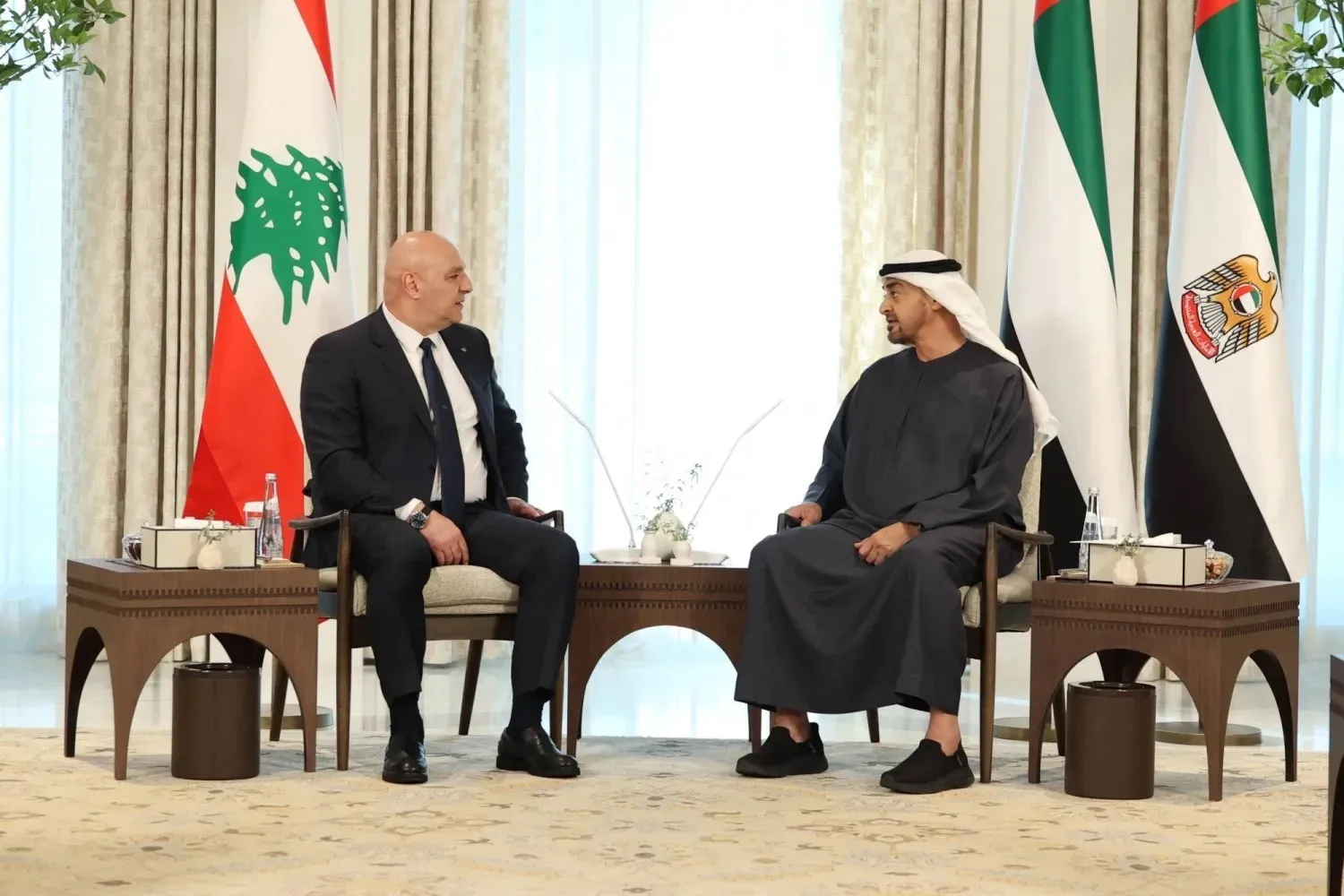

UAE-Lebanon Summit Marks New Chapter in Bilateral Relations

Lebanese President Joseph Aoun and UAE President Sheikh Mohamed bin Zayed Al Nahyan meet at Al Shati Palace in Abu Dhabi (Lebanese Presidency)
TT

UAE-Lebanon Summit Marks New Chapter in Bilateral Relations

Lebanese President Joseph Aoun and UAE President Sheikh Mohamed bin Zayed Al Nahyan meet at Al Shati Palace in Abu Dhabi (Lebanese Presidency)

Lebanese President Joseph Aoun met with UAE President Sheikh Mohamed bin Zayed Al Nahyan on Wednesday in Abu Dhabi, launching a new phase in Lebanese-Emirati relations marked by renewed cooperation and mutual support.

The summit, held at Al Shati Palace shortly after Aoun’s arrival, highlighted both leaders’ commitment to strengthening ties between the two nations.

“The past is behind us,” Aoun said, adding that Lebanon is “regaining its presence, capacity, and sovereignty,” with state institutions working together to build the country’s future.

Sheikh Mohamed reaffirmed the UAE’s unwavering support for Lebanon’s sovereignty, unity, and territorial integrity, stressing the importance of strong Lebanese institutions in ensuring national stability. He also noted that the recent reopening of the UAE embassy in Beirut signals a renewed commitment to deeper, more fruitful relations.

Aoun, who was accompanied by Foreign Minister Youssef Raji, was received at Abu Dhabi International Airport by UAE Foreign Minister Sheikh Abdullah bin Zayed Al Nahyan, Minister Khalifa Shaheen, and Lebanese Ambassador to the UAE Fouad Shihab Dandan.

During a broader meeting with Emirati and Lebanese officials, Sheikh Mohamed described the two countries’ relationship as historic and deeply rooted in mutual respect and shared values.

“The ties between the UAE and Lebanon are strong, and the people of both nations share longstanding bonds of goodwill,” he said.

Aoun expressed appreciation for the UAE’s hospitality to the Lebanese diaspora, which numbers around 190,000. He also thanked Sheikh Mohamed for responding positively to the reopening of the UAE embassy in Lebanon, a pledge made during a congratulatory call following Aoun’s election.

“Lebanon is going through a challenging period,” Aoun acknowledged. “But the state is recovering, and the situation is evolving. We are working together for a better future.” He emphasized regional unity, stating: “The Arab world is one body - when one part suffers, the whole is affected.”

Aoun also paid tribute to the UAE’s founding father, the late Sheikh Zayed bin Sultan Al Nahyan, calling him a visionary leader who propelled the UAE into the ranks of the world’s most advanced nations.

The summit concluded with a one-on-one meeting between the two presidents that lasted approximately 30 minutes.



Iraqi Lawmakers to Elect President Tuesday, PM Appointment Next

 A photograph shows Iraq's parliament building in Baghdad as newly elected lawmakers are due to hold their first session on Dec. 29, 2025. (AFP)
A photograph shows Iraq's parliament building in Baghdad as newly elected lawmakers are due to hold their first session on Dec. 29, 2025. (AFP)
TT

Iraqi Lawmakers to Elect President Tuesday, PM Appointment Next

 A photograph shows Iraq's parliament building in Baghdad as newly elected lawmakers are due to hold their first session on Dec. 29, 2025. (AFP)
A photograph shows Iraq's parliament building in Baghdad as newly elected lawmakers are due to hold their first session on Dec. 29, 2025. (AFP)

Iraq's parliament will meet on Tuesday to elect the country's new president, who will then appoint a prime minister expected to be Nouri al-Maliki after he was endorsed by the largest Shiite bloc.

By convention, a Shiite holds the post of prime minister, the parliament speaker is Sunni and the largely ceremonial presidency goes to a Kurd.

Parliamentary speaker Haibat al-Halbousi announced on Sunday that the new parliament will convene on Tuesday to elect a president, according to the official INA press agency.

The president will then have 15 days to appoint a prime minister, who is usually nominated by the largest Shiite bloc formed through post-election alliances.

On Saturday, the Coordination Framework alliance -- whose Shiiite factions have varying links to Iran -- endorsed former prime minister and powerbroker Maliki as the country's next premier.

The alliance, to which Maliki belongs, spoke of his "political and administrative experience and his record in running the state".

Kurdish parties have yet to agree on a presidential candidate, who must be endorsed by other blocs and win a two-thirds majority in parliament.

The presidency is usually held by the Patriotic Union of Kurdistan (PUK). This year, the rival Kurdistan Democratic Party (KDP) named its own candidate: Foreign Minister Fuad Hussein.

Although Maliki's endorsement effectively guarantees him the post, forming a new government remains a daunting challenge that could drag on for months and still fail.

The designated premier has one month to form a government and present it to parliament for a vote of confidence.

The 75-year-old Maliki, a shrewd politician, is set to return to power at a time of seismic changes in the Middle East, as Tehran's regional influence wanes and tensions with Washington rise.

Government formation in Iraq must balance internal political dynamics and power-sharing among major parties, all under the continued influence of Iraq's two main allies: Iran and the United States.

A close Iran ally, Maliki will be expected to address Washington's longstanding demand that Baghdad dismantle Tehran-backed factions, many of which are designated terrorist groups by the US.

Last month, Iraqi officials and diplomats told AFP that Washington demanded the eventual government exclude Iran-backed armed groups, even though most of them hold seats in parliament, and have seen their political and financial clout increase.

But Iraq is struggling with weak economic growth and cannot risk punitive measures by the US, which has already sanctioned several Iraqi entities, accusing them of helping Tehran evade sanctions.


Baghdad Says It Will Prosecute ISIS Militants Being Moved from Syria to Iraq

 Iraqi Border Guards patrol in armored vehicles along the border with Syria, in Sinjar, northern Iraq, Thursday, Jan. 22, 2026. (AP)
Iraqi Border Guards patrol in armored vehicles along the border with Syria, in Sinjar, northern Iraq, Thursday, Jan. 22, 2026. (AP)
TT

Baghdad Says It Will Prosecute ISIS Militants Being Moved from Syria to Iraq

 Iraqi Border Guards patrol in armored vehicles along the border with Syria, in Sinjar, northern Iraq, Thursday, Jan. 22, 2026. (AP)
Iraqi Border Guards patrol in armored vehicles along the border with Syria, in Sinjar, northern Iraq, Thursday, Jan. 22, 2026. (AP)

Baghdad will prosecute and try militants from the ISIS group who are being transferred from prisons and detention camps in neighboring Syria to Iraq under a US-brokered deal, Iraq said Sunday.

The announcement from Iraq’s highest judicial body came after a meeting of top security and political officials who discussed the ongoing transfer of some 9,000 ISIS detainees who have been held in Syria since the extremist group's collapse there in 2019.

The need to move them came after Syria's nascent government forces routed Syrian Kurdish-led fighters — once top US allies in the fight against ISIS — from areas of northeastern Syria they had controlled for years and where they had been guarding camps holding IS prisoners.

Syrian troops seized the sprawling al-Hol camp — housing thousands, mostly families of ISIS militants — from the Kurdish-led force, which withdrew as part of a ceasefire. Troops last Monday also took control of a prison in the northeastern town of Shaddadi, from where some ISIS detainees had escaped during the fighting. Syrian state media later reported that many were recaptured.

Now, the clashes between the Syrian military and the Kurdish-led Syrian Democratic Forces (SDF) sparked fears of ISIS activating its sleeper cells in those areas and of ISIS detainees escaping. The Syrian government under its initial agreement with the Kurds said it would take responsibility of the ISIS prisoners.

Baghdad has been particularly worried that escaped ISIS detainees would regroup and threaten Iraq’s security and its side of the vast Syria-Iraq border.

Once in Iraq, ISIS prisoners accused of terrorism will be investigated by security forces and tried in domestic courts, Iraq's Supreme Judicial Council said.

The US military started the transfer process on Friday with the first ISIS prisoners moved from Syria to Iraq. On Sunday, another 125 ISIS prisoners were transferred, according to two Iraqi security officials who spoke to The Associated Press on condition of anonymity in line with regulations.

So far, 275 prisoners have made it to Iraq, a process that officials say has been slow as the US military has been transporting them by air.

Both Damascus and Washington have welcomed Baghdad's offer to have the prisoners transferred to Iraq.

Iraq’s parliament will meet later on Sunday to discuss the ongoing developments in Syria, where its government forces are pushing to boost their presence along the border.

The fighting between the Syrian government and the SDF has mostly halted with a ceasefire that was recently extended. According to Syria's Defense Ministry, the truce was extended to support the ongoing transfer operation by US forces.

The ISIS group was defeated in Iraq in 2017, and in Syria two years later, but ISIS sleeper cells still carry out deadly attacks in both countries. As a key US ally in the region, the SDF played a major role in defeating ISIS.

During the battles against ISIS, thousands of extremists and tens of thousands of women and children linked to them were taken and held in prisons and at the al-Hol camp. The sprawling al-Hol camp hosts thousands of women and children.

Last year, US troops and their partner SDF fighters detained more than 300 ISIS militants in Syria and killed over 20. An ambush in December by ISIS militants killed two US soldiers and one American civilian interpreter in Syria.


Lebanon PM Says International Force Needed After UNIFIL

 France's President Emmanuel Macron (R) wearing sunglasses shakes hands with Lebanon's Prime Minister Nawaf Salam prior to their meeting at the Elysee presidential palace in Paris, on January 23, 2026. (AFP)
France's President Emmanuel Macron (R) wearing sunglasses shakes hands with Lebanon's Prime Minister Nawaf Salam prior to their meeting at the Elysee presidential palace in Paris, on January 23, 2026. (AFP)
TT

Lebanon PM Says International Force Needed After UNIFIL

 France's President Emmanuel Macron (R) wearing sunglasses shakes hands with Lebanon's Prime Minister Nawaf Salam prior to their meeting at the Elysee presidential palace in Paris, on January 23, 2026. (AFP)
France's President Emmanuel Macron (R) wearing sunglasses shakes hands with Lebanon's Prime Minister Nawaf Salam prior to their meeting at the Elysee presidential palace in Paris, on January 23, 2026. (AFP)

Lebanon will need some sort of international force after the withdrawal of the United Nations's UNIFIL mission scheduled for 2027, Prime Minister Nawaf Salam said during a visit to Paris Saturday.

Some 10,800 UN Interim Force in Lebanon (UNIFIL) peacekeepers have manned a buffer zone between Israel and Lebanon since March 1978, but they will have one year to leave Lebanon starting 31 December, under a resolution passed last August under pressure from the United States and Israel.

"We will always need an international presence in the south, and preferably a UN presence, given the impartiality and neutrality that only the UN can provide," Nawaf Salam said the day after a meeting with French President Emmanuel Macron.

The force would need a mix of observers and peacekeepers, largely because of a "history of hostility" with Israel, he added.

UN peacekeepers current operate in southern Lebanon in cooperation with the Lebanese army, part of a ceasefire between Israel and the pro-Iranian Hezbollah in place since November 2024.

While Israel was supposed to withdraw its forces from southern Lebanon, it has maintained them in five areas it considers strategic.

It regularly conducts airstrikes in the country on what it claims are Hezbollah sites and members, whom it accuses of rearming.

Questioned about Hezbollah's promised disarmament, Salam said Phase 2 of this process had begun "two weeks ago".

The Lebanese army says it has completed the first phase, which calls for disarming Hezbollah south of the Litani River.

The second phase will involve disarmament between the Litani and the Awali River, an area further north that has significant Hezbollah influence.

"I can clearly see that Phase 2 has different requirements than Phase 1," said Salam, adding that Hezbollah's rhetoric had been "rather harsh".

"But let me be clear, we will not back down," he added.