

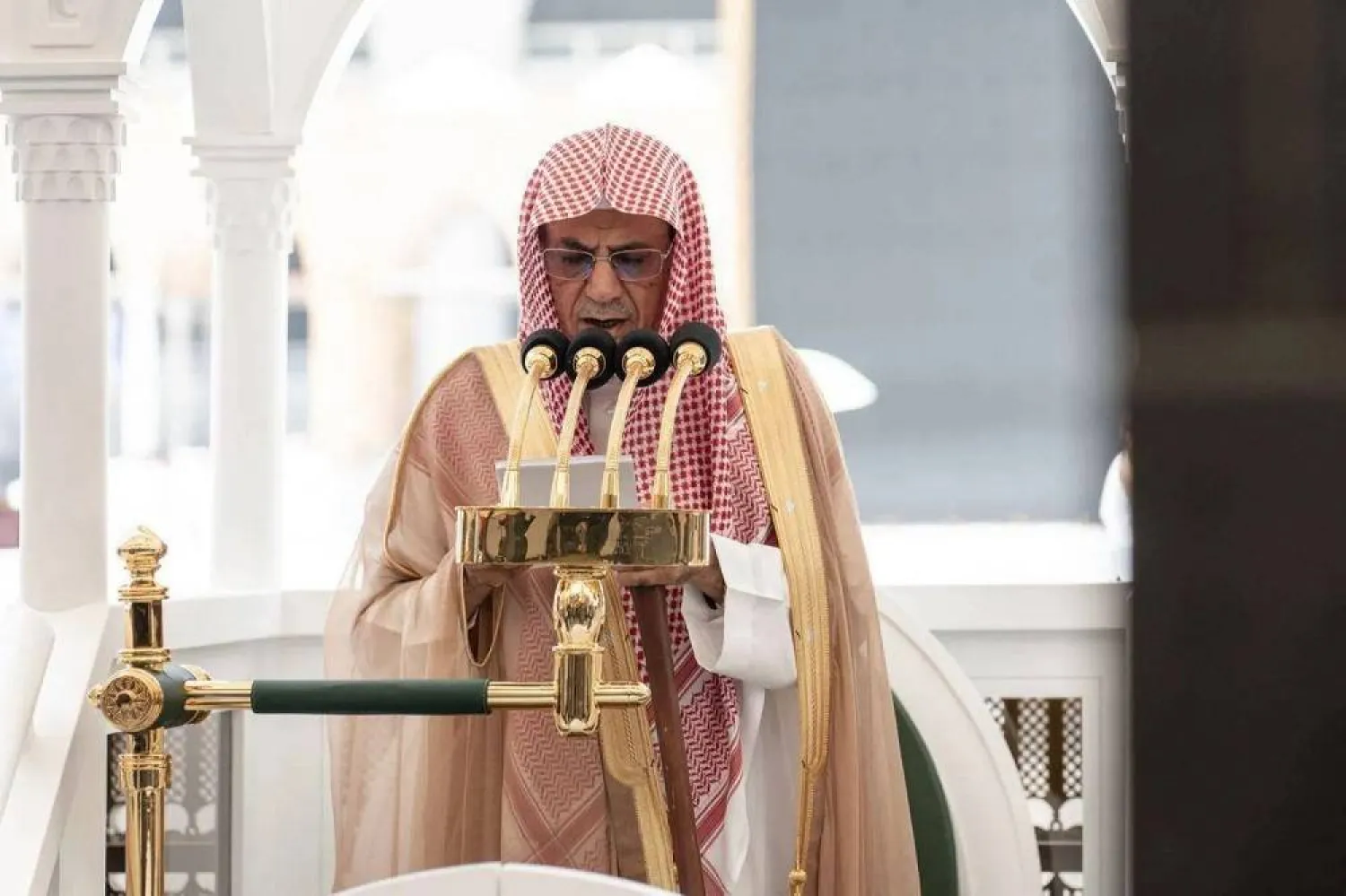

Sheikh Saleh bin Humaid to Deliver Arafat Day Sermon

Sheikh Dr. Saleh bin Humaid, imam and preacher of the Grand Mosque. (SPA)
TT

Sheikh Saleh bin Humaid to Deliver Arafat Day Sermon

Sheikh Dr. Saleh bin Humaid, imam and preacher of the Grand Mosque. (SPA)

Custodian of the Two Holy Mosques King Salman bin Abdulaziz approved the appointment of Sheikh Dr. Saleh bin Humaid, imam and preacher of the Grand Mosque in Makkah, to deliver this year’s Arafat Day sermon at the Namira Mosque, Saudi Arabia’s Presidency for the Affairs of the Two Holy Mosques said in a statement.

Bin Humaid, a prominent religious and academic figure, was born in 1950 in Buraidah, in the Qassim region. He later moved to Makkah, where he completed his high school education in 1967. He earned his bachelor’s degree in Islamic law from Umm Al-Qura University in 1975, followed by a master’s degree in 1976 and a PhD in Islamic jurisprudence and its principles in 1981, graduating with top honors.

His academic career began at the same university, where he served as a teaching assistant, lecturer, and eventually associate professor. He later became head of the university’s Islamic Economics Department.

Bin Humaid was the first holder of a doctoral degree to be appointed as an imam at the Grand Mosque. Over the years, he held several high-profile positions, including Deputy President for the Affairs of the Two Holy Mosques and member of the Shura Council between 1993 and 2000.

In 2000, he was appointed President of the General Presidency for the Affairs of the Two Holy Mosques.

A royal decree in 2002 named him Chairman of the Shura Council. In 2009, he became President of the Supreme Judicial Council. In 2012, he stepped down from the judiciary role at his request and was appointed a royal adviser with the rank of minister.

The General Authority for the Affairs of the Grand Mosque and the Prophet’s Mosque announced that the Mataf, the circumambulation area around the Kaaba, is fully prepared to receive pilgrims during this year’s Hajj, under comprehensive organizational plans aimed at ensuring the safety, comfort, and well-being of worshippers.

The Mataf’s operational capacity has reached 107,000 pilgrims per hour, across multiple levels, including the ground floor, first floor, two mezzanine levels, and the rooftop, it added. The entire Mataf area can accommodate up to 203,000 worshippers.

Officials confirmed that the entire Mataf area has been made accessible exclusively for pilgrims performing Tawaf.

Multiple main and secondary entrances have been designated to ease access to the area, with certain gates reserved for emergency and service use, all while ensuring full crowd-capacity management.

The measures are part of broader efforts to streamline the performance of Hajj rituals and provide high-quality services to pilgrims, in line with the directives of the Saudi leadership.



Crown Prince, UK PM Address Global Economic Crisis; Starmer Condemns Iran’s Attacks on Saudi Arabia

Prince Mohammed bin Salman bin Abdulaziz Al Saud, Saudi Crown Prince and Prime Minister, and British Prime Minister Keir Starmer meet in Riyadh in December 2024. (SPA)
TT

Crown Prince, UK PM Address Global Economic Crisis; Starmer Condemns Iran’s Attacks on Saudi Arabia

Prince Mohammed bin Salman bin Abdulaziz Al Saud, Saudi Crown Prince and Prime Minister, and British Prime Minister Keir Starmer meet in Riyadh in December 2024. (SPA)

Saudi Crown Prince and Prime Minister Prince Mohammed bin Salman bin Abdulaziz Al Saud received a phone call on Wednesday from British Prime Minister Keir Starmer, who condemned Iran’s continued assaults against Saudi Arabia.

Starmer expressed his country’s strong condemnation of Iran’s attacks highlighting their threat to security and stability, during the phone call with the Crown Prince.

The two leaders discussed regional security amid the ongoing military escalation, its impact on regional and global stability, and the associated risks to international maritime security and the global economy.


UN Rights Council Slams ‘Egregious’ Iran Strikes on Gulf, Demands Reparation

Smoke rises from Kuwait international airport after a drone strike on fuel storage in Kuwait City, Kuwait, Friday, Wednesday, March 25, 2026. (AP Photo)
TT

UN Rights Council Slams ‘Egregious’ Iran Strikes on Gulf, Demands Reparation

Smoke rises from Kuwait international airport after a drone strike on fuel storage in Kuwait City, Kuwait, Friday, Wednesday, March 25, 2026. (AP Photo)

The UN Human Rights Council on Wednesday condemned Iran's "egregious attacks" on Gulf countries and demanded full "reparation" for all victims of its strikes.

The 47-member council backed a resolution brought by the six Gulf Cooperation Council (GCC) countries and Jordan demanding Iran immediately "cease all unprovoked attacks.”

The resolution was adopted by consensus.

The resolution "condemns in the strongest terms the egregious attacks" by Iran, condemns Tehran's actions aimed at closing the Strait of Hormuz and voices "grave concerns at the Iranian attacks on energy infrastructure.”

It demands Iran "immediately and unconditionally cease all unprovoked attacks" against the GCC states and Jordan and "provide full, effective and prompt reparation to all victims for the damage and injury caused by its attacks.”

Saudi Arabia welcomed the UN Human Rights Council’s unanimous adoption of the resolution, which reflects the international community’s rejection of Iranian attacks and its condemnation of these brutal acts as grave violations of human rights.

In a statement, the Saudi Foreign Ministry said Iranian attacks on the Kingdom and other countries in the region “constitute a flagrant violation of the sovereignty and territorial integrity of states and a clear breach of international conventions and international law.”

“Targeting countries that are not party to the conflict is a blatant act of aggression that cannot be justified or accepted,” it added.


Iran Launched 83% of Missiles and Drones at the Gulf Compared to 17% at Israel

Smoke rises from a high-rise building following a drone attack in Kuwait City on March 8, 2026. (AFP/file photo)
TT

Iran Launched 83% of Missiles and Drones at the Gulf Compared to 17% at Israel

Smoke rises from a high-rise building following a drone attack in Kuwait City on March 8, 2026. (AFP/file photo)

Since the start of the war on February 28, about 83% of missiles and drones launched by Iran have targeted Gulf Cooperation Council (GCC) states, compared to 17% launched at Israel, reports indicate.

Official data shows that by Wednesday night, Iran had launched 4,391 missiles and drones at GCC vital infrastructure and civilian facilities, constituting a dangerous escalation that threatens regional security and stability.

As for Israel, which has initiated the war, it was hit by 930 Iranian missiles and drones or just 17% of the total attacks in the region.

Data shows that Iran has launched a total of 723 missile and drone attacks at Saudi Arabia since the beginning of the conflict.

The United Arab Emirates bore the brunt of Iranian attacks with 2,156 missiles and drones, followed by Kuwait with 791 attacks, Bahrain (429), Qatar (270) and Oman with 22 drone attacks.

Gulf air defense systems have demonstrated exceptional efficiency and professionalism in neutralizing these threats, proving to be an impenetrable shield safeguarding the region’s security and stability.

Arab and Muslim nations condemned the Iranian attacks, urging Tehran to cease aggression and respect international law for regional stability.

But Iran has escalated military operations against GCC countries, directly threatening the global economy and international energy security.