

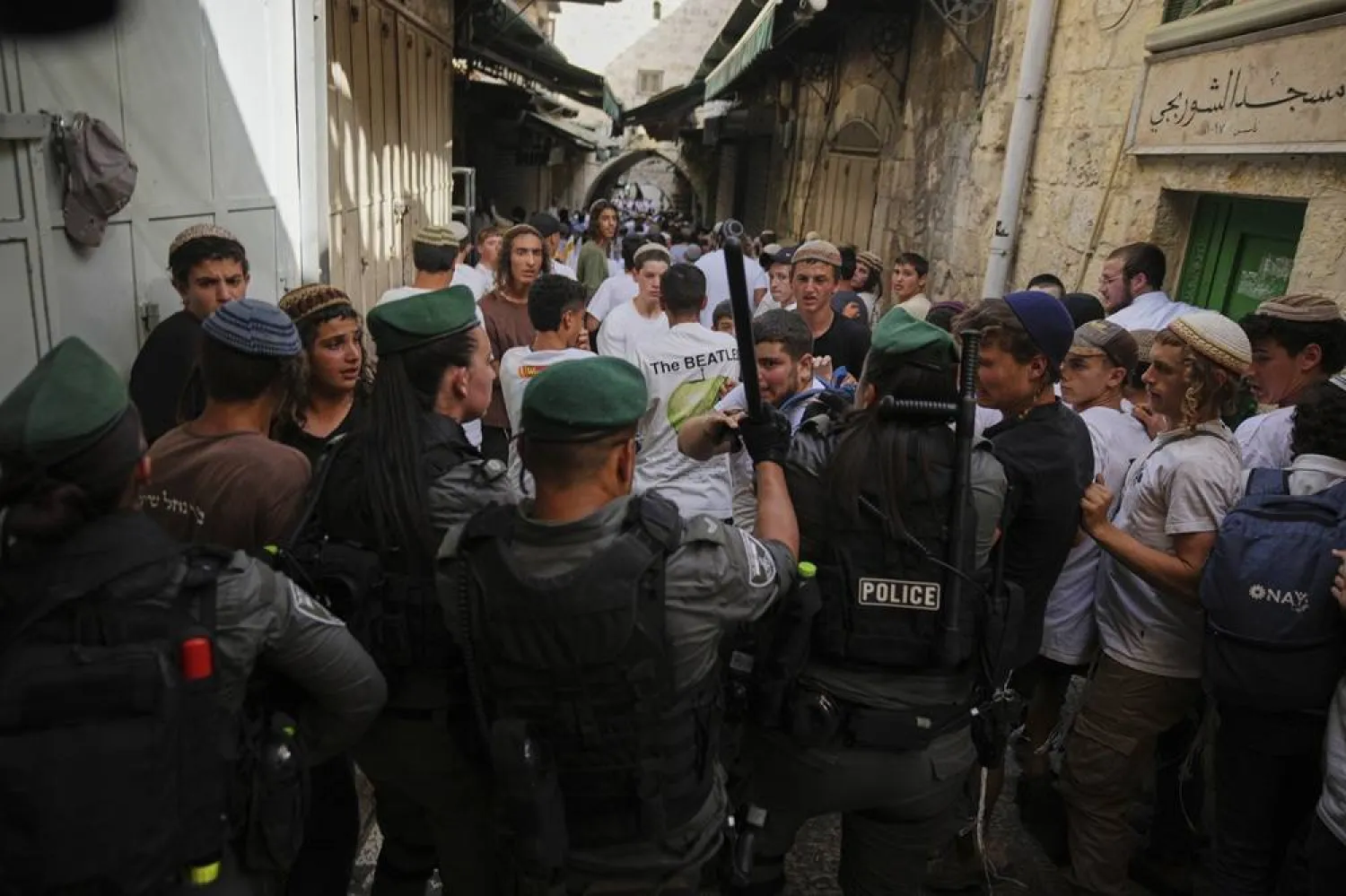

Chanting ‘Death to Arabs,’ Israeli Nationalists Begin an Annual March in Jerusalem

 Israeli police scuffle with young Israelis marching through Jerusalem's Old City marking Jerusalem Day, an Israeli holiday marking the capture of east Jerusalem in the 1967 Middle East War, Monday, May 26, 2025. (AP)
Israeli police scuffle with young Israelis marching through Jerusalem's Old City marking Jerusalem Day, an Israeli holiday marking the capture of east Jerusalem in the 1967 Middle East War, Monday, May 26, 2025. (AP)
TT

Chanting ‘Death to Arabs,’ Israeli Nationalists Begin an Annual March in Jerusalem

 Israeli police scuffle with young Israelis marching through Jerusalem's Old City marking Jerusalem Day, an Israeli holiday marking the capture of east Jerusalem in the 1967 Middle East War, Monday, May 26, 2025. (AP)
Israeli police scuffle with young Israelis marching through Jerusalem's Old City marking Jerusalem Day, an Israeli holiday marking the capture of east Jerusalem in the 1967 Middle East War, Monday, May 26, 2025. (AP)

Chanting "Death to Arabs" and singing "May your village burn," groups of young Israeli Jews made their way through Muslim neighborhoods of Jerusalem's Old City on Monday during an annual march marking Israel's capture of the eastern part of the city.

Palestinian shopkeepers had closed up early and police lined the narrow alleys before the march that often becomes a rowdy and sometimes violent procession of ultranationalist Jews. A policeman raised his arms in celebration at one point, recognizing a marcher and going in for a hug. It was blazing hot, with temperatures hitting 98 degrees Fahrenheit (37 Celsius) in late afternoon.

A small group of protesters, including an Israeli member of parliament, meanwhile, stormed a compound in east Jerusalem belonging to the UN agency for Palestinian refugees, known as UNRWA.

The march commemorates Jerusalem Day, which marks Israel’s capture of east Jerusalem, including the Old City and its holy sites sacred to Jews, Christians and Muslims, in the 1967 Middle East war. The event threatens to inflame tensions that are already rife in the restive city amid nearly 600 days of war in Gaza.

Jerusalem lies at the heart of the conflict between Israelis and Palestinians, who each see the city as a key part of their national and religious identity. It is one of the most intractable issues of the conflict and often emerges as a flashpoint.

Israel considers all of Jerusalem to be its eternal, undivided capital. Its annexation of east Jerusalem is not internationally recognized. Palestinians want an independent state with east Jerusalem as its capital.

Last year’s procession, which came during the first year of the war in Gaza, saw ultranationalist Israelis attack a Palestinian journalist in the Old City and call for violence against Palestinians. Four years ago, the march helped set off an 11-day war in Gaza.

Tour buses carrying young ultranationalist Jews lined up near entrances to the Old City, bringing hundreds from outside Jerusalem, including settlements in the Israeli-occupied West Bank.

Police, who were calling the procession the "Dance of Flags," said they had detained a number of individuals and "acted swiftly to prevent violence, confrontations and provocations."

Speaking in an east Jerusalem archaeological park located in a Palestinian neighborhood, Prime Minister Benjamin Netanyahu pledged to "preserve a united, whole Jerusalem, and the sovereignty of Israel." He said the government was encouraging foreign embassies to recognize Jerusalem as the capital of Israel and investing billions of shekels in the city's development.

Volunteers from the pro-peace organization Standing Together and the Free Jerusalem collective, which works with Palestinians in Jerusalem, tried to position themselves between the marchers and residents to prevent violence.

One shopkeeper swept the floor after the marchers tipped over his bale of bay leaves. A group of young Jewish Israelis followed a Palestinian woman through the streets, calling her "sharmouta", Arabic for "whore."

"This is our home, this is our state," shouted one protester at a Palestinian woman.

"Go away from here!" she responded, in Hebrew.

Israel's far-right National Security Minister Itamar Ben-Gvir, who oversees the country’s police force, visited a flashpoint hilltop compound holy to Jews and Muslims, where the Al Aqsa Mosque and the Dome of the Rock are located today. One Israeli lawmaker, Yitzhak Kroizer, could be seen praying.

Perceived encroachments by Jews on the site have set off widespread violence on a number of occasions going back decades.

"We are marking a holiday for Jerusalem," Ben-Gvir said Monday at the site, accompanied by other lawmakers and a rabbi. "There are truly many Jews flooding the Temple Mount. How nice to see that."

Beyadenu, an activist group that encourages Jewish visits to the site, said dozens of people had ascended to the holy compound Monday draped in the Israeli flag, and had prayed there.

Since Israel captured the site in 1967, a tenuous understanding between Israeli and Muslim religious authorities at the compound has allowed Jews, who revere the site as the Temple Mount, the location of the biblical temples, to visit but not pray there.

Ben-Gvir says he is changing that status quo. Palestinians already say it has long been eroding because of an increase in Jewish visits to the site.

"Today, thank God, it is possible to pray on the Temple Mount," Ben-Gvir said at the site, according to a statement from his office.

Netanyahu’s office said there has been no change to the status quo. Police said that Monday's march would not enter the site.

For many in Israel, Jerusalem Day is a joyous occasion, but over recent years, the Jerusalem Day march in the city has become dominated by young nationalist and religious Israelis and on some occasions has descended into violence.

Daniel Luria, executive director of settler organization Ateret Cohanim, said the racist songs and chants were coming from a subsection of "hot-headed youth" and "were not a tragedy."

Separately, UNRWA West Bank coordinator Roland Friedrich said around a dozen Israeli protesters, including Yulia Malinovsky, one of the legislators behind an Israeli law that banned UNRWA, forcefully entered the compound, climbing its main gate in view of Israeli police.

Protesters held a banner calling for the compound to be turned into an Israeli settlement. Israel’s Housing Minister stated last year that he had instructed the ministry to "examine how to return the area to the State of Israel and utilize it for housing."

Israel has accused the agency, which is the biggest aid provider in Gaza, of being infiltrated by Hamas, allegations denied by the UN.

There was no immediate comment from Israeli police.

The compound has stood mainly empty since the end of January, after UNRWA asked staff not to work from there, fearing for their safety. The UN says it has not vacated the compound and that it is protected under international law.



A Man Detonates Explosive Belt during Arrest Attempt in Iraq, Injuring 2 Security Members

A man wearing an explosives belt blew himself up Friday while a security force was trying to arrest him in western Iraq near the Syrian border, killing himself and wounding two security members, an Iraqi security official said. (Reuters/File)
TT

A Man Detonates Explosive Belt during Arrest Attempt in Iraq, Injuring 2 Security Members

A man wearing an explosives belt blew himself up Friday while a security force was trying to arrest him in western Iraq near the Syrian border, killing himself and wounding two security members, an Iraqi security official said. (Reuters/File)

A man wearing an explosives belt blew himself up Friday while a security force was trying to arrest him in western Iraq near the Syrian border, killing himself and wounding two security members, an Iraqi security official said.

The raid was being conducted in the al-Khaseem area in Qaim district that borders Syria, said the official who spoke on condition of anonymity in line with regulations.

The official added that “preliminary information” confirms that no members of the security forces were killed, while two personnel were injured and transferred for medical treatment, The Associated Press said.

Iraq’s National Security Agency said in a statement that its members besieged a hideout of an ISIS group security official and two of his bodyguards. One bodyguard ignited his explosives belt, killing him. It gave no further details.

ISIS once controlled large parts of Syria and Iraq and declared a caliphate in 2014. The extremist group was defeated on the battlefield in Iraq in 2017 and in Syria in 2019 but its sleeper cells still carry out deadly attacks in both countries.

In December, two US service members and an American civilian were killed in an attack in Syria that the United States blamed on ISIS. The US carried out strikes on Syria days later in retaliation.

US and Iraqi authorities in January began transferring hundreds of the nearly 9,000 ISIS members held in jails run by the US-backed and Kurdish-led Syrian Democratic Forces in northeast Syria to Iraq, where Iraqi authorities plan to prosecute them.


UN Peacekeepers in Lebanon Allege Surge in Israeli Violence toward Them

United Nations Spanish UNIFIL forces arrive to inspect chalets, after the Israeli army reportedly booby-trapped and blew them up at dawn, on the outskirts of the town of al-Khiam, southern Lebanon on January 31, 2026. (Photo by Rabih DAHER / AFP)
TT

UN Peacekeepers in Lebanon Allege Surge in Israeli Violence toward Them

United Nations Spanish UNIFIL forces arrive to inspect chalets, after the Israeli army reportedly booby-trapped and blew them up at dawn, on the outskirts of the town of al-Khiam, southern Lebanon on January 31, 2026. (Photo by Rabih DAHER / AFP)

UN peacekeepers patrolling southern Lebanon have faced a dramatic surge of “aggressive behavior” by Israeli forces over the last year, including drone-dropped grenades and machine-gun fire, according to an internal report seen by The Associated Press.

The report by one of the 48 nations that together have more than 7,500 peacekeepers in southern Lebanon says the number of incidents jumped from just one in January to 27 in December. The hilly frontier zone where the UNIFIL force patrols has seen decades of cross-border violence. Israel and Lebanon's Hezbollah militants fought a full-scale war in 2024.

The targeting of peacekeepers appears aimed at undermining the international force and strengthening Israel’s military footprint along the UN-drawn border with Lebanon, known as the Blue Line, the report alleges. It was shared with AP on condition that the news organization not identify the country whose peacekeepers compiled the findings for internal use by their senior command.

Israel has long mistrusted UNIFIL, accusing it of failing to prevent Hezbollah from building up its military presence along the border in violation of ceasefire agreements going back two decades.

The growing catalog of run-ins comes as a half-century of international peacekeeping efforts along the border face an uncertain future. UNIFIL’s mission is scheduled to end this year and US President Donald Trump ’s administration regards it as a waste of money.

Israel says it tries to reduce harm

In a statement to AP, the Israeli military said it “is not conducting a deterrence campaign against UNIFIL forces" and is working within accepted frameworks to dismantle Hezbollah, largely based in southern Lebanon.

The military “takes steps to reduce harm to UNIFIL forces and other international actors operating in the area,” it said.

UNIFIL said in a statement that “the number of attacks on or near peacekeepers, as well as aggressive behavior toward peacekeepers, have increased since September 2025,” with most of those incidents attributed to the Israeli military.

“The majority of incidents do not involve physical harm to peacekeepers, but any action that interferes with our mandated activities is a matter of concern,” it said.

The UN force has reported additional incidents this year. An Israeli tank opened fire with small-caliber bullets on a UNIFIL post on Jan. 16, it said. This week, it reported that a drone dropped a stun grenade that exploded in the vicinity of a peacekeeping patrol before flying toward Israeli territory.

Report details array of incidents

The report seen by AP details multiple instances in 2025 of grenades being dropped by Israeli drones near UNIFIL patrols, including an attack in October that wounded a peacekeeper, as well as machine-gun fire near UNIFIL positions. In some cases, UNIFIL vehicles were damaged.

The last four months of 2025 also saw a surge in incidents of direct fire at all targets from Israeli positions on both sides of the Blue Line, the report says. Such incidents spiked to 77 in December, up from just two in January, it says.

UNIFIL vehicles and positions are clearly marked as belonging to the UN, and Hezbollah militants have not maintained a visible presence or fired on Israeli forces in recent months.

The report says “it cannot be excluded” that Israel is using the incidents to maintain a military presence north of the border and prevent people who have fled the zone from returning.

Israel-Hezbollah conflict

After the Oct. 7, 2023, Hamas -led attack on Israel that triggered war in Gaza, Hezbollah began firing rockets from Lebanon into Israel in support of Hamas and the Palestinians.

Israel responded with airstrikes and shelling. The low-level conflict escalated into full-scale war in September 2024, later reined in but not fully stopped by a US-brokered ceasefire two months later.

Since then, Israel has accused Hezbollah of trying to rebuild in the south, in violation of the ceasefire, and has carried out near-daily strikes in Lebanon that it says target Hezbollah militants and facilities. Israeli forces also continue to occupy five hilltop points on the Lebanese side of the border. Hezbollah has claimed one strike against Israel since the ceasefire.

Spraying of chemicals spurs an outcry

The UN and Lebanon say Israeli forces dropped herbicide on Lebanese territory on Sunday, forcing a more than nine-hour pause in peacekeeping activities, including patrols.

“The use of herbicides raises questions about the effects on local agricultural lands, and how this might impact the return of civilians to their homes and livelihoods in the long-term,” UN spokesperson Stéphane Dujarric said. There was no Israeli comment.

Dujarric added that “any activity” by the Israeli military north of the Blue Line violates a UN resolution adopted in 2006 that expanded the UNIFIL mission, in hopes of restoring peace to the area after a monthlong war between Israel and Hezbollah.

Uncertain future for border area UNIFIL was created nearly five decades ago to oversee Israel's withdrawal from southern Lebanon after its troops invaded in 1978.

The UN Security Council voted last August to terminate its mission at the end of 2026.

Israel had long sought an end to its mandate, saying UNIFIL failed to keep Hezbollah away from the border. Under the 2006 UN ceasefire, the Lebanese army was supposed to maintain security in the south with backing from UNIFIL and militants were to disarm.

Hezbollah supporters in Lebanon have frequently accused UNIFIL of collusion with Israel and have sometimes attacked its patrols.

The Lebanese government says UNIFIL serves a necessary purpose. Prime Minister Nawaf Salam said in December that Lebanon will need a follow-up force to fill the vacuum and to help Lebanese troops along the border as they expand their presence there.

In an AP interview this week, Lebanese Deputy Prime Minister Tarek Mitri said several proposals are under discussion.

One possibility is an expansion of the United Nations Truce Supervision Organization, or UNTSO, which maintains a small observer force in Lebanon. The European Union has also offered to contribute to an international observer force, he said.

Whatever the arrangement, Mitri said: “We need a neutral, internationally mandated force to observe and make sure that whatever is agreed upon in negotiations is fully respected."


France to Rally Aid for Lebanon as It Warns Truce Gains Remain Fragile

This handout photograph released by the Lebanese Presidency Press Office shows Lebanon's President Joseph Aoun (R) receiving France's Minister for Europe and Foreign Affairs Jean-Noel Barrot (L) at the Presidential Palace in Baabda, east of Beirut, on February 6, 2026. (Photo by Lebanese Presidency Press Office / AFP)
TT

France to Rally Aid for Lebanon as It Warns Truce Gains Remain Fragile

This handout photograph released by the Lebanese Presidency Press Office shows Lebanon's President Joseph Aoun (R) receiving France's Minister for Europe and Foreign Affairs Jean-Noel Barrot (L) at the Presidential Palace in Baabda, east of Beirut, on February 6, 2026. (Photo by Lebanese Presidency Press Office / AFP)

France said on Friday that Lebanon's recovery remains precarious despite positive signs following a ceasefire and government transition, and it stood ready to support the country's reconstruction if it continues with reforms.

French Minister for Europe and Foreign Affairs Jean-Noel Barrot, addressing reporters after meetings in Beirut with Lebanese President Joseph Aoun and other top officials, said France was prepared to host a dedicated conference in Paris on reconstruction, but only if reforms continue, legislation is passed ‌and decisions ‌are implemented.

While Lebanon has adopted ‌banking ⁠secrecy and ‌bank resolution laws, it must still complete restructuring, reach an IMF agreement and pass a loss-sharing law, Barrot said. He also urged swift action on Hezbollah disarmament and national reconciliation.

Barrot said Lebanon had reached a crucial juncture in implementing the November 2024 truce with Israel, as well as restoring ⁠state authority over weapons and stabilizing a shattered financial system.

France, the ‌country's former colonial power, plans ‍to mobilize international backing for ‍the Lebanese armed forces and internal security forces at ‍a separate conference scheduled for March 5 in Paris.

"Lebanon must work to restore confidence - that of its citizens, businesses, depositors, and the diaspora," Barrot said.

France's immediate focus was ensuring respect for the ceasefire, which he emphasized "implies that Israel withdraws from Lebanese territory, in accordance with its ⁠commitments, and that civilians are protected from strikes," alongside implementation by Lebanese authorities of an agreed-upon arms monopoly plan.

Lebanon has pledged to bring all arms in the country under state control, in line with the 2024 agreement that ended a devastating war between Hezbollah and Israel, and has asserted control over areas of the country closest to the border with Israel. But Hezbollah has warned the government that pressing on with efforts to disarm ‌the group throughout the country would trigger chaos and possibly civil war.