In recent years, Saudi Arabia has undergone a transformation in the way travel is perceived. Journeys are no longer viewed simply as movement from one place to another, but as immersive cultural experiences that deepen people’s connection to places and redefine the meaning of discovery. Interest in overland travel and camping has grown steadily, evolving into a lifestyle rooted in environmental awareness and respect for nature.
This shift has been driven in part by the Kingdom’s remarkable geographic diversity — from sweeping deserts and lush valleys to dramatic coastlines — creating an ideal environment for exploration and outdoor adventure.
Solo travel, in particular, has emerged as a powerful form of self-discovery, where camping is no longer a casual pastime, but an experience built on careful planning, openness to uncertainty, and a balance between safety and adventure.
Saudi traveler and content creator Salwa Ibrahim has made local geography the focus of her work. Specializing in highlighting tourism destinations across Saudi Arabia, Ibrahim says her goal is to help audiences experience places as she did — emotionally as much as visually.
Speaking to Asharq Al-Awsat, Ibrahim said that despite the growing accessibility of international destinations, she remains deeply connected to the region she calls home.
“My primary focus has been Saudi Arabia and the Gulf countries because of the richness of their landscapes,” she said. “I documented these places through a series called The Other Side, where I showcase unconventional destinations and experiences beyond the usual tourist routes. There are astonishing places across Saudi Arabia that many people still know very little about.”
Unlike tightly scheduled travel itineraries, Ibrahim prefers a slower, more immersive approach.
“I don’t rely on a strict daily schedule,” she said. “I give myself enough time to absorb a place fully. I might spend two or three nights in one location, or even several days if I feel it deserves more time.”
She pointed to Wadi Al-Disah as one destination she has returned to repeatedly throughout her travels.
Among the places that have left the strongest impression on her are three major valleys in Saudi Arabia, each defined by its own distinct landscape and atmosphere. Ibrahim described Wadi Al-Disah as a vast natural sanctuary surrounded by towering mountains, threaded with green pathways and seasonal streams that create an environment strikingly different from the surrounding desert.
Wadi Tayyib Al-Ism, she said, is distinguished by the dramatic meeting of jagged mountain formations and the waters of the Gulf of Aqaba, creating a rare harmony between contrasting natural elements. As for Wadi Lajab, Ibrahim called it “a sensory experience in itself,” where visitors pass through a narrow rocky canyon flanked by soaring cliffs and flowing water.
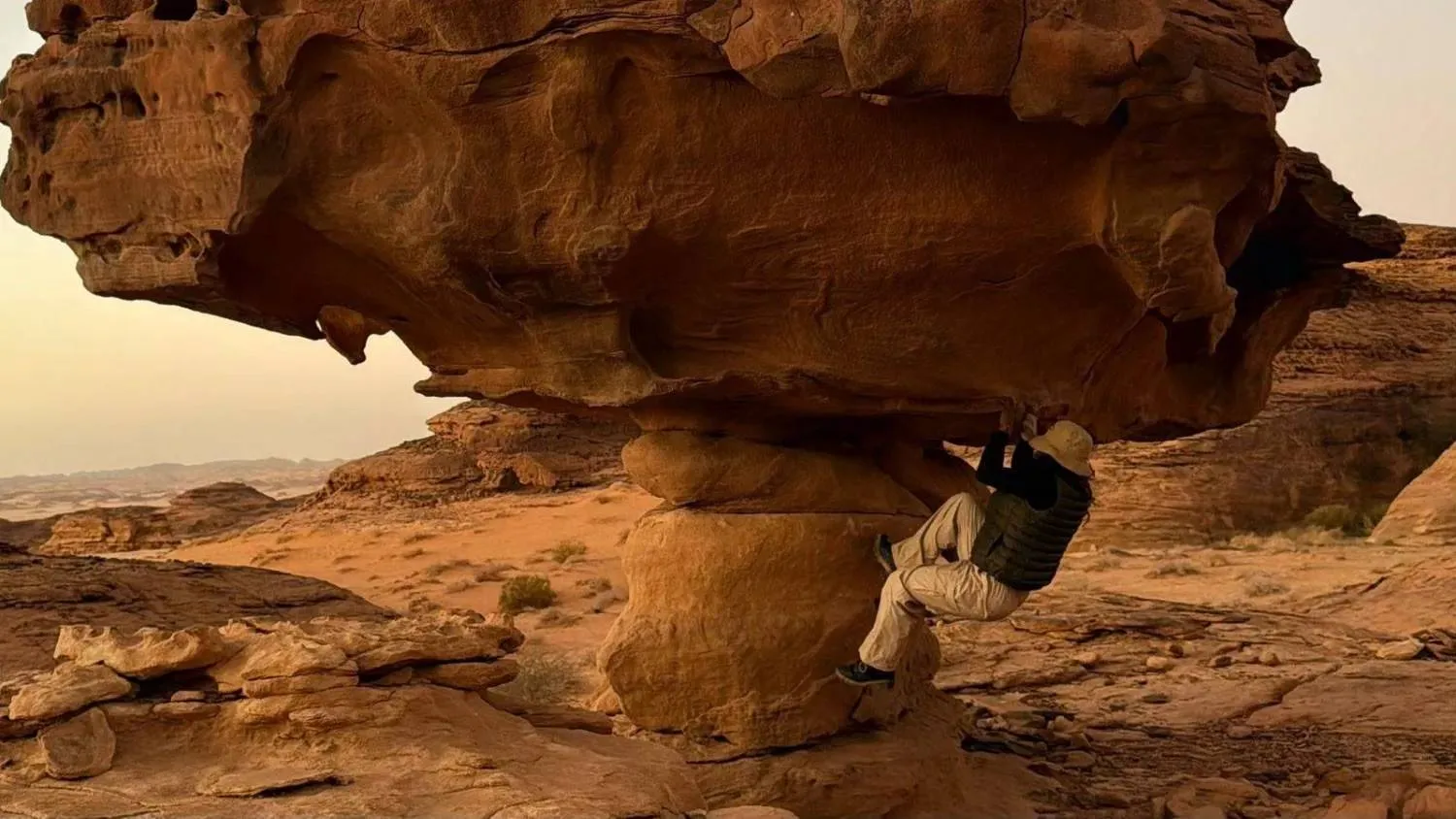
She also described the Bajdah Desert in the Tabuk region as “one of the most visually surreal places” in Saudi Arabia, citing the interplay of red mountains, sand dunes, and complex geological formations, as well as the abundance of natural caves that make the area ideal for advanced exploration.
Ibrahim said her Jeep Wrangler four-wheel-drive vehicle was essential to launching these journeys.
“My Jeep Wrangler was a fundamental part of the experience,” she stated. “It allowed me to reach places that smaller vehicles simply cannot access.”
Her trips begin long before she sets out on the road. Preparation, she explained, involves more than logistics; it requires complete mental readiness. Her planning process includes studying maps and access routes, pinpointing campsites, saving emergency contacts, coordinating with trusted local guides, and packing enough food supplies and practical cooking equipment to minimize risks during each trip.
Despite her meticulous planning, Ibrahim intentionally leaves room for spontaneity.
“Some of the most memorable experiences come from unexpected changes in direction,” she said. “Those moments often lead me to places that were never part of the original plan.”
That balance between discipline and flexibility has become central to her style of travel and exploration.
Ibrahim selects destinations through a combination of research, recommendations from followers on social media, and personal intuition, which she says often plays a decisive role in her final decisions. She relies heavily on mapping applications and advice from local guides, while also paying close attention to recurring suggestions from her audience.
In her interview with Asharq Al-Awsat, Ibrahim stressed that Al-Ahsa holds a particularly special place in her work. More than just another stop on her travels, the region has become a personal project through which she hopes to reshape visual perceptions of the area. Al-Ahsa is also her hometown.
“I don’t present palm trees as a stereotypical image,” she said. “I try to convey a complete experience that reflects Al-Ahsa’s unique diversity. The region is home to millions of palm trees and multiple landscapes that coexist within one area, alongside vast deserts stretching toward the Rub’ al Khali and Al-Dahna, as well as a coastal extension. This overlap makes Al-Ahsa one of the richest natural environments in Saudi Arabia.”
Ibrahim’s philosophy of travel goes beyond sightseeing. She believes beauty is not defined by a destination’s popularity, but by a traveler’s emotional connection to it. In her view, even simple or lesser-known places can hold extraordinary value for those who connect with them deeply.
She cited AlUla as one example, describing its rock formations and mountains as possessing a uniquely powerful visual and spiritual presence.
Solo travel, however, was not easy at first. Ibrahim said fear accompanied her during her earliest camping trips, prompting her to stay close to main roads for safety. Over time, those fears evolved into a turning point that shaped both her personal and professional life.
As solo travel became a defining part of her identity, its impact extended into her work as a nurse, strengthening her ability to make decisions and handle pressure with confidence.
Ibrahim’s experience reflects the high levels of safety found across Saudi Arabia and the Gulf region, though she emphasizes that awareness and personal responsibility remain essential — particularly for young women interested in solo travel or camping. Advance planning, choosing familiar destinations, and avoiding isolated areas without sufficient experience are all critical to ensuring a safe experience.
Saudi Arabia’s tourism sector has also seen significant development in recent years, including the expansion of designated camping facilities and stronger tourism infrastructure. These changes have helped foster a growing culture of overland travel and exploration, positioning the Kingdom as an increasingly attractive destination for travelers from within Saudi Arabia and abroad, especially during the winter season.