
Yemen’s al-Alimi Criticizes International Concessions Made to the Houthis

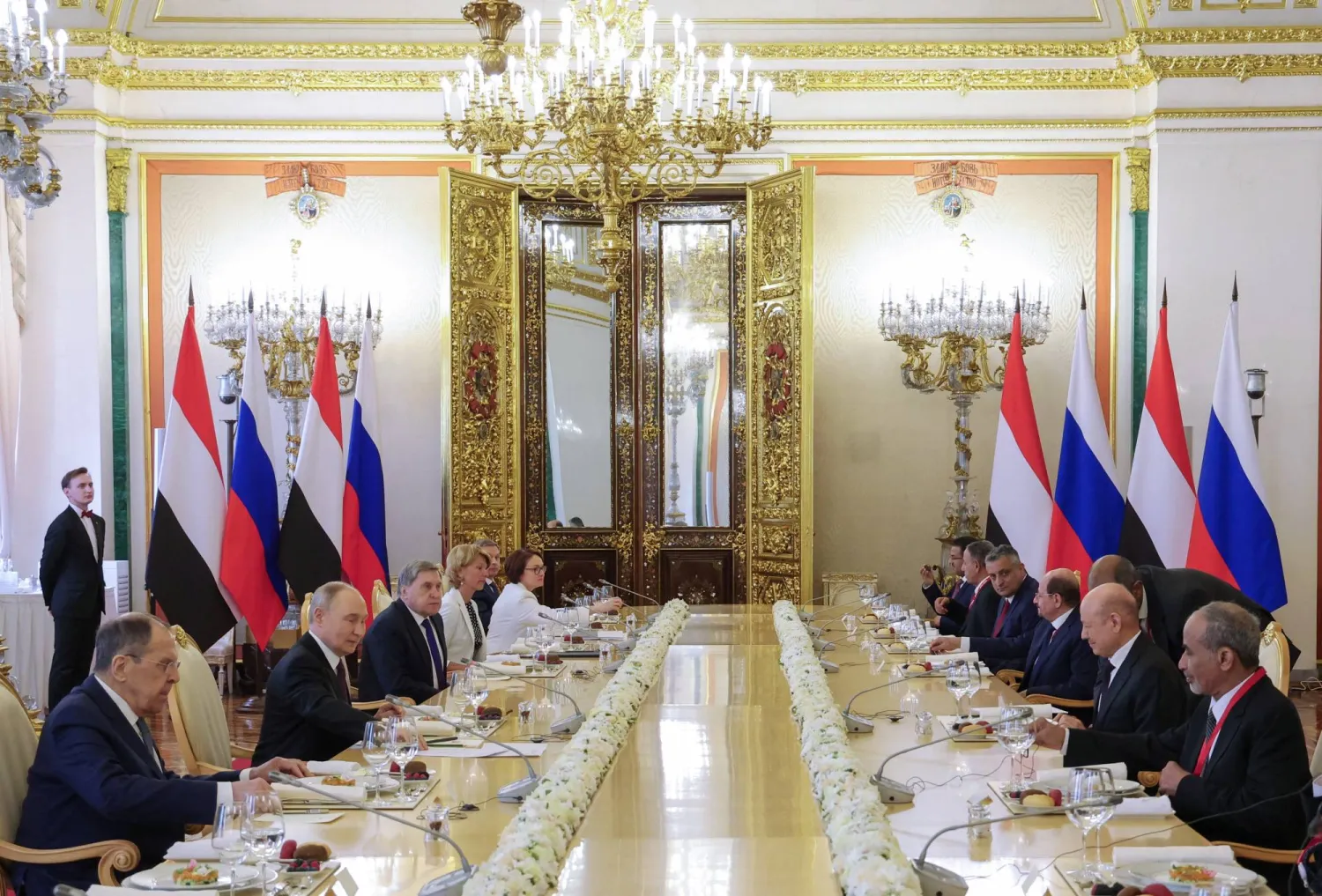
Members of the delegations, led by Russia's President Vladimir Putin and head of Yemen's Presidential Council Rashad Al-Alimi, attend a meeting at the Kremlin in Moscow, Russia, May 28, 2025. Sputnik/Vyacheslav Prokofyev/Pool via REUTERS
TT

Yemen’s al-Alimi Criticizes International Concessions Made to the Houthis

Members of the delegations, led by Russia's President Vladimir Putin and head of Yemen's Presidential Council Rashad Al-Alimi, attend a meeting at the Kremlin in Moscow, Russia, May 28, 2025. Sputnik/Vyacheslav Prokofyev/Pool via REUTERS

Chairman of Yemen’s Presidential Leadership Council Dr. Rashad al-Alimi has described the Houthis as an “enduring” threat to Yemen, the region and international shipping lanes, and criticized what he termed “incentives and concessions from certain international actors” made to the militias.

During a panel discussion organized by the Institute of Oriental Studies of the Russian Academy of Sciences in Moscow on Thursday, al-Alimi stated: We are confronting a sectarian theocratic project that does not recognize the state or the law and is rooted in the ideology of divine right to rule. These are the very ideas Russia has historically opposed in various arenas, in defense of the civil state.”

He criticized the lack of an accurate understanding of the Yemeni situation and the prevalence of misleading narratives in some international circles, including certain think tanks and decision-making institutions, which still view Yemen through a blurred lens or as part of a geopolitical conflict solvable through superficial compromises.

He identified among these false narratives claims portraying the Houthis as an “oppressed minority” suitable for political assimilation.

“The truth is we face an armed doctrinal movement grounding its authority in 'divine right' theology, while rejecting all civil state constructs and the principle of equal citizenship,” he said.

Al-Alimi deemed even more dangerous the designation of the Houthis as a “transient threat” linked to the repercussions of the Gaza war. He affirmed this to be a mistaken and misleading perception.

He explained that the Houthis are an enduring and structural danger to Yemen, the region, and international shipping lanes.

Al-Alimi drew attention to the fact that ship piracy, naval mine deployment, and Red Sea piracy did not begin in 2024, but have been a recurrent Houthi tactic for years.

He affirmed that the Houthis' criminal conduct mirrors that of organizations and groups that Moscow itself condemns, including targeting airports and seaports, booby-trapping mosques, schools, and hospitals, suppressing women's rights, child conscription, and militarizing civilian infrastructure.

He added: “Despite all this, the Houthis continue to receive incentives and concessions from certain international actors, while the legitimate government, representing Yemen's constitutional framework, stands accused of weakness or division. This completely ignores the reality that it effectively controls approximately 70% of Yemen's territory and unites all national components under its umbrella.”

“What is required today is restoring the logic of the state against claims of divine guardianship ... while supporting legitimate institutions against illegitimate armed groups. This is the same principle Russia has consistently upheld in its global counterterrorism efforts,” he added.

Al- Alimi reaffirmed Yemen's unequivocal position supporting the Palestinian people's right to an independent state and the imperative to halt Israeli aggressions. However, he stressed that this stance cannot be exploited to justify Iran's behavior in the region or to advance its agenda through proxies, as witnessed in Yemen.

“Iran’s expansionist policies threaten not only Yemen but also destabilize the entire Red Sea and Horn of Africa region,” he warned.

He noted with concern the Houthis’ close ties with al-Qaeda, ISIS, and other criminal organizations, entities that share ideological alignment, mutual interests, and logistical cooperation with the group. “This signals the resurgence of cross-border terrorist networks,” he said.

Al-Alimi held talks in Moscow on Wednesday with Russian President Vladimir Putin.


US, Qatar, Egypt, Türkiye, Urge Restraint in Gaza

Members of the Palestinian Civil Defense remove the rubble of a destroyed home as they search for the bodies of Palestinians killed during the conflict in Khan Younis, southern Gaza Strip, 20 December 2025. (EPA)
TT

US, Qatar, Egypt, Türkiye, Urge Restraint in Gaza

Members of the Palestinian Civil Defense remove the rubble of a destroyed home as they search for the bodies of Palestinians killed during the conflict in Khan Younis, southern Gaza Strip, 20 December 2025. (EPA)

The United States was joined Saturday by Qatar, Egypt and Türkiye in urging parties in the Gaza ceasefire to uphold their obligations and exercise restraint, the chief US envoy said after talks in Miami.

Top officials from each nation met with Steve Witkoff, President Donald Trump's special envoy, to review the first stage of the ceasefire that came into effect on October 10.

"We reaffirm our full commitment to the entirety of the President’s 20-point peace plan and call on all parties to uphold their obligations, exercise restraint, and cooperate with monitoring arrangements," said a statement posted by Witkoff on X.

Their meeting came amid continuing strains on the agreement.

Gaza's civil defense said six people were killed Friday in Israeli shelling of a shelter. That brought to 400 the number of Palestinians killed by Israeli fire since the deal took effect.

Israel has also repeatedly accused Hamas of violating the truce, with the military reporting of its three soldiers killed in the territory since October.

Saturday's statement cited progress yielded in the first stage of the peace agreement, including expanded humanitarian assistance, return of hostage bodies, partial force withdrawals and a reduction in hostilities.

It called for "the near-term establishment and operationalization" of a transitional administration which is due to happen in the second phase of the agreement, and said consultations would continue in the coming weeks over its implementation.

Under the deal's terms, Israel is supposed to withdraw from its positions in Gaza, an interim authority is to govern the Palestinian territory instead of Hamas, and an international stabilization force is to be deployed.

On Friday, US Secretary of State Marco Rubio expressed hope that countries would contribute troops for the stabilization force, but also urged the disarmament of Hamas, warning the process would unravel unless that happened.


Lebanese Deputy PM to Asharq Al-Awsat: No Political Negotiations with Israel

Smoke rises from the site of a series of Israeli airstrikes that targeted the outskirts of the southern Lebanese village of al-Katrani on December 18, 2025. (AFP)
TT

Lebanese Deputy PM to Asharq Al-Awsat: No Political Negotiations with Israel

Smoke rises from the site of a series of Israeli airstrikes that targeted the outskirts of the southern Lebanese village of al-Katrani on December 18, 2025. (AFP)

Lebanon’s Deputy Prime Minister Tarek Mitri denied on Saturday that the appointment of civilian negotiators between Lebanon and Israel means that political negotiations have been launched between the two neighbors.

He told Asharq Al-Awsat that the negotiating team is primarily tasked with ensuring that the Lebanese army carries out Lebanon’s part of the ceasefire with Israel.

The army is close to completing the first phase of the agreement to impose state monopoly over arms in southern Lebanon, he added.

Other phases of the deal will follow to cover the whole of Lebanon.

Mitri added that attention must be focused on not giving Israel excuses to attack Lebanon, meaning Lebanon must meet its ceasefire obligations.

He warned, however, that Israel "could expand its military operations in Lebanon with or without excuses."

He noted that the United States appears to be pressuring Israel against launching a new war against Lebanon.

Lebanon is close to completing the disarmament of Hezbollah south of the Litani River, Prime Minister Nawaf Salam said on Saturday, as the country races to fulfil a key demand of its ceasefire with Israel before a year-end deadline.

The US-backed ceasefire, agreed in November 2024, ended more than a year of fighting between Israel and Hezbollah and required the disarmament of the Iran-aligned group, starting in areas south of the river adjacent to Israel.

Lebanese authorities, ‌led by President ‌Joseph Aoun and Salam, tasked the Lebanese ‌army ⁠on August ‌5 with devising a plan to establish a state monopoly on arms by the end of the year.

"Prime Minister Salam affirmed that the first phase of the weapons consolidation plan related to the area south of the Litani River is only days away from completion," a statement from his ⁠office said.

"The state is ready to move on to the second ‌phase - namely (confiscating weapons) north of the ‍Litani River - based on the ‍plan prepared by the Lebanese army pursuant to ‍a mandate from the government," Salam added.

The statement came after Salam held talks with Simon Karam, Lebanon's top civilian negotiator on a committee overseeing the Hezbollah-Israel truce.

Since the ceasefire, the sides have regularly accused each other of violations, with Israel questioning the Lebanese army's efforts to disarm Hezbollah. ⁠Israeli warplanes have increasingly targeted Hezbollah in southern Lebanon and even in the capital.

Israel has publicly urged Lebanese authorities to fulfil the conditions of the truce, saying it will act "as ‌necessary" if Lebanon fails to take steps against Hezbollah, which has refused to disarm.


Lebanese PM to Asharq Al-Awsat: 2nd Phase of Disarmament to Begin Soon Covering Regions between Litani, Awali

Prime Minister Nawaf Salam and ambassador Simon Karam meet on Saturday. (PM's office)
TT

Lebanese PM to Asharq Al-Awsat: 2nd Phase of Disarmament to Begin Soon Covering Regions between Litani, Awali

Prime Minister Nawaf Salam and ambassador Simon Karam meet on Saturday. (PM's office)

Lebanon would have completed the first phase of the army’s plan to impose state monopoly over arms, or the disarmament of Hezbollah, by the end of the year.

Prime Minister Nawaf Salam’s office confirmed on Saturday that the first phase was close to completion.

“The first phase of the weapons consolidation plan related to the area south of the Litani River is only days away from completion,” it said.

“The state is ready to move on to the second ‌phase - namely (confiscating weapons) north of the ‍Litani River - based on the ‍plan prepared by the Lebanese army pursuant to ‍a mandate from the government,” Salam added.

The cabinet will meet at the beginning of the new year after the first phase is completed.

Salam, meanwhile, told Asharq Al-Awsat that the second phase of the disarmament will cover the areas between the Litani and Awali Rivers to its north.

The third phase will cover Beirut and Mount Lebanon and the fourth covers the Bekaa followed by remaining regions.

Lebanese sources said the army has completed most of its report on its disarmament efforts south of the Litani. It has completed the confiscation and destruction of thousands of tons of ammunition and military gear. It has discovered around a hundred military tunnels in the region.

As it stands, the army is unlikely to ask for an extension of the deadline to complete the first phase by the end of the year. It may ask for a “technical” extension for a few weeks if necessary.

Salam refused to go into the details of the government’s next step after it receives the army’s detailed report on the disarmament south of the Litani.

“The military has succeeded in imposing complete state authority over the regions from south of the Litani to the southern border, except for the areas occupied by Israel and from where it should withdraw without delay,” the PM told Asharq Al-Awsat.

He confirmed that the government will convene at the beginning of the year to assess the first phase of the disarmament, stressing that Israel must take reciprocal steps, such as ceasing its violations of the ceasefire.

This will not prevent Lebanon from moving on to the second phase of implementing state monopoly over arms, he revealed.

Progress hinges of Hezbollah’s cooperation with Lebanon’s efforts to limit possession of weapons to the state and move towards activating state institutions in the South and kick off the reconstruction process with the help of Lebanon’s friends, he added.

“Imposing state monopoly over weapons is a Lebanese need before it is an international one,” he declared.

Everyone should be concerned with facilitating the process to end the cycle of violence, he urged.

Salam met on Saturday with Simon Karam, Lebanon's top civilian negotiator on the Mechanism committee overseeing the Hezbollah-Israel truce.

Karam briefed Salam on the latest meeting of the Mechanism.

Hezbollah continues to resist calls to disarm, saying the ceasefire with Israel does not cover areas north of the Litani. Party officials continue to tie disarmament to Israel’s withdrawal from regions it occupies in the South.