Russia and Ukraine Reach Deal on New POW Swap and Handover of Bodies

Members of Ukrainian (R), Russian (L) and Turkish (C) delegations attend the second meeting at the Ciragan Palace, in Istanbul, on June 2, 2025. (AFP)
TT

Russia and Ukraine Reach Deal on New POW Swap and Handover of Bodies

Members of Ukrainian (R), Russian (L) and Turkish (C) delegations attend the second meeting at the Ciragan Palace, in Istanbul, on June 2, 2025. (AFP)

Russia and Ukraine said they had agreed at peace talks on Monday to exchange more prisoners of war and return the bodies of 12,000 dead soldiers. 

The warring sides met for barely an hour in the Turkish city of Istanbul, for only the second such round of negotiations since March 2022. 

Turkish President Recep Tayyip Erdogan described it as a great meeting and said he hoped to bring together Russia's Vladimir Putin and Ukraine's Volodymyr Zelenskiy for a meeting in Türkiye with US President Donald Trump. 

But there was no breakthrough on a proposed ceasefire that Ukraine, its European allies and Washington have all urged Russia to accept. 

Moscow says it seeks a long-term settlement, not a pause in the war; Kyiv says Putin is not interested in peace. 

Kremlin aide Vladimir Medinsky said Russian negotiators had handed their Ukrainian counterparts a detailed memorandum outlining Moscow's terms for a full ceasefire. 

Medinsky, who heads the Russian team, said Moscow had also suggested a "specific ceasefire of two to three days in certain sections of the front" so that the bodies of dead soldiers could be collected. 

Each side said it would hand over the bodies of 6,000 dead soldiers to the other. 

In addition, they said they would conduct a further big swap of prisoners of war, after 1,000 captives on each side were traded following a first round of talks in Istanbul on May 15. 

Ukrainian Defense Minister Rustem Umerov, who headed Kyiv's delegation, said the new exchange would focus on those severely injured in the war and on young people. 

Umerov also said that Moscow had handed a draft peace accord to Ukraine and that Kyiv, which has drawn up its own version, would review the Russian document. 

Ukraine has proposed holding more talks before the end of June, but believes that only a meeting between Zelenskiy and Putin can resolve the many issues of contention, Umerov said. 

Zelenskiy's chief of staff, Andriy Yermak, said Kyiv's delegation had requested the return of a list of children who it said had been deported to Russia. 

Moscow says such children were moved in order to protect them from fighting. Medinsky said there were 339 names on Ukraine's list but that the children had been "saved", not stolen. 

LOW EXPECTATIONS FOR ISTANBUL BREAKTHROUGH 

Ukraine had a day earlier launched one of its most ambitious attacks of the war, using drones to target Russian nuclear-capable long-range bomber planes in Siberia and elsewhere. 

Angry war bloggers urged Moscow to retaliate strongly. 

While both countries, for different reasons, are keen to keep Trump engaged in the peace process, expectations of a breakthrough on Monday had been low. 

Ukraine regards Russia's approach to date as an attempt to force it to capitulate - something Kyiv says it will never do - while Moscow, which advanced on the battlefield in May at its fastest rate in six months, says Kyiv should submit to peace on Russian terms or face losing more territory. 

Putin set out his opening terms for an immediate end to the war last June: Ukraine must drop its ambitions to join the Western NATO alliance and withdraw its troops from the entirety of the four Ukrainian regions claimed and largely controlled by Russia. 

According to a proposed roadmap drawn up by Ukraine, a copy of which was seen by Reuters, Kyiv wants no restrictions on its military strength after any peace deal, no international recognition of Russian sovereignty over parts of Ukraine taken by Moscow's forces, and reparations. 

Russia currently controls just under one fifth of Ukraine, or about 113,100 sq km, about the area of the US state of Ohio. 

Putin sent his army into Ukraine on February 24, 2022, after eight years of fighting in eastern Ukraine between Russian-backed separatists and Ukrainian forces. 

The United States, which under Trump's predecessor Joe Biden was Ukraine's main source of advanced weaponry in the war, says over 1.2 million people have been killed and injured in the conflict since 2022. 

Trump has called Putin "crazy" and berated Zelenskiy in public in the Oval Office, but the US president has also said he thinks peace is achievable and that if Putin delays, the US could impose tough sanctions on Russia. 


North Korea Vows Boost to Nuclear Buildup, Military Intelligence

North Korean leader Kim Jong Un reacts on the day of a cruise missile launch at an unknown location in North Korea, July 3, 2026, in this picture released July 5, 2026 by North Korea's official Korean Central News Agency. KCNA via REUTERS
TT

North Korea Vows Boost to Nuclear Buildup, Military Intelligence

North Korean leader Kim Jong Un reacts on the day of a cruise missile launch at an unknown location in North Korea, July 3, 2026, in this picture released July 5, 2026 by North Korea's official Korean Central News Agency. KCNA via REUTERS

North Korea will strengthen its nuclear force "both in quality and quantity" and expand the role of its military intelligence agency focused on South Korea, state media said Friday.

Pyongyang is under widespread sanctions over its nuclear programme, and the two Koreas remain technically at war as their 1950-53 conflict ended without a peace treaty.

The announcement comes after North Korea has repeatedly spurned South Korean President Lee Jae Myung's dovish overtures, labelling Seoul its "most hostile" enemy and declaring itself an "irreversible" nuclear state.

The issues were discussed during an enlarged meeting of the ruling party's central military commission on Thursday, Pyongyang's official Korean Central News Agency said.

The meeting decided on measures such as "bolstering up the nuclear force both in quality and quantity", the report said.

It also called for broadly expanding the functions and missions of the General Reconnaissance and Intelligence Bureau, Pyongyang's military intelligence agency tasked with operations involving South Korea.

The unit "plays a pivotal role in controlling the potential enemies' threats and gathering key information", KCNA said.

The meeting discussed ways to enhance the unit's "capability of military reconnaissance and intelligence activities in a radical way", it added.

Hong Min, a senior researcher at the Korea Institute for National Unification, said North Korea's latest move reflects Pyongyang's shift to treating the two Koreas as "two hostile states", potentially replacing the previous armistice-based framework.

"Military reconnaissance takes on a different meaning under a state-to-state approach, as intelligence activities targeting another sovereign state can carry diplomatic implications," he told AFP.

Experts have said that North Korea is likely aiming to acquire military technology, including surveillance satellites, in return for the troops it sent to aid Russia's war against Ukraine.

In 2023, the country successfully put a military spy satellite into orbit and claimed it was capturing images of major US and South Korean military sites.

South Korea's Unification Ministry told AFP it was "closely monitoring" any developments related to the North Korean unit's reported expansion.


Landslide Kills 5 in Philippines as Biggest Typhoon in Decades Nears Taiwan

Bavi's strong-wind radius of 380 kilometers (240 miles) will make it the largest typhoon to hit Taiwan in more than 30 years. I-Hwa Cheng / AFP
TT

Landslide Kills 5 in Philippines as Biggest Typhoon in Decades Nears Taiwan

Bavi's strong-wind radius of 380 kilometers (240 miles) will make it the largest typhoon to hit Taiwan in more than 30 years. I-Hwa Cheng / AFP

Five people were killed in a landslide in the Philippines, and hundreds in Taiwan were evacuated from their homes, as the biggest typhoon in decades swept towards the region on Friday.

Typhoon Bavi is expected to pound Taiwan's north and east, as well as Japan's remote southwestern islands, on Friday and Saturday before smashing into China, which has been hit by deadly storms this week.

A landslide triggered by heavy rains enhanced by Bavi killed at least five people and left six others missing on the Philippines' southern island of Mindanao, police said.

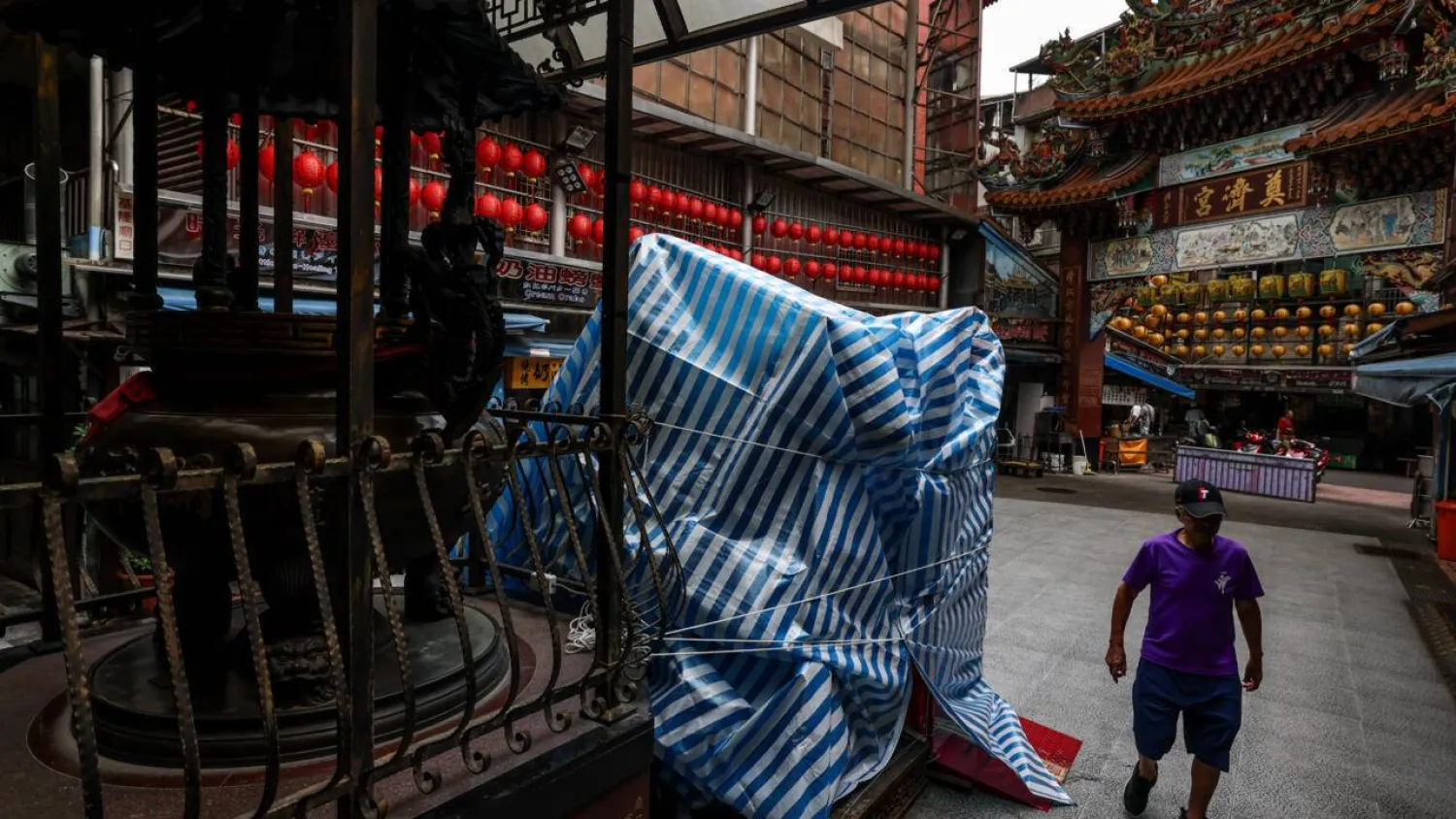
Locals in Taiwan's port city of Keelung, which is expected to be one of the hardest hit areas on the island, stocked up on food, taped windows, and stacked sandbags along shop fronts, heeding warnings from authorities to take precautions.

"They're saying it's going to be huge; of course that's scary, right?" Keelung grocery store owner Chang Shih-huo, 76, told AFP.

"We've stocked up on some instant noodles and bread and stuff like that. Once the wind and rain really start picking up, we'll have to close the shop."

After hitting Guam and the Northern Marianas on Monday as a super typhoon, Bavi was downgraded to a typhoon as it moved across the Pacific Ocean.

Bavi's maximum sustained wind speeds were 162 kilometers (100 miles) per hour, with gusts of around 198 kilometers per hour, on Friday -- slower than on Thursday -- the Central Weather Administration (CWA) said.

"The typhoon is likely to continue weakening because environmental conditions are not favorable," CWA forecaster Wang Ping-hsiang told AFP.

"The greatest impact is expected in Taipei, New Taipei, Keelung and Yilan, while the heaviest rainfall is forecast for mountainous areas in central and northern Taiwan."

Bavi's strong-wind radius of 380 kilometers (240 miles) will make it the largest typhoon to hit Taiwan in more than 30 years.

Many schools and businesses were shuttered on Friday across northern and eastern Taiwan, including the capital Taipei, and hundreds of domestic and international flights were cancelled.

In Keelung, locals flocked to a fresh food market to buy fruit and vegetables, street vendors secured their stands, and a temple covered and tied down an outdoor statue ahead of the storm.

"What you're seeing now is the most remarkable sight we haven't seen in 10 years," Keelung restaurant owner Penny Pan, 48, said as her husband placed sandbags at the entrance to their eatery.

"In the past we never used sandbags to prepare for typhoons. But this time they're forecasting Force 10 gusts, so the captains and fishermen have all been saying we need to be better prepared," Pan said.

Bavi is expected to dump up to a meter of rain, raising concerns about potential flooding and landslides.

More than a thousand people have been evacuated from their homes, mostly in the mountainous county of Hualien in Taiwan's east, where authorities are monitoring two barrier dams.

Taiwanese President Lai Ching-te urged people in areas likely to be most affected by Bavi to remain on "high alert".

More than 20,000 troops, along with machinery, equipment and vehicles, were on standby to respond to emergencies.


China Successfully Tests Sea-based Rocket Booster Recovery System

FILE PHOTO: A delivery driver looks at this phone as he rests on his electric bike in Beijing, China January 25, 2020. REUTERS/Thomas Peter
TT

China Successfully Tests Sea-based Rocket Booster Recovery System

FILE PHOTO: A delivery driver looks at this phone as he rests on his electric bike in Beijing, China January 25, 2020. REUTERS/Thomas Peter

China on Friday successfully tested an experimental rocket retrieval system using a net attached to a sea platform, state media reported, in the hopes of breaking ⁠US dominance in ⁠reusable rockets.

The Long March 10B rocket lifted off from the Hainan commercial ⁠space launch site in southern China and, about six minutes after separation of its booster and upper stage, the booster returned vertically and was recovered on ⁠an ⁠offshore platform, state broadcaster CCTV reported.

It marked China's first successful controlled recovery of a carrier rocket's booster, CCTV said.