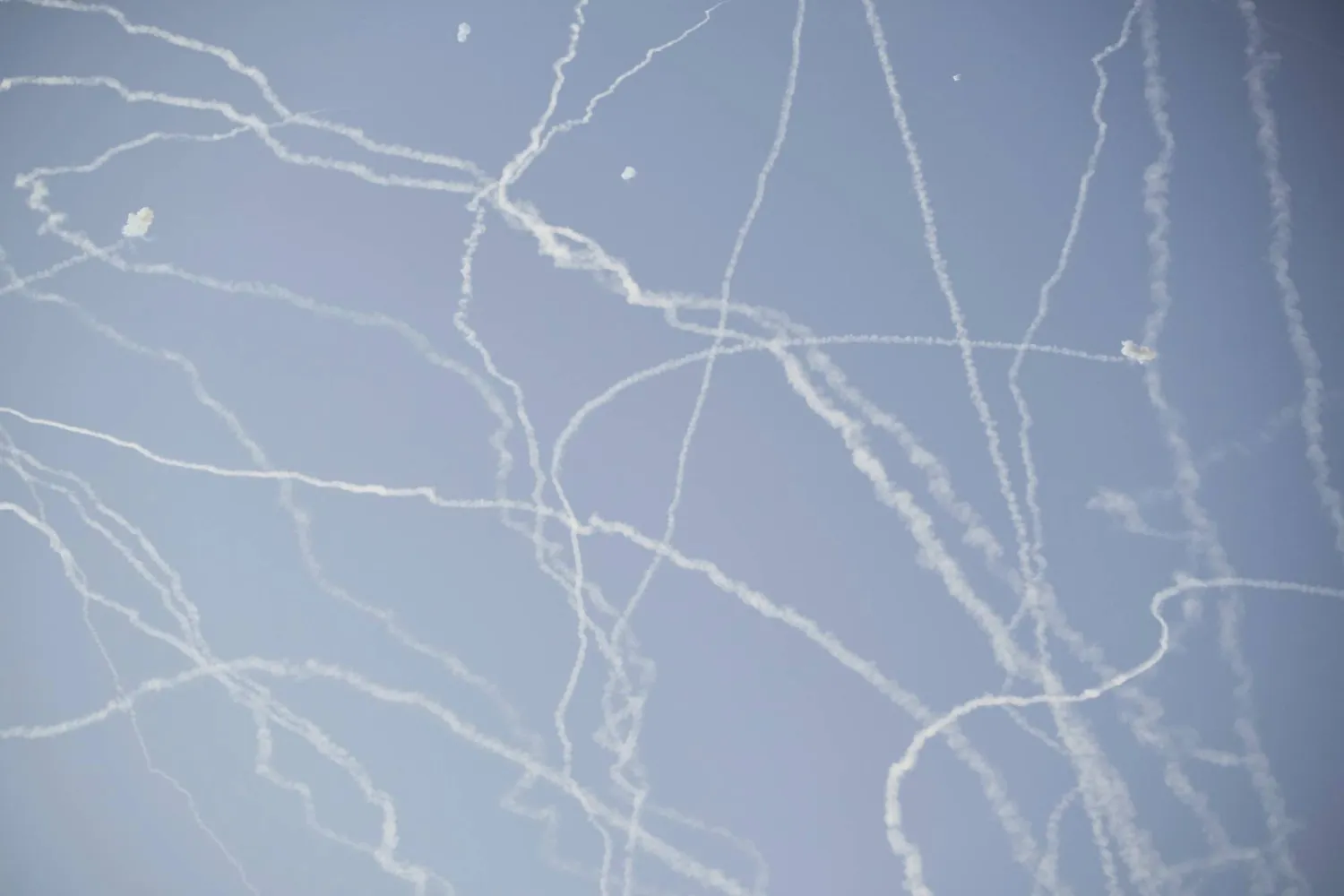
Airlines Keep Avoiding Middle East Airspace after US Attack on Iran

FILE - Israeli air defense system fires to intercept missiles during an Iranian attack over Tel Aviv, Israel, Thursday, June 19, 2025. (AP Photo/Leo Correa, File)
TT

Airlines Keep Avoiding Middle East Airspace after US Attack on Iran

FILE - Israeli air defense system fires to intercept missiles during an Iranian attack over Tel Aviv, Israel, Thursday, June 19, 2025. (AP Photo/Leo Correa, File)

Airlines continued to avoid large parts of the Middle East on Sunday after US strikes on Iranian nuclear sites, according to flight tracking website FlightRadar24, with traffic already skirting airspace in the region due to recent missile exchanges.

"Following US attacks on Iranian nuclear facilities, commercial traffic in the region is operating as it has since new airspace restrictions were put into place last week," FlightRadar24 said on social media platform X.

Its website showed airlines were not flying in the airspace over Iran, Iraq, Syria and Israel.

Missile and drone barrages in an expanding number of conflict zones globally represent a high risk to airline traffic.

Since Israel launched strikes on Iran on June 13, carriers have suspended flights to destinations in the affected countries, though there have been some evacuation flights from neighbouring nations and some bringing stranded Israelis home.

Israel's two largest carriers, El Al Israel Airlines and Arkia, said on Sunday they were suspending rescue flights that allowed people to return to Israel until further notice.

Israel's airports authority said the country's airspace was closed for all flights, but land crossings with Egypt and Jordan remained open.

Japan's foreign ministry said on Sunday it had evacuated 21 people, including 16 Japanese nationals, from Iran overland to Azerbaijan. It said it was the second such evacuation since Thursday and that it would conduct further evacuations if necessary.

New Zealand's government said on Sunday it would send a Hercules military transport plane to the Middle East on standby to evacuate New Zealanders from the region.

It said in a statement that government personnel and a C-130J Hercules aircraft would leave Auckland on Monday. The plane would take some days to reach the region, it said.

The government was also in talks with commercial airlines to assess how they may be able to assist, it added.


Gaza Civil Defense Says Israeli Strikes Killed Four

 Palestinian policemen inspect a vehicle in Khan Younis in the southern Gaza Strip, March 16, 2026. (Reuters)
Palestinian policemen inspect a vehicle in Khan Younis in the southern Gaza Strip, March 16, 2026. (Reuters)
TT

Gaza Civil Defense Says Israeli Strikes Killed Four

 Palestinian policemen inspect a vehicle in Khan Younis in the southern Gaza Strip, March 16, 2026. (Reuters)
Palestinian policemen inspect a vehicle in Khan Younis in the southern Gaza Strip, March 16, 2026. (Reuters)

Gaza's civil defense agency said Israeli airstrikes killed four people on Thursday, in the latest violence to hit the war-shattered Palestinian territory despite the ceasefire.

It came as Gaza's Rafah border crossing with Egypt reopened for a limited number of people, for the first time since Israel and the United States launched strikes on Iran at the end of February.

The civil defense agency, which operates as a rescue force under Hamas authority, said strikes in two neighborhoods of Gaza City killed a total of four people.

Al-Ahli Hospital in Gaza City said it received two bodies following an Israeli strike on the Tuffah neighborhood east of Gaza City.

Gaza City's Al-Shifa Hospital said it had also received two bodies following an Israeli drone strike on the Zeitoun neighborhood in Gaza City.

Media restrictions and limited access in Gaza have prevented AFP from independently verifying casualty figures or freely covering the fighting.

When asked by AFP about the two incidents, the Israeli military said it was looking into the reports.

In a separate statement, the Israeli military said it had struck and killed Muhammad Abu Shaleh, the military intelligence commander of Hamas's Khan Yunis Brigade.

It said Shaleh had "operated in violation of the ceasefire agreement to rehabilitate the organization's capabilities in the Gaza Strip and planned to carry out terror attacks against Israeli army troops and the State of Israel."

Violence has persisted in Gaza despite a ceasefire which came into effect on October 10, with both Israel and Hamas regularly accusing each other of violations.

On Sunday, Gaza's Hamas-run interior ministry said an Israeli airstrike on a police vehicle killed nine officers, with the civil defense reporting another four people killed in an earlier strike.

Gaza's health ministry, which operates under Hamas authority, says at least 677 Palestinians have been killed since the start of the truce.

The Israeli military says at least five of its soldiers have been killed in the same period since October 10.


Gaza-Egypt Border Crossing Reopens for Small Numbers of People

A UN vehicle leads ambulances carrying war-wounded people and patients who leave Gaza, for treatment abroad, through the Rafah border crossing between Gaza and Egypt after it was opened by Israel on Thursday for a limited number of people, in Khan Younis in the southern Gaza Strip, March 19, 2026. (Reuters)
TT

Gaza-Egypt Border Crossing Reopens for Small Numbers of People

A UN vehicle leads ambulances carrying war-wounded people and patients who leave Gaza, for treatment abroad, through the Rafah border crossing between Gaza and Egypt after it was opened by Israel on Thursday for a limited number of people, in Khan Younis in the southern Gaza Strip, March 19, 2026. (Reuters)

Gaza's border crossing with Egypt reopened on Thursday for a limited number of people, Egyptian state media and a Red Crescent official said, for the first time since Israel and the United States launched strikes on Iran.

An Egyptian Red Crescent official, speaking anonymously to AFP, said the Rafah crossing had reopened in both directions and would allow Palestinian patients to cross into Egypt and stranded Palestinians to return to Gaza.

Al-Qahera News, which is close to Egypt's intelligence services, aired footage showing a small number of Palestinians, including people who had been receiving medical treatment, preparing to cross from the Egyptian side back into Gaza.

Several ambulances were also seen waiting to receive patients coming out of the devastated Palestinian territory.

Israel had announced earlier this week that Rafah would reopen on Wednesday, but the reopening did not materialize.

It said travel would resume in coordination with Egypt, subject to Israeli security approval and monitored by the European Union's border mission.

Incoming travelers will undergo additional screening inside Gaza in an area controlled by the Israeli army, according to COGAT, the Israeli defense ministry body overseeing civilian affairs in the Palestinian territories.

The EU deployed its border assistance mission (EUBAM) to Rafah in early February.

Rafah, seized by Israeli forces nearly two years ago in the war with Hamas, had briefly reopened on February 2 for limited movement, but was shut again on February 28 when Israel closed all crossings after the strikes on Iran began.

The Israeli-controlled Kerem Shalom crossing reopened days later for limited humanitarian aid, including fuel.

For many sick and injured Gazans, Rafah has been a crucial route to medical care in Egypt and one of the few means for separated families to reunite.

But despite its reopening last month, only small numbers of Palestinians have been permitted to cross.

According to three Egyptian border officials, the daily cap for entry into Egypt was 50 patients, each allowed a maximum of two companions, with the number of people allowed back into Gaza also limited to 50.

Those who returned during the brief February reopening said that they underwent extensive security checks and interrogations.


Iraqi Factions: Tehran’s Arm in an Open War of Attrition

A burning fire outside the perimeter of the United States Embassy in the fortified Green Zone in Baghdad on March 17, 2026. 
TT

Iraqi Factions: Tehran’s Arm in an Open War of Attrition

A burning fire outside the perimeter of the United States Embassy in the fortified Green Zone in Baghdad on March 17, 2026. 

Since the outbreak of conflict in the Middle East, Iraqi factions aligned with Tehran have placed US interests squarely in their sights, repeatedly targeting bases hosting international forces, diplomatic missions and key oil infrastructure.

Designated as terrorist organizations by Washington, these groups had issued early warnings that the confrontation would evolve into a prolonged “war of attrition.”

Interlocking Axes

In a statement underscoring domestic production, Harakat al-Nujaba said the manufacture of drones and missiles within the so-called Axis of Resistance had become “as commonplace as making sweets in Iraqi homes.”

The factions operate under a loose umbrella known as the Islamic Resistance in Iraq, which regularly claims drone and rocket attacks against what it describes as hostile targets inside Iraq and across the region.

They form a core part of Iran’s Axis of Resistance, alongside Hezbollah in Lebanon, Hamas in Gaza and the Houthis in Yemen. Iraqi factions also pledged full support for Iran following the Israeli–US strike on Feb. 28.

Military and Political Landscape

Several actors shape the current landscape. Kataib Hezbollah is widely seen as the spearhead of attacks on US interests and has lost several commanders in past strikes. It has also developed a political role by backing a parliamentary bloc with six seats.

Kataib Sayyid al-Shuhada, led by Abu Alaa al-Walaei, is represented within the Coordination Framework, the ruling Shiite alliance with a parliamentary majority. Harakat al-Nujaba, by contrast, rejects political participation, favoring a purely military approach.

Asaib Ahl al-Haq has so far avoided direct involvement in the current fighting, focusing instead on political influence through its 27-seat bloc. It is widely seen as gradually distancing itself from its armed role.

Strategy of Attrition

Attacks have extended beyond the US Embassy in Baghdad and its airport facilities to include oil fields operated by foreign companies and sites in the Kurdistan Region, which hosts a major US consulate and military forces. The impact has also spread beyond Iraq, with Kuwait previously summoning the Iraqi ambassador after strikes hit its territory.

Lahib Higel of the International Crisis Group said the factions’ involvement reflects an “existential battle” for Iran, describing them as a last line of defense. Despite their use of drones and short-range missiles, she said Tehran continues to withhold heavier weapons compared with those supplied to Hezbollah or the Houthis. The ultimate aim, she added, is to expel US forces from Iraq.

Wave of Assassinations

The United States and Israel have responded with precision strikes. Early in the conflict, airstrikes targeted Kataib Hezbollah strongholds in Jurf al-Sakhr, south of Baghdad, as well as sites linked to the Popular Mobilization Forces.

According to Agence France-Presse, at least 43 fighters from these groups have been killed since the start of operations. The escalation peaked last Saturday when a missile struck a house in central Baghdad, killing three Kataib Hezbollah members, including a senior commander, and wounding the group’s leader, Abu Hussein al-Hamidawi.

An Iraqi security official said the wave of assassinations that began during the Gaza war in 2023 has now moved openly into Iraq, signaling a new phase of intensified confrontation.