

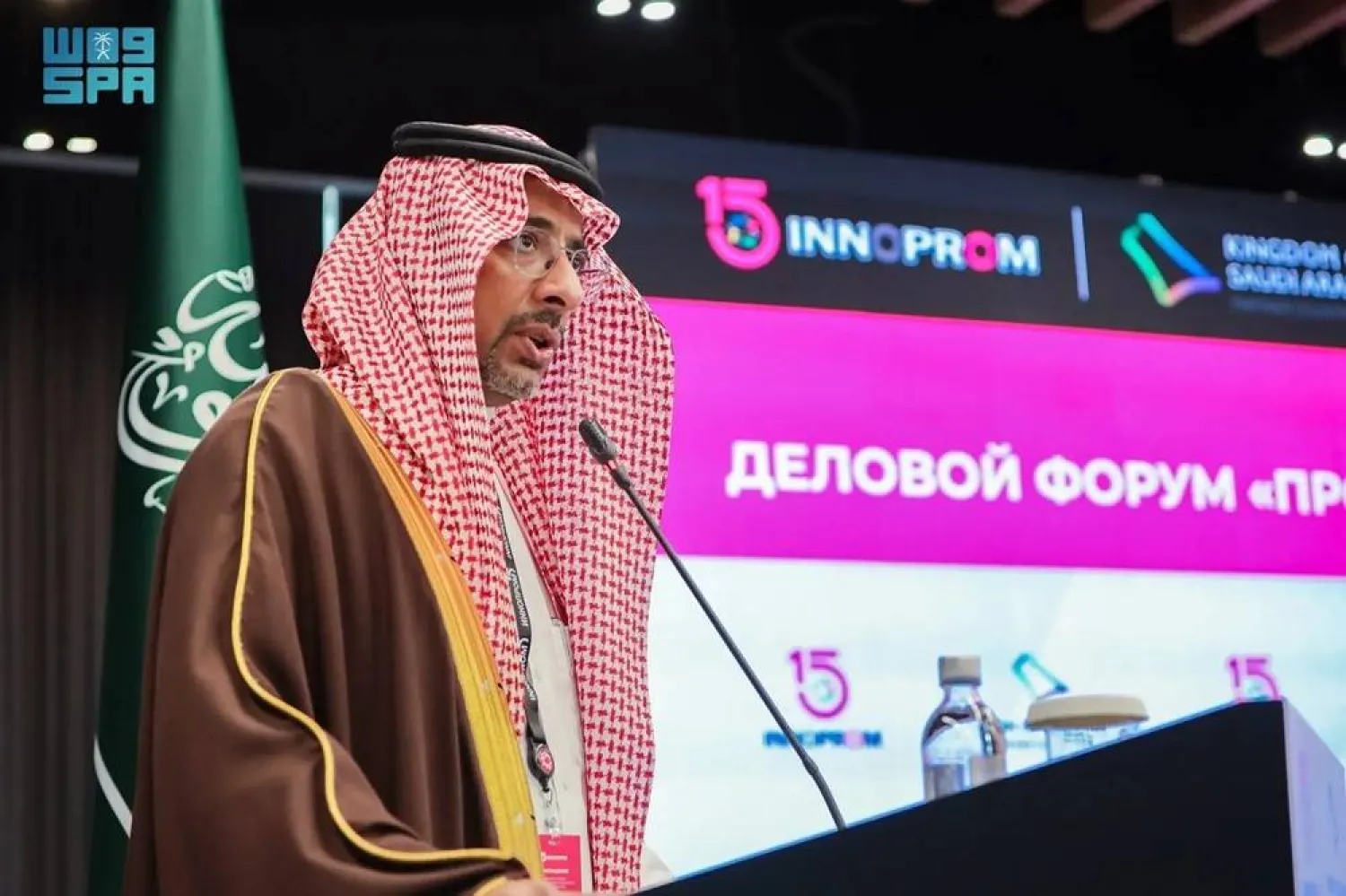

Alkhorayef Highlights Opportunities for Russian-Saudi Industrial Collaboration

Saudi Minister of Industry and Mineral Resources Bandar Alkhorayef speaks at the Russian-Saudi Dialogue Forum on Monday. (SPA)
TT

Alkhorayef Highlights Opportunities for Russian-Saudi Industrial Collaboration

Saudi Minister of Industry and Mineral Resources Bandar Alkhorayef speaks at the Russian-Saudi Dialogue Forum on Monday. (SPA)

Saudi Minister of Industry and Mineral Resources Bandar Alkhorayef emphasized on Monday the enduring strength of economic ties between Saudi Arabia and Russia.

Speaking at the Russian-Saudi Dialogue Forum, held as part of INNOPROM 2025 in Yekaterinburg, he stressed the importance of Saudi Arabia’s mining sector as a vital enabler for economic diversification as part of the Kingdom’s objectives under Saudi Vision 2030.

Underscoring the Kingdom’s vast mineral resources, he highlighted its strategic geographic location as a global trade hub that connects three continents, offering promising opportunities for international investors.

Alkhorayef praised the outcomes of the Saudi-Russian Joint Committee, emphasizing its role in identifying investment opportunities across key sectors and enhancing knowledge exchange between the two countries.

The minister called on forum participants to continue strengthening cooperation and creating tangible projects that support the sustainable growth of both Saudi Arabia and Russia. He also extended an open invitation to Russian counterparts to visit the Kingdom, explore its diverse investment prospects, and experience its rich cultural heritage, noting that Saudi nationals have been showing increasing interest in travel to Russia.

Alkhorayef praised the longstanding relationship between Saudi Arabia and Russia that has spanned over 100 years, creating a foundation to advance joint initiatives in industry, mining, technology, and global trade.

Saudi Arabia and Russia’s economic relations have already witnessed monumental growth in recent years, particularly in the fields of industry, mining, petrochemicals, and advanced manufacturing. Bilateral non-oil trade increased from $491 million in 2016 to $3.28 billion in 2024, reflecting a growing partnership between the two countries.

Alkhorayef is currently leading a high-level Saudi delegation to Russia, accompanied by senior officials from 18 government entities and more than 20 leading national companies representing priority sectors including industrial services, technology, manufacturing, machinery, mining, industrial automation, energy, tourism, and culture.



Maersk Halts Operations at Oman's Salalah Port Due to Security Incident

(FILES) Containers of Danish shipping and logistics company Maersk stand on a vessel in Copenhagen on September 14, 2023. (Photo by SERGEI GAPON / AFP)
TT

Maersk Halts Operations at Oman's Salalah Port Due to Security Incident

(FILES) Containers of Danish shipping and logistics company Maersk stand on a vessel in Copenhagen on September 14, 2023. (Photo by SERGEI GAPON / AFP)

Danish container shipping group Maersk has temporarily halted its operations at the Port of Salalah in Oman, it said, following a security incident that occurred early on Saturday.

All Maersk crew were safe ⁠and accounted for, and ⁠no company cargo or vessels were affected, the shipping giant said in a statement.

The port was evacuated ⁠after an incident damaged a terminal crane, prompting a temporary suspension of operations across the facility.

Maersk currently estimates that operations will be halted for approximately 48 hours, Reuters quoted it as saying.

The disruption comes as the ⁠conflict ⁠in the region has unsettled energy and transport markets, with shipping affected by the effective closure of the Strait of Hormuz.


Fitch Affirms Israel's 'A' Rating with Negative Outlook

Smoke rises following a missile attack from Iran on Tel Aviv (Reuters)
TT

Fitch Affirms Israel's 'A' Rating with Negative Outlook

Smoke rises following a missile attack from Iran on Tel Aviv (Reuters)

Global ratings agency Fitch reaffirmed Israel's long-term foreign-currency rating at "A" with a negative outlook on Friday, adding that rising public debt levels and ongoing war-related risks could weaken the country's ⁠fiscal trajectory.

Fitch forecast ⁠military expenditure will remain high in 2026, well above pre-war levels, as Israel's involvement in Lebanon intensifies ⁠and operations continue.

It also expects Israel's central government cash budget deficit to widen this year before narrowing in 2027 as military spending declines.

"Israel's recent and ongoing military operations have somewhat diminished geopolitical risks ⁠to ⁠the ratings and demonstrated a highly effective defensive capability", the ratings agency said, although it warned the duration and scope of the current conflict remains uncertain.


SoftBank Secures $40 Billion Loan to Boost OpenAI Investments

FILE PHOTO: The logo of SoftBank is displayed at a company shop in Tokyo, Japan January 28, 2025.  REUTERS/Issei Kato/File Photo
FILE PHOTO: The logo of SoftBank is displayed at a company shop in Tokyo, Japan January 28, 2025. REUTERS/Issei Kato/File Photo
TT

SoftBank Secures $40 Billion Loan to Boost OpenAI Investments

FILE PHOTO: The logo of SoftBank is displayed at a company shop in Tokyo, Japan January 28, 2025.  REUTERS/Issei Kato/File Photo
FILE PHOTO: The logo of SoftBank is displayed at a company shop in Tokyo, Japan January 28, 2025. REUTERS/Issei Kato/File Photo

Softbank Group said on Friday it has secured a $40 billion bridge loan to bolster investments in ChatGPT-maker OpenAI and for general corporate purposes, marking another significant step in its artificial intelligence strategy.

The Japanese investment conglomerate, led by founder Masayoshi Son, continues to strengthen ties with OpenAI as global tech firms race to gain an edge in the increasingly competitive ⁠generative AI space.

The Japanese investor has previously agreed to invest $30 billion in OpenAI through its Vision Fund 2. The bridge loan is unsecured, the company said.

The loan, which matures in March 2027, was arranged with lenders including JPMorgan Chase, Goldman Sachs, Mizuho Bank, Sumitomo Mitsui Banking Corp and MUFG Bank.

OpenAI, backed by Microsoft, has emerged as a leading player following the ⁠widespread adoption of ChatGPT, prompting a surge in investment across the sector.

The loan underscores Son's increasingly aggressive bet on AI following years when SoftBank swung between outsized gains and heavy Vision Fund losses.

SoftBank ⁠and OpenAI were among the companies behind the Stargate Project last year, which said it aimed to invest up to $500 billion over ⁠four years to build AI infrastructure in the United States.

Son and then President-elect Donald Trump announced in December 2024 ⁠that SoftBank planned to invest $100 billion in AI and related infrastructure in the US over four years.

Giant Alliance

In a related development, Japanese industrial conglomerate Toshiba said on Friday it will start negotiations with Mitsubishi Electric and chipmaker Rohm to merge their power semiconductor businesses, as international competition over the sector heats up.

The move comes as Japan has been pushing for a greater presence in the global semiconductor market.

If realized, the alliance would create the world's second-largest power chip group, according to local media.

Billed as able to drastically reduce power loss, power semiconductors are seen as pivotal to sectors ranging from railway to automotive and renewable energy.

Toshiba Electronic Devices & Storage Corporation (TDSC), a subsidiary of Toshiba, signed a memorandum of understanding to begin discussions with Mitsubishi and Rohm.

“As the global competition over the semiconductor industry keeps intensifying, TDSC and Rohm have long explored the possibility of coordinating in the power semiconductor sector,” Toshiba said.

With Mitsubishi Electric now on board, too, a merger would make “our business scale and technological infrastructure competitive in the global market,” Toshiba said.

The agreement was also signed by Japan Industrial Partners and TBJ Holdings.

Japan currently holds less than 10% of the global chip market, but the government is investing heavily in new factories in a bid to change that.

Earlier this month, Prime Minister Sanae Takaichi's administration set a new sales target for domestically produced microchips, aiming for an eightfold increase by 2040 compared with 2020 levels.

The 2040 target of 40 trillion yen ($250 billion) far exceeds sales of around five trillion yen in 2020, according to figures from the ministry of economy, trade and industry.