
Trump Seeks to Broker Ceasefire in Thai-Cambodia Border Conflict

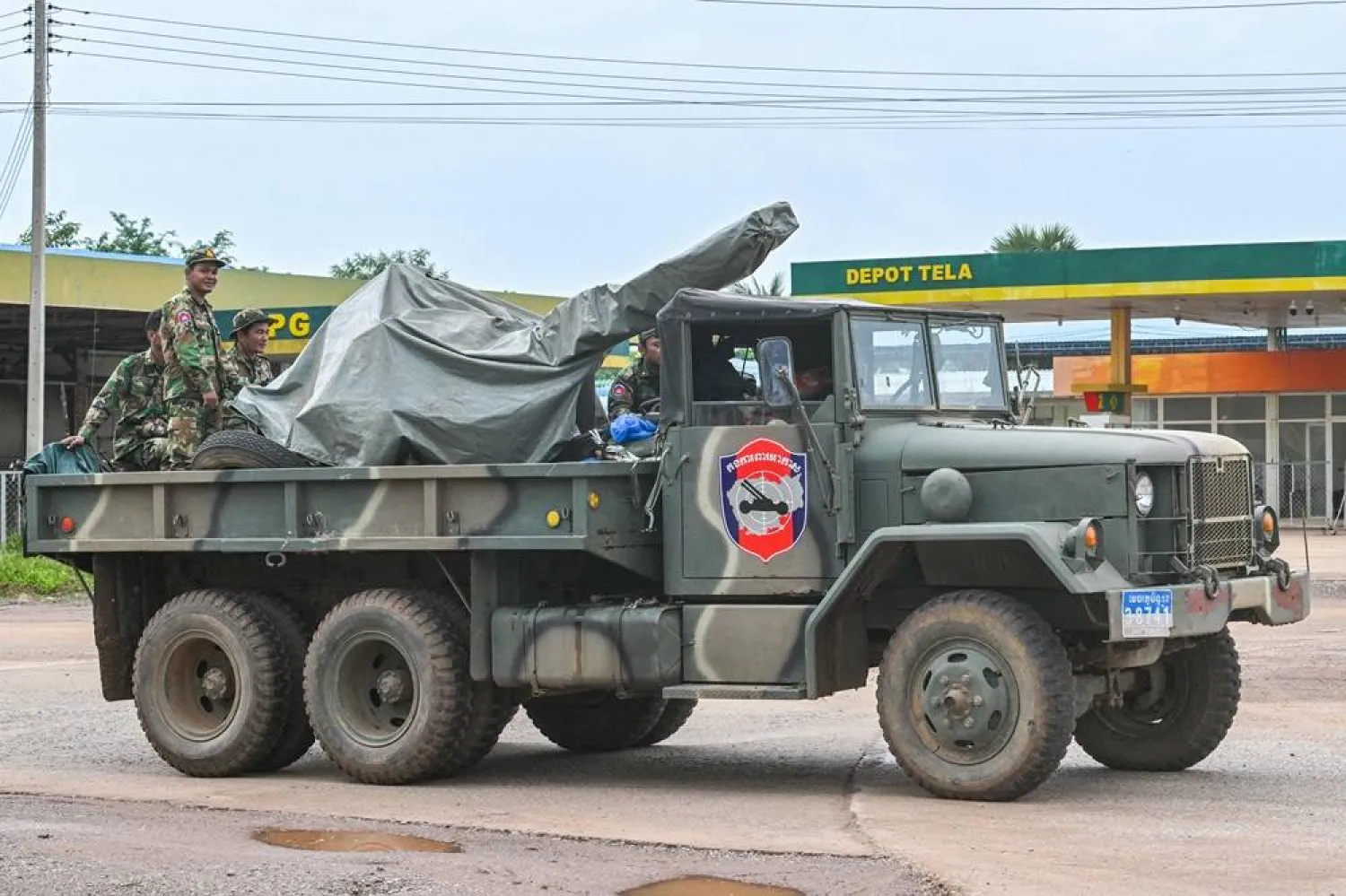
Cambodian soldiers stand on a military truck with an anti-aircraft gun in Oddar Meanchey province on July 26, 2025. (AFP)
TT

Trump Seeks to Broker Ceasefire in Thai-Cambodia Border Conflict

Cambodian soldiers stand on a military truck with an anti-aircraft gun in Oddar Meanchey province on July 26, 2025. (AFP)

US President Donald Trump said on Saturday he had spoken to the leaders of Cambodia and Thailand and that both countries want an immediate ceasefire, as he sought to broker peace while fighting along their border extended into a third day.  

In social media posts during a visit to Scotland, Trump said he wanted an "END to the War, which is currently raging" and warned that he would not make trade deals with either of the Southeast Asian governments if they are still fighting. 

Clashes on the Thai-Cambodian border continued into a third day and new flashpoints emerged on Saturday as both sides said they had acted in self-defense in the border dispute and called on the other to cease fighting and start negotiations.  

More than 30 people have been killed and more than 130,000 people displaced in the worst fighting between the Southeast Asian neighbors in 13 years. 

There were clashes early on Saturday, both sides said, in the neighboring Thai coastal province of Trat and Cambodia's Pursat Province, a new front more than 100 km (60 miles) from other conflict points along the long-contested border. 

The two countries have faced off since the killing of a Cambodian soldier late in May during a brief skirmish. Troops on both sides of the border were reinforced amid a full-blown diplomatic crisis that brought Thailand's fragile coalition government to the brink of collapse. 

As of Saturday, Thailand said seven soldiers and 13 civilians had been killed in the clashes, while in Cambodia five soldiers and eight civilians had been killed, said Defense Ministry spokesperson Maly Socheata. 

Trump wrote in his initial post: "Just spoke to the Prime Minister of Cambodia relative to stopping the War with Thailand. I am trying to simplify a complex situation!" 

Minutes later, he posted: "I have just spoken to the Acting Prime Minister of Thailand, and it was a very good conversation. Thailand, like Cambodia, wants to have an immediate Ceasefire, and PEACE. I am now going to relay that message back to the Prime Minister of Cambodia. 

"After speaking to both Parties, Ceasefire, Peace, and Prosperity seems to be a natural," Trump added. 

The Thai and Cambodian embassies in Washington did not immediately respond to requests for comment. 

In the Thai border province of Sisaket, a university compound has been converted into temporary accommodation, where a volunteer said more than 5,000 people were staying. 

Samrong Khamduang said she left her farm, about 10 km from the border, when fighting broke out on Thursday. The 51-year-old's husband stayed behind to look after livestock. 

"We got so scared with the sound of artillery," she said. "But my husband stayed back and now we lost the connection. I couldn’t call him. I don’t know what is happening back there."  

In Kuala Lumpur, Malaysian Prime Minister Anwar Ibrahim, the chair of the ASEAN regional bloc, said he would continue to push a ceasefire proposal. Cambodia has backed Anwar's plan, while Thailand has said it agreed with it in principle. 

"There is still some exchange of fire," Anwar said, according to state news agency Bernama. He said he had asked his foreign minister "to liaise with the respective foreign ministries and, if possible, I will continue engaging with them myself – at least to halt the fighting". 

SECURITY COUNCIL MEETING 

Thailand's ambassador to the United Nations told a Security Council meeting on Friday that soldiers had been injured by newly planted land mines in Thai territory on two occasions since mid-July - claims Cambodia has strongly denied - and said Cambodia had then launched attacks on Thursday morning. 

"Thailand urges Cambodia to immediately cease all hostilities and acts of aggression, and resume dialogue in good faith," Cherdchai Chaivaivid told the council in remarks released to media. 

Cambodia's defense ministry said Thailand had launched "a deliberate, unprovoked, and unlawful military attack" and was mobilizing troops and military equipment on the border. 

"These deliberate military preparations reveal Thailand's intent to expand its aggression and further violate Cambodia's sovereignty," the ministry said in a statement on Saturday. 

Cambodia called for the international community to "condemn Thailand's aggression in the strongest terms" and to prevent an expansion of its military activities, while Bangkok reiterated it wanted to resolve the dispute bilaterally. 

Thailand and Cambodia have bickered for decades over jurisdiction of various undemarcated points along their 817-km (508-mile) land border, with ownership of the ancient Hindu temples Ta Moan Thom and the 11th century Preah Vihear central to the disputes. 

Preah Vihear was awarded to Cambodia by the International Court of Justice in 1962, but tension escalated in 2008 after Cambodia attempted to list it as a UNESCO World Heritage site. 

That led to skirmishes over several years and at least a dozen deaths. 

Cambodia in June said it had asked the court to resolve its disputes with Thailand, which says it has never recognized the court's jurisdiction and prefers a bilateral approach. 


Iran Summons French, German, Italian, UK Envoys Over Support for Protests

 Cars burn in a street during a protest over the collapse of the currency's value, in Tehran, Iran, January 8, 2026. Stringer/WANA (West Asia News Agency) via Reuters
Cars burn in a street during a protest over the collapse of the currency's value, in Tehran, Iran, January 8, 2026. Stringer/WANA (West Asia News Agency) via Reuters
TT

Iran Summons French, German, Italian, UK Envoys Over Support for Protests

 Cars burn in a street during a protest over the collapse of the currency's value, in Tehran, Iran, January 8, 2026. Stringer/WANA (West Asia News Agency) via Reuters
Cars burn in a street during a protest over the collapse of the currency's value, in Tehran, Iran, January 8, 2026. Stringer/WANA (West Asia News Agency) via Reuters

Iran on Monday summoned diplomats in Tehran representing France, Germany, Italy and the UK to object to what it described as support by those countries for the protests that have shaken the country, its foreign ministry said.

The diplomats were shown a video of the damage caused by "rioters" and told their governments should "withdraw official statements supporting the protesters", the ministry said in a statement quoted by state television.

In Paris, the French foreign ministry confirmed that "European ambassadors" had been summoned by Iran.


Iran’s Traders, Frustrated by Economic Losses, Turn Against Clerics

 Cars burn in a street during a protest over the collapse of the currency's value, in Tehran, Iran, January 8, 2026. Stringer/WANA (West Asia News Agency) via Reuters
Cars burn in a street during a protest over the collapse of the currency's value, in Tehran, Iran, January 8, 2026. Stringer/WANA (West Asia News Agency) via Reuters
TT

Iran’s Traders, Frustrated by Economic Losses, Turn Against Clerics

 Cars burn in a street during a protest over the collapse of the currency's value, in Tehran, Iran, January 8, 2026. Stringer/WANA (West Asia News Agency) via Reuters
Cars burn in a street during a protest over the collapse of the currency's value, in Tehran, Iran, January 8, 2026. Stringer/WANA (West Asia News Agency) via Reuters

Iran's bazaar merchants, the trader class who were the financial backbone of the 1979 revolution, have turned against the clerics they helped bring to power, fueling unrest over an economy that has morphed into full-blown anti-government protests.

Frustration among bazaar merchants, from small-scale shopkeepers to large wholesale traders, has grown as their political and economic clout in Iran has diminished over the decades while the elite Revolutionary Guards have tightened their grip on the economy, building sprawling and tightly held networks of power.

"We are struggling. We cannot import goods because of US sanctions and because only the Guards or those linked to them control the economy. They only think about their own benefits," said a trader at Tehran’s centuries-old Grand Bazaar, speaking on condition of anonymity.

The wave of protests that has engulfed the country, posing one of the toughest challenges ever to the clerical leadership, erupted in late December in Tehran's Grand Bazaar, where hundreds of shopkeepers denounced the sharp fall in the rial currency.

The demonstrations quickly swelled and turned political, challenging the Islamic Republic's legitimacy. Protesters burned images of Supreme Leader Ali Khamenei and chanted "Death ‌to the dictator" - ‌undeterred by security forces armed with tear gas, batons, and, in many cases, live ammunition.

Iran’s ‌rulers, ⁠while acknowledging economic difficulties, have ‌blamed their longtime foes the US and Israel for fomenting the unrest. They appear intent on holding onto power at any cost, backed by a security apparatus refined over decades of suppressing ethnic revolts, student movements, and protests over economic hardship and social freedoms.

A combination of international sanctions and the Guards' sprawling economic empire has limited the government's ability to ease the dire economic situation.

Tehran-based analyst Saeed Laylaz said the government has lost control over the situation.

"What is striking is that the unrest began in the bazaar. For merchants, the core issue isn’t inflation - it’s price volatility, which leaves them unable to decide whether to buy or sell," he said.

Economic disparities between ordinary Iranians and the clerical and security elite, along with economic mismanagement and state corruption - ⁠reported even by state media - have fanned discontent at a time when inflation is pushing the price of many goods beyond the means of most people.

Iran's rial currency has lost nearly ‌half its value against the dollar in 2025, with official inflation reaching 42.5% in December.

CONTROL ‍OF SECTORS FROM OIL TO CONSTRUCTION

Created by the republic's ‍late founder Khomeini, the Guards first secured an economic foothold after the Iran-Iraq war in the 1980s, when clerical rulers allowed them ‍to invest in leading Iranian industries.

Their influence expanded exponentially over decades, benefiting from Khamenei's full backing and from opportunities created by Western sanctions, which effectively excluded Iran from the global financial and trading system.

The Guards now control vast sectors of the economy, from oil to transportation, communications, and construction.

Another trader said the crisis was not over, as the Guards have long proved adept at defending their economic interests.

"The government wants to resolve the problem, but it lacks the means and power in this system. The economy is not controlled by the government," said the trader, a 62-year-old carpet seller in Tehran.

All aspects of the country's sanctions-hit oil business have come under the growing influence of the ⁠Guards - from the shadow fleet of tankers that secretly ship sanctioned crude, to logistics and front companies selling the oil, mostly to China.

"No one knows how much of the oil money that the Guards get from selling Iran’s oil returns to the country ... they are too powerful to be questioned about it,” said a senior Iranian official, who asked not to be named.

During his 2013–2021 presidency, pragmatist Hassan Rouhani repeatedly clashed with the Guards, accusing them publicly of resisting budget cuts, while his attempts to curb their commercial networks and assets were largely frustrated.

THE ESTABLISHMENT RELIES ON THE GUARDS TO END UNREST

Even as it has relinquished economic power, the clerical establishment has relied on its loyal forces - the Guards and its affiliated Basij paramilitary - to violently crush ethnic uprisings, student unrest, and protests over economic hardship, preserving the political order.

"Given the sensitive circumstances when the country faces foreign threats, Khamenei cannot upset the Guards by curbing their economic influence. The establishment needs them to quell the protests and confront foreign threats," said an insider, close to Rouhani.

US-based rights group HRANA said it had verified the deaths of 544 people - 496 protesters and 48 security personnel - with 10,681 people arrested since ‌the protests began on December 28 and spread around the country. Reuters was unable to independently verify the tallies.

The authorities have not given numbers of casualties, but officials say many members of the security forces have been killed by "terrorists and rioters" linked to foreign foes, including the US States and Israel.


Greenland Says It Should Be Defended by NATO, Rejects Any US Takeover

 A view of houses in Nuuk, Greenland, June 22, 2025. (AP)
A view of houses in Nuuk, Greenland, June 22, 2025. (AP)
TT

Greenland Says It Should Be Defended by NATO, Rejects Any US Takeover

 A view of houses in Nuuk, Greenland, June 22, 2025. (AP)
A view of houses in Nuuk, Greenland, June 22, 2025. (AP)

Greenland's government said on Monday it will increase efforts to ensure the defense of the Arctic territory takes place under the auspices of NATO and again rejected US President Donald Trump's ambition to take over the island.

Trump has said the United States must own Greenland, an autonomous part of the Kingdom of Denmark, to prevent Russia ‌or China occupying the ‌strategically located and minerals-rich territory ‌in ⁠the future.

"All ‌NATO member states, including the United States, have a common interest in the defense of Greenland," the island's coalition government said in a statement, adding that it can in no way accept a US takeover of Greenland.

"As part of ⁠the Danish commonwealth, Greenland is a member of NATO and ‌the defense of Greenland ‍must therefore be through NATO," ‍the government said.

The European Union Commissioner ‍for Defense and Space Andrius Kubilius said earlier on Monday that any US military takeover of Greenland would be the end of NATO.

Trump first floated the idea of a US takeover of Greenland in 2019 during his first term ⁠in office, although he faces opposition in Washington, including from within his own party.

While Denmark has ruled Greenland for centuries, the territory has gradually been moving towards independence since 1979, a goal shared by all political parties elected to the island's parliament.

"We are a democratic society that makes our own decisions. And our actions are based on international law," Greenland's Prime Minister ‌Jens-Frederik Nielsen wrote on LinkedIn.