


Saudi Arabia Launches New Industrial Projects in Eastern Province

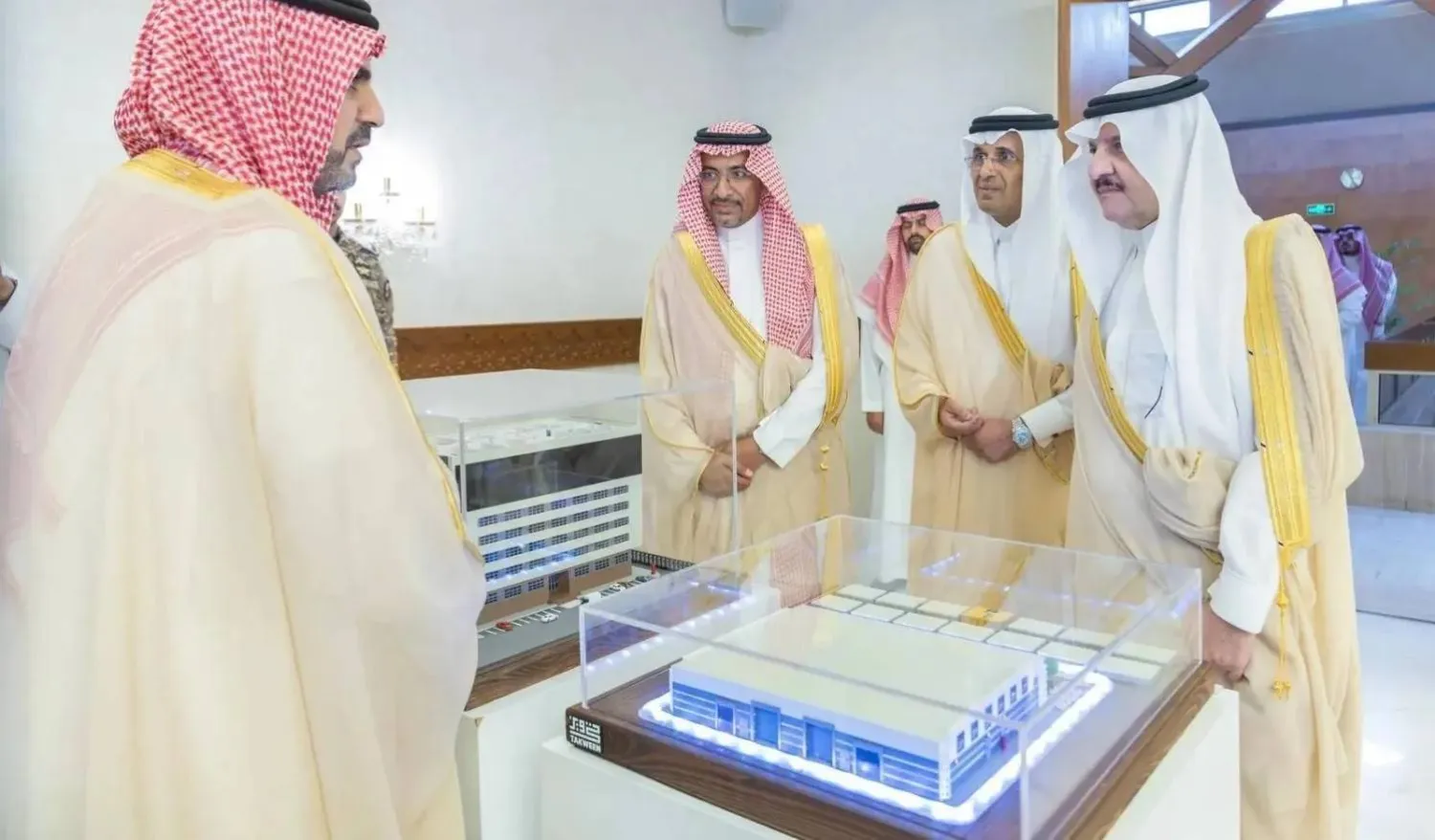
Eastern Province Governor, Industry Minister review model of new projects – SPA
TT

Saudi Arabia Launches New Industrial Projects in Eastern Province

Eastern Province Governor, Industry Minister review model of new projects – SPA

Saudi Arabia inaugurated new industrial projects in Dammam on Thursday, as Eastern Province Governor Prince Saud bin Naif opened two major facilities in the city’s First and Second Industrial Zones.

The launch was attended by Industry and Mineral Resources Minister Bandar Alkhorayef, who also chairs the Saudi Authority for Industrial Cities and Technology Zones (MODON), and MODON CEO Majed Al-Argoubi.

Prince Saud highlighted the rapid growth in the Kingdom’s industrial sector, attributing it to strong government backing aligned with Vision 2030 objectives to enhance local content, boost competitiveness, and solidify the Eastern Province’s status as a key industrial hub.

Multi-Storey and Ready-Built Factories

The projects include an eight-storey multi-purpose factory complex in Dammam’s First Industrial City, housing 78 industrial units ranging between 156 and 251 square meters. The facility aims to support small and medium enterprises (SMEs) and entrepreneurs with modern infrastructure, consultancy, and training services in a flexible environment designed to foster expansion and innovation.

In the Second Industrial City, Prince Saud also inaugurated a ready-built factory project comprising 84 units with floor spaces of 700 and 1,500 square meters, spanning more than 92,000 square meters in total.

This development targets light industries, offering opportunities for investors in sectors such as food processing, pharmaceuticals, medical equipment, electrical goods, electronics, and 3D printing.

Among the newly opened projects was a production plant for food and beverage giant PepsiCo. Speaking to Asharq Al-Awsat, Ahmed El-Sheikh, PepsiCo’s President for the Middle East, North Africa, and Pakistan, said the company’s latest investment reflected growing confidence in the Saudi market, fueled by Vision 2030 reforms.

“Saudi Arabia has undergone a remarkable transformation in recent years, making it a highly competitive and attractive investment destination,” he said. “Modernized regulations, streamlined procedures, and robust incentives have opened the door to greater growth and innovation.”

El-Sheikh noted that PepsiCo’s recent expansions—including its Dammam plant and the launch of a regional headquarters in Riyadh—underscore the Kingdom’s strategic role in the company’s regional operations.

The Dammam factory is now one of PepsiCo’s most advanced production sites in the region, with plans to export more than 8,600 tons of products across the Middle East this year.

Boost from Logistics and Tech Infrastructure

“Logistical and infrastructure upgrades under Vision 2030 and the National Industrial Development and Logistics Program (NIDLP) have significantly improved our operational efficiency,” El-Sheikh said.

He cited the implementation of technologies such as a Warehouse Management System (WMS) and a Transport Control Tower (TCT), enabling real-time tracking, better inventory control, and lower operating costs. These advances have enhanced PepsiCo’s delivery speed to regional markets and improved customer experience.

Saudi Arabia’s geographic location also plays a pivotal role, enabling efficient distribution via well-developed land, sea, and air networks.

The Dammam facility has achieved a 84.3% Saudization rate, with women making up more than 21% of the workforce. The expansion has created 30 new jobs in the supply chain, offering fresh opportunities for Saudi youth.

PepsiCo sources 100% of the potatoes used in its snack products from Saudi farms, reinforcing local food security and encouraging sustainable agricultural practices, such as drip irrigation, which has reduced water consumption by 30% compared to 2015 levels.

The company also procures most of its packaging materials domestically, supporting local manufacturers and bolstering the SME ecosystem.

Focus on Innovation and Industry 4.0

“The Saudi snack food market is highly competitive and constantly growing, which pushes us to keep innovating and meeting evolving consumer demands,” El-Sheikh added.

PepsiCo is also integrating Industry 4.0 technologies—including advanced digital systems, solar panels, and water recycling solutions—to enhance operational efficiency and minimize environmental impact.

The latest expansion, valued at SAR 300 million ($80 million), has increased the plant’s production capacity by 19,000 metric tons. The company plans to build on this momentum by boosting local sourcing, improving operational performance, and expanding its use of smart manufacturing technologies.


Internet Shutdown Squeezes Iran’s Ailing Businesses Already Hurt by Crashing Currency

Iranians walk in street in Tehran, Iran, 20 January 2026. (EPA)
TT

Internet Shutdown Squeezes Iran’s Ailing Businesses Already Hurt by Crashing Currency

Iranians walk in street in Tehran, Iran, 20 January 2026. (EPA)

Iranians have been struggling for nearly two weeks with the longest, most comprehensive internet shutdown in the history of the country — one that has not only restricted their access to information and the outside world, but is also throttling many businesses that rely on online advertising.

Authorities shut down internet access on Jan. 8 as nationwide protests led to a brutal crackdown that activists say has killed over 4,500 people, with more feared dead. Since then, there has been minimal access to the outside world, with connectivity in recent days restored only for some domestic websites. Google also began partially functioning as a search engine, with most search results inaccessible.

Officials have offered no firm timeline for the internet to return, leading to fears by businesses across the country about their future.

One pet shop owner in Tehran, who spoke on the condition of anonymity like others for fear of reprisals, said his business had fallen by 90% since the protests. “Before that, I mainly worked on Instagram and Telegram, which I don’t have access to anymore. The government has proposed two domestic alternatives. The point is our customers are not there — they don’t use it.”

Internet outages are the latest squeeze on businesses

The internet outage compounds economic pain already suffered by Iranians. The protests, which appear to have halted under a bloody suppression by authorities, began Dec. 28 over Iran’s rial currency falling to over 1.4 million to $1. Ten years ago, the rial traded at 32,000 to $1. Before the 1979 revolution, it traded at 70 to $1.

The currency’s downward spiral pushed up inflation, increasing the cost of food and other daily necessities. The pressure on Iranians’ pockets was compounded by changes to gasoline prices that were also introduced in December, further fueling anger.

Iran’s state-run news agency IRNA quoted a deputy minister of communications and information technology, Ehsan Chitsaz, as saying the cut to the internet cost Iran between $2.8 to $4.3 million each day.

But the true cost for the Iranian economy could be far higher. The internet monitoring organization NetBlocks estimates each day of an internet shutdown in Iran costs the country over $37 million.

The site says it estimates the economic impact of internet outages based on indicators from multiple sources including the World Bank and the International Telecommunication Union, which is the United Nations’ specialized agency for digital technology.

In 2021 alone, a government estimate suggested Iranian businesses made as much as $833 million a year in sales from social media sites, wrote Dara Conduit, a lecturer at the University of Melbourne in Australia, in an article published by the journal Democratization in June.

She cited a separate estimate suggesting internet disruptions around the 2022 Mahsa Amini protests cost the Iranian economy $1.6 billion.

The 2022 internet disruptions' "far-reaching and blanket economic consequences risked further heightening tensions in Iran and spurring the mobilization of new anti-regime cohorts onto the streets at a time when the regime was already facing one of the most serious existential threats of its lifetime," Conduit wrote.

More than 500 people were reportedly killed during that crackdown and over 22,000 detained.

Prosecutors target some businesses over protest support

Meanwhile, prosecutors have also begun targeting some businesses in the crackdown.

The judiciary's Mizan news agency reported Tuesday that prosecutors in Tehran filed paperwork to seize the assets of 60 cafes it alleged had a role in the protests.

It also announced plans to seek the assets of athletes, cinema figures and others as well. Some cafes in Tehran and Shiraz have been shut down by authorities, other reports say.

Internet cuts drive more outrage

The financial damage also has some people openly discussing the internet blackout.

In the comments section of a story on the internet blackout carried by the semiofficial Fars news agency, believed to be close to the country’s paramilitary Revolutionary Guard, one reader wrote: “For heaven’s sake, please do not let this internet cut become a regular thing. We need the net. Our business life is vanishing. Our business is being destroyed.”

Another commentator questioned why the internet remained blocked after days with no reports of street protests.

It’s not just the internet blackout that is hurting businesses. The violent crackdown on the protests, and the wave of a reported 26,000 arrests that followed, also have dampened the mood of consumers.

In Iran's capital, many shops and restaurants are open, but many look empty as customers focus primarily on groceries and little else.

“Those who pass by our shops don’t show any appetite for shopping,” said the owner of an upscale tailor shop in Tehran. “We are just paying our regular expenses, electricity and staff ... but in return, we don't have anything.”


Larry Fink from Davos: In Age of Artificial Intelligence, Trust Is Hardest Currency

Chairman and CEO of BlackRock, Larry Fink, attends the 56th annual World Economic Forum (WEF) meeting in Davos, Switzerland, January 21, 2026. (Reuters)
TT

Larry Fink from Davos: In Age of Artificial Intelligence, Trust Is Hardest Currency

Chairman and CEO of BlackRock, Larry Fink, attends the 56th annual World Economic Forum (WEF) meeting in Davos, Switzerland, January 21, 2026. (Reuters)

CEO of BlackRock Larry Fink kicked off the World Economic Forum on Tuesday with a stark message, acknowledging a significant erosion of trust in global institutions and elites.

Speaking at the 56th Annual Meeting of the WEF in Davos, which gathered around 65 heads of state and government and nearly 850 of the world's top CEOs and chairpersons, he acknowledged that the gathering has lost trust and “feels out of step with the moment.”

“But now for the harder question: Will anyone outside this room care? Because if we’re being honest, for many people this meeting feels out of step with the moment: elites in an age of populism, an established institution in an era of deep institutional distrust,” he admitted.

Fink, who was appointed interim co-chair of the World Economic Forum in August 2025, said it is also obvious that the world now places far less trust in the forum to help shape what comes next.

“If WEF is going to be useful going forward, it has to regain that trust,” he said.

The billionaire boss of the world’s largest asset manager said that prosperity is not just growth in the aggregate. “It can’t be measured by GDP or the market caps of the world’s largest companies alone. It has to be judged by how many people can see it, touch it, and build a future on it.”

Fink said that since the fall of the Berlin Wall, more wealth has been created than in any time prior in human history, but in advanced economies, that wealth has accrued to a far narrower share of people than any healthy society can ultimately sustain.

He noted that now AI threatens to replay the same pattern.

Fink said early gains are flowing to the owners of models, data, and infrastructure, questioning what AI does to white-collar work what globalization did to blue-collar.

He urged those gathered at Davos to create a “credible plan” for broad participation in the gains AI can deliver.

“Not with abstractions about the jobs of tomorrow, but with a credible plan for broad participation in the gains.”

In another dimension of change, Fink said the forum shouldn’t want panels where everyone agrees 95% of the time.

“The objective isn’t agreement. It’s understanding. It’s sitting with people we disagree with, taking their arguments seriously, and being willing to admit that they might see something we don’t,” he said.

Fink also noted that the central tension of the forum is that many of the people most affected by what participants talk about will never come to the conference. “Davos is an elite gathering trying to shape a world that belongs to everyone.”

He added, “That’s why this year’s theme is the Spirit of Dialogue. Because dialogue is the only way a room like this earns the legitimacy to shape ideas for people who aren’t in it.”

Fink called for WEF to start doing something new: showing up and listening in the places where the modern world is actually built. “Davos, yes. But also places like Detroit and Dublin and cities like Jakarta and Buenos Aires. The mountain will come down to earth.”


China’s Vice Premier Tells Davos World Cannot Revert to 'Law of the Jungle'

20 January 2026, Switzerland, Davos: Vice Premier of the People's Republic of China He Lifeng speaks during "Special Address by He Lifeng, Vice-Premier of the People's Republic of China session" at the World Economic Forum annual meeting in Davos. (Boris Baldinger/World Ecomonic Forum/dpa)
TT

China’s Vice Premier Tells Davos World Cannot Revert to 'Law of the Jungle'

20 January 2026, Switzerland, Davos: Vice Premier of the People's Republic of China He Lifeng speaks during "Special Address by He Lifeng, Vice-Premier of the People's Republic of China session" at the World Economic Forum annual meeting in Davos. (Boris Baldinger/World Ecomonic Forum/dpa)

Chinese Vice Premier He Lifeng warned Tuesday the world must not revert to the "law of the jungle", speaking at the World Economic Forum in Davos as Washington steps up its bid to take Greenland.

"A select few countries should not have privileges based on self-interest, and the world cannot revert to the law of the jungle where the strong prey on the weak," He said in a speech which came as US President Donald Trump pushes his increasingly assertive America First agenda, and demands NATO ally Denmark to cede Greenland to him.

"All countries have the right to protect their legitimate interests," He added.

In a veiled reference to Trump's mercurial trade policies, He slammed the "unilateral" actions and trade agreements of "some countries" which he said violates the rules of the World Trade Organization.

Beijing and Washington last year were locked in a blistering trade war that saw both countries impose tit-for-tat tariffs on each others' products.

"The current multilateral trading system is facing unprecedented and severe challenges," He said.

"We must firmly uphold multilateralism and promote the improvement of a more just and equitable international economic and trade order."
