Iran’s Deputy FM: We Coordinate with China, Russia to Counter Snapback

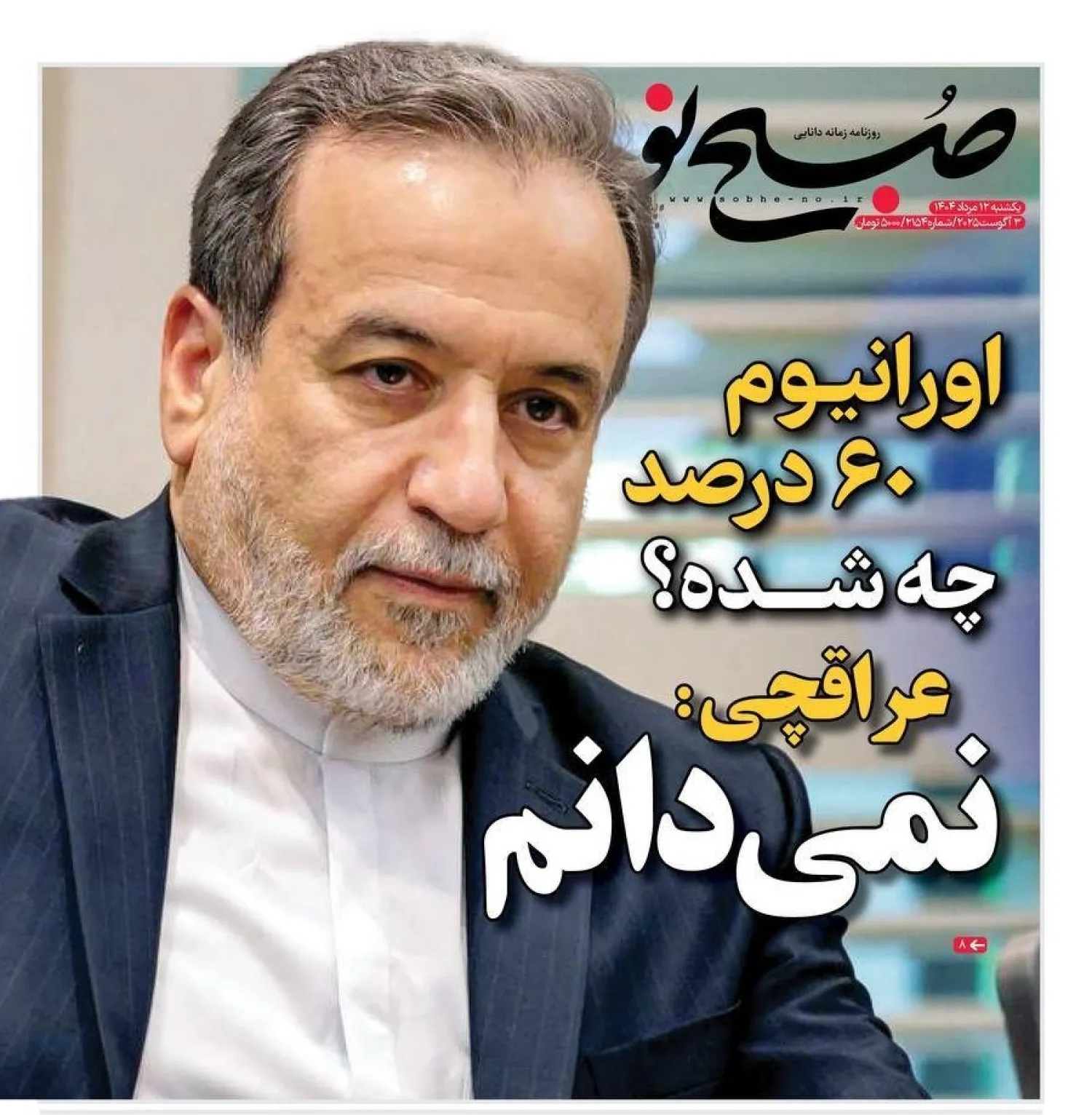
The front page of Iran’s newspaper Sobh-e-No shows Iranian Foreign Minister Abbas Araghchi’s response to the Financial Times on the fate of the nuclear stockpile “I don’t know” 
TT

Iran’s Deputy FM: We Coordinate with China, Russia to Counter Snapback

The front page of Iran’s newspaper Sobh-e-No shows Iranian Foreign Minister Abbas Araghchi’s response to the Financial Times on the fate of the nuclear stockpile “I don’t know” 

Iran's Deputy Foreign Minister for Legal and International Affairs, Kazem Gharibabadi said on Sunday that his country is closely coordinating with China and Russia to respond to the “snapback” mechanism should the E3 decide to invoke the United Nations sanctions over Tehran’s nuclear program before it is set to expire on Oct. 18.

According to Committee spokesman Ebrahim Rezaei, Gharibabadi told deputies that the European signatories to the 2015 nuclear deal have no legal grounds to invoke the snapback mechanism, as they have failed to fulfill their own commitments under the agreement.

Rezaei said the deputy foreign minister presented a detailed report to the Iranian Parliament following talks were held in Istanbul last month with counterparts from the European trio and the EU, addressing prospects for resuming negotiations.

The E3 have set a deadline of the end of August to revive diplomacy. Diplomats say they want Iran to take concrete steps to convince them to extend the deadline by up to six months.

In this regard, Gharibabadi said the European side proposed extending UN Security Council Resolution 2231 for an additional six months under specific conditions.

However, he added, “We proposed that instead of extending Resolution 2231, negotiations should focus on ending the Snapback mechanism altogether. The resolution must expire at its predetermined date. Decisions will be made based on our national interests and security.”

Concerning talks with the US, Gharibabadi said there have been no recent developments.

“The Iranian people’s rights—such as uranium enrichment, lifting of sanctions, compensation for damages, and rebuilding trust—must be respected,” he noted.

Rezaei said committee members warned against stirring public fear over the Snapback mechanism. “The West and Europeans are not trustworthy. They’ve violated their own commitments,” he stated, while stressing Iran should prioritize its internal capabilities and strengthen ties with China and Russia, according to ISNA.

Gharibabadi’s comments however appeared to contradict remarks made by another deputy foreign minister, Saeed Khatibzadeh, who said the IAEA inspectors would return to Tehran soon.

Speaking to Chinese broadcaster Phoenix, Khatibzadeh said Parliament’s recent decision does not mandate severing ties with the IAEA.

Rather, he said, it places the Supreme National Security Council in charge of managing relations. “We’re implementing a new mechanism, but we have no intention of halting cooperation,” the deputy FM said.

“Inspectors left voluntarily amid the conflict and attacks. They were not expelled,” Khatibzadeh said, adding that the inspectors would return to Iran in the coming weeks.

Concerning talks with the US, he said, “We are not in a hurry to enter any indirect talks or frameworks unless solid guarantees are provided for meaningful negotiations.”

“The United States observes no red lines when it comes to attacking peaceful nuclear facilities in other nations. It must be taught a lesson—it cannot recklessly and brutally violate the sovereignty and territorial integrity of others,” he added.

Khatibzadeh declined to provide specific details when asked about the fate of Iran’s 60% enriched uranium stockpile.

On Sunday, Iranian Foreign Minister Abbas Araghchi was quoted by a local newspaper responding to the Financial Times on the same matter. When asked about the stockpile’s current status, Araghchi said, “I don’t know.”


Australian Police Say Bondi Beach Mass Shooting Was Inspired by ISIS Group 

An Australian flag is placed near flowers laid as a tribute at Bondi Beach to honor the victims of a mass shooting that targeted a Hanukkah celebration at Bondi Beach on Sunday, in Sydney, Australia, December 16, 2025. (Reuters)
TT

Australian Police Say Bondi Beach Mass Shooting Was Inspired by ISIS Group 

An Australian flag is placed near flowers laid as a tribute at Bondi Beach to honor the victims of a mass shooting that targeted a Hanukkah celebration at Bondi Beach on Sunday, in Sydney, Australia, December 16, 2025. (Reuters)

A mass shooting in which 15 people were killed during a Hanukkah celebration at Sydney’s Bondi Beach was “a terrorist attack inspired by ISIS,” Australia’s federal police commissioner Krissy Barrett said Tuesday.

The suspects were a father and son, aged 50 and 24, authorities have said. The older man was shot dead while his son was being treated at a hospital on Tuesday.

A news conference by political and law enforcement leaders on Tuesday was the first time officials confirmed their beliefs about the suspects' ideologies. Prime Minister Anthony Albanese said the remarks were based on evidence obtained, including “the presence of ISIS flags in the vehicle that has been seized.”

There are 25 people still being treated in hospitals after Sunday’s massacre, 10 of them in critical condition. Three of them are patients in a children's hospital.

Also among them is Ahmed al Ahmed, who was captured on video tackling and disarming one assailant, before pointing the man’s weapon at him and then setting it on the ground.

Those killed ranged in age from 10 to 87 years old. They were attending a Hanukkah event at Australia's most famous beach Sunday when the gunshots rang out.

Calls for stricter gun laws

Albanese and the leaders of some of Australia's states have pledged to tighten the country's already strict gun laws in what would be the most sweeping reforms since a shooter killed 35 people in Port Arthur, Tasmania in 1996. Mass shootings in Australia have since been rare.

Officials divulged more information as public questions and anger grew on the third day following the attack about how the suspects were able to plan and enact it and whether Australian Jews had been sufficiently protected from rising antisemitism.

Albanese announced plans to further restrict access to guns, in part because it emerged the older suspect had amassed his cache of six weapons legally.

“The suspected murderers, callous in how they allegedly coordinated their attack, appeared to have no regard for the age or ableness of their victims,” said Barrett. “It appears the alleged killers were interested only in a quest for a death tally.”

Authorities probe suspects' trip to Philippines

The suspects traveled to the Philippines last month, said Mal Lanyon, the Police Commissioner for New South Wales state. Their reasons for the trip and where in the Philippines they went would be probed by investigators, Lanyon said.

He also confirmed that a vehicle removed from the scene, registered to the younger suspect, contained improvised explosive devices.

“I also confirm that it contained two homemade ISIS flags,” Lanyon said.

Groups of separatist militants, including Abu Sayyaf in the southern Philippines, once expressed support for the ISIS group and have hosted small numbers of foreign militant combatants from Asia, the Middle East and Europe in the past.

Decades of military offensives, however, have considerably weakened Abu Sayyaf and other such armed groups, and Philippine military and police officials say there has been no recent indication of any foreign militants in the country’s south.

Albanese visits man who tackled shooter

Earlier, Albanese visited al Ahmed in hospital. Albanese said the 42-year-old Syrian-born fruit shop owner had further surgery scheduled on Wednesday for shotgun wounds to his left should and upper body.

“It was a great honor to met Ahmed al Ahmed. He is a true Australian hero,” Albanese told reporters after a 30-minute meeting with him and his parents.

“We are a brave country. Ahmed al Ahmed represents the best of our country. We will not allow this country to be divided. That is what the terrorists seek. We will unite. We will embrace each other, and we’ll get through this,” Albanese added.

Lifeguards praised for actions during massacre

The famous blue-shirted lifeguards of Bondi Beach attracted praise as more stories of their actions during the shooting emerged.

One duty lifeguard, identified by the organization’s Instagram account as Rory Davey, performed an ocean rescue during the shooting after people fled, fully clothed, into the sea.

Another lifeguard, Jackson Doolan, posted to his social media a photo taken as he sprinted, barefoot and clutching a first aid kit, from Tamarama beach a mile away towards Bondi as the massacre continued.

“These guys are community members and it’s not about the surf,” Anthony Caroll, one of the stars of a popular reality television show called “Bondi Rescue,” told Sky News on Tuesday. “They heard the gunshots and they left the beach and came right up the back here into the scene of the crime, into harm’s way while those bullets were being shot.”

Israel’s Ambassador to Australia Amir Maimon visited the scene of the carnage on Tuesday and was welcomed by Jewish leaders.

“I’m not sure that my vocabulary is rich enough to express how I feel. My heart is torn apart because the Jewish community, the Australians of Jewish faith, the Jewish community is also my community,” Maimon said.

Thousands have visited Bondi from all walks of life since the tragedy to pay their respects and lay flowers on a mounting pile at an impromptu memorial site.

One of the visitors on Tuesday was former Prime Minister John Howard, who was responsible for the 1996 overhaul of gun laws and an associated buy-back of newly outlawed weapons.

In the aftermath of the shooting, a record number of Australians signed up to donate blood. On Monday alone close to 50,000 appointments were booked, more than double the previous record, the national donation organization Lifeblood told The Associated Press.

Almost 1,300 people signed up to donate for the first time. Such was the enthusiasm at Lifeblood’s Bondi location that appointments to give blood were unavailable before Dec. 31, according to the organization’s website.

A total of 7,810 donations of blood, plasma and platelets were made across the country on Monday, spokesperson Cath Stone said. Australian news outlets reported queues of up to four hours at some Sydney donation sites.


FBI Foils 'Terror Plot' Targeting Los Angeles, US Attorney General Says

US Attorney General Pam Bondi speaks at a press conference following the arrest in the D.C. pipe bomber investigation, at the Justice Department in Washington, D.C., US, December 4, 2025. REUTERS/Jessica Koscielniak
TT

FBI Foils 'Terror Plot' Targeting Los Angeles, US Attorney General Says

US Attorney General Pam Bondi speaks at a press conference following the arrest in the D.C. pipe bomber investigation, at the Justice Department in Washington, D.C., US, December 4, 2025. REUTERS/Jessica Koscielniak

The FBI has foiled a bomb plot targeting multiple targets, including immigration agents and vehicles, in Los Angeles and Orange County, Attorney General Pam Bondi said on Monday, Reuters reported.

"The Turtle Island Liberation Front—a far-left, pro-Palestine, anti-government, and anti-capitalist group—was preparing to conduct a series of bombings against multiple targets in California beginning on New Year’s Eve. The group also planned to target ICE agents and vehicles," Bondi said in a statement.

Four people have been charged with conspiracy and possession of an unregistered destructive device, according to the complaint filed in the US District Court for the Central District of California.

The bombing plot called for planting explosive devices at five locations targeting two US companies at midnight on New Year's Eve in the Los Angeles area, it said.


Iran Hosts Regional Talks on Afghanistan, but Kabul Stays Away

The Iranian flag waves in front of the International Atomic Energy Agency (IAEA) headquarters, before the beginning of a board of governors meeting, amid the coronavirus disease (COVID-19) outbreak in Vienna, Austria, March 1, 2021. (Reuters)
TT

Iran Hosts Regional Talks on Afghanistan, but Kabul Stays Away

The Iranian flag waves in front of the International Atomic Energy Agency (IAEA) headquarters, before the beginning of a board of governors meeting, amid the coronavirus disease (COVID-19) outbreak in Vienna, Austria, March 1, 2021. (Reuters)

Afghanistan's neighbors met in Iran and agreed to deepen regional coordination to address political, economic and security challenges, as well as calling for sanctions on Afghanistan to be lifted. The only absent party? Afghanistan itself.

China, Pakistan, Pakistan, Tajikistan, Uzbekistan and Turkmenistan all joined the talks organized by Iran, as did Russia, according to a statement released after the meeting on Sunday, The AP news reported.

Afghanistan was invited but decided not to attend. Its Taliban-led government was tight-lipped on the reasons, with the foreign ministry saying only that it would not participate because Afghanistan “currently maintains active engagement with regional countries through existing regional organizations and formats, and has made good progress in this regard.”

The statement from the talks in Iran stressed the importance of maintaining economic and trade ties with Afghanistan to improve living conditions and called for the country’s integration into regional political and economic processes.

The Taliban were isolated after they retook power in Afghanistan in August 2021, but in the past year, they have developed diplomatic ties. They now raise several billion dollars every year in tax revenues to keep the lights on.

However, Afghanistan is still struggling economically. Millions rely on aid for survival, and the struggling economy has been further impacted by the international community not recognizing the Taliban government's seizure of power in the wake of the chaotic withdrawal of US-led troops in 2021. Natural disasters and the flow of Afghans fleeing Pakistan under pressure to return home have underlined Afghanistan’s reliance on foreign aid to meet essential needs.

The countries at the talks also voiced security concerns and pledged cooperation in combating terrorism, drug trafficking and human smuggling, while opposing any foreign military presence in Afghanistan. They underscored the responsibility of the international community to lift sanctions and release Afghanistan’s frozen assets, and urged international organizations to support the dignified return of Afghan refugees from neighboring countries.

The participants backed efforts to reduce tensions between Afghanistan and Pakistan, which have been particularly strained, with border clashes between the two sides killing dozens of civilians, soldiers and suspected militants and wounding hundreds more.

The violence followed explosions in Kabul on Oct. 9 that Afghan authorities blamed on Pakistan. A Qatar-mediated ceasefire has largely held since October, although there have been limited border clashes. The two sides failed to reach an overall agreement in November despite three rounds of peace talks.

Asif Durrani, Pakistan’s former special representative for Afghanistan, said the Taliban government’s decision to skip the meeting reflected a “lack of political maturity.” Writing on X, Durrani said the move reinforced concerns that the Taliban were unwilling to negotiate, instead adopting an “I don’t accept” stance that he said would do little to resolve serious regional problems.

Mohammad Sadiq, the current Pakistani special representative for Afghanistan who attended the talks, wrote on X that the Afghan people had already suffered enough and deserved better.

Only an Afghanistan that does not harbor militants would inspire confidence among neighboring and regional countries to engage meaningfully with Kabul and help unlock the country’s economic and connectivity potential, he wrote.

Participants agreed to hold the next meeting of foreign ministers of Afghanistan’s neighboring countries as soon as possible in Ashgabat, Turkmenistan, and welcomed Pakistan’s offer to host the next round of special envoys’ talks in Islamabad in March.

Iran’s foreign ministry spokesman, Esmail Baghaei, on Sunday said that the meeting had not been held for about two years and marked the first such gathering attended by special envoys on Afghanistan from neighboring countries as well as Russia. Russia and Uzbekistan sent the special envoys of their presidents, while Pakistan was represented by a delegate from the prime minister’s office.

Landlocked Afghanistan is sandwiched between the Middle East, Central Asia, and South Asia, making it strategically located for energy-rich and energy-hungry nations.