


Sudanese Lay First Bricks to Rebuild War-torn Khartoum

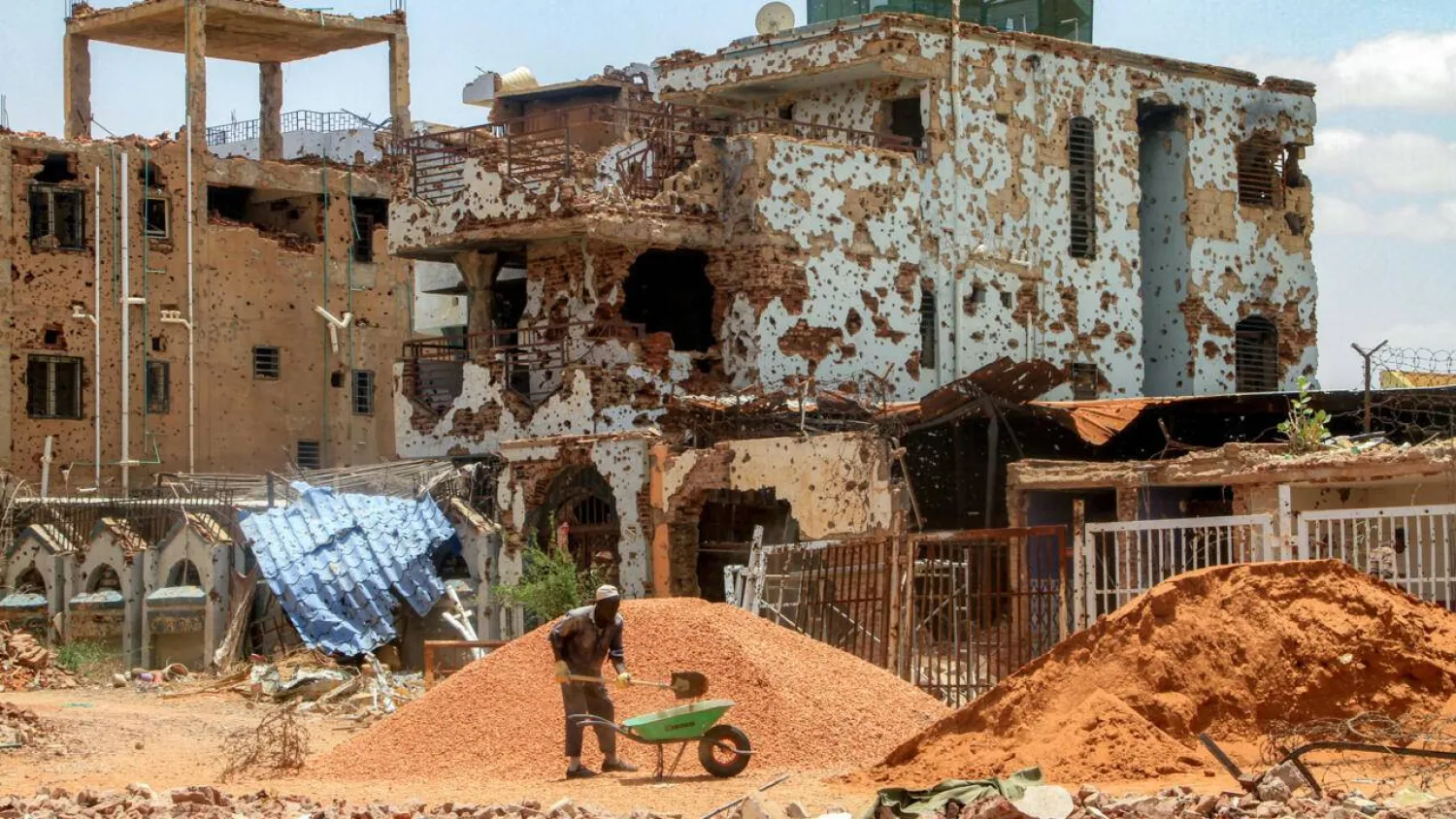
(FILES) A worker shovels pebbles from a mound into a wheelbarrow near a heavily-damaged buildings at a site in the Lamab suburb on the southwestern outskirts of Sudan's capital Khartoum. Ebrahim Hamid / AFP/File
TT

Sudanese Lay First Bricks to Rebuild War-torn Khartoum

(FILES) A worker shovels pebbles from a mound into a wheelbarrow near a heavily-damaged buildings at a site in the Lamab suburb on the southwestern outskirts of Sudan's capital Khartoum. Ebrahim Hamid / AFP/File

On the streets of Sudan's capital Khartoum, builders clear rubble from houses pockmarked with bullet holes, haul away fallen trees and repair broken power lines, in the city's first reconstruction effort since war began over two years ago.

Fighting between Sudan's army and the paramilitary Rapid Support Forces (RSF), which broke out in April 2023, has left the capital battered and hollowed out.

But reconstruction -- led by government agencies and youth-led volunteer groups -- has finally begun to repair hospitals, schools and water and power networks, AFP reported.

"We are working to restore the state's infrastructure," volunteer Mostafa Awad said.

Once a thriving metropolis of nine million people, Khartoum's skyline is now a jagged silhouette of collapsed buildings.

Electrical poles lean precariously or lie snapped on the ground in the streets. Cars, stripped for parts, sit burnt-out and abandoned, their tires melted into the asphalt.

AFP correspondents saw entire residential blocks standing with their exterior walls ripped away in the fighting.

Danger remains within the soot-stained buildings as authorities slowly work to clear tens of thousands of unexploded bombs left behind by fighters.

The UN warns Khartoum is "heavily contaminated by unexploded ordnance", and this month said landmines have been discovered across the capital.

Sudan's war has killed tens of thousands, displaced 13 million and plunged the nation into the world's worst hunger and displacement crisis.

'Proud national capital'

Until the army pushed the RSF out of Khartoum in March, the capital -- where four million alone were displaced by fighting -- was a battlefield.

Before they left, paramilitary fighters stripped infrastructure bare, looting everything from medical equipment and water pumps to copper wiring.

"Normally in a war zone, you see massive destruction... but you hardly ever see what happened in Khartoum," the UN's resident and humanitarian coordinator Luca Renda said.

"All the cables have been taken away from homes, all the pipes have been destroyed," he told AFP, describing systematic looting of both small and large-scale items.

Today, power and water systems remain among the city's greatest challenges.

The head of east Khartoum's electricity department, Mohamed al-Bashir, described "massive damage" in the capital's main transformer stations.

"Some power stations were completely destroyed," he told AFP, explaining the RSF had "specifically targeted transformer oil and copper cables".

Vast swathes of Khartoum are without electricity, and with no reliable water supply, a cholera outbreak gripped the city this summer.

Health officials reported up to 1,500 new cases a day in June, according to the UN.

On his first visit to Khartoum last month, Sudan's prime minister pledged a wide-scale recovery effort.

"Khartoum will return as a proud national capital," Kamil Idris said.

Even as war rages on elsewhere in the country, the government has begun planning its return from its wartime capital Port Sudan.

Taking shape

On Tuesday, it announced central Khartoum -- the devastated business and government district where some of the fiercest battles took place -- would be evacuated and redesigned.

The UN estimates the rehabilitation of the capital's essential facilities to cost around $350 million, while the full rebuilding of Khartoum "will take years and several billion dollars", Renda told AFP.

Hundreds have rolled up their sleeves to start the long and arduous rebuilding work, but obstacles remain.

"We faced challenges such as the lack of raw materials, especially infrastructure tools, sanitation (supplies) and iron," said Mohamed El Ser, a construction worker.

"Still, the market is relatively starting to recover," he told AFP.

In downtown Khartoum, a worker, his hands coated in mud, stacks bricks beside a crumbling building.

AFP correspondents accompanied workers carefully refitting pipes into what once was a family home, while nearby others lifted slabs of concrete and mangled metal into wheelbarrows.

On one road that had been a front line, a man repaired a downed streetlight while others dragged a felled tree onto a flatbed truck.

The UN expects up to two million people to make their way back to Khartoum by the end of the year.

Those who have already returned, estimated to be in the tens of thousands, say life is still difficult, but there's reason for hope.

"Honestly, there is an improvement in living conditions," said Ali Mohamed, who recently returned.

"There is more stability now, and real services are beginning to come back, like water, electricity and even basic medical care."
Israeli Fire Kills 11, Including Journalists, Gaza Health Officials Say

 Mourners react during the funeral of Palestinians who, according to medics, were killed by Israeli strikes on Wednesday, at Al-Aqsa Martyrs Hospital, in Deir al-Balah, central Gaza Strip, January 21, 2026. REUTERS/Mahmoud Issa
Mourners react during the funeral of Palestinians who, according to medics, were killed by Israeli strikes on Wednesday, at Al-Aqsa Martyrs Hospital, in Deir al-Balah, central Gaza Strip, January 21, 2026. REUTERS/Mahmoud Issa
TT

Israeli Fire Kills 11, Including Journalists, Gaza Health Officials Say

 Mourners react during the funeral of Palestinians who, according to medics, were killed by Israeli strikes on Wednesday, at Al-Aqsa Martyrs Hospital, in Deir al-Balah, central Gaza Strip, January 21, 2026. REUTERS/Mahmoud Issa
Mourners react during the funeral of Palestinians who, according to medics, were killed by Israeli strikes on Wednesday, at Al-Aqsa Martyrs Hospital, in Deir al-Balah, central Gaza Strip, January 21, 2026. REUTERS/Mahmoud Issa

Israeli fire killed 11 Palestinians, including two boys and three journalists, in Gaza on Wednesday, local medics ​said, and the Israeli military said it had "eliminated" a Palestinian militant who posed a threat to soldiers.

In the latest violence disrupting a brittle, three-month-old ceasefire, Palestinian health officials said an Israeli airstrike killed three Palestinian journalists travelling in a car in the central Gaza Strip.

The three were on an assignment sponsored by the Egyptian Committee, which supervises Egypt's relief work in Gaza, to film tent encampments built by Egypt for displaced Palestinians, other local journalists told Reuters.

An Egyptian security source confirmed the vehicle belonged to the committee but gave no further details. The Israeli military did not immediately respond to a request ‌for comment.

Israel and Hamas ‌have traded blame for multiple breaches of the October truce after ‌two ⁠years ​of war ‌that devastated Gaza and caused a humanitarian disaster, and remain at odds over the next steps in US President Donald Trump's 20-point peace plan.

Earlier on Wednesday, Palestinian medics said three people, including a 10-year-old boy, were killed as a result of Israeli tank shelling east of Deir Al-Balah in central Gaza. Two others, a boy of 13 and a woman, were killed in two Israeli shooting incidents in eastern Khan Younis in Gaza's south, they said.

Three other Palestinians were killed in other shootings across the coastal enclave, taking Wednesday's ⁠death toll to at least 11, the health ministry of the Hamas-run Gaza said.

Residents said the two incidents occurred in Palestinian-controlled areas. The ‌ceasefire brought about a partial Israeli military withdrawal, leaving Israeli forces holding ‍about 53% of the enclave, but they ‍have been gradually expanding their presence in recent weeks, leading to further displacement of Palestinian families, residents ‍told Reuters.

There was also no immediate Israeli military comment on the two incidents.

Earlier on Wednesday, it said in a statement that Israeli forces had killed a "terrorist" who entered an area under their control, posing an imminent threat to soldiers operating there.

TRUMP PLAN STRUGGLES TO MOVE BEYOND FIRST STAGE

The US-brokered October deal has not progressed beyond ​the first-phase ceasefire, under which major fighting stopped, some Israeli forces pulled back, and Hamas freed hostages in return for Palestinian detainees and convicted prisoners.

Under future phases whose details ⁠have yet to be hammered out, Hamas is supposed to disarm, Israeli forces withdraw further and an internationally backed administration installed to rebuild the ruined, densely populated territory.

But no timetable has been set to implement the plan.

Trump was due on Thursday to preside over a ceremony celebrating the Board of Peace, a group he formed with the stated goal of redeveloping the coastal enclave.

Israel says it can only move into the second phase after Hamas hands over the remains of the last Israeli hostage.

On Wednesday, Hamas Gaza spokesperson Hazem Qassem said the Islamist group had shared all information it had on the body of the last hostage and searched for it but in vain, blaming what it called Israeli military obstruction.

More than 460 Palestinians and three Israeli soldiers have been reported killed in clashes since the ceasefire took effect.


Egyptian President Says Palestinian Cause Remains Top Priority

Egypt's President Abdel Fattah al-Sisi delivers a speech during the World Economic Forum (WEF) annual meeting in Davos on January 21, 2026.  (AFP)
Egypt's President Abdel Fattah al-Sisi delivers a speech during the World Economic Forum (WEF) annual meeting in Davos on January 21, 2026. (AFP)
TT

Egyptian President Says Palestinian Cause Remains Top Priority

Egypt's President Abdel Fattah al-Sisi delivers a speech during the World Economic Forum (WEF) annual meeting in Davos on January 21, 2026.  (AFP)
Egypt's President Abdel Fattah al-Sisi delivers a speech during the World Economic Forum (WEF) annual meeting in Davos on January 21, 2026. (AFP)

Egyptian President Abdel Fattah al-Sisi on Wednesday said the Palestinian cause is still “at the forefront of priorities” in the Middle East.

He told a panel at Davos that resolving Palestinian cause “is the core of regional stability, and a cornerstone to achieve a just and comprehensive peace.”

The Egyptian leader lauded US President Donald Trump’s efforts to help reach a ceasefire that stropped the Israel-Hamas war in Gaza in October.

The two leaders are expected to meet at Davos, said the Egyptian Presidency on Tuesday.

This ‌will be ‌the first ‌meeting ⁠between ​the ‌two leaders since the US announced it was launching the second phase of its plan to end the war in Gaza.

Sisi and ⁠Trump met in the ‌Red Sea resort ‍of Sharm ‍el-Sheikh in October during a ‍summit convened by Egypt to sign a ceasefire deal aimed at ending the ​war.


Israel’s Netanyahu Agrees to Join Trump’s Board of Peace

12 July 2025, Jerusalem: Benjamin Netanyahu, Prime Minister of Israel, speaks at the press conference after talks at the seat of government. (dpa)
TT

Israel’s Netanyahu Agrees to Join Trump’s Board of Peace

12 July 2025, Jerusalem: Benjamin Netanyahu, Prime Minister of Israel, speaks at the press conference after talks at the seat of government. (dpa)

Prime Minister Benjamin Netanyahu of Israel said Wednesday he had agreed to join US President Donald Trump’s Board of Peace, after his office earlier criticized makeup of the board’s executive committee.

The board, chaired by Trump, was originally envisioned as a small group of world leaders overseeing the Gaza ceasefire plan. The Trump administration’s ambitions have appeared to balloon into a more sprawling concept, with Trump extending invitations to dozens of nations and hinting it will soon broker global conflicts.

Netanyahu’s office had previously said the executive committee, which includes Türkiye, a key regional rival, wasn’t coordinated with the Israeli government and “is contrary to its policy,” without clarifying its objections.

Israel’s far-right finance minister, Bezalel Smotrich, has criticized the board and called for Israel to take unilateral responsibility for Gaza’s future.

Others who have joined the board are the UAE, Morocco, Vietnam, Belarus, Hungary, Kazakhstan and Argentina. Others, including the UK, Russia and the executive arm of the European Union, say they have received invitations but have not yet responded.

It came as Trump traveled to the World Economic Forum meeting in Davos, Switzerland, where he is expected to provide more details about the board. There are many unanswered questions. It was not immediately clear how many or which other leaders would receive invitations.

When asked by a reporter Tuesday if the board should replace the UN, Trump said, “It might.”

He asserted that the world body “hasn’t been very helpful” and “has never lived up to its potential” but also said the UN should continue ”because the potential is so great.”

That has created controversy, with some saying Trump is trying to replace the UN. French Foreign Minister Jean-Noel Barrot said Tuesday, “Yes to implementing the peace plan presented by the president of the United States, which we wholeheartedly support, but no to creating an organization as it has been presented, which would replace the United Nations.”

Told late Monday that French President Emmanuel Macron was unlikely to join, Trump said, “Well, nobody wants him because he’s going to be out of office very soon.” A day later, Trump called Macron “a friend of mine”, but reiterated that the French leader is “not going to be there very much longer.”

The executive board’s members include US Secretary of State Marco Rubio, Trump envoy Steve Witkoff, Trump’s son-in-law Jared Kushner, former British Prime Minister Tony Blair, Apollo Global Management CEO Marc Rowan, World Bank President Ajay Banga, and Trump’s deputy national security adviser Robert Gabriel.

The White House also announced the members of another board, the Gaza Executive Board, which, according to the ceasefire, will be in charge of implementing the tough second phase of the agreement. That includes deploying an international security force, disarming Hamas and rebuilding the war-devastated territory.

Nickolay Mladenov, a former Bulgarian politician and UN Mideast envoy, is to serve as the Gaza executive board’s representative overseeing day-to-day matters. Additional members include: Witkoff, Kushner, Blair, Rowan, Turkish Foreign Minister Hakan Fidan; Qatari diplomat Ali Al-Thawadi; Hassan Rashad, director of Egypt’s General Intelligence Agency; Emirati minister Reem Al-Hashimy; Israeli businessman Yakir Gabay; and Sigrid Kaag, the Netherlands’ former deputy prime minister and a Mideast expert.

The board also will supervise a newly appointed committee of Palestinian technocrats who will be running Gaza’s day-to-day affairs.
