


Australia Expels Iranian Envoy Over Antisemitic Attacks 

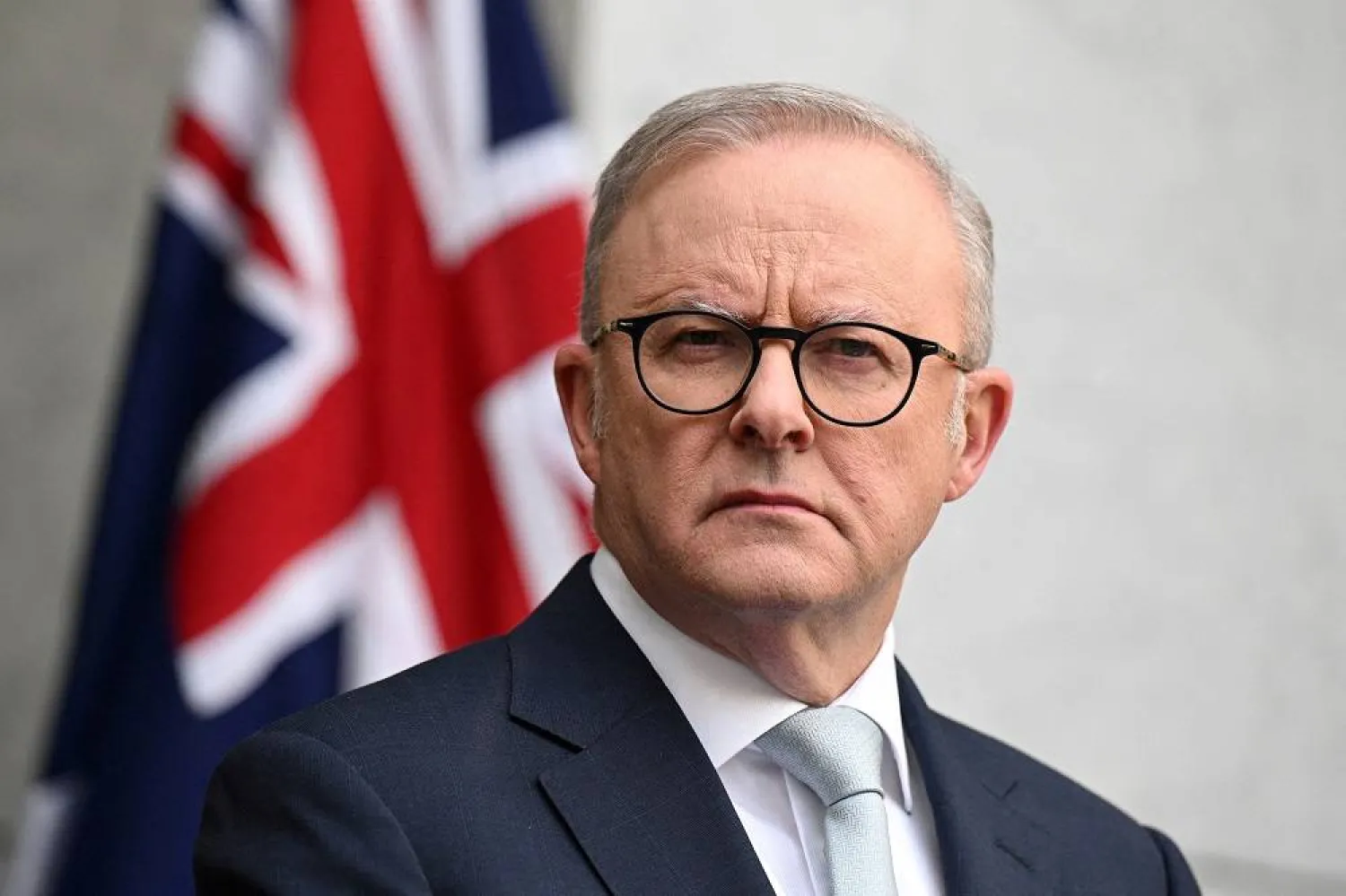
Australian Prime Minister Anthony Albanese speaks to the media during a press conference at Parliament House in Canberra, Australia, August 26, 2025. (AAP/Lukas Coch via Reuters) 
TT

Australia Expels Iranian Envoy Over Antisemitic Attacks 

Australian Prime Minister Anthony Albanese speaks to the media during a press conference at Parliament House in Canberra, Australia, August 26, 2025. (AAP/Lukas Coch via Reuters) 

Australia accused Iran on Tuesday of executing two antisemitic arson attacks in the cities of Sydney and Melbourne and gave Tehran's ambassador seven days to leave the country, its first such expulsion since World War Two.  

Since the Israel-Gaza war began in October 2023, Australian homes, schools, synagogues and vehicles have been targeted in antisemitic vandalism and arson, while Islamophobic incidents have surged.  

Prime Minister Anthony Albanese said the Australian Security Intelligence Organization (ASIO) had gathered credible intelligence that Iran had directed at least two attacks. 

"These were extraordinary and dangerous acts of aggression orchestrated by a foreign nation on Australian soil," Albanese told a press briefing. "They were attempts to undermine social cohesion and sow discord in our community."  

Iran had sought to "disguise its involvement" in last year's attacks on a kosher restaurant in Sydney and the Adass Israel Synagogue in Melbourne, Albanese said.  

No injuries were reported in the attacks. 

Iran's embassy in Canberra did not immediately respond to a request for comment.  

Australia's security agency said it was likely that Iran had directed further attacks, Albanese said, adding that Australia has suspended operations at its Tehran embassy and all its diplomats were safe in a third country.  

The government will designate Tehran's Iranian Revolutionary Guard Corps (IRGC) as a terrorist organization, Albanese added.  

Foreign Minister Penny Wong said Ambassador Ahmad Sadeghi and three Iranian officials had seven days to leave, in Australia's first expulsion of an envoy since World War Two.  

"Iran's actions are completely unacceptable," she told the briefing. 

The IRGC was directing people in Australia to undertake crimes, said Mike Burgess, director general of the security agency.  

"They're just using cut-outs, including people who are criminals and members of organized crime gangs to do their bidding or direct their bidding," he added. 

Israel's embassy in Australia welcomed the action against its major rival Iran. 

"Iran's regime is not only a threat to Jews or Israel, it endangers the entire free world, including Australia," it said in a statement on X. 

The two countries fought a 12-day air war in June, after Israel launched attacks on Iran's nuclear facilities. 

Iran's actions were an attack on Australia's sovereignty, said Daniel Aghian, president of the Executive Council of Australian Jewry (ECAJ), an umbrella group of more than 200 organizations.  

"These were attacks that deliberately targeted Jewish Australians, destroyed a sacred house of worship, caused millions of dollars of damage, and terrified our community," he said on Tuesday. 

ARSON ATTACKS 

Two men have been charged over the December attack that set ablaze the synagogue, built in the 1960s by Holocaust survivors in the suburb of Ripponlea. 

Last week, police in the southeastern state of Victoria said they were examining electronic devices seized in a search of the home of one of the men, who is set to appear in court on Wednesday. 

Police say three people broke into the synagogue and set the fire. 

Fire gutted the kosher restaurant in Bondi, Lewis Continental Kitchen. Media said the man arrested in January over that attack had links to a well-known Australian motorcycle gang. He denied the charges in court and was freed on bail. 

The Australian Iranian Community Organization welcomed the expulsion and the move to declare the IRGC as a terrorist group. 

"We are really happy to see them go," its president, Siamak Ghahreman, told the Australian Broadcasting Corporation in an interview. 

About 90,000 Iranian-born people live in Australia.  

Ties between Israel and Australia have been strained since Canberra's center-left government decided to recognize a Palestinian state on August 11. 

The move came after tens of thousands marched across Sydney's Harbor Bridge, calling for peace and aid deliveries to Gaza, where Israel began an offensive nearly two years ago after the Hamas group launched a deadly cross-border attack.  

Palestinian authorities say the conflict has killed more than 62,000 people in Gaza, while humanitarian groups say Israel's blockade has caused a food shortage that is leading to widespread starvation.  

On Sunday, thousands joined nationwide pro-Palestinian protests prompting the ECAJ to warn they were leading to an "unsafe environment". Some Jewish organizations in Australia have supported the rallies, however. 

Rights groups have flagged a worldwide rise in antisemitism, Islamophobia and anti-Arab bias during the war. Australian civil society group, the Islamophobia Register, recorded a 500% rise in Islamophobic incidents in workplaces, universities and the media since October 2023, with 1,500 incidents reported. 


Nigeria's President to Make a Sate Visit to the UK in March

Nigeria’s President Bola Tinubu gives a joint statement with Brazil’s President Luiz Inacio Lula da Silva, at the Planalto presidential palace, in Brasilia, Brazil, Aug. 25, 2025. (AP Photo/Eraldo Peres, File)
TT

Nigeria's President to Make a Sate Visit to the UK in March

Nigeria’s President Bola Tinubu gives a joint statement with Brazil’s President Luiz Inacio Lula da Silva, at the Planalto presidential palace, in Brasilia, Brazil, Aug. 25, 2025. (AP Photo/Eraldo Peres, File)

Nigeria’s president is set to make a state visit to the UK in March, the first such trip by a Nigerian leader in almost four decades, Britain’s Buckingham Palace said Sunday.

Officials said President Bola Tinubu and first lady Oluremi Tinubu will travel to the UK on March 18 and 19, The AP news reported.

King Charles III and Queen Camilla will host them at Windsor Castle. Full details of the visit are expected at a later date.

Charles visited Nigeria, a Commonwealth country, four times from 1990 to 2018 before he became king. He previously received Tinubu at Buckingham Palace in September 2024.m

Previous state visits by a Nigerian leader took place in 1973, 1981 and 1989.

A state visit usually starts with an official reception hosted by the king and includes a carriage procession and a state banquet.

Last year Charles hosted state visits for world leaders including US President Donald Trump, French President Emmanuel Macron and German President Frank-Walter Steinmeier.


Iran Strikes Hard Line on US Talks, Saying Tehran's Power Comes From Saying 'No'

Traffic moves through a street in Tehran on February 7, 2026. (Photo by ATTA KENARE / AFP)
TT

Iran Strikes Hard Line on US Talks, Saying Tehran's Power Comes From Saying 'No'

Traffic moves through a street in Tehran on February 7, 2026. (Photo by ATTA KENARE / AFP)

Iran's top diplomat insisted Sunday that Tehran's strength came from its ability to “say no to the great powers," striking a maximalist position just after negotiations with the United States over its nuclear program and in the wake of nationwide protests.

Foreign Minister Abbas Araghchi, speaking to diplomats at a summit in Tehran, signaled that Iran would stick to its position that it must be able to enrich uranium — a major point of contention with President Donald Trump, who bombed Iranian atomic sites in June during the 12-day Iran-Israel war.

Iran will never surrender the right to enrich uranium, even if war "is imposed on us,” he noted.

"Iran has paid a very heavy price for its peaceful nuclear program and for uranium enrichment." 

Israeli Prime Minister Benjamin Netanyahu is expected to travel to Washington this week, with Iran expected to be the major subject of discussion, his office said.

While Iranian President Masoud Pezeshkian praised the talks Friday in Oman with the Americans as “a step forward,” Araghchi's remarks show the challenge ahead. Already, the US moved the aircraft carrier USS Abraham Lincoln, ships and warplanes to the Middle East to pressure Iran into an agreement and have the firepower necessary to strike the Islamic Republic should Trump choose to do so, according to The AP news.

“I believe the secret of the Islamic Republic of Iran’s power lies in its ability to stand against bullying, domination and pressures from others," Araghchi said.

"They fear our atomic bomb, while we are not pursuing an atomic bomb. Our atomic bomb is the power to say no to the great powers. The secret of the Islamic Republic’s power is in the power to say no to the powers.”

‘Atomic bomb’ as rhetorical device Araghchi's choice to explicitly use an “atomic bomb” as a rhetorical device likely wasn't accidental. While Iran has long maintained its nuclear program is peaceful, the West and the International Atomic Energy Agency say Tehran had an organized military program to seek the bomb up until 2003.

Iran had been enriching uranium up to 60% purity, a short, technical step to weapons-grade levels of 90%, the only non-weapons state to do so. Iranian officials in recent years had also been increasingly threatening that Tehran could seek the bomb, even while its diplomats have pointed to Iranian Supreme Leader Ali Khamenei’s preachings as a binding fatwa, or religious edict, that Iran wouldn’t build one.

Pezeshkian, who ordered Araghchi to pursue talks with the Americans after likely getting Khamenei's blessing, also wrote on X on Sunday about the talks.

“The Iran-US talks, held through the follow-up efforts of friendly governments in the region, were a step forward,” the president wrote. “Dialogue has always been our strategy for peaceful resolution. ... The Iranian nation has always responded to respect with respect, but it does not tolerate the language of force.”

It remains unclear when and where, or if, there will be a second round of talks. Trump, after the talks Friday, offered few details but said: “Iran looks like they want to make a deal very badly — as they should.”

Aircraft carrier in the Arabian Sea During Friday's talks, US Navy Adm. Brad Cooper, the head of the American military's Central Command, was in Oman. Cooper's presence was apparently an intentional reminder to Iran about US military power in the region. Cooper later accompanied US special envoy Steve Witkoff and Jared Kushner, Trump's son-in-law, to the Lincoln out in the Arabian Sea after the indirect negotiations.

Araghchi appeared to be taking the threat of an American military strike seriously, as many worried Iranians have in recent weeks. He noted that after multiple rounds of talks last year, the US “attacked us in the midst of negotiations."

“If you take a step back (in negotiations), it is not clear up to where it will go,” Araghchi said.


Russia: Man Suspected of Shooting Top General Detained in Dubai

An investigator works outside a residential building where the assassination attempt on Russian Lieutenant General Vladimir Alexeyev took place in Moscow, Russia February 6, 2026. REUTERS/Anastasia Barashkova
TT

Russia: Man Suspected of Shooting Top General Detained in Dubai

An investigator works outside a residential building where the assassination attempt on Russian Lieutenant General Vladimir Alexeyev took place in Moscow, Russia February 6, 2026. REUTERS/Anastasia Barashkova

Russia's Federal Security Service (FSB) said on Sunday that the man suspected of shooting top Russian military intelligence officer Vladimir Alexeyev in Moscow has been detained in Dubai and handed over to Russia.

Lieutenant General Vladimir Alexeyev, deputy head of the GRU, ⁠Russia's military intelligence arm, was shot several times in an apartment block in Moscow on Friday, investigators said. He underwent surgery after the shooting, Russian media ⁠said.

The FSB said a Russian citizen named Lyubomir Korba was detained in Dubai on suspicion of carrying out the shooting.

Russian Foreign Minister Sergei Lavrov accused Ukraine of being behind the assassination attempt, which he said was designed to sabotage peace talks. ⁠Ukraine said it had nothing to do with the shooting.

Alexeyev's boss, Admiral Igor Kostyukov, the head of the GRU, has been leading Russia's delegation in negotiations with Ukraine in Abu Dhabi on security-related aspects of a potential peace deal.
