


Erdogan: Türkiye is the Security Guarantee for Syria’s Kurds

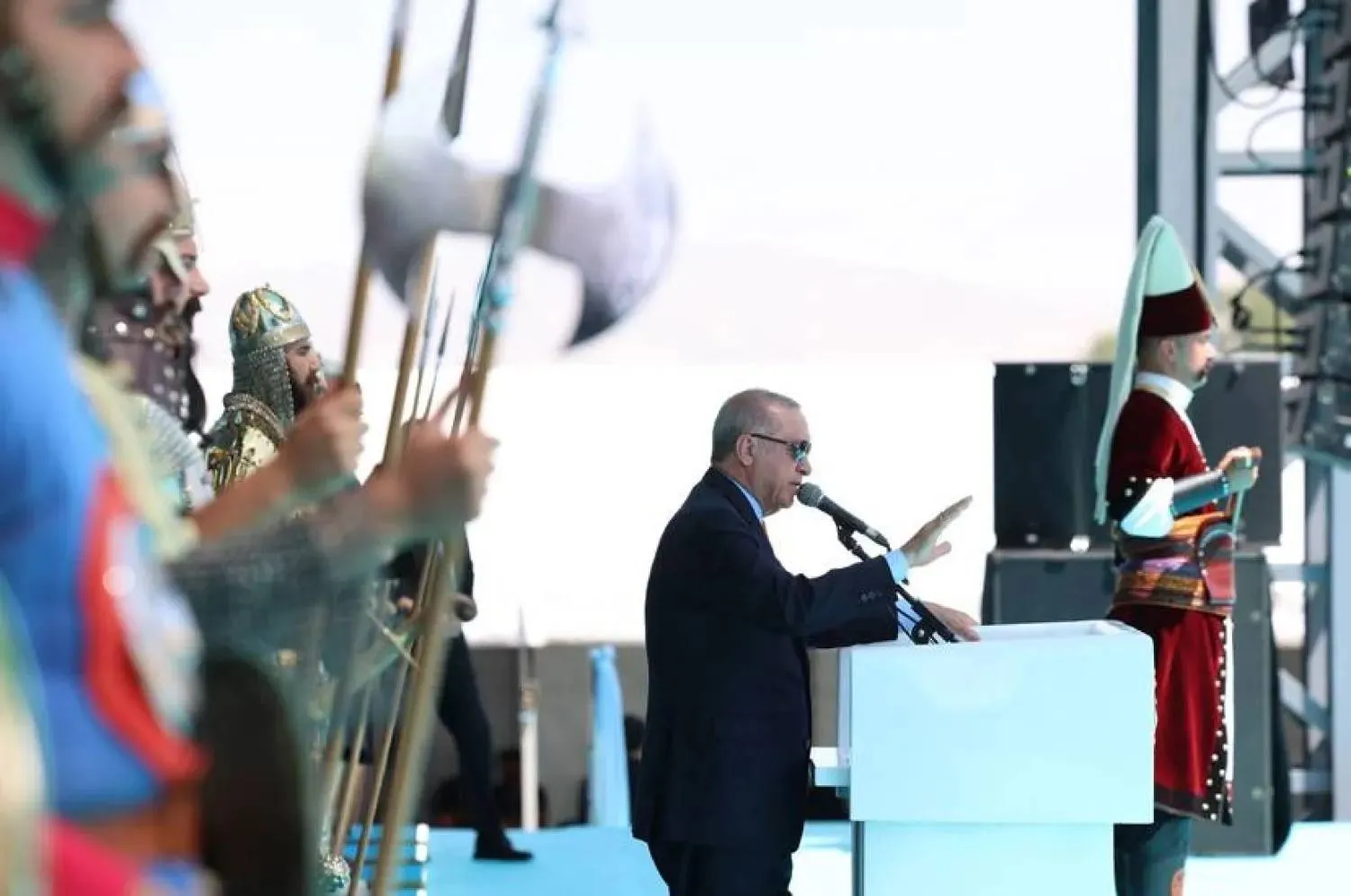
Erdogan speaking during the commemoration of the Battle of Manzikert (Turkish Presidency)
TT

Erdogan: Türkiye is the Security Guarantee for Syria’s Kurds

Erdogan speaking during the commemoration of the Battle of Manzikert (Turkish Presidency)

President Recep Tayyip Erdogan has sent a message to Syria’s Kurds, saying that Türkiye is the guarantee for their security, peace and well-being. This comes at a time when Ankara is pressing to resolve the long-running issue of the Kurdistan Workers’ Party (PKK) and advance domestic peace.

His remarks were also interpreted as a signal to the Syrian Democratic Forces (SDF), dominated by the Kurdish People’s Protection Units (YPG), which Ankara considers the Syrian extension of the PKK. The SDF has expressed frustration over Damascus’s failure to implement an integration agreement signed in March.

Speaking in the eastern province of Mus during commemorations of the 954th anniversary of the historic Battle of Manzikert, the Turkish president highlighted the government’s progress toward building what he described as a Türkiye free of terrorism, dismantling barriers of discord within society.

The country has launched a process to disarm the PKK, beginning with talks involving its imprisoned founder Abdullah Ocalan. These efforts include the creation of a parliamentary committee, “National Solidarity, Brotherhood, and Democracy,” tasked with drafting legislation to oversee disarmament and promote unity between Turks and Kurds.

Erdogan underlined that Türkiye supports lasting peace across the region and favors resolving disputes through dialogue and diplomacy. He added that the country also serves as a safe harbor for its neighbors facing crises.

Trade Relations in Focus

In parallel, Turkish Trade Minister Omer Bolat announced plans to lead a major business delegation to Syria to attend the Damascus International Fair on Wednesday. He described the event as an opportunity to boost economic ties, calling it a gateway for deepening cooperation between the two countries.

The 62nd edition of the fair runs from August 27 to September 5, marking its return after the collapse of the Assad government last December. Bolat noted that the fair is held with the support of Türkiye’s Ministry of Trade and southeastern export unions, allowing Turkish businesses to secure a stronger presence in the Syrian market.

He confirmed that Ankara and Damascus are preparing steps to expand reciprocal trade liberalization, guided by mutual benefit. A joint customs committee, working groups, and expertise-sharing programs are also under discussion, supported by a statement of intent sent to Syrian authorities.



Israel Seeks to Exclude its Occupation of South Lebanon from US–Iran Agreement

Israeli military vehicles drive on a Lebanese road towards the Israel-Lebanon border, as seen from northern Israel, May 4, 2026. REUTERS/Avi Ohayon
TT

Israel Seeks to Exclude its Occupation of South Lebanon from US–Iran Agreement

Israeli military vehicles drive on a Lebanese road towards the Israel-Lebanon border, as seen from northern Israel, May 4, 2026. REUTERS/Avi Ohayon

Israel reportedly is trying to separate its occupation of parts of southern Lebanon from the anticipated agreement between the United States and Iran.

An Israeli source said on Sunday that the preliminary US-Iran agreement, which would also stipulate a ceasefire in Lebanon, grants Israel “the right to defend itself against attacks by Hezbollah.” To that end, the Israeli army would remain in the 600 square kilometers areas it occupied in southern Lebanon over the past year, extending 10 to 15 kilometers beyond the border between the two countries.

According to Israel’s Kan11 broadcaster, PM Benjamin Netanyahu had expressed concern during talks with US President Donald Trump on Saturday over “linking a ceasefire agreement in Lebanon with the agreement in Iran”. But Trump had reportedly "appeased" Netanyahu saying the US is directly monitoring the direct talks between the Lebanese and Israeli governments, assuring his keenness on preserving Israeli interests.

The channel quoted “a source familiar with the details” as saying that “Israel received a green light not only to remain on Lebanese territory, but also to retain 25 military positions until the negotiations are successfully concluded and the objective of disarming Hezbollah is achieved.”

Israeli media outlets quoted a political official on Sunday as saying that Netanyahu had stressed during his talks with Trump that “Israel will preserve its freedom of action against threats on all fronts, including Lebanon,” claiming that Trump “reiterated his support for this principle.”

For his part, Trump had stressed that he would “stand firm” in the negotiations regarding the disarmament of Hezbollah and “Israel’s right to respond forcefully to any violation of the ceasefire in Lebanon”, according to the source.

The official said Netanyahu will brief the cabinet and security chiefs on Israel’s position, stressing that Israel will remain in Lebanese territory and continue its operations against Hezbollah as long as negotiations are ongoing.

He added that Israel is committed to the ceasefire and does not strike all Hezbollah-linked locations, such as Beirut, but, backed fully by the United States, it targets Hezbollah cells and drones preparing attacks through so-called “preemptive strikes”.

Since October 2024, Israel continues its military operations and occupation of parts of south Lebanon despite a ceasefire agreement reached in November 2024.

Hezbollah launched six drones toward the Galilee, which Israel used as a pretext to escalate its incursion and expand its occupation, destroying villages, displacing 1.2 million Lebanese, and killing over 3,000 people.

Hezbollah’s operations displaced tens of thousands of Israelis in the north and killed 30, including 22 soldiers.


Iraqi Security Delegation to Visit Tehran to Address Attacks on Kurdistan

Kurdistan President Masrour Barzani and Iraqi PM Ali al-Zaidi meet in Erbil. (Kurdistan government media file photo)
TT

Iraqi Security Delegation to Visit Tehran to Address Attacks on Kurdistan

Kurdistan President Masrour Barzani and Iraqi PM Ali al-Zaidi meet in Erbil. (Kurdistan government media file photo)

Iraqi Kurdistan Region President Masrour Barzani held talks in Baghdad on Sunday with new Prime Minister Ali al-Zaidi on pending issues between Baghdad and Erbil.

Iraqi National Security Adviser Qasim al-Araji said: “There is great understanding between the federal government and the Kurdistan Region on the need to resolve disputes and pending issues to ensure the interests of all Iraqi citizens.”

Speaking at a joint press conference with Barzani, he revealed that a senior joint security delegation from Baghdad and Erbil will soon visit Tehran.

The delegation will represent Baghdad in the Iraqi-Iranian High Security Committee that was previously announced, he added.

The committee will meet to address the attacks that have targeted Kurdistan and Iraq during the recent military conflict in the region, he went on to say. It will also tackle other issues of common interest.

For his part, Barzani said that Araji stressed his rejection of the attacks on Kurdistan and the whole of Iraq.

Araji did not disclose the date of the delegation’s visit.

Iraqi observers in Baghdad said the development marks a shift in the new Iraqi government’s stance towards the attacks that were likely launched by pro-Iran Iraqi armed factions, which have targeted Saudi Arabia and the United Arab Emirates, or by Iran against Erbil and other Kurdish regions.

Spokesperson for the Commander-in-Chief of the Iraqi Armed Forces Sabah al-Numan had recently revealed that al-Zaidi had formed a committee that includes security agencies to probe the attacks against Saudi Arabia and the UAE. The committee will visit Riyadh and Abu Dhabi to further investigate the attacks.

An informed security source told Asharq Al-Awsat that the official authorities and security agencies “are fully aware of the movements of the armed factions and the attacks they have carried out and their motivations for doing so.”

“The countries that have been targeted continue to have positive stances and they strongly support the peace negotiations,” it added.

It noted that the attacks “are an embarrassment to the new Iraqi government, which has nevertheless expressed a determination to resolve the issue” and cooperate with the concerned countries.

This marks a shift in Baghdad’s stance towards the possession of weapons outside the authority of the state, explained the source.


Israel Military Says Soldier Killed in southern Lebanon

Smoke rises following an Israeli strike on the southern village of Nabatieh on May 24, 2026. (Photo by Abbas Fakih / AFP)
TT

Israel Military Says Soldier Killed in southern Lebanon

Smoke rises following an Israeli strike on the southern village of Nabatieh on May 24, 2026. (Photo by Abbas Fakih / AFP)

Israel said on Monday a soldier was killed in southern Lebanon, taking to 23 the number of its troops killed in the war with Iran-backed Hezbollah.

A military statement named him as 19-year-old Sergeant Nehoray Leizer of the 601st Combat Engineering Battalion, who "fell in combat in southern Lebanon".

During the incident in which Leizer was killed, "an additional soldier was severely injured", the Israeli military said separately on Telegram.

A total of 24 Israelis have been killed in the conflict, 23 soldiers and one civilian contractor, since hostilities began on March 2.