
Israel Declares Gaza’s Largest City a Combat Zone as Death Toll Surpasses 63,000

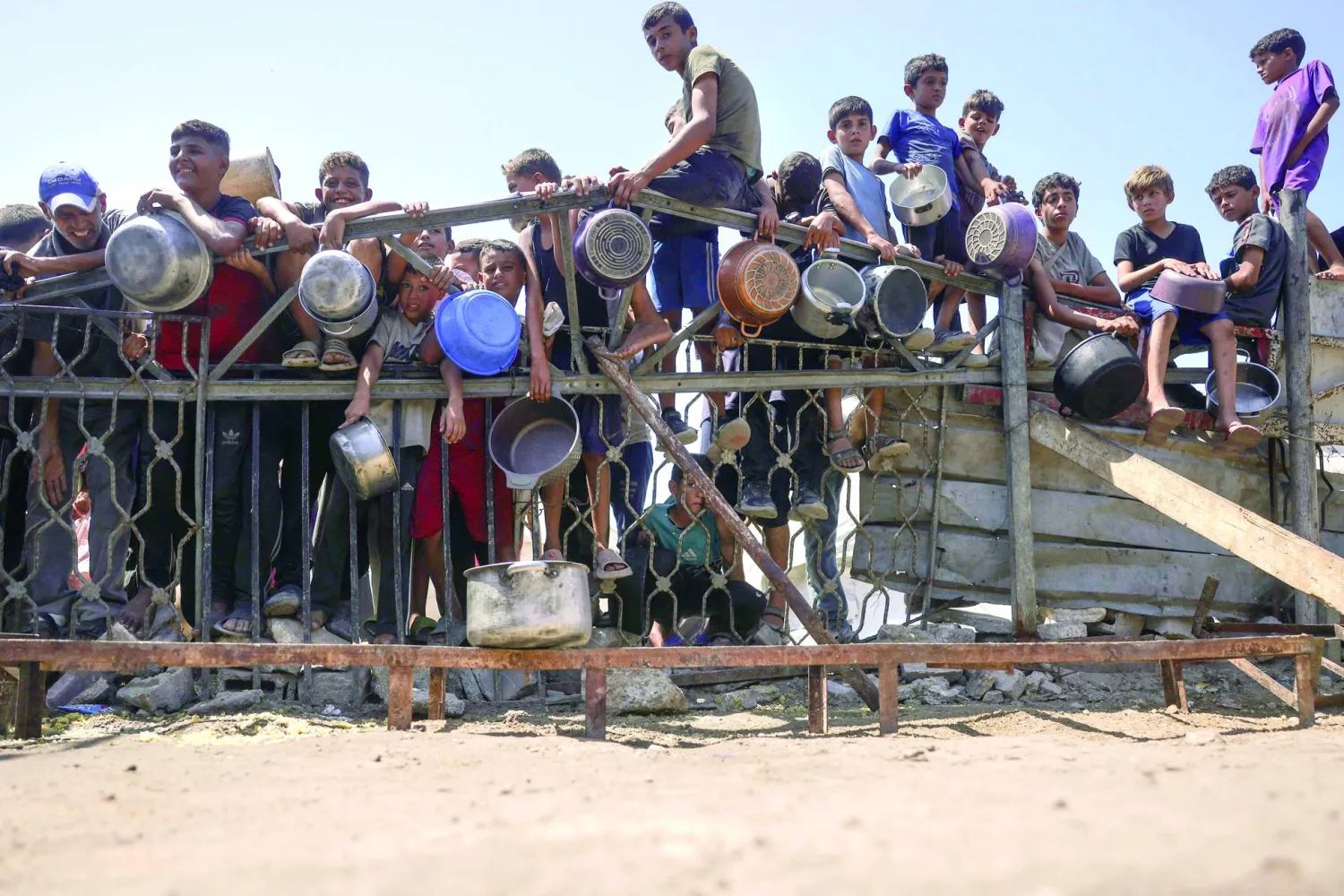
Children gather by a fence as they try to get rice from a charity kitchen providing food for free in the west of Gaza City, on August 28, 2025, as the war between Israel and the Hamas movement continues. (Photo by BASHAR TALEB / AFP)
TT

Israel Declares Gaza’s Largest City a Combat Zone as Death Toll Surpasses 63,000

Children gather by a fence as they try to get rice from a charity kitchen providing food for free in the west of Gaza City, on August 28, 2025, as the war between Israel and the Hamas movement continues. (Photo by BASHAR TALEB / AFP)

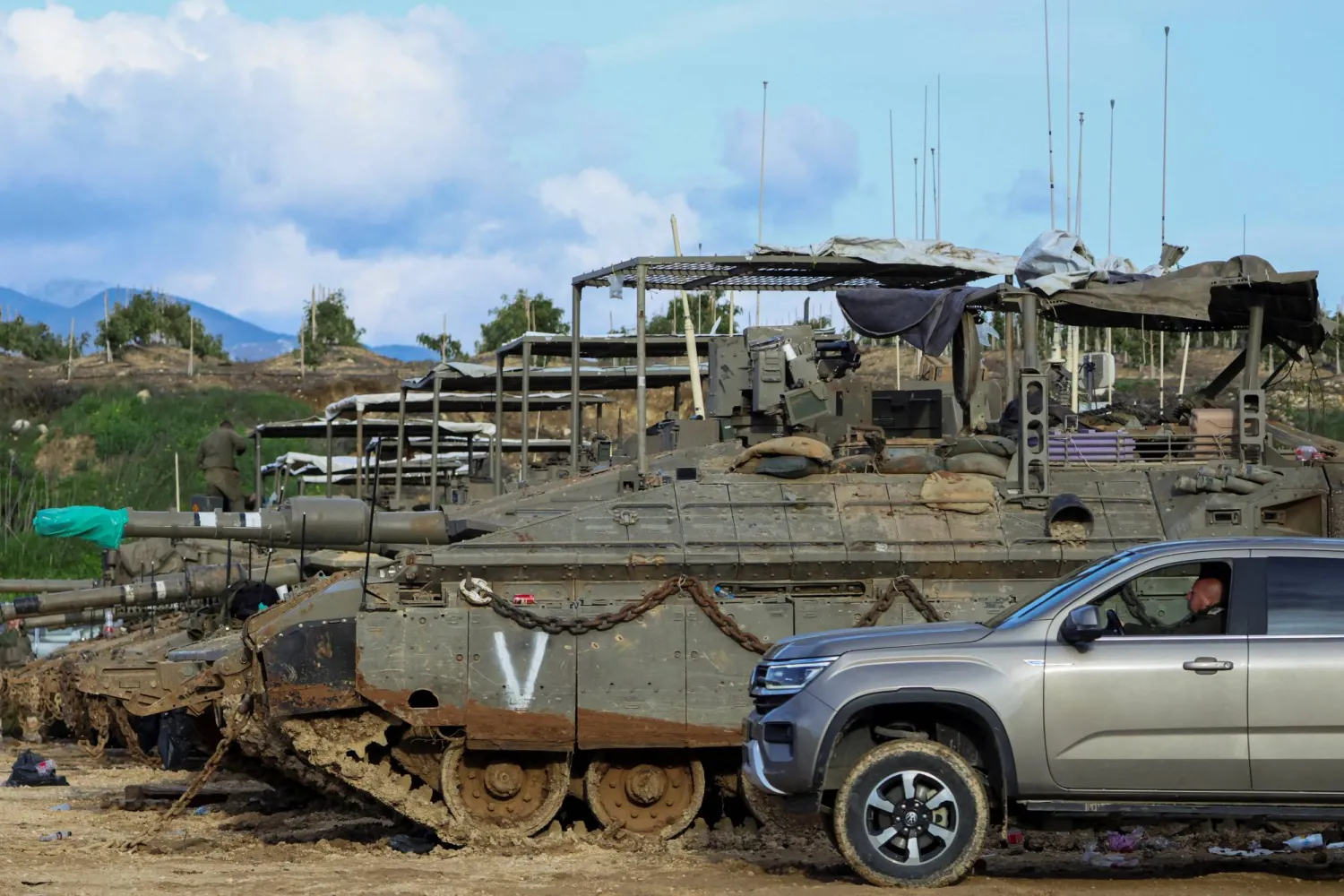
Israel declared Gaza’s largest city a dangerous combat zone and recovered the remains of two hostages on Friday as the army launched the "initial stages" of a planned offensive that has drawn international condemnation. 

As the military announced the resumption of fighting, health officials said the death toll in Gaza has risen to 63,025, with 59 new deaths reported by hospitals over the last 24 hours. Aid groups and a church sheltering people said they would stay in Gaza City, refusing to abandon the hungry and displaced who depend on them. 

The shift comes weeks after Israel first announced plans to widen its offensive in the city, where hundreds of thousands are sheltering while enduring famine. The military has in recent days ramped up strikes in neighborhoods on the city's outskirts. 

Plumes of smoke and thunderous blasts could be seen and heard across the border in southern Israel on Friday morning. 

Israel has called Gaza City a Hamas stronghold, alleging that a network of tunnels remain in use by group after several previous large-scale raids on the area throughout nearly 23 months of war. 

Prime Minister Benjamin Netanyahu has argued that crippling Hamas’ capabilities in the city is critical to shielding Israel from a repeat of the Oct. 7, 2023, attack that ignited the war. 

While United Nations agencies and aid groups condemned the offensive's announced start, people in Gaza City said it made little difference: Strikes already have been intensifying and the aid reaching them was insufficient. 

City resident Mohamed Aboul Hadi said it made no difference. “The massacres never stopped, even during the humanitarian pauses,” he said in a text message sent from Gaza City. 

More than 63,000 Palestinians have been killed since the war started, the Gaza Health Ministry said Friday. The ministry’s count — 63,025 — does not distinguish between fighters and civilians. It also said five people had died from malnutrition-related causes over the past 24 hours, raising the toll to 322, including 121 children, since the war began. 

The ministry is part of the Hamas-run government and staffed by medical professionals. The UN and independent experts consider it the most reliable source on war casualties. Israel disputes its figures but has not provided its own. 

Some refuse to leave 

Facing international criticism, Israel instituted what it called “tactical pauses” in Gaza City and two other populated areas last month that it said were geared toward letting in more food and aid. The pauses included a daily halt in fighting from 10 a.m. to 8 p.m., though aid groups have said deliveries remained challenging due to blockade, looting and Israeli restrictions. 

Midday Friday, the military said it had suspended pauses, marking the latest escalation after weeks of preparatory strikes in some of the city’s neighborhoods and calling up tens of thousands of reservists. 

“We will intensify our strikes until we bring back all the kidnapped hostages and dismantle Hamas,” Israeli army spokesperson Avichay Adraee said. 

Adraee, the Israeli military’s Arabic-language spokesperson, has for days urged Palestinians in Gaza City to flee south, calling evacuation “inevitable.” 

Hundreds of residents began the journey south on Friday, piling their few remaining possessions onto pickup trucks or donkey carts. Many have been forced to leave their homes more than once. 

“We cannot find any place in the west nor in the south. Conditions are difficult. Where are we going? We don’t know,” said Saddam Yazigi as he prepared to leave Gaza City. 

The UN said Thursday that 23,000 people had evacuated over the past week, but many Palestinians in Gaza City question the effort when there is nowhere safe to go. 

The Holy Family Church of Gaza City told The Associated Press on Friday that the roughly 440 people sheltering there would remain along with members of the clergy who would assist them. 

Farid Jubran said the church had left the decision up to the people even though they had little recourse to insulate themselves from fighting. 

“When we feel danger, people get closer to the walls or whatever, it’s more protected,” he said, noting the church had few specific defenses. 

The UN’s humanitarian agency said its staff and NGOs also would remain on the ground. 

Aid groups say they weren’t notified 

As Israel suspended pauses on Friday in Gaza City, the military did not say whether they had notified residents or aid groups of the impending declaration ahead of the 11:30 a.m. announcement. 

Norwegian Refugee Council, which coordinates a coalition of aid groups active in Gaza, said it had not received notification that Israel’s “tactical pauses” would be suspended. 

The UN said Thursday the besieged strip could lose half of its hospital bed capacity during an expanded assault on Gaza City. 

“We cannot provide health services to 2 million people besieged in the south,” said Zaher al-Wahidi, a spokesperson for Gaza’s Health Ministry, noting a forcible evacuation of the strip’s largest city would be an environmental and health catastrophe. 

The suspension of the pause also comes one week after the world’s leading food security authority declared Gaza City was being gripped by famine after months of warnings. 

An Israeli military official said Israel intended to continue facilitating aid to Gaza City. But the official provided no details on how they would continue to get aid in amid a ramped-up offensive. 

“This will have a horrific impact on people already exhausted, malnourished, bereaved, displaced, and deprived of basics needed for survival,” the UN’s humanitarian agency said in a statement. “Forcing hundreds of thousands to move south is a recipe for further disaster.” 

Remains of hostages recovered  

Israel on Friday said its military had recovered the remains of two hostages — Ilan Weiss and another left unnamed. 

“The campaign to return the hostages continues continuously. We will not rest or be silent until we return all of our hostages home — both the living and the dead,” Netanyahu said in a statement. 

Weiss, 55, was killed in the attack on Kibbutz Be’eri, one of the communities near Gaza that Hamas-led fighters stormed on Oct. 7. 

For the families of hostages, the return of their remains meets a central demand and brings some closure, but also is a reminder of hostages who remain in Gaza. 

“At least they have closure,” said Rubi Chen, whose son was abducted during the Oct. 7 attack and is believed to be dead. “There are still 49 families waiting to have that closure.” 

Of the 251 hostages taken by Hamas-led fighters, nearly 50 remain in Gaza including 20 that Israel believes to be alive. 

Israel’s Hostages and Missing Families Forum, which has organized large-scale protests demanding a ceasefire to return the hostages, mourned the losses and said Israeli leaders should prioritize a deal to return both the living and the dead. 

“We call on the Israeli government to enter negotiations and stay at the table until every last hostage comes home. Time is running out for the hostages,” it said in a statement. 

Hamas-led fighters abducted 251 people and killed around 1,200 people, mostly civilians, in the Oct. 7 attack. Most of the hostages have been released in ceasefires or other deals. 


Israeli Fire Kills 11, Including Journalists, Gaza Health Officials Say

 Mourners react during the funeral of Palestinians who, according to medics, were killed by Israeli strikes on Wednesday, at Al-Aqsa Martyrs Hospital, in Deir al-Balah, central Gaza Strip, January 21, 2026. REUTERS/Mahmoud Issa
Mourners react during the funeral of Palestinians who, according to medics, were killed by Israeli strikes on Wednesday, at Al-Aqsa Martyrs Hospital, in Deir al-Balah, central Gaza Strip, January 21, 2026. REUTERS/Mahmoud Issa
TT

Israeli Fire Kills 11, Including Journalists, Gaza Health Officials Say

 Mourners react during the funeral of Palestinians who, according to medics, were killed by Israeli strikes on Wednesday, at Al-Aqsa Martyrs Hospital, in Deir al-Balah, central Gaza Strip, January 21, 2026. REUTERS/Mahmoud Issa
Mourners react during the funeral of Palestinians who, according to medics, were killed by Israeli strikes on Wednesday, at Al-Aqsa Martyrs Hospital, in Deir al-Balah, central Gaza Strip, January 21, 2026. REUTERS/Mahmoud Issa

Israeli fire killed 11 Palestinians, including two boys and three journalists, in Gaza on Wednesday, local medics ​said, and the Israeli military said it had "eliminated" a Palestinian militant who posed a threat to soldiers.

In the latest violence disrupting a brittle, three-month-old ceasefire, Palestinian health officials said an Israeli airstrike killed three Palestinian journalists travelling in a car in the central Gaza Strip.

The three were on an assignment sponsored by the Egyptian Committee, which supervises Egypt's relief work in Gaza, to film tent encampments built by Egypt for displaced Palestinians, other local journalists told Reuters.

An Egyptian security source confirmed the vehicle belonged to the committee but gave no further details. The Israeli military did not immediately respond to a request ‌for comment.

Israel and Hamas ‌have traded blame for multiple breaches of the October truce after ‌two ⁠years ​of war ‌that devastated Gaza and caused a humanitarian disaster, and remain at odds over the next steps in US President Donald Trump's 20-point peace plan.

Earlier on Wednesday, Palestinian medics said three people, including a 10-year-old boy, were killed as a result of Israeli tank shelling east of Deir Al-Balah in central Gaza. Two others, a boy of 13 and a woman, were killed in two Israeli shooting incidents in eastern Khan Younis in Gaza's south, they said.

Three other Palestinians were killed in other shootings across the coastal enclave, taking Wednesday's ⁠death toll to at least 11, the health ministry of the Hamas-run Gaza said.

Residents said the two incidents occurred in Palestinian-controlled areas. The ‌ceasefire brought about a partial Israeli military withdrawal, leaving Israeli forces holding ‍about 53% of the enclave, but they ‍have been gradually expanding their presence in recent weeks, leading to further displacement of Palestinian families, residents ‍told Reuters.

There was also no immediate Israeli military comment on the two incidents.

Earlier on Wednesday, it said in a statement that Israeli forces had killed a "terrorist" who entered an area under their control, posing an imminent threat to soldiers operating there.

TRUMP PLAN STRUGGLES TO MOVE BEYOND FIRST STAGE

The US-brokered October deal has not progressed beyond ​the first-phase ceasefire, under which major fighting stopped, some Israeli forces pulled back, and Hamas freed hostages in return for Palestinian detainees and convicted prisoners.

Under future phases whose details ⁠have yet to be hammered out, Hamas is supposed to disarm, Israeli forces withdraw further and an internationally backed administration installed to rebuild the ruined, densely populated territory.

But no timetable has been set to implement the plan.

Trump was due on Thursday to preside over a ceremony celebrating the Board of Peace, a group he formed with the stated goal of redeveloping the coastal enclave.

Israel says it can only move into the second phase after Hamas hands over the remains of the last Israeli hostage.

On Wednesday, Hamas Gaza spokesperson Hazem Qassem said the Islamist group had shared all information it had on the body of the last hostage and searched for it but in vain, blaming what it called Israeli military obstruction.

More than 460 Palestinians and three Israeli soldiers have been reported killed in clashes since the ceasefire took effect.


Egyptian President Says Palestinian Cause Remains Top Priority

Egypt's President Abdel Fattah al-Sisi delivers a speech during the World Economic Forum (WEF) annual meeting in Davos on January 21, 2026.  (AFP)
Egypt's President Abdel Fattah al-Sisi delivers a speech during the World Economic Forum (WEF) annual meeting in Davos on January 21, 2026. (AFP)
TT

Egyptian President Says Palestinian Cause Remains Top Priority

Egypt's President Abdel Fattah al-Sisi delivers a speech during the World Economic Forum (WEF) annual meeting in Davos on January 21, 2026.  (AFP)
Egypt's President Abdel Fattah al-Sisi delivers a speech during the World Economic Forum (WEF) annual meeting in Davos on January 21, 2026. (AFP)

Egyptian President Abdel Fattah al-Sisi on Wednesday said the Palestinian cause is still “at the forefront of priorities” in the Middle East.

He told a panel at Davos that resolving Palestinian cause “is the core of regional stability, and a cornerstone to achieve a just and comprehensive peace.”

The Egyptian leader lauded US President Donald Trump’s efforts to help reach a ceasefire that stropped the Israel-Hamas war in Gaza in October.

The two leaders are expected to meet at Davos, said the Egyptian Presidency on Tuesday.

This ‌will be ‌the first ‌meeting ⁠between ​the ‌two leaders since the US announced it was launching the second phase of its plan to end the war in Gaza.

Sisi and ⁠Trump met in the ‌Red Sea resort ‍of Sharm ‍el-Sheikh in October during a ‍summit convened by Egypt to sign a ceasefire deal aimed at ending the ​war.


Israel’s Netanyahu Agrees to Join Trump’s Board of Peace

12 July 2025, Jerusalem: Benjamin Netanyahu, Prime Minister of Israel, speaks at the press conference after talks at the seat of government. (dpa)
TT

Israel’s Netanyahu Agrees to Join Trump’s Board of Peace

12 July 2025, Jerusalem: Benjamin Netanyahu, Prime Minister of Israel, speaks at the press conference after talks at the seat of government. (dpa)

Prime Minister Benjamin Netanyahu of Israel said Wednesday he had agreed to join US President Donald Trump’s Board of Peace, after his office earlier criticized makeup of the board’s executive committee.

The board, chaired by Trump, was originally envisioned as a small group of world leaders overseeing the Gaza ceasefire plan. The Trump administration’s ambitions have appeared to balloon into a more sprawling concept, with Trump extending invitations to dozens of nations and hinting it will soon broker global conflicts.

Netanyahu’s office had previously said the executive committee, which includes Türkiye, a key regional rival, wasn’t coordinated with the Israeli government and “is contrary to its policy,” without clarifying its objections.

Israel’s far-right finance minister, Bezalel Smotrich, has criticized the board and called for Israel to take unilateral responsibility for Gaza’s future.

Others who have joined the board are the UAE, Morocco, Vietnam, Belarus, Hungary, Kazakhstan and Argentina. Others, including the UK, Russia and the executive arm of the European Union, say they have received invitations but have not yet responded.

It came as Trump traveled to the World Economic Forum meeting in Davos, Switzerland, where he is expected to provide more details about the board. There are many unanswered questions. It was not immediately clear how many or which other leaders would receive invitations.

When asked by a reporter Tuesday if the board should replace the UN, Trump said, “It might.”

He asserted that the world body “hasn’t been very helpful” and “has never lived up to its potential” but also said the UN should continue ”because the potential is so great.”

That has created controversy, with some saying Trump is trying to replace the UN. French Foreign Minister Jean-Noel Barrot said Tuesday, “Yes to implementing the peace plan presented by the president of the United States, which we wholeheartedly support, but no to creating an organization as it has been presented, which would replace the United Nations.”

Told late Monday that French President Emmanuel Macron was unlikely to join, Trump said, “Well, nobody wants him because he’s going to be out of office very soon.” A day later, Trump called Macron “a friend of mine”, but reiterated that the French leader is “not going to be there very much longer.”

The executive board’s members include US Secretary of State Marco Rubio, Trump envoy Steve Witkoff, Trump’s son-in-law Jared Kushner, former British Prime Minister Tony Blair, Apollo Global Management CEO Marc Rowan, World Bank President Ajay Banga, and Trump’s deputy national security adviser Robert Gabriel.

The White House also announced the members of another board, the Gaza Executive Board, which, according to the ceasefire, will be in charge of implementing the tough second phase of the agreement. That includes deploying an international security force, disarming Hamas and rebuilding the war-devastated territory.

Nickolay Mladenov, a former Bulgarian politician and UN Mideast envoy, is to serve as the Gaza executive board’s representative overseeing day-to-day matters. Additional members include: Witkoff, Kushner, Blair, Rowan, Turkish Foreign Minister Hakan Fidan; Qatari diplomat Ali Al-Thawadi; Hassan Rashad, director of Egypt’s General Intelligence Agency; Emirati minister Reem Al-Hashimy; Israeli businessman Yakir Gabay; and Sigrid Kaag, the Netherlands’ former deputy prime minister and a Mideast expert.

The board also will supervise a newly appointed committee of Palestinian technocrats who will be running Gaza’s day-to-day affairs.