

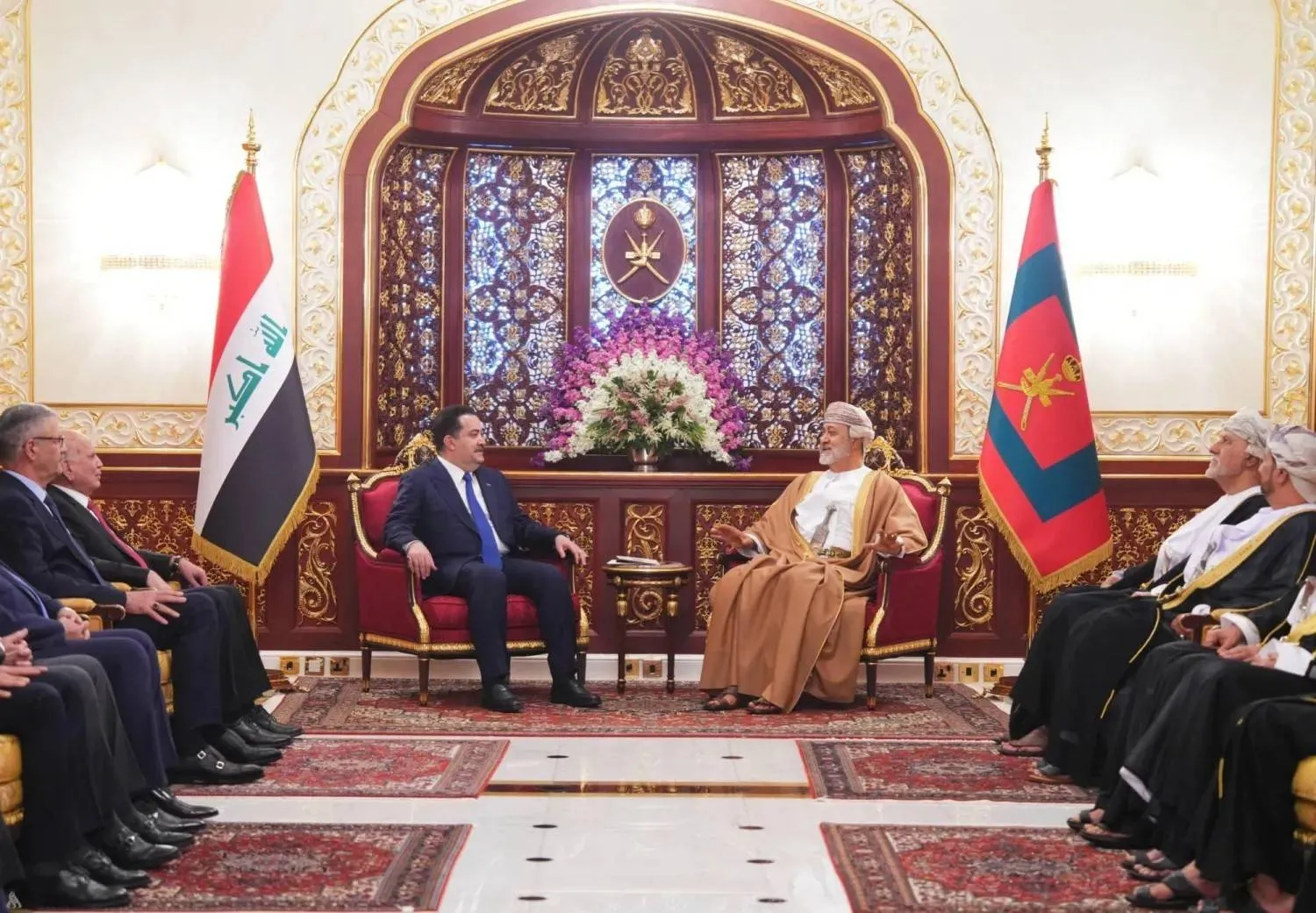

Iraq, Oman Call for Halt to the Spread of Regional Conflict

Oman’s Sultan Haitham bin Tariq welcomes Iraqi Prime Minister Mohammed Shia Al-Sudani at Al-Hosn Palace (Oman News Agency)
TT

Iraq, Oman Call for Halt to the Spread of Regional Conflict

Oman’s Sultan Haitham bin Tariq welcomes Iraqi Prime Minister Mohammed Shia Al-Sudani at Al-Hosn Palace (Oman News Agency)

Iraq and Oman signed memorandums of understanding (MoUs) covering multiple sectors during Iraqi Prime Minister Mohammed Shia Al-Sudani’s visit to Muscat, as both countries emphasized the need to halt the spread of conflict in the region.

Al-Sudani met Sultan Haitham bin Tariq at Al-Hosn Palace in Salalah on Wednesday. In a statement from his office, the Iraqi premier said he stressed Baghdad’s desire to strengthen bilateral ties and reaffirmed his government’s commitment to contributing to regional stability.

Al-Sudani praised Oman’s stance advocating an end to aggression and the promotion of stability, while Sultan Haitham highlighted Muscat’s intent to expand cooperation with Iraq across all sectors. He instructed Omani ministers to translate the MoUs into concrete, collaborative projects.

The Omani ruler also expressed support for Iraq’s regional initiatives, commending Baghdad’s efforts to curb the spread of conflict and consolidate peace in the region.

According to Oman News Agency, the two leaders “reviewed avenues for cooperation and partnership in diverse fields, particularly energy and investment, with the aim of benefiting the peoples of both countries.”

A senior Iraqi diplomatic source told Asharq Al-Awsat that Al-Sudani’s visit was part of Iraq’s effort to chart a new course in regional diplomacy, aiming to lower tensions in consultation with regional and international partners.

Bilateral relations between Baghdad and Muscat have remained largely unaffected since 2003, despite Iraq’s shifting geopolitical landscape. Both governments have sought to enhance partnerships through the Iraq-Oman Joint Committee, which last met in Baghdad in 2024.

Expanding a Multi-Sector Partnership

Ahead of his departure from Baghdad, Al-Sudani told reporters that preparatory meetings had paved the way for MoUs in energy, tourism, oil storage and refining, industry and defense localization, maritime transport and port management, scientific research, education, tax avoidance, urban planning, housing, youth and sports, trade, export development, competition promotion, and anti-monopoly measures.

Since taking office, the Iraqi government has focused on strengthening ties with neighboring states through bilateral and multi-polar partnerships and productive diplomacy, Al-Sudani said, praising Oman’s consistent official and public support for Iraq during times of challenge.

He added that Iraq is enjoying a period of relative stability, clear regional positions, urban and economic development, and is keen to involve Oman and other Arab countries in long-term investment and development partnerships.

Sources familiar with the visit said discussions in Muscat would also address regional security and ways to prevent war between Iran and Israel amid ongoing tensions. Iraqi officials are particularly concerned about the potential impact of any new regional conflict on the upcoming elections scheduled for Nov. 11.

Iranian Envoy Visits Baghdad Amid Regional Tensions

Meanwhile, Iranian Deputy Foreign Minister Saeed Khatibzadeh arrived in Baghdad on an unannounced visit, meeting Iraqi Foreign Minister Fuad Hussein and National Security Adviser Qasim Al-Araji.

According to sources, Khatibzadeh discussed regional developments following the recent 12-day conflict with Israel, underscoring threats posed by Israel and the United States and calling for joint measures to address shared risks facing Iran and Iraq.



Israel Orders Gaza Families to Move in First Forced Evacuation Since Ceasefire

A Palestinian girl walks past the rubble of houses destroyed in Israeli strikes during the war, in Khan Younis, southern Gaza Strip, January 17, 2026. (Reuters)
TT

Israel Orders Gaza Families to Move in First Forced Evacuation Since Ceasefire

A Palestinian girl walks past the rubble of houses destroyed in Israeli strikes during the war, in Khan Younis, southern Gaza Strip, January 17, 2026. (Reuters)

Israeli forces have ordered dozens of Palestinian families in the southern Gaza Strip to leave their homes in the first forced evacuation since October's ceasefire, as residents and Hamas said on Tuesday the military was ​expanding the area under its control.

Residents of Bani Suhaila, east of Khan Younis, said the leaflets were dropped on Monday on families living in tent encampments in the Al-Reqeb neighborhood.

“Urgent message. The area is under Israeli army control. You must evacuate immediately,” said the leaflets, written in Arabic, Hebrew, and English, which the army dropped over the Al-Reqeb neighborhood in the town of Bani Suhaila.

In the two-year war before the US brokered ceasefire was signed in October, Israel dropped leaflets over areas that were subsequently raided or bombarded, forcing some families to move several times.

Residents and a source from the Hamas group said this was the first time they had been ‌dropped since then. ‌The Israeli military did not immediately respond to a request for comment.

SIDES FAR ‌APART ⁠ON ​NEXT PHASES

The ‌ceasefire has not progressed beyond its first phase, under which major fighting has stopped, Israel withdrew from less than half of Gaza, and Hamas released hostages in return for Palestinian detainees and prisoners.

Virtually the entire population of more than 2 million people are confined to around a third of Gaza's territory, mostly in makeshift tents and damaged buildings, where life has resumed under control of an administration led by Hamas.

Israel and Hamas have accused each other of major breaches of the ceasefire and remain far apart on the more difficult steps planned for the next phase.

Mahmoud, a resident from the ⁠Bani Suhaila area, who asked not to give his family name, said the evacuation orders impacted at least 70 families, living in tents and homes, ‌some of which were partially damaged, in the area.

"We have fled ‍the area and relocated westward. It is maybe the ‍fourth or fifth time the occupation expanded the yellow line since last month," he told Reuters by phone ‍from Khan Younis, referring to the line behind which Israel has withdrawn.

"Each time they move it around 120 to 150 meters (yards) inside the Palestinian-controlled territory, swallowing more land," the father-of-three said.

HAMAS CITES STATE OF HUMANITARIAN DISRUPTION

Ismail Al-Thawabta, director of the Hamas-run Gaza government media office, said the Israeli military had expanded the area under its control in eastern Khan Younis five times since ​the ceasefire, forcing the displacement of at least 9,000 people.

“On Monday, 19 January 2026, the Israeli occupation forces dropped warning leaflets demanding the forced evacuation of the Bani Suhaila area in eastern ⁠Khan Younis Governorate, in a measure that falls within a policy of intimidation and pressure on civilians,” Thawabta told Reuters.

He said the new evacuation orders affected approximately 3,000 people.

“The move created a state of humanitarian disruption, increased pressure on the already limited shelter areas, and further deepened the internal displacement crisis in the governorate,” Thawabta added.

Israel's military has previously said it has opened fire after identifying what it called "terrorists" crossing the yellow line and approaching its troops, posing an immediate threat to them.

It has continued to conduct air strikes and targeted operations across Gaza. The Israeli military has said it views "with utmost severity" any attempts by militant groups in Gaza to attack Israel.

Under future phases of the ceasefire that have yet to be hammered out, US President Donald Trump's plan envisages Hamas disarming, Israel pulling out further, and an internationally backed administration rebuilding Gaza.

More than 460 Palestinians and three Israeli soldiers have been reported killed since the ceasefire took ‌effect.

Israel launched its operations in Gaza in the wake of an attack by Hamas-led fighters in October 2023 which killed 1,200 people, according to Israeli tallies. Israel's assault has killed 71,000 people, according to health authorities in the enclave.


Syrian Interior Ministry: 120 ISIS Members Escape from Prison amid Clashes

Civilians cross a collapsed bridge linking Raqqa with its western countryside of Tabqa, northern Syria, 19 January 2026. EPA/AHMAD FALLAHA
TT

Syrian Interior Ministry: 120 ISIS Members Escape from Prison amid Clashes

Civilians cross a collapsed bridge linking Raqqa with its western countryside of Tabqa, northern Syria, 19 January 2026. EPA/AHMAD FALLAHA

Syria's ministry of interior said Tuesday that 120 ISIS members escaped from a prison in northeast Syria a day earlier, amid clashes between government forces and the Kurdish-led Syrian Democratic Forces, which guards the prison.

Security forces recaptured 81 of the escapees, “while intensive security efforts continue to pursue the remaining fugitives and take the necessary legal measures against them,” The Associated Press quoted the statement as saying.

The SDF and the government have traded blame over the escape at a prison in the town of Shaddadeh, amid the breakdown of a ceasefire deal between the two sides.

Also Tuesday, the SDF accused “Damascus-affiliated factions” of cutting off water supplies to the al-Aqtan prison near the city of Raqqa, which it called a “blatant violation of humanitarian standards.”

The SDF, the main US-backed force that fought ISIS in Syria, controls more than a dozen prisons in the northeast where some 9,000 ISIS members have been held for years without trial.

Under a deal announced Sunday, government forces were to take over control of the prisons from the SDF, but the transfer did not go smoothly.

On Monday, Syrian government forces and SDF fighters clashed around two prisons housing members of ISIS in Syria’s northeast.

The clashes came as SDF chief commander Mazloum Abdi was said to be in Damascus to attempt to solidify a ceasefire deal reached Sunday that ended days of deadly fighting during which government forces captured wide areas of northeast Syria from the SDF.

Abdi issued no statement after the meeting and the SDF later issued a statement calling for “all of our youth” to “join the ranks of the resistance," appearing to signal that the deal had fallen apart.

Interim President Ahmad al-Sharaa postponed a planned trip to Germany Tuesday amid the ongoing tensions in northeast Syria.


Egypt’s Sisi to Meet Trump on the Sidelines of Davos, Presidency Says

US President Donald Trump and Egyptian President Abdel Fattah al-Sisi meet ahead of a world leaders' summit on ending the Gaza war, amid a US-brokered prisoner-hostage swap and ceasefire deal between Israel and Hamas, in Sharm el-Sheikh, Egypt, October 13, 2025. (Reuters)
TT

Egypt’s Sisi to Meet Trump on the Sidelines of Davos, Presidency Says

US President Donald Trump and Egyptian President Abdel Fattah al-Sisi meet ahead of a world leaders' summit on ending the Gaza war, amid a US-brokered prisoner-hostage swap and ceasefire deal between Israel and Hamas, in Sharm el-Sheikh, Egypt, October 13, 2025. (Reuters)

Egypt's President Abdel ​Fattah al-Sisi will meet US President Donald Trump on the sidelines of the World Economic Forum in Davos, Egypt's presidency said on Tuesday.

This ‌will be ‌the first ‌meeting ⁠between ​the ‌two leaders since the US announced it was launching the second phase of its plan to end the war in Gaza.

Sisi and ⁠Trump met in the ‌Red Sea resort ‍of Sharm ‍el-Sheikh in October during a ‍summit convened by Egypt to sign a ceasefire deal aimed at ending the ​war.

On Friday, Trump said that he was also ⁠ready to restart US mediation between Egypt and Ethiopia to resolve the dispute over an Ethiopian dam, which both Egypt and Sudan consider a serious threat to vital water supplies.