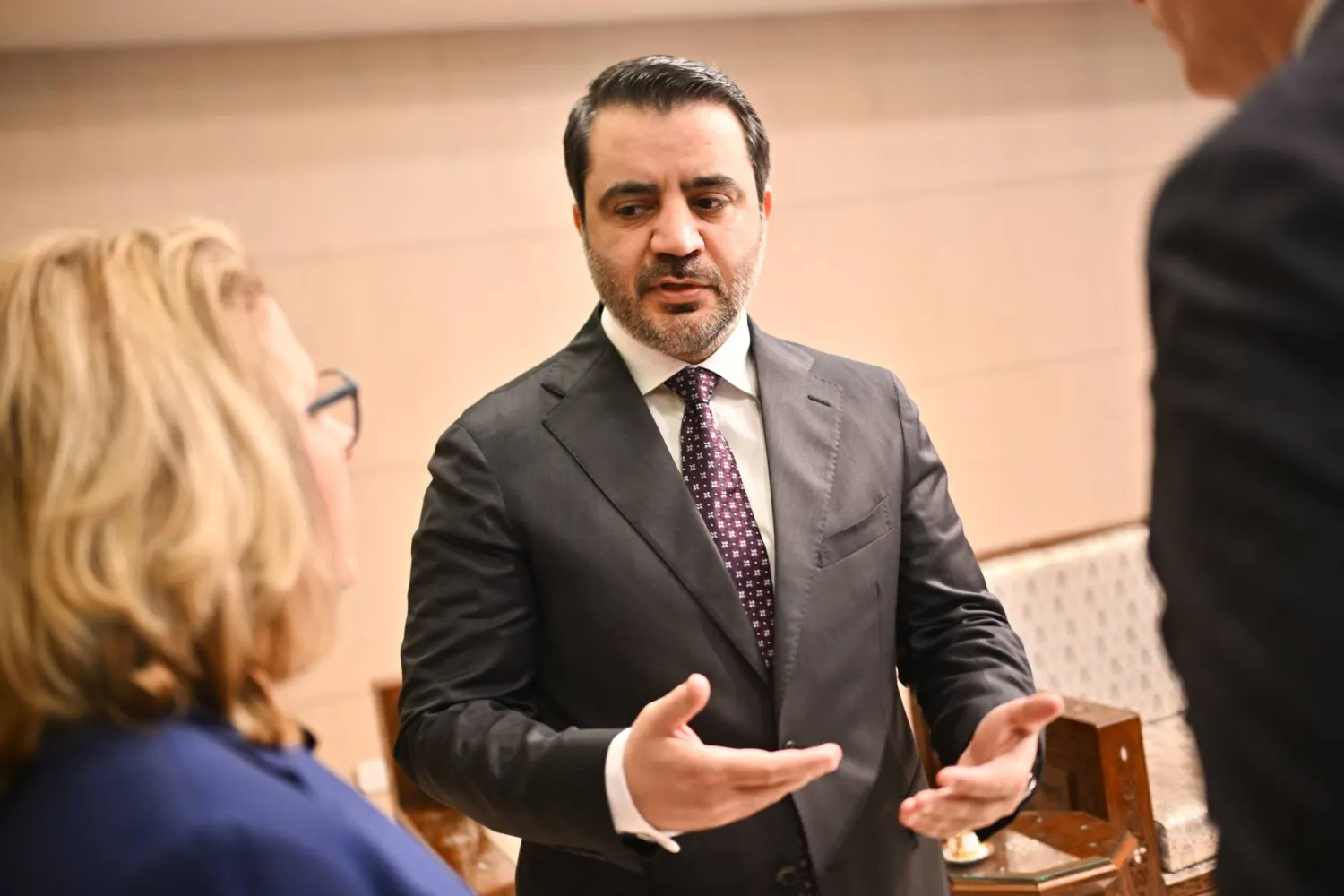
Russia Sends High-Level Team to Syria to Discuss Aid, Energy

15 January 2025, Syria, Damascus: Syrian Foreign Minister Asaad al-Shaibani is pictured during a meeting in Damascus.(dpa)
TT

Russia Sends High-Level Team to Syria to Discuss Aid, Energy

15 January 2025, Syria, Damascus: Syrian Foreign Minister Asaad al-Shaibani is pictured during a meeting in Damascus.(dpa)

Russia on Tuesday sent a big delegation to Syria, headed by its top energy official, in its most visible effort yet to build relations with the government that toppled former President Bashar al-Assad, a key ally of Moscow, late last year.

Russian Deputy Prime Minister Alexander Novak said in televised comments that Russia and Qatar are discussing humanitarian aid to Syria and the restoration of its energy sector. He did not spell out what form of support they might provide.

Syria's energy sector was crippled by the country's 13-year civil war, which made it highly reliant on imports, especially from Iran.

Novak, who is President Vladimir Putin's point man for energy issues, is heading a large Russian delegation with representatives of various ministries including defense.

In comments broadcast by Russian television, he said Moscow could use its network of contacts in the Middle East to help the Syrian government.

"I would like to emphasize the unique negotiating capabilities of Russia, which maintains contacts with Israel and all ethnic groups in Syria. We propose using this factor to stabilize the situation in Syria," Novak said.

Syria's state news agency quoted Foreign Minister Asaad al-Shaibani as alluding indirectly to Russia's history of support for Assad, to whom it provided extensive military backing.

"Our relationship with Russia is deep and has witnessed periods of friendship and cooperation, but there has never been a balance. Any foreign presence on our soil must be aimed at helping the Syrian people build their future," Shaibani said.

Novak said Russia shared the Syrian government's concerns about the "destructive" actions of Israel, including air strikes on Syria.

The Russian official said his trip was a good opportunity to discuss the "entire range" of cooperation between Russia and Syria, and Moscow attached great importance to the upcoming visit of President Ahmed al-Sharaa to Moscow for a Russia-Arab summit.

Among Russia's key priorities is to maintain the use of a naval base and an airfield, which, during Assad's rule, gave it an important military foothold in the region. Novak did not refer to the military facilities in his remarks.


Report: US Blocks Iraq’s Dollar Shipments to Squeeze Iran-Backed Factions

An Iraqi man walks past shops in the Jamila food market in Sadr City, east Baghdad on April 13, 2026. (AFP)
TT

Report: US Blocks Iraq’s Dollar Shipments to Squeeze Iran-Backed Factions

An Iraqi man walks past shops in the Jamila food market in Sadr City, east Baghdad on April 13, 2026. (AFP)

US President Donald Trump's administration has halted US dollar shipments to Iraq and frozen security cooperation programs with its military, as it presses Baghdad to dismantle Iranian-backed factions operating in the country, the Wall Street Journal reported on Tuesday, citing Iraqi ‌and US ‌officials.

US Treasury Department officials ‌recently ⁠blocked a delivery of ⁠nearly $500 million in US banknotes - the proceeds of Iraqi oil sales - from accounts at the Federal Reserve Bank of New York, the Journal ⁠said.

Reuters could not immediately verify ‌the ‌report. The US Treasury Department and the ‌Federal Reserve did not ‌immediately respond to a request for comment.

Washington has also informed Baghdad it is suspending funding for some counter-terrorism ‌and military training programs until faction attacks end and ⁠Iraqi ⁠authorities take steps to dismantle armed groups, the report added.

The United States earlier this month summoned Iraq’s ambassador after a drone struck a major US diplomatic facility in Baghdad, following a series of drone attacks that Washington has blamed on Iran-aligned “terrorist militias."


Israeli Strike on Lebanon's Bekaa Kills One Despite Truce

A young boy walks amid the rubble of a building destroyed in an Israeli strike in the southern Lebanese village of Kfar Sir on April 21, 2026. (Photo by Anwar AMRO / AFP)
TT

Israeli Strike on Lebanon's Bekaa Kills One Despite Truce

A young boy walks amid the rubble of a building destroyed in an Israeli strike in the southern Lebanese village of Kfar Sir on April 21, 2026. (Photo by Anwar AMRO / AFP)

An Israeli drone strike on Lebanon's Bekaa region killed one person and injured two others on Wednesday, Lebanese state media reported, despite an ongoing truce between Israel Hezbollah.

"One person was killed and two others were wounded as a result of an attack carried out by an enemy drone at dawn on the outskirts of Al-Jabur in West Bekaa," the National News Agency (NNA) reported.

However, the Israeli military said it was unaware of the ‌strike.

Hezbollah on Tuesday said it had launched rockets and attack drones at a site in northern Israel in response to "blatant" Israeli ceasefire violations, which it said included "attacks on civilians and the destruction of their homes and villages.”

The Israeli military said that day that Hezbollah "launched several rockets" towards soldiers stationed in south Lebanon and that the military struck the launcher in response.

NNA on Wednesday reported Israeli artillery shelling and demolitions in southern towns Israel continues to occupy.

Israel conducted huge strikes across Lebanon and invaded the south after Hezbollah entered the Middle East war in support of its backer Iran on March 2.

Despite the truce which began on Friday, Israeli soldiers are still active in south Lebanon, with Defense Minister Israel Katz saying on Sunday that they would use "full force" if threatened.

Under the truce terms, Israel says it reserves the right to act against "planned, imminent or ongoing attacks.”

Israeli attacks on Lebanon have killed at least 2,454 people since the start of the war, a Lebanese government body said in its latest toll.


Israel Destroys Infrastructure in Southern Lebanon to Prevent Residents’ Return

A nun inspects a Christian religious site hit by an Israeli strike in the southern Lebanese city of Nabatieh. (AFP)
TT

Israel Destroys Infrastructure in Southern Lebanon to Prevent Residents’ Return

A nun inspects a Christian religious site hit by an Israeli strike in the southern Lebanese city of Nabatieh. (AFP)

Israel is escalating its campaign in southern Lebanon beyond direct military operations, pursuing what Lebanese officials describe as a systematic destruction of infrastructure, particularly in villages along the so-called “Yellow Line.”

Hospitals, schools, and water, electricity and telecommunications networks have been repeatedly targeted, alongside the destruction of bridges and roads, severing links between towns and isolating communities.

Lebanese ministerial sources noted that the approach is part of a policy of displacement. Residents have been repeatedly warned not to return to more than 80 villages, in what appears to be an effort to create an uninhabited buffer zone lacking basic services.

Air strikes have also hit areas outside occupied zones, including Wadi al-Hujeir, which was struck on Tuesday.

Israeli demolitions using explosives and bulldozers have not been limited to homes, but health and education facilities, seen by Lebanese officials as part of pressure on Hezbollah’s support base.

Israel considers civilian infrastructure in these areas a form of indirect support for the group and a potential platform where it can renew its activity.

Hospitals hit

From the first hours after hostilities erupted on March 2, triggering large-scale displacement, the Israeli army targeted hospitals and health centers in the south.

MP Bilal Abdullah, head of the parliamentary health committee, said Isarel had “intensified the destruction of health institutions and the medical system in southern villages.”

He told Asharq Al-Awsat that available data indicate “partial destruction of eight southern hospitals, all of which are now completely out of service,” listing them as the Tebnin Governmental Hospital, Sheikh Ragheb Harb Hospital, Salah Ghandour Hospital, Hiram Hospital, Jabal Amel Hospital, Hasbaya Governmental Hospital and Bint Jbeil Governmental Hospital.

He added that “the greatest damage has affected primary health centers,” noting that more than 100 ambulances had been destroyed and 121 doctors and paramedics killed in the hospitals and medical centers he listed.

Education sector targeted

The destruction of infrastructure is also aimed at deterring civilians from returning to the area for years to come, Lebanese officials say.

The education sector has been among the hardest hit. A source at the education ministry told Asharq Al-Awsat that targeting schools and institutes aims “to undermine the population’s ability to remain in their towns.”

Israel sees strikes on education as an effective way to empty villages of residents, forcing families to relocate in search of schooling alternatives for their children, the source stated.

The war has resulted in the total destruction of public schools in Dhayra, Bustan, Yarin and Tayr Harfa, as well as partial damage to Naqoura Intermediate School. In vocational and technical education, the Khiam and Qantara institutes have been completely destroyed, while institutes in Bint Jbeil, Aita al-Shaab, Tebnin, Toul, Nabatiyeh, Zrariyeh, Jbaa, Maarakeh, Abbasiyeh, Jouaiyya, Qana and Ansar have sustained partial damage.

The extent of structural damage means some of these institutions may be beyond repair, the source added.

According to education ministry statistics, schools in Nabatiyeh and its district have suffered the most damage: one school has been completely destroyed, 18 heavily damaged and seven left unharmed, while no information is currently available on 61 others.

Electricity and water

Damage to electricity and water infrastructure has also been severe. A source at the energy and water ministry told Asharq Al-Awsat it is not yet possible to compile a precise assessment of losses, but it confirmed damage to a number of power transformers and water facilities.

“The biggest problem lies in water networks,” the source remarked, noting that losses in the sector during the 2024 war exceeded $100 million. “The damage in this war surpasses that figure,” due to the destruction or disruption of pumping stations, treatment plants, reservoirs and supply networks.

Israel is pressing ahead with turning dozens of southern villages into a scorched zone, in what observers see as an attempt to extract political or security concessions from Lebanon. The higher the cost of destruction, the greater the pressure on the Lebanese state to seek arrangements to halt the war and limit its losses.