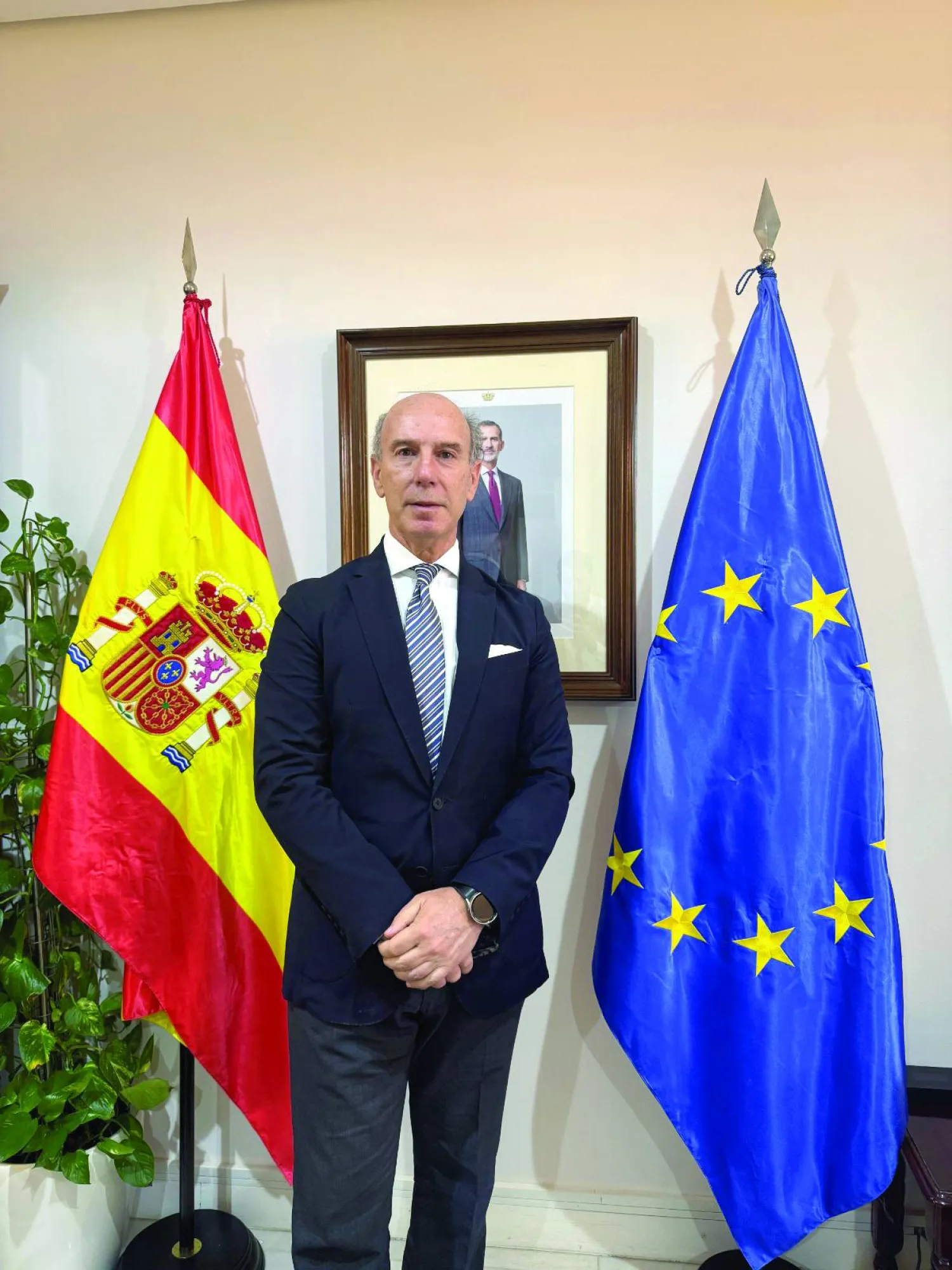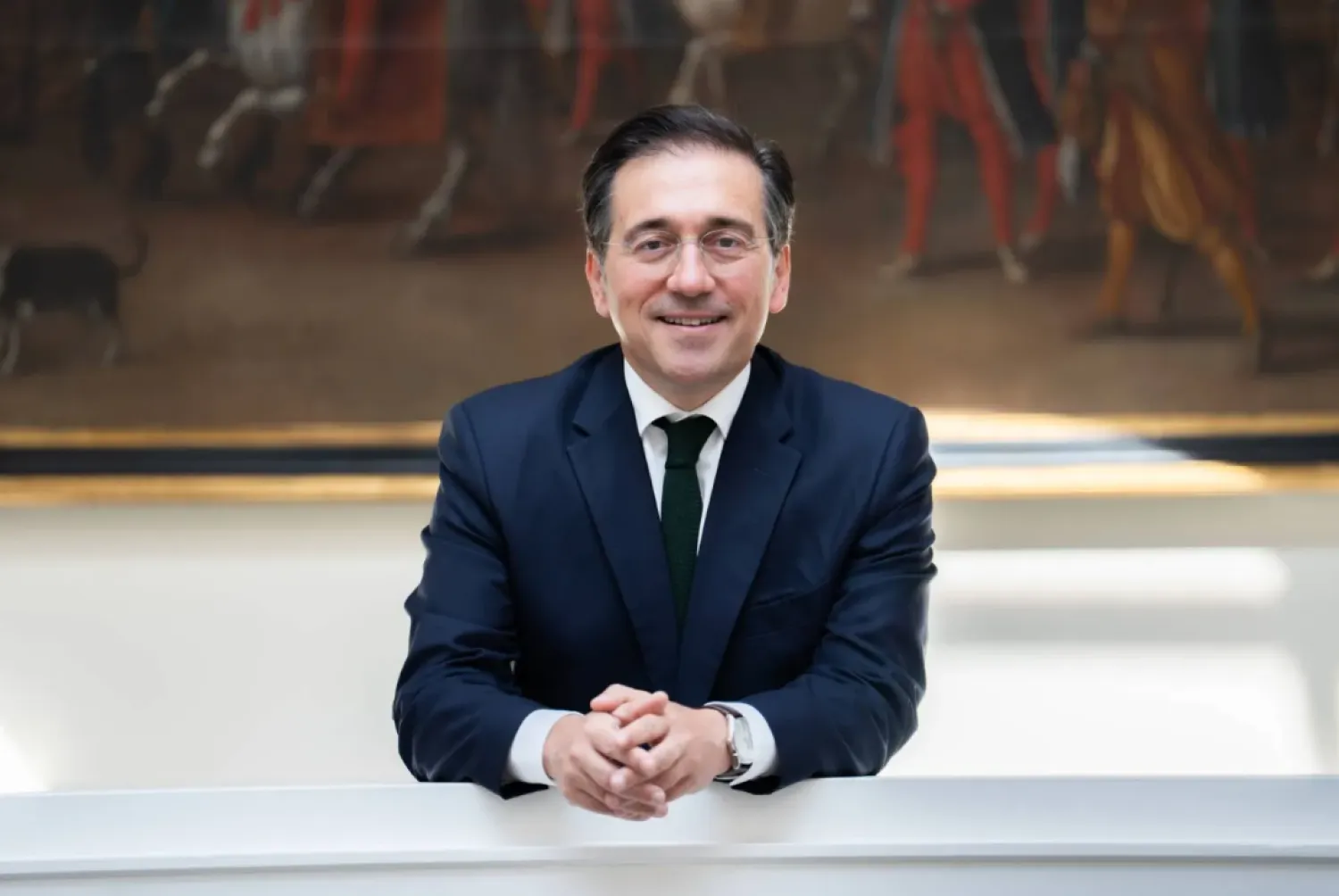

Spanish Foreign Minister José Manuel Albares affirmed that his country has prepared a set of measures to sanction Israel for its relentless killing of Palestinians and the occupation of Gaza. He also acknowledged Spain’s readiness to provide weapons to Ukraine, while stressing the importance of US guarantees to translate President Donald Trump’s vision for resolving the Russian–Ukrainian crisis.
Regarding the expected outcomes of the Alaska Summit on the future of the Russian–Ukrainian crisis, he said in an interview with Asharq Al-Awsat: "We welcome any efforts to bring us closer to achieving a just and lasting peace, including those of President Trump."
"While we would love to see progress, we currently observe no commitment from the Russian side. We still believe that peace should begin with a verifiable and sustainable ceasefire to save lives. As we speak, the attacks, killings and destruction continue. Our first demand is for Russia to stop its aggression immediately," he added.
On the Spanish-European view of President Trump’s proposals for the Russian–Ukrainian crisis, Albares explained: "In Spain and Europe, we believe that the future of Ukraine should be decided by the Ukrainian people, and that any sustainable agreement requires Ukraine and Europe to be present at the negotiating table. We reject any peace agreement that rewards the aggressor."
"This would only encourage further aggression and could lead to another war. We are ready to contribute to Ukraine’s security, because Ukraine’s security is Europe’s security. This is why we welcome the US's commitment to providing much-needed security guarantees. Fundamental principles of international law are at stake here, namely the independence, sovereignty and territorial integrity of States, and these must be upheld," he added.
"Europe is united in its support for Ukraine, and as long as Russia continues its aggression, Spain stands ready to provide military and economic support alongside its European partners, and to maintain pressure on Russia by strengthening sanctions and introducing wider economic measures."
On Palestine, the minister said: "We are working closely with our Saudi partners to stop the killing and humanitarian catastrophe in Gaza and to foster new hope for peace in the region, based on the establishment of a Palestinian State alongside Israel. We launched Madrid+ and the Global Alliance for the Implementation of a Two-State Solution to mobilize political will and a sense of collective responsibility within the international community. This will encourage respect for humanitarian law, justice for Palestinians and security for all in the region."
He also affirmed that Spain's recognition of the State of Palestine, alongside Norway, Ireland and Slovenia, was "therefore only the first step, and many others are now following suit."
He added: "Last July, the United Nations Conference for the Implementation of the Two-State Solution finally convened in New York, following hard work by Spain and Saudi Arabia, and it will resume in September. On 12 September, the New York Declaration was endorsed by 142 Members of the United Nations General Assembly. We will continue our efforts until the State of Palestine is admitted to the United Nations and until a realistic and viable State of Palestine is established in Gaza and the West Bank under a unified Palestinian Authority with access to the sea and its capital in East Jerusalem."
Concerning Israel’s plan to invade Gaza, Albares stated: "Our position is very clear. We condemn the obstruction of humanitarian aid and the escalation of military operations in Gaza, where the United Nations has declared a famine. We have led a group of like-minded countries within the European Union and globally to issue a joint statement, and this group is growing. However, talking is not enough. We cannot tolerate the continued suffering of innocent civilians or the deaths of children from hunger while trucks carrying food are prevented from entering Gaza."
The Spanish FM recalled that in light of the scale of the catastrophe, on 9 September Spain adopted a new set of national measures aimed at ending the war and supporting the Palestinian people.
"These measures include an arms embargo on Israel, sanctions against individuals involved in human rights violations or war crimes in the Gaza Strip, a ban on imports from settlements, increased cooperation with the Palestinian Authority, and an additional contribution of €10 million to UNRWA. There is also an increased humanitarian and cooperation budget for Gaza of up to €150 million until 2026," he noted.
"At the same time, we presented a new package of urgent EU measures to increase pressure and end this nightmare, including suspending the EU-Israel Association Agreement."
On measures to prevent the conflict in Israel from spreading across the region, he said:”I am convinced that the state of permanent war we are witnessing will only divide the peoples of the region and will not deliver security for anyone in the end. Regional security can only be achieved through dialogue, cooperation, mutual recognition and peace."
"This is the clear lesson we learnt in Europe after centuries of war. This is why we unequivocally condemned the Israeli attack on Qatari territory, which violated its sovereignty and international law, threatening the region's overall stability.
Saudi Arabia and our other regional partners are more determined and united than ever on this agenda of mutual recognition and peace. We all condemn terrorism and violence. Therefore, everything depends on establishing the State of Palestine, implementing the two-State solution and respecting international law. The international community must assume its responsibility in this regard, just as it must do to end the tragedy in Gaza. The credibility of the international community and the upholding of United Nations principles and values are at stake," he added.
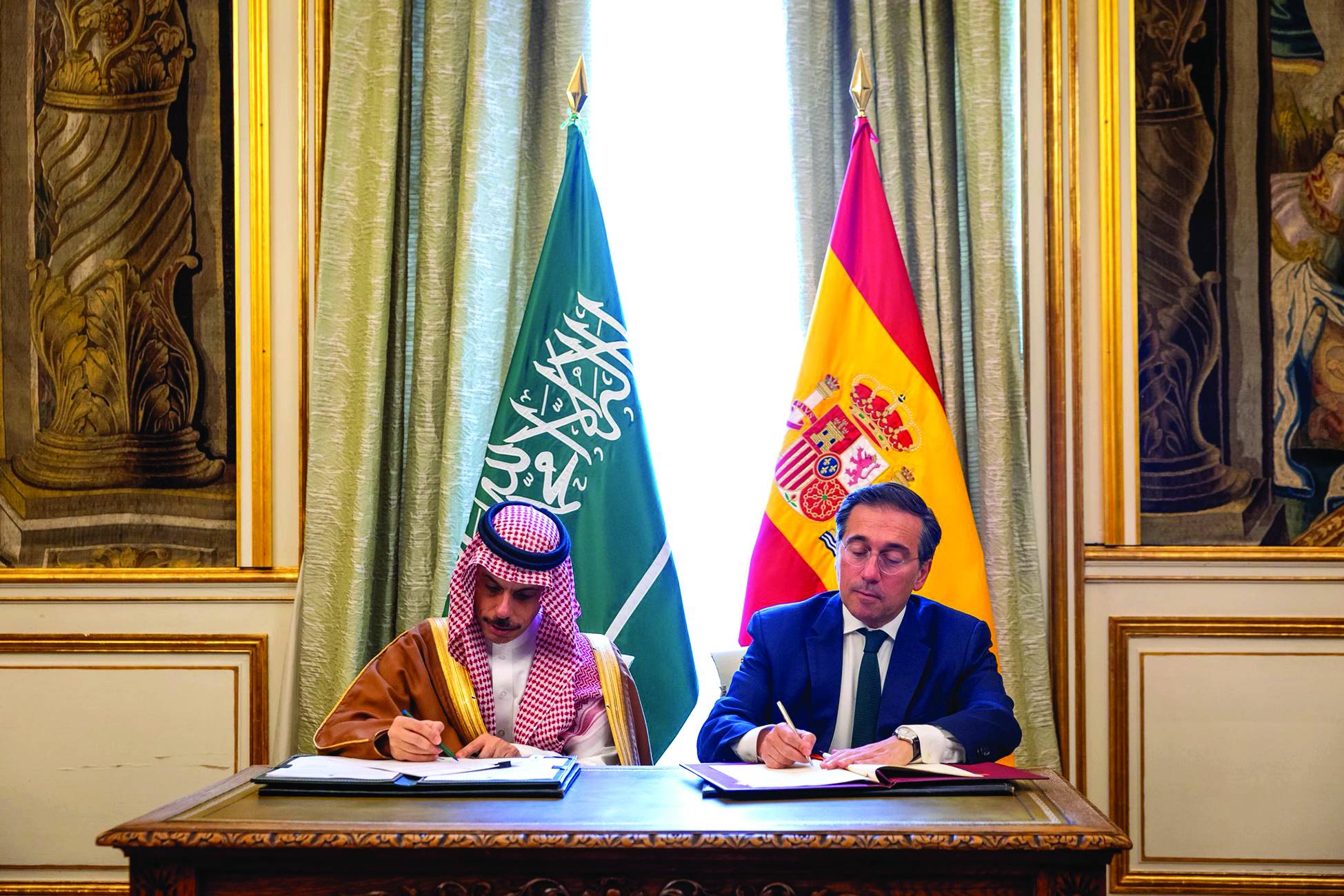
On the strategic Saudi–Spanish partnership, Albares noted: "The historical friendship between the two countries has deep roots, nurtured by feelings of profound sympathy and sincere friendship between our royal households, and the will of our Governments and peoples to explore the full potential of our bilateral relations."
"Our commitment to strengthening our partnership is reinforced by our shared interests. At the diplomatic level, Saudi Arabia is a key regional partner, and we look forward to raising the level of our strategic relations in the near future. In this regard, during the recent visit of my dear friend and colleague, Saudi Foreign Minister Prince Faisal bin Farhan bin Abdullah, to Madrid for the Madrid+ meeting on Gaza in May, we had the opportunity to further develop our strategic relationship, based on mutually beneficial economic projects, a shared vision for the region, peace in the Middle East, and respect for international law," he revealed.
Albares said that as the origin of the international alliance, "we are both countries that are clearly committed to implementing the two-State solution, and we have increased our efforts to foster the recognition of Palestine as a State among our partners. We have also condemned all actions that hinder the future creation of a Palestinian State, particularly the expansion of settlements in the West Bank."
Furthermore, both countries intend to increase the frequency of high-level visits in the future, the Spanish FM stressed.
"In economic terms, the Kingdom of Saudi Arabia is our country's most important commercial partner in the region. The recent visit of my colleague, the Spanish Minister of Economy Carlos Cuerpo, to the Kingdom of Saudi Arabia provided a valuable opportunity to explore new opportunities within the framework of Saudi Vision 2030."
Albares added: "Another way of strengthening our bilateral ties will be cultural promotion, through the celebration of Cultural Years or the promotion of the Spanish language in Saudi Arabia."