


Rembrandt Copied Another Artist’s Canine for His Famous ‘Night Watch’ 

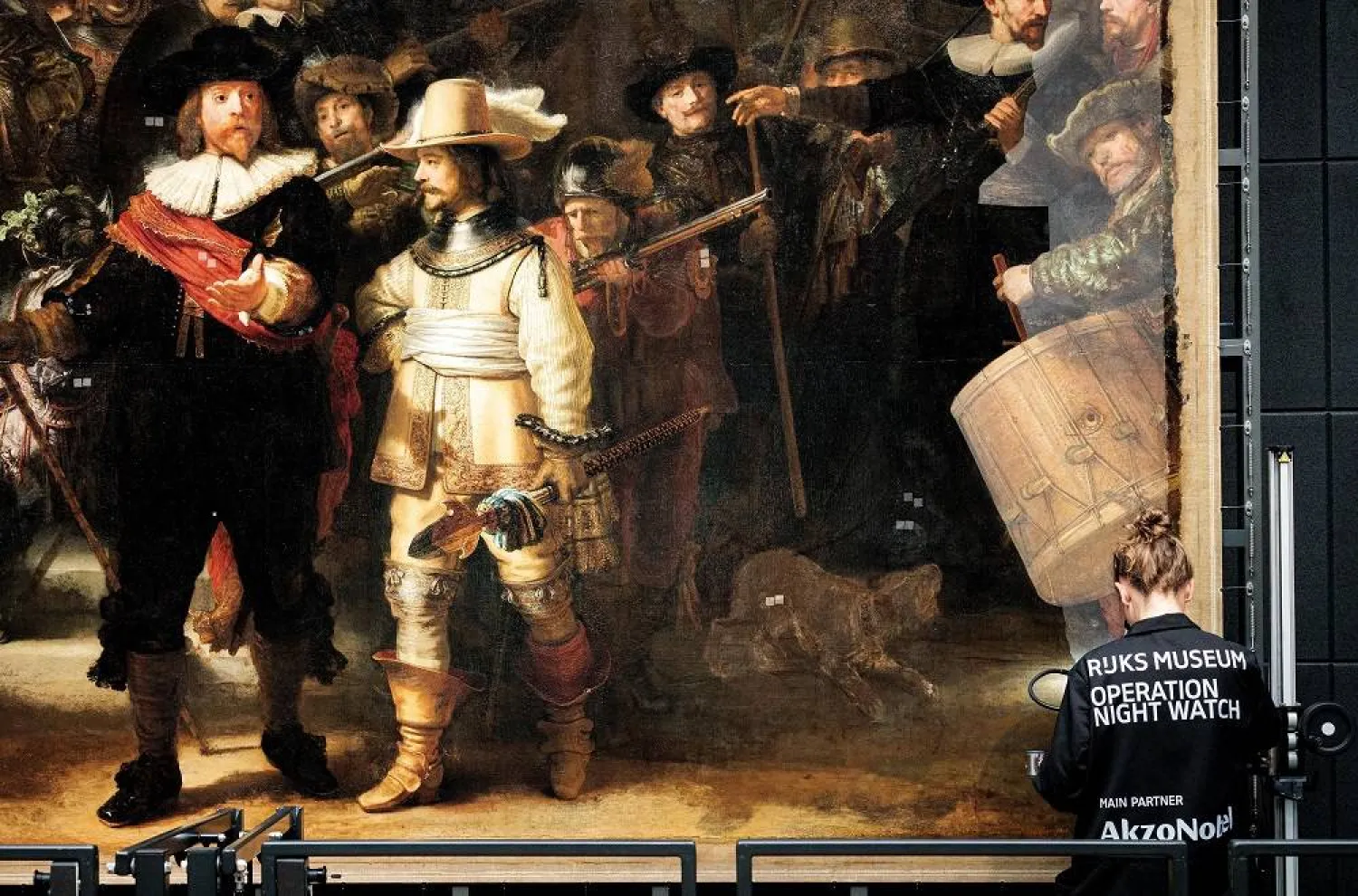
The painting "The Night Watch" by Dutch painter Rembrandt at the Rijksmuseum, in Amsterdam, the Netherlands, 23 September 2025. (EPA)
TT

Rembrandt Copied Another Artist’s Canine for His Famous ‘Night Watch’ 

The painting "The Night Watch" by Dutch painter Rembrandt at the Rijksmuseum, in Amsterdam, the Netherlands, 23 September 2025. (EPA)

It didn't exactly take dogged detective work for an art sleuth in Amsterdam to solve a canine conundrum dating back to the Dutch Golden Age.

Anne Lenders, a curator at the city's landmark Rijksmuseum, said Tuesday that it was more or less by accident that she discovered that the barking dog in Rembrandt van Rijn’s famous "Night Watch" is a near-identical copy of one that features in a 1619 pen and ink drawing by fellow Dutch artist Adriaen van de Venne.

"I wasn't looking for this; it was really unexpected," Lenders said in the glass room where "Night Watch" is undergoing extensive restoration.

She was visiting an exhibition at the Zeeuws Museum in the southern Netherlands when her eye fell on a picture of a dog by Van de Venne that was printed in a book by the poet Jacob Cats. The original drawing, which turned out to be part of the Rijksmuseum's own vast collection, was also on display

"The resemblance is so strong that at the very first moment I thought he (Rembrandt) must have used this," she added.

That's when the research started: a comparison of Van de Venne's and Rembrandt's dogs; their pose, even the collar they wear.

"The head turns in exact the same angle with the mouth slightly opened. ... Both dogs have long hair and ears that hang vertical," said Lenders.

In the "Night Watch," the dog adds tension to a dark corner of the crowded composition, crouching and apparently barking near a drummer called Jacob Jorisz and just behind one of the iconic 1642 painting's main characters, Lieutenant Willem van Ruytenburch.

The discovery is the latest in a series of revelations to emerge during a yearslong project to reexamine the 379.5 by 453.5-centimeter (149.4 by 178.5-inch) canvas using modern techniques. "Operation Night Watch" began in 2019 with an extensive study of the painting and is continuing with restoration work that is likely to take years to complete.

"One tends to think, well, it’s been researched so well, we know everything about it," Rijksmuseum Director Taco Dibbits said. "But the great thing with great art is that you always keep discovering things."

One thing the Rijksmuseum couldn't figure out was exactly what kind of dog it is, with expert opinions divided between a French or a Dutch breed. Most likely, the two artists used a little poetic license.

"We will never have a conclusion on which breed it is," Dibbits said. "But it’s definitely very much loved."



Najran Sees Growing Interest in Heritage and Archaeological Artifact Collection

These collections also include artifacts illustrating stages of the modern Saudi state, serving as educational platforms that bridge the past and present - SPA
TT

Najran Sees Growing Interest in Heritage and Archaeological Artifact Collection

These collections also include artifacts illustrating stages of the modern Saudi state, serving as educational platforms that bridge the past and present - SPA

Najran Region has witnessed growing enthusiasm among community members and heritage enthusiasts for collecting traditional and archaeological artifacts that document historical eras linked to the region’s civilization and the lives of previous generations, contributing to reconnecting society with its roots and raising awareness of the importance of preserving tangible heritage as an essential part of cultural identity.

Heritage enthusiasts play a significant role in preserving Najran’s cultural legacy by establishing private museums that display archaeological items, traditional tools, clothing, photographs, and historical collections reflecting daily life and customs, SPA reported.

These collections also include artifacts illustrating stages of the modern Saudi state, serving as educational platforms that bridge the past and present.

The hobby of collecting heritage items in Najran ranges from gathering everyday tools such as pottery and agricultural equipment to traditional clothing, jewelry, weapons, books, and manuscripts. Motivations vary between personal documentation, preserving family memory, and academic research aimed at understanding historical social and economic practices.

Local markets and seasonal exhibitions, along with digital platforms, have contributed to expanding this hobby, enabling knowledge exchange and increasing awareness of preservation methods and historical value. Community initiatives and workshops further support proper documentation and conservation, ensuring that this passion complements heritage preservation while adhering to scientific and legal standards.


Why is Fadak Known as the 'City of Walls and Fortresses'?

Located 250 kilometers southwest of Hail, this historic village boasts a legacy as rich as its soil - SPA
TT

Why is Fadak Known as the 'City of Walls and Fortresses'?

Located 250 kilometers southwest of Hail, this historic village boasts a legacy as rich as its soil - SPA

Encircled by a massive, seven-kilometer wall of rugged black lava stone, the ancient village of Fadak, known today as Al-Hait, earned its title as the "City of Walls and Fortresses." Guarded by north and south gates, the village is flanked by ancient castles and robust fortifications that still dominate the landscape, SPA reported.

Located 250 kilometers southwest of Hail, this historic village boasts a legacy as rich as its soil. While known in antiquity as Fadak, its modern name, "Hait Al-Nakhl" (The Palm Wall), captures its lush topography—defined by sprawling palm groves, fertile land, and abundant water.

According to the Encyclopedia of the Kingdom of Saudi Arabia, published by the King Abdulaziz Public Library, Al-Hait is one of the oldest urban centers in Hail Region.

According to SPA, the name Fadak echoes through antiquity, recorded among the cities conquered by Babylonian King Nabonidus in the sixth century BC, and frequently cited in classical chronicles and early geographical dictionaries.

Bridging the pre-Islamic and Islamic eras, the site remains an archaeological treasure. From early rock inscriptions and crumbling fortresses to ancient stone wells and traditional farms, these enduring artifacts stand as a living testament to Fadak’s rich cultural heritage and continuous human settlement.


Dragon Boat Festival Links Modern China to Traditions More Than 2,000 Years Old

Competitors take part in the Aberdeen Dragon Boat Race to celebrate the Dragon Boat Festival in Hong Kong, Friday, June 19, 2026. (AP Photo/Chan Long Hei)
TT

Dragon Boat Festival Links Modern China to Traditions More Than 2,000 Years Old

Competitors take part in the Aberdeen Dragon Boat Race to celebrate the Dragon Boat Festival in Hong Kong, Friday, June 19, 2026. (AP Photo/Chan Long Hei)

The Dragon Boat Festival was celebrated Friday across mainland China, Hong Kong and Taiwan with colorful boat races, lion dances and other festivities.

The more than 2,000-year-old holiday is best known for its sporting events, but its origins are rooted in Chinese history and ancient beliefs about health, protection and harmony with nature.

“The Dragon Boat Festival is probably the richest and most diverse of all traditional Chinese festivals,” said Tsinghua University’s history professor Liu Xiaofeng. “Across different regions, people developed a wide variety of traditions based on ideas connected to the summer solstice and the balance of yin and yang.”

The festival is widely associated with the ancient poet Qu Yuan, who according to legend drowned himself more than 2,000 years ago. The tradition of dragon boat races was born from the story that people raced out in boats to search for the poet and threw rice into the river so fish would not eat his body.

A three-day race in Beijing features men’s, women’s and mixed dragon boat races over distances of 100, 200 and 500 meters. Teams from Beijing, Tianjin, Hebei, Shanxi and Guangdong will compete throughout the holiday weekend.

Guided by the thunderous beat of their drummers, crews pulled their paddles through the water in unison, each boat surging toward the finish line as spectators cheered them on.

Others watched the races at home as they enjoyed a traditional sticky rice treat known as “zongzi” with their families.

Beijing’s 2026 celebrations will continue through June 21 at the capital’s Grand Canal.

“The competition helped strengthen our team spirit,” said Li Maoshan, a participant in Friday’s races. “It also gave us an opportunity to demonstrate the spirit of perseverance and hard work.”

Participants in Hong Kong’s dragon boat races on Friday wore costumes including a cartoon version of Chinese Taoist deity Ne Zha.