


Egypt FM to Asharq Al-Awsat: Trump Himself Is the Real Guarantee for Implementing His Gaza Plan

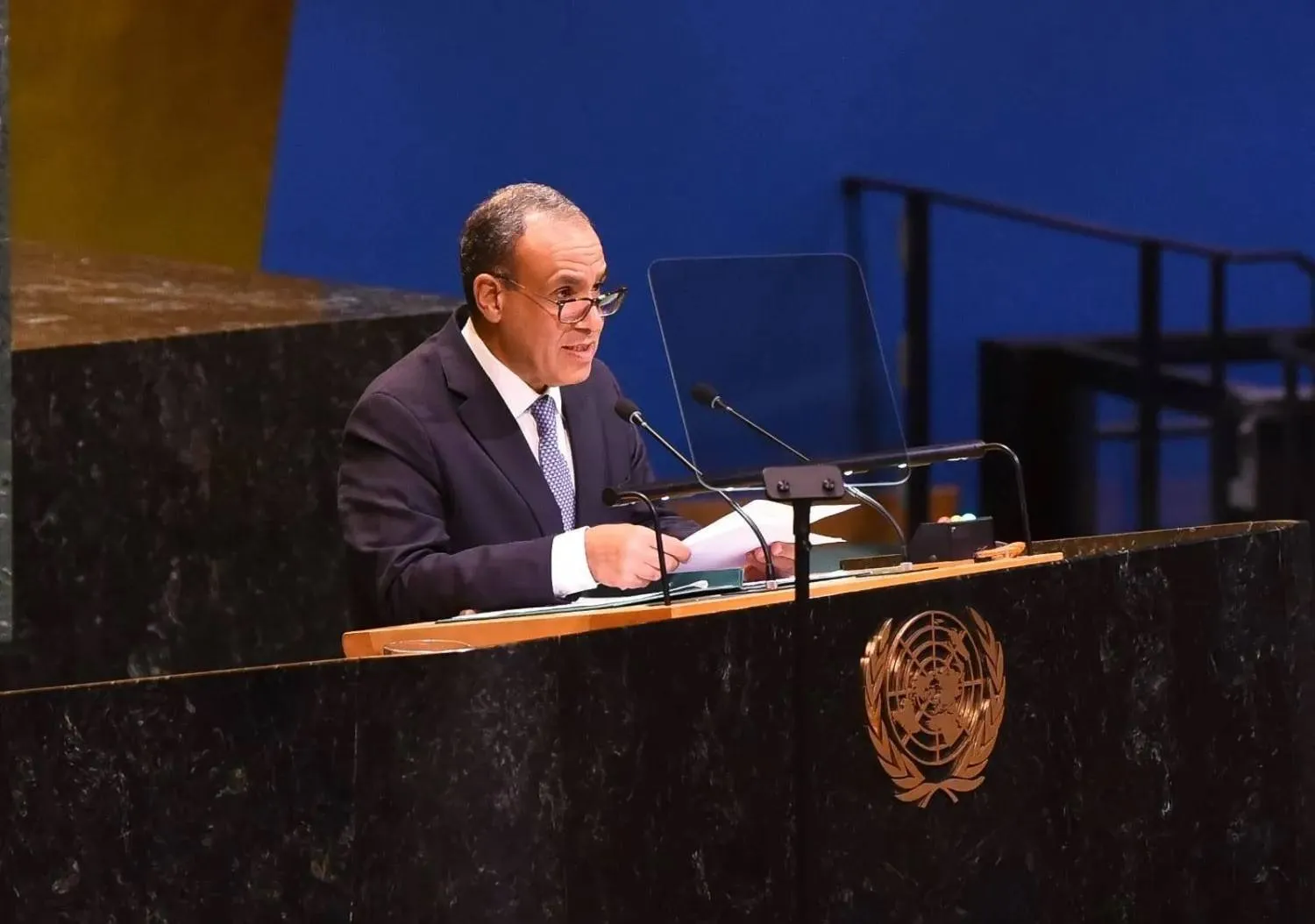
Egyptian Foreign Minister Badr Abdelatty delivers his country’s address at the UN General Assembly meetings in New York last month. (Egyptian Foreign Ministry)
TT

Egypt FM to Asharq Al-Awsat: Trump Himself Is the Real Guarantee for Implementing His Gaza Plan

Egyptian Foreign Minister Badr Abdelatty delivers his country’s address at the UN General Assembly meetings in New York last month. (Egyptian Foreign Ministry)

Egyptian Foreign Minister Badr Abdelatty stressed that “the foremost guarantee” for the implementation of US President Donald Trump’s plan to end the war in Gaza “is Trump himself.”

Speaking to Asharq Al-Awsat, Abdelatty said that Trump “clearly stated and reaffirmed his personal commitment to carrying out the plan and achieving security, stability, and peace in the Middle East.”

Abdelatty, together with Egyptian Prime Minister Mostafa Madbouly, attended a meeting with Trump last month on the sidelines of the UN General Assembly in New York. The meeting brought together several Arab and Islamic leaders, including representatives from Saudi Arabia, Qatar, and Türkiye.

His remarks come ahead of a new round of negotiations scheduled in Cairo on Monday to discuss the first phase of Trump’s plan between Israel and Hamas under international mediation. The talks will take place amid growing concerns among Palestinian factions that Israel might backtrack on its commitments.

According to Abdelatty, Trump “reiterated his pledges and conveyed his determination to achieve peace in the Middle East through messages directed to Arab and Islamic leaders during the New York meeting.”

His comments align with the assessment of Arab and European diplomatic sources who say that Trump is “the only one capable of twisting the arm” of Israeli Prime Minister Benjamin Netanyahu, who initially agreed to the plan, including the creation of a Palestinian state, but later declared upon his return to Israel that he “has not and will not accept” such a state.

Cairo, Abdelatty noted, welcomes Hamas’ response to the US initiative, describing it as “a reflection of the movement’s and other Palestinian factions’ sense of responsibility, as they take into account the fate of the Palestinian people and the protection of civilians.”

He outlined the main “positives” in Trump’s proposal, including “ending the war, rejecting annexation, and halting displacement,” emphasizing that these “are essential and powerful elements that we can build upon to make the plan viable and applicable on the ground.”

“The Palestinian response is a very positive step in the right direction, which we highly value. We now expect the other side, Israel, to fulfill its commitments under the plan so that both parties carry out their obligations,” he added.

The FM acknowledged that certain details still require discussion and clarification within the framework of the US proposal, saying that the plan “serves as a general framework to stop the war, end the bloodshed, deliver humanitarian aid, release hostages, and return remains.”

“These details,” he said, “will be addressed through technical-level negotiations to create suitable conditions and an enabling environment for implementation.”

He noted that the upcoming Cairo meetings would see technical and security discussions aimed at completing the first stage, which includes “the release of prisoners from both sides and the repatriation of Israeli remains as a first step, to be followed by later phases.”

When asked whether Netanyahu might ignore Washington’s call for an immediate ceasefire, especially after reports that at least 30 Palestinians were killed on the first day following the US request, Abdelatty replied: “We always rely on President Trump’s leadership and resolve in enforcing his important plan to end this war and bring about peace. He is the only one capable of making Israel comply.”

He added: “What matters now is that the Arab and Islamic worlds, along with the international community, have welcomed this plan. Our duty is to work collectively to ensure its implementation. Egypt remains in close coordination with the United States and all concerned parties to translate the plan’s provisions into action.”

Addressing questions about the proposed “international stabilization force,” Abdelatty clarified that Egypt “does not reject the idea of deploying such a force; on the contrary, it supports it, but insists that several key conditions must be met: its mandate must be clearly defined, it must be established by a UN Security Council resolution, and its functions must be explicitly outlined.”

The force should “support the Palestinian police, who are responsible for maintaining security and enforcing the law inside Gaza, as in the West Bank. It should also strengthen national unity between the two regions, since Gaza and the West Bank together form the foundation of the future Palestinian state. Egypt cannot accept their separation,” he told Asharq Al-Awsat.

Abdelatty tied Egypt’s potential participation in such a force to the inclusion of the United States, saying: “We are talking about a multinational force in which the US must play a key and effective role. Eventually, there should also be a presence in the West Bank to reinforce the organic link between the two territories.”

He explained that “security arrangements should primarily be handled by the Palestinians themselves in managing their daily affairs, while the international force would assist the Palestinian police, provide external border security, and offer training and technical support.”

Such a deployment, he added, should be temporary - “a transitional period determined by the UN Security Council, with the goal of enabling the Palestinian Authority to take full control of Gaza and reinforce unity between the West Bank and the Strip.”

When asked about the issue of Hamas’ weapons, Abdelatty described it as “a purely Palestinian matter to be resolved internally.” He noted that Hamas has agreed to Trump’s plan, and this issue will be handled within the Palestinian framework.


Abu Shabab Successor Pledges to Keep Up Resistance to Hamas

A photo of Yasser Abu Shabab published by Israel's Yedioth Ahronoth. (File photo)
TT

Abu Shabab Successor Pledges to Keep Up Resistance to Hamas

A photo of Yasser Abu Shabab published by Israel's Yedioth Ahronoth. (File photo)

Hamas was taken by surprise by news of the killing of Yasser Abu Shabab, the self-styled leader of armed groups operating east of Rafah in southern Gaza.

The movement stayed silent until his men confirmed he had been shot dead, while Israel’s account of the incident continued to stir questions amid firm denials from several sides. Ghassan al-Dahini, who is expected to take over the Popular Forces, vowed to press on in defying Hamas.

Hamas’s position

Hamas sources told Asharq al-Awsat that the movement had no involvement in the incident and learned of it with surprise, even though it has a clear policy of using force against anyone who collaborates with Israel.

The sources said the movement also has high level instructions to deal in particular with armed cells that serve Israel, including Abu Shabab’s group and others.

According to the sources, Hamas’s leadership decided to withhold comment until the circumstances of the killing became clear. Once the details were verified, the movement issued a statement.

The sources acknowledged that Hamas had hoped Abu Shabab would be killed by his own fighters who remained in the Rafah tunnels throughout the past period, but at the same time conceded that his death would have far reaching implications for Israel’s reliance on such armed groups. The sources said these groups have failed to achieve Israel’s aims, whether in challenging Hamas’s strength in Gaza, taking control of large areas or even sowing Palestinian divisions.

In its statement on Abu Shabab’s killing, Hamas said his fate was inevitable for anyone “who betrayed his people and homeland and accepted being a tool in Israel’s hands”. It accused him of criminal acts that represented “a clear break with national and social norms”. The movement praised families, tribes and clans that disowned Abu Shabab and anyone who had cooperated with Israel.

Israel, Hamas said, “had failed to protect its agents and would not be able to protect any of its collaborators”. It added that “anyone who undermines the security of his own people and serves the enemy will end up in the dustbin of history and lose any respect or standing within his community”.

The Israeli account

The Popular Forces, which Abu Shabab headed, confirmed he was killed while trying to break up a family dispute between members of the Abu Seneima clan. It stressed that Hamas had nothing to do with his death, describing the movement as “too weak to harm” the general commander or his comrades.

The group did not address the Israeli version that surprised many Palestinians. That account claimed Abu Shabab was beaten and kicked to death by his own escorts and bodyguards amid disputes over positions, money and his cooperation with Israel.

Hamas sources said the Israeli narrative amounted to a clear abandonment of those who work for it and was designed to tarnish Abu Shabab and the circumstances of his death in a way that serves Israel’s current interest in ending the phenomenon of such armed groups.

Israel had nurtured and supported them, the sources said, but now understands they have little value in influencing Hamas’s grip on Gaza and have become a burden, having failed to deliver what Israel sought, which was to fracture Palestinian society and take control of wide areas.

The sources estimated that Israel is now keen to eliminate Abu Shabab and others, particularly under continued United States pressure to move to the second phase of the war. That shift would reduce the areas under Israeli control in Gaza, where these groups are present. Israel had hoped they would serve as a governing force for the enclave.

Yedioth Ahronoth reported on Friday that Abu Shabab’s killing, after some had portrayed him as a rising force challenging Hamas’s rule, paints a more troubling picture.

It said official Israeli reports point to a silent and brutal war within his armed faction and that his killing was not a routine incident but a moment that exposed the collapse of Israel’s idea of forming a local alternative force to fill the civilian and security vacuum left by Hamas.

Although the newspaper had been first to report the security establishment’s version that he died from a severe beating, it later noted that he was shot during a brawl between his men and local families that then escalated into internal disputes.

The paper said Abu Shabab, in an earlier interview, “had boasted that he had become the strongest man in Gaza and saw himself as Hamas’s replacement. But the man who thought he was leading a revolution was brought down by the forces he helped empower and his vision of a different Gaza ended with the bullet that struck him in the back.”

A weak successor

The newspaper said Abu Shabab’s death created a “dangerous” vacuum and that no stable entity currently exists to replace Hamas in leading Gaza. It said existing militias are divided and disorganized and that Abu Shabab’s deputy, Ghassan al-Dahini, might assume leadership, although his position is far from secure.

Al-Dahini suffered a minor leg injury during the same incident and was taken to Barzilai Medical Center in Ashkelon for treatment, according to Israel’s Army Radio.

He appeared in a short video posted on social media performing the funeral prayer for Abu Shabab alongside dozens of gunmen, led by an elderly bearded man whose identity was not known.

In a brief interview with the Israeli newspaper published Friday, Al-Dahini vowed to continue Abu Shabab’s project and resist Hamas by establishing an alternative to its rule.

Al-Dahini, a former Palestinian security officer, described Hamas as too weak to undermine anyone’s morale.

Sources told Asharq al-Awsat that Abu Shabab was killed by two young men from the Debari and Abu Seneima clans. The two were later killed in a gunfight with Abu Shabab’s men during the incident in which he was present.


Lebanon Tells a UN Team the Country Will Need a Back-up Force Once Peacekeepers’ Term Ends

Lebanese Prime Minister Nawaf Salam, in front of the Lebanese flags (C), meets with a United Nations Security Council delegation at the government palace in Beirut, Lebanon, 05 December 2025. (EPA)
TT

Lebanon Tells a UN Team the Country Will Need a Back-up Force Once Peacekeepers’ Term Ends

Lebanese Prime Minister Nawaf Salam, in front of the Lebanese flags (C), meets with a United Nations Security Council delegation at the government palace in Beirut, Lebanon, 05 December 2025. (EPA)

The Lebanese prime minister on Friday told a visiting UN delegation that his country will need a follow-up force in southern Lebanon along the border with Israel to fill the vacuum once the UN peacekeepers' term expires by the end of next year.

The UN Security Council voted unanimously in August to terminate the UN Interim Force in Lebanon (UNIFIL) at the end of 2026 — nearly five decades after the force was deployed. The multinational force has played a significant role in monitoring the security situation in the region, including during the Israel-Hezbollah war last year.

But it has drawn criticism from officials in President Donald Trump’s administration, which has moved to slash US funding for the operation as Trump remakes America’s approach to foreign policy.

Lebanese Prime Minister Nawaf Salam held talks with the team representing the 15 members of the UN Security Council, saying he believes another, follow-up force would help Lebanese troops along the border where they have intensified efforts in the volatile area that witnessed the 14-month war between Israel and the Iran-backed Hezbollah group.

Salam proposed that a small follow-up force could work much like the UN observers force that has been deployed along Syria’s border with Israel since 1974.

There was no immediate response from the UN delegation, which arrived in Lebanon after a visit to Syria. Earlier Friday, the delegation also met with Lebanese President Joseph Aoun, who said Lebanon would welcome any country's decision to keep its forces in southern Lebanon after UNIFIL's term expires.

Aoun also touted Lebanon’s appointment of former ambassador to Washington, Simon Karam, to head the Lebanese delegation to a previously military-only committee that monitors the US-brokered ceasefire that halted the latest Israel-Hezbollah war.

The appointment has angered Hezbollah, whose leader Sheikh Naim Qassem said in a televised speech later Friday that the appointment of the ex-ambassador was allegedly a “concession" to Israel.

Qassem said it would not change "the enemy’s stance and its aggression,” referring to Israel’s almost daily airstrikes on what the Israeli military says are Hezbollah targets in Lebanon since the ceasefire went into effect in November last year. The UN says that the Israeli strikes since the ceasefire have killed 127 civilians.

Israel’s air force carried out a series of airstrikes on Thursday in south Lebanon, saying it struck Hezbollah’s infrastructure. Warnings were issued in advance to evacuate the area.

The latest Israel-Hezbollah war began a day after Hamas attacked southern Israel on Oct. 7, 2023, with Hezbollah firing rockets into Israel in solidarity with the Palestinian Hamas group. Israel's response operation that included bombardment and a ground operation last year has severely weakened Hezbollah.


Palestinians Say Israeli Army Killed Man in Occupied West Bank

 Israeli military vehicles roll during a raid in Ramallah, in the occupied West Bank on December 1, 2025. (AFP)
Israeli military vehicles roll during a raid in Ramallah, in the occupied West Bank on December 1, 2025. (AFP)
TT

Palestinians Say Israeli Army Killed Man in Occupied West Bank

 Israeli military vehicles roll during a raid in Ramallah, in the occupied West Bank on December 1, 2025. (AFP)
Israeli military vehicles roll during a raid in Ramallah, in the occupied West Bank on December 1, 2025. (AFP)

The Ramallah-based Palestinian health ministry said that Israeli forces killed a man in the northern occupied West Bank on Friday.

"Bahaa Abdel-Rahman Rashid (38 years old) was killed by Israeli fire in the town of Odala, south of Nablus," the health ministry said in a statement.

Shortly before, the Palestinian Red Crescent said its teams handled the case of a man "who suffered a critical head injury during clashes in the town of Odala near Nablus, and CPR is currently being performed on him".

The Israeli military told AFP it was looking into the incident.

Witness and Odala resident Muhammad al-Kharouf told AFP that Israeli troops were patrolling in Odala and threw tear gas canisters at men who were exiting the local mosque for Friday prayer.

Rashid was killed by live fire in the clashes that followed, added Kharouf, who had been inside the mosque with him.

The Israeli military said Friday it had completed a two-week counter-terrorism operation in the northern West Bank during which it killed six gunmen and questioned dozens of suspects.

It told AFP that Rashid was not among the six gunmen killed over the past two weeks.

Dozens of men including Rashid's father gathered at the nearby city of Nablus' Rafidia hospital to bid him goodbye on Friday, an AFP journalist reported.

Violence in the West Bank has soared since Hamas's October 2023 attack on Israel triggered the Gaza war.

It has not ceased despite the fragile truce between Israel and Hamas that came into effect in October.

Israeli troops or settlers have killed more than 1,000 Palestinians, many of them gunmen, but also scores of civilians, in the West Bank since the start of the Gaza war, according to an AFP tally based on Palestinian health ministry figures.

At least 44 Israelis, including both soldiers and civilians, have been killed in Palestinian attacks or Israeli military operations, according to official Israeli figures.
