


Taiwan’s President Pledges to Build Air Defense System in Face of China Threat 

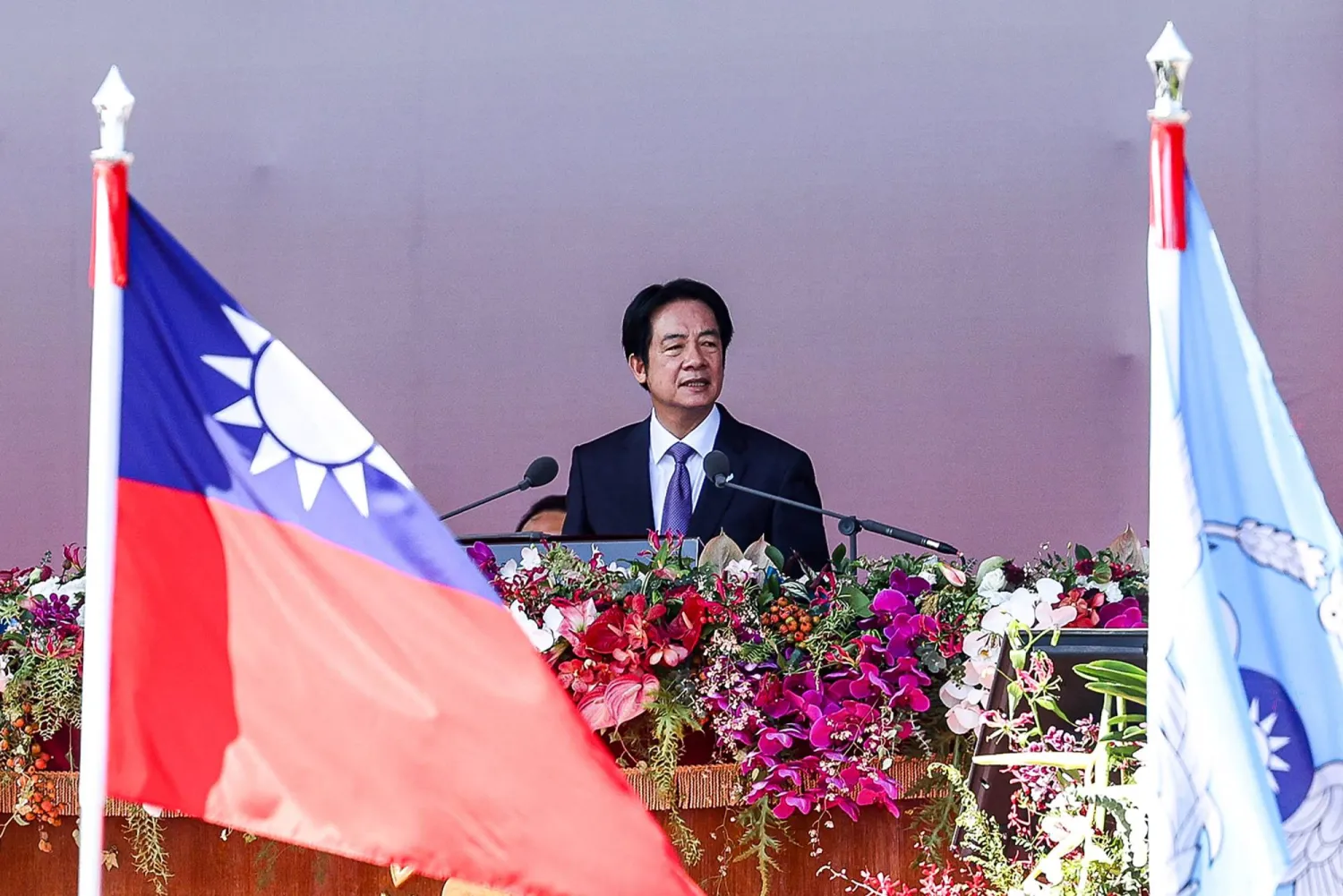
Taiwan's President Lai Ching-te delivers a speech during National Day celebrations at the Presidential Palace in Taipei on October 10, 2025. (AFP)
TT

Taiwan’s President Pledges to Build Air Defense System in Face of China Threat 

Taiwan's President Lai Ching-te delivers a speech during National Day celebrations at the Presidential Palace in Taipei on October 10, 2025. (AFP)

Taiwan will accelerate the building of a “Taiwan Shield” or “T-Dome” air defense system in the face of the military threat from China, its leader said Friday.

President Lai Ching-te also pledged to raise defense spending to more than 3% of GDP and to reach 5% by 2030. GDP, or gross domestic product, is a measure of the size of the overall economy.

“The increase in defense spending has a purpose,” he said in an address to an outdoor crowd on Taiwan National Day. “It is a clear necessity to counter enemy threats and a driving force for developing our defense industries.”

Taiwan is a self-governing island off China’s east coast that the Chinese government claims as part of its territory and says must come under its rule.

Lai called Taiwan a “beacon of democracy” in Asia, drawing a distinction with China’s one-party state.

“Democratic Taiwan ... will strive to maintain the status quo, protect peace and stability in the Taiwan Strait, and promote regional prosperity and development,” he said from a large stage set up in front of the early 20th-century presidential office building.

Most of his speech focused on economic issues, including Taiwan's response to the high tariffs that President Donald Trump has imposed on exports to the United States this year.

The government has launched a 93 billion New Taiwan dollar ($3 billion) plan to help companies, workers and those in farming and fishing who are affected by the tariffs.

“We will also actively engage in reciprocal tariff negotiations with the US to secure a reasonable rate,” Lai said.

Without mentioning Trump, he said America's tariffs have added to the challenges already facing the world, namely the Russia-Ukraine war, the turmoil in the Middle East, and China’s continued military expansion.

The Chinese military regularly sends fighter jets and warships into the skies and waters off Taiwan and has staged major military exercises in the area in recent years.

Lai said his government would establish a rigorous defense system with high-level detection and effective interception capabilities.

His use of the phrase “T-Dome,” short for Taiwan Dome, was an apparent reference to the Iron Dome system that Israel has developed.

Taiwan’s Defense Ministry said in a report this week that it is training soldiers to shoot down drones and looking to procure anti-drone weapons systems in response to China's expanding development and use of military drones.

Taiwan, home to 23 million people, operates independently but has not declared formal independence, which would risk provoking a Chinese military response.

Chinese authorities issued a public warning Friday to a Taiwanese company it accused of spreading disinformation and Taiwan independence and separatist fallacies.

The Ministry of State Security posted the names and pictures of three individuals linked with the company, WangShi Art & Design. No one answered at a publicly listed number for the company, and it did not respond immediately to an email request for comment.

The United States, like most countries, does not recognize Taiwan as a country, but it supplies the government with military equipment for its defense and opposes any use of military force by China to settle its dispute with Taiwan.

Trump has pressured Taiwan to increase military spending to 10% of its GDP, an expectation reiterated on Tuesday by the nominee to be the Pentagon's senior official for the Indo-Pacific region.

China and Taiwan have been governed separately since 1949, when a civil war brought the Communist Party to power in Beijing. Defeated Nationalist Party forces fled to Taiwan, where they set up their own government.

Taiwan's Oct. 10 national day marks the anniversary of a 1911 uprising in China that led to the fall of its last imperial dynasty. It comes nine days after China's national day on Oct. 1, when communist revolutionary leader Mao Zedong declared the founding of the People's Republic of China in 1949.



NATO: Ukraine Still Receiving Arms Despite Mideast War

NATO Secretary General Mark Rutte via Reuters/File
TT

NATO: Ukraine Still Receiving Arms Despite Mideast War

NATO Secretary General Mark Rutte via Reuters/File

Ukraine is still getting essential defense equipment despite the war in the Middle East, which is depleting stockpiles in Europe and the United States, NATO Secretary General Mark Rutte said Thursday.

"The good news is that essential equipment into Ukraine continues to flow," he told reporters. That included American-made Patriot missile interceptors, which Ukraine desperately needs, he added, AFP reported.

The PURL program, launched last year, allows Ukraine to receive US equipment financed by European countries.

Some 75 percent of the missiles used by Patriot batteries in Ukraine have been supplied through the program, and 90 percent of the munitions used by other air-defense systems, Rutte added.

Rutte called on European countries to increase their own production capacity.

"They need to produce more extra production lines, extra shifts, opening new factories. The money is there," he said.


Germany FM Says 'Encouraging' if US Speaking Directly to Iran

German Foreign Minister Johann Wadephul. (Reuters: File Photo)
TT

Germany FM Says 'Encouraging' if US Speaking Directly to Iran

German Foreign Minister Johann Wadephul. (Reuters: File Photo)

Germany's foreign minister Thursday said it was encouraging if the United States was talking directly to Iran to end the war in the Middle East, but Washington should make its intentions clear.

"I hear that there are signs that the US is speaking directly to Iran. I think that this is encouraging and this is welcome," Johann Wadephul told reporters before heading into the meeting of G7 foreign ministers outside Paris, AFP reported.

With US Secretary of State Marco Rubio set to join the discussions from Friday, he added: "For the German government it is of great importance to know precisely what our American partners are intending."


US Envoy Witkoff Says Iran is Seeking an Off-ramp

US Special Envoy Steve Witkoff speaks during a cabinet meeting at the White House in Washington, DC, US, March 26, 2026. REUTERS/Evelyn Hockstein
TT

US Envoy Witkoff Says Iran is Seeking an Off-ramp

US Special Envoy Steve Witkoff speaks during a cabinet meeting at the White House in Washington, DC, US, March 26, 2026. REUTERS/Evelyn Hockstein

The United States has sent Iran a "15-point action list" as a basis for negotiations to end the current conflict, US Special Envoy Steve Witkoff said on Thursday, adding that there are signs that Tehran was interested in making a deal.


Witkoff, speaking during a cabinet meeting at the White House, said that the nascent talks could be successful if the Iranians realize there were no good alternatives - a realization Tehran might be coming to, he argued, Reuters reported.


"We will see where things lead, and if we can convince Iran that this is the inflection point with no good alternatives for them other than more death and destruction," Witkoff told reporters.


"We have strong signs that this is a possibility."


Witkoff said Pakistan had been acting as a mediator, confirming statements from Pakistani officials.