


Egyptian Source: Gaza Deal’s Second Phase Yet to Start amid Hurdles

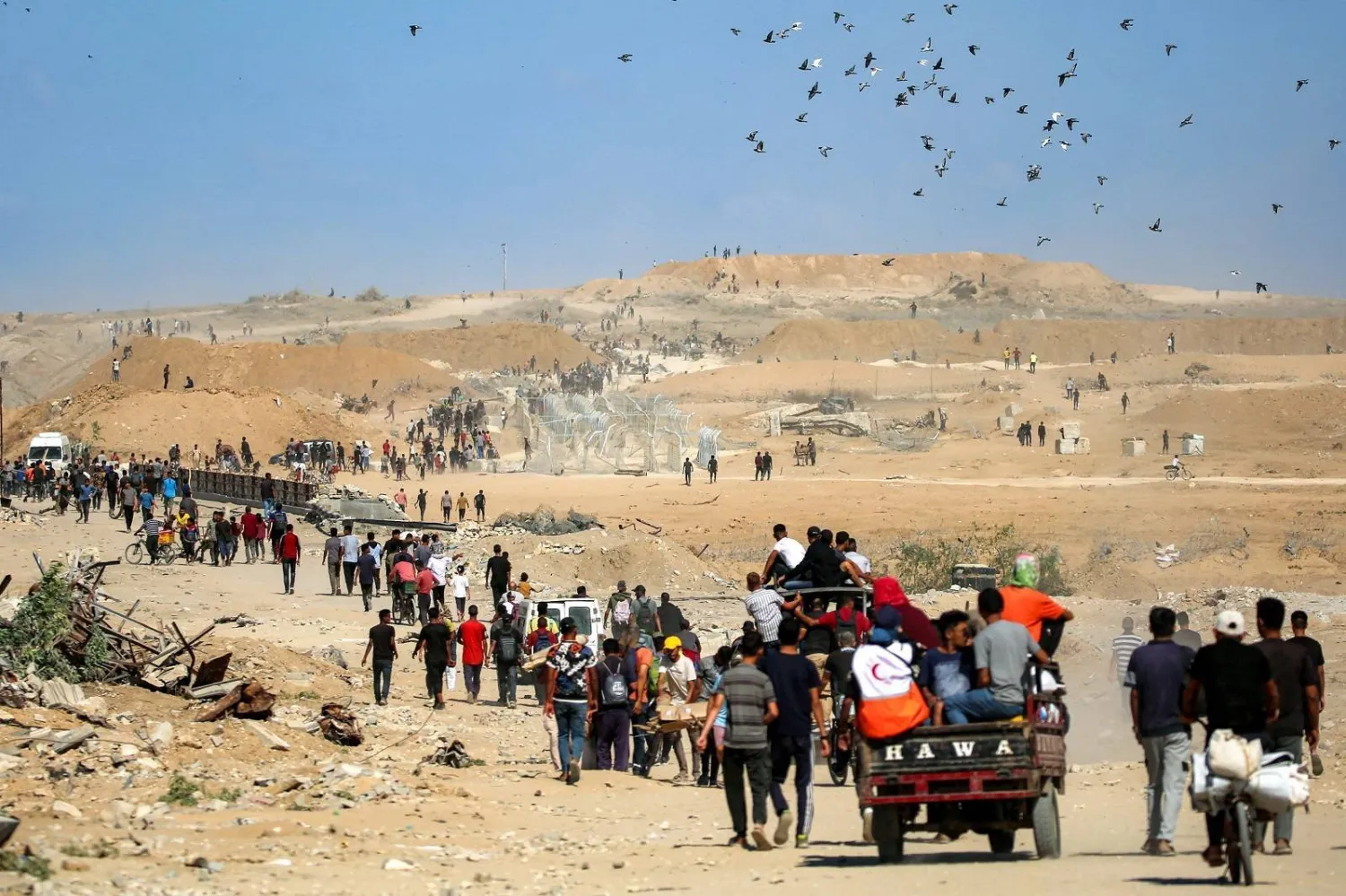
Palestinians walk through the so-called “Netzarim Corridor” near Nuseirat in central Gaza (AFP)
TT

Egyptian Source: Gaza Deal’s Second Phase Yet to Start amid Hurdles

Palestinians walk through the so-called “Netzarim Corridor” near Nuseirat in central Gaza (AFP)

A well-informed Egyptian source told Asharq Al-Awsat on Wednesday that “talks for the second phase have not practically begun; they exist only in theory due to difficulties on the ground and Israel’s clear exploitation of loopholes, including the issue of the bodies.”

The source added that “there is a need to deploy international forces to avert future complications, an effort Egypt is currently pursuing.”

The source warned that “the situation on the ground is extremely dangerous, with divisions that could widen,” adding, “theoretically, we are in the second phase as President Donald Trump says, but practically it hasn’t started.

The phase is difficult, the path toward it is rough, and there are no conditions that allow us to claim we’ve entered the second stage.”

Trump announced Tuesday on his Truth Social platform the start of the second phase of the Gaza agreement amid ambiguity surrounding the ceasefire deal, as Israel delayed aid deliveries and Hamas tightened its grip on the enclave.

Qatari Foreign Ministry spokesperson Majed Al-Ansari said Tuesday that difficult discussions have begun on how to secure and manage the situation and ensure the war in Gaza does not resume.

He told Fox News that talks have already started in Sharm El-Sheikh, with teams working around the clock to avoid any gap between the first and second phases.

Regarding Egypt’s recent call for deploying international forces with UN Security Council approval, the Egyptian source told Asharq Al-Awsat: “We need this, and Egypt is working on it with partners and stakeholders. But it’s difficult to set a timetable, especially as Hamas appears intent on asserting military displays during the transitional period Trump recently allowed to maintain order, a move that contradicts his call on Tuesday for its swift disarmament.”

The source noted that “the issue isn’t just disarmament — which won’t be easy — but also Israel’s plan to demolish tunnels. These are complex issues that can’t be resolved quickly. The situation is opaque, and no one knows what tomorrow will bring for Gaza.”

During a White House meeting with Argentine President Javier Milei on Tuesday, Trump said: “If they (Hamas) don't disarm, we will disarm them. And it will happen quickly and perhaps violently.”

An Egyptian source said Cairo “is moving in all directions to uphold the agreement, ensure its full implementation, and facilitate humanitarian aid deliveries.” The source added that Israel’s refusal to open the Palestinian side of the Rafah crossing “is part of a stalling policy — exploiting the situation to delay progress — citing the ongoing issue of the bodies.”

He stressed that “developments must be monitored minute by minute, as changes are numerous and fast-moving. Unlike the first phase, which was completed within hours through Sharm El-Sheikh talks, the next stages will take longer.” The source said both Hamas and Israel “must act with great responsibility to implement the agreement as outlined.”

On Monday, Hamas released the last surviving Israeli hostages from Gaza, while Israel sent buses carrying Palestinian detainees to the enclave under the Trump-mediated ceasefire deal. However, a dispute remains over the return of bodies.

According to The Times of Israel, citing a diplomat and another informed source, Hamas told mediators it intends to hand over the remains of four more Israeli hostages on Wednesday, bringing the total number of bodies returned to Israel to 12.

Under the ceasefire agreement, Hamas is required to hand over 28 bodies in total. After Tuesday’s transfer of four, 20 remain in its possession. Hamas said it is struggling to locate the remains beneath the rubble after two years of war.

Meanwhile, Kan, Israel’s public broadcaster, reported Wednesday that Israel decided to reopen the Rafah crossing with Egypt and allow humanitarian aid into Gaza after the return of four hostages’ remains. Israel also scrapped plans to halve the number of aid trucks entering the enclave. Reuters expects the crossing to reopen Thursday.

Beyond the crossing issue, the deployment of Palestinian police forces trained in Egypt and Jordan, as Cairo recently announced, also requires negotiations with Hamas and other factions over how they will be integrated into Gaza, said Palestinian researcher on US affairs Kamal Al-Zughoul.

Al-Zughoul told Asharq Al-Awsat that Trump “is determined to complete the stages of the agreement. When he sensed Tuesday that the handover of bodies was faltering, he said, ‘We immediately contacted Hamas at the highest levels.’ But Israel is now using the crossing as leverage to push the deal forward — and will likely repeat that in every phase.”

He added that Trump is expected to push ahead with his pledge to end the war and complete the ceasefire process, even as he faces Israeli Prime Minister Benjamin Netanyahu. “If Hamas fails to locate the remaining bodies,” Al-Zughoul warned, “things will get complicated, and new talks will be needed to finish the first stage.”

Two elements of the first phase remain outstanding — the handover of all bodies and the full reopening of the Rafah crossing with Egypt to allow unrestricted, large-scale humanitarian aid into Gaza.



Over 4,500 ISIS Detainees Brought to Iraq from Syria, Says Official

Vehicles transporting ISIS detainees by the US military, according to a security source from the Syrian Democratic Forces, head from Syria towards Iraq, in Qamishli, Syria, February 8, 2026. (Reuters)
TT

Over 4,500 ISIS Detainees Brought to Iraq from Syria, Says Official

Vehicles transporting ISIS detainees by the US military, according to a security source from the Syrian Democratic Forces, head from Syria towards Iraq, in Qamishli, Syria, February 8, 2026. (Reuters)

More than 4,500 suspected extremists have been transferred from Syria to Iraq as part of a US operation to relocate ISIS group detainees, an Iraqi official told AFP on Tuesday.

The detainees are among around 7,000 suspects the US military began transferring last month after Syrian government forces captured Kurdish-held territory where they had been held by Kurdish fighters.

They include Syrians, Iraqis and Europeans, among other nationalities.

Saad Maan, a spokesperson for the Iraqi government's security information unit, told AFP that 4,583 detainees had been brought to Iraq so far.

ISIS swept across swathes of Syria and Iraq in 2014 where it committed massacres. Backed by US-led forces, Iraq proclaimed the defeat of ISIS in 2017, while in neighboring Syria the Kurdish-led Syrian Democratic Forces ultimately beat back the group two years later.

The SDF went on to jail thousands of suspected extremists and detain tens of thousands of their relatives in camps.

In Iraq, where many prisons are packed with ISIS suspects, courts have handed down hundreds of death sentences and life terms to those convicted of terrorism offences, including many foreign fighters.

This month Iraq's judiciary said it had begun investigations into detainees transferred from Syria.


UN Force to Withdraw Most Troops from Lebanon by Mid-2027

An Italian UN peacekeeper soldier stands guard at a road that links to a United Nations Interim Force In Lebanon (UNIFIL) base, in Naqoura town, Lebanon, on May 4, 2021. (AP)
TT

UN Force to Withdraw Most Troops from Lebanon by Mid-2027

An Italian UN peacekeeper soldier stands guard at a road that links to a United Nations Interim Force In Lebanon (UNIFIL) base, in Naqoura town, Lebanon, on May 4, 2021. (AP)

The United Nations Interim Force in Lebanon plans to withdraw most of its troops by mid 2027, its spokesperson told AFP on Tuesday, after the peacekeepers' mandate expires this year.

UNIFIL has acted as a buffer between Israel and Lebanon for decades and has been assisting the Lebanese army as it dismantles Hezbollah infrastructure near the Israeli border after a recent war between Israel and the Iran-backed group.

Under pressure from the United States and Israel, the UN Security Council voted last year to end the force's mandate on December 31, 2026, with an "orderly and safe drawdown and withdrawal" within one year.

Spokesperson Kandice Ardiel, said that "UNIFIL is planning to draw down and withdraw all, or substantially all, uniformed personnel by mid-year 2027", completing the pullout by year end.

After UNIFIL operations cease on December 31 this year, she said that "we begin the process of sending UNIFIL personnel and equipment home and transferring our UN positions to the Lebanese authorities".

During the withdrawal, the force will only be authorized to perform limited tasks such as protecting UN personnel and bases and overseeing a safe departure.

Despite a November 2024 ceasefire that sought to end more than a year of hostilities with Hezbollah, Israel has kept up regular strikes on Lebanon, mainly saying it is targeting Hezbollah, and has maintained troops in five border areas.

UNIFIL patrols near the border and monitors violations of a UN resolution that ended a 2006 war between Israel and Hezbollah and which forms the basis of the current ceasefire.

It has repeatedly reported Israeli fire at or near its personnel since the truce.

Ardiel said UNIFIL had reduced the number of peacekeepers in south Lebanon by almost 2,000 in recent months, "with a couple hundred more set to leave by May".

The force now counts some 7,500 peacekeepers from 48 countries.

She said the reduction was "a direct result" of a UN-wide financial crisis "and the cost-saving measures all missions have been forced to implement", and unrelated to the end of the force's mandate.

Lebanese authorities want a continued international troop presence in the south after UNIFIL's exit, even if its numbers are limited, and have been urging European countries to stay.

French Foreign Minister Jean-Noel Barrot said in Beirut this month that Lebanon's army should replace the force when the peacekeepers withdraw.

Italy has said it intends to keep a military presence in Lebanon after UNIFIL leaves.


Israeli Strikes Kill 3 People in Gaza, Hospital Says

Makeshift tents of displaced Palestinian families next to the beach in Gaza City, Gaza Strip, 09 February 2026. (EPA)
TT

Israeli Strikes Kill 3 People in Gaza, Hospital Says

Makeshift tents of displaced Palestinian families next to the beach in Gaza City, Gaza Strip, 09 February 2026. (EPA)

Israeli military strikes on Monday killed three people west of Gaza City, according to the hospital where the casualties arrived.

Shifa Hospital reported the deaths amid the months-old ceasefire that has seen continued fighting. The Israeli army said Monday it is striking targets in response to Israeli troops coming under fire in the southern city of Rafah, which it says was a violation of the ceasefire. The army said it is striking targets “in a precise manner."

The four-month-old US-backed ceasefire followed stalled negotiations and included Israel and Hamas accepting a 20-point plan proposed by US President Donald Trump aimed at ending the war unleashed by Hamas’ Oct. 7, 2023, attack into Israel. At the time, Trump said it would lead to a “strong, durable, and everlasting peace.”

Hamas freed all the living hostages it still held at the outset of the deal in exchange for thousands of Palestinian prisoners held by Israel and the remains of others.

But the larger issues the agreement sought to address, including the future governance of the strip, were met with reservations, and the US offered no firm timeline.

Rafah crossing improving, official says

The Palestinian official set to oversee day-to-day affairs in Gaza said on Monday that passage through the Rafah crossing with Egypt is starting to improve after a chaotic first week of reopening marked by confusion, delays and a limited number of crossings.

Ali Shaath, head of the National Committee for the Administration of Gaza, told Egypt’s Al-Qahera News that operations at the crossing were improving on Sunday.

He said 88 Palestinians were scheduled to travel through Rafah on Monday, more than have crossed in the initial days since reopening. Israel did not immediately confirm the figures.

The European Union border mission at the crossing said in a statement Sunday that 284 Palestinians had crossed since reopening. Travelers included people returning after having fled the war and medical evacuees and their escorts. In total, 53 medical evacuees departed during the first five days of operations.

That remains well below the agreed target of 50 medical evacuees exiting and 50 returnees entering daily, negotiated by Israeli, Egyptian, Palestinian and international officials.

Shaath and other members of the committee remain in Egypt, without Israeli authorization to enter the war-battered enclave.

The Rafah crossing opened last week for the first time since mid-2024, one of the main requirements for the ceasefire between Israel and Hamas. It was closed Friday and Saturday because of confusion around operations.

Palestinian officials say nearly 20,000 people are seeking to leave Gaza for medical care unavailable in its largely destroyed health system.

Palestinians who returned to Gaza in the first days after the crossing reopened described hourslong delays and invasive searches by Israeli authorities and an Israeli-backed Palestinian armed group, Abu Shabab. Israel denied mistreatment.

Gaza's Health Ministry said on Monday that five people were killed over the previous 24 hours, bringing the death toll to 581 since the October ceasefire. The truce led to the return of the remaining hostages — both living captives and bodies — from the 251 abducted during the Oct. 7, 2023, attack that triggered the war.

Hamas-led fighters killed around 1,200 people, mostly civilians, in the attack. Israel’s military offensive has since killed over 72,000 Palestinians, according to the ministry, which operates under the Hamas-run government and is staffed by medical professionals. The UN and independent experts consider it the most reliable source on war casualties.