
Why the Handover of Israeli Hostage Bodies in Gaza Stalled

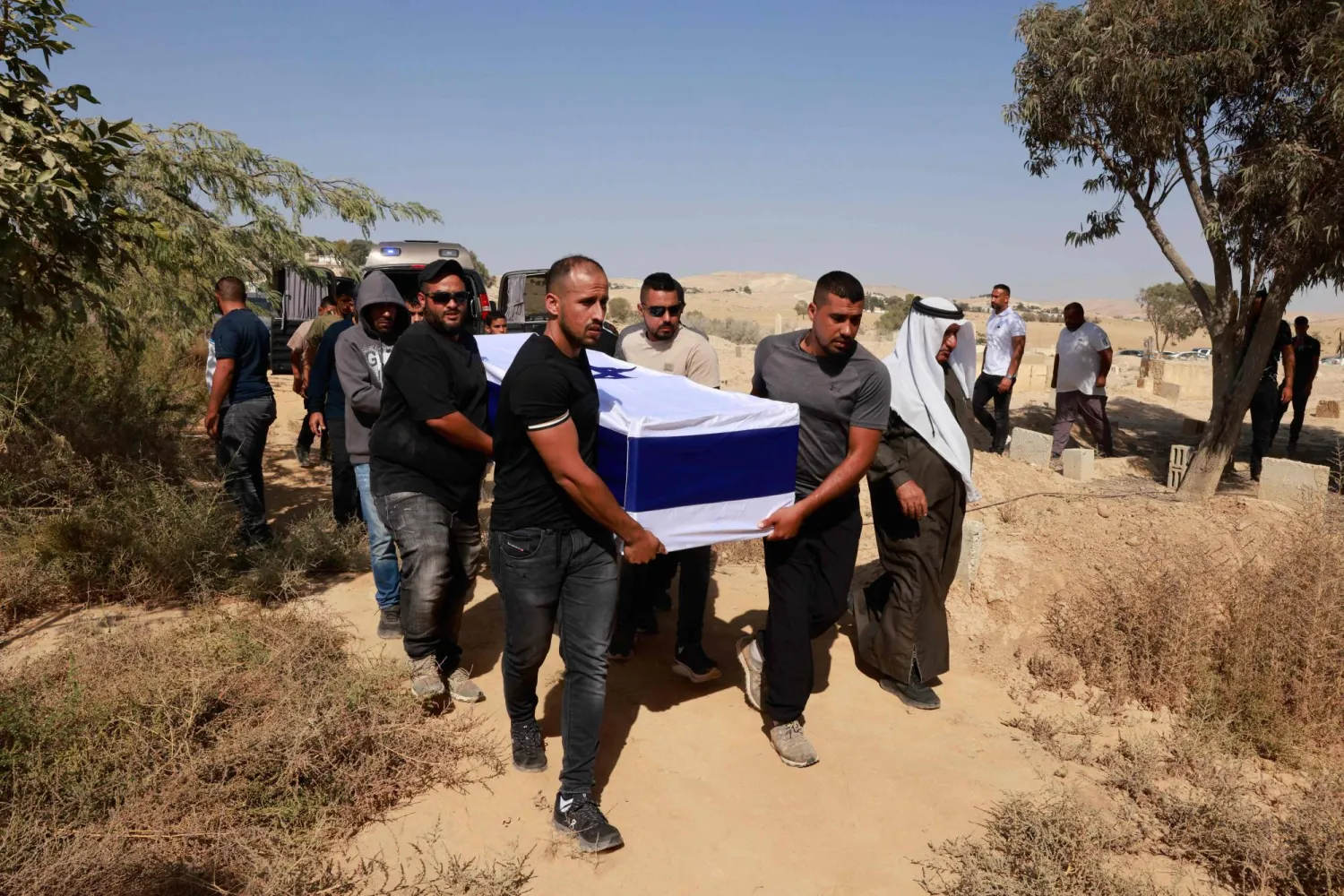
Relatives and friends of Israeli soldier Mohammad Alatrash, a sergeant major in the Israeli military's Bedouin Trackers Unit who was killed in combat during Hamas' October 7, 2023 attack on Israel, carry his coffin during his funeral near Beersheba, on October 16, 2025. (Photo by Menahem Kahana / AFP)
TT

Why the Handover of Israeli Hostage Bodies in Gaza Stalled

Relatives and friends of Israeli soldier Mohammad Alatrash, a sergeant major in the Israeli military's Bedouin Trackers Unit who was killed in combat during Hamas' October 7, 2023 attack on Israel, carry his coffin during his funeral near Beersheba, on October 16, 2025. (Photo by Menahem Kahana / AFP)

The handover of Israeli hostage bodies held by Hamas in the Gaza Strip has become mired in complications, mainly over the locations where the captives were lost during their detention.

Several hostages were killed in Israeli airstrikes, according to medical examinations conducted by Israel’s Abu Kabir Forensic Institute, which confirmed the cause of death after testing one of the bodies returned in recent days. Others were kidnapped with critical injuries and later died, while some were abducted already dead.

The Qassam Brigades, Hamas’s armed wing, said late Wednesday it had handed over all bodies whose burial sites were known. Israel, however, disputed the claim, saying the group knows the locations of additional bodies.

Sources from Hamas told Asharq Al-Awsat that the Qassam leadership had delivered the remains it held in certain areas, while others still require an extensive search operation in sites where they may have been buried.

According to the sources, some Palestinian factions had already transferred to the Qassam Brigades the bodies they had been holding, and those were subsequently handed over to Israel.

Explaining why the locations of other bodies remain unknown, the sources said all captives’ whereabouts were initially known to the relevant units within the Qassam Brigades, with regional commanders fully aware of their status.

But the assassinations of key figures responsible for guarding living hostages and remains have complicated technical efforts. Several field commanders overseeing the captives’ protection were killed in recent Israeli strikes before the war ended, the sources said.

They added that while many remains were buried in specific, known locations, Israeli incursions and bulldozing of certain areas had made recovery difficult, as graves were destroyed or mixed with other bodies in makeshift burial sites opened during intense fighting.

The sources said entire residential blocks where Israeli hostages were held were bombed, killing both captives and their guards. The locations of their bodies remain unknown and require heavy equipment to remove rubble and identify remains, a task beyond the capacity of any Palestinian group. That, the sources said, prompted the formation of a joint Turkish-Egyptian-Qatari committee to help locate and identify the bodies once found.

Those responsible for the hostages’ safety - both living and dead - tried to preserve them under a specific protocol, the sources said. But battlefield conditions overwhelmed any organized effort after Israel resumed its offensive on March 18.

The Financial Times reported Thursday that Israel had allowed Turkish rescue workers to enter Gaza to help recover the bodies of Israeli hostages. The paper quoted sources as saying the move was approved despite long-standing tensions between Turkish President Recep Tayyip Erdogan’s administration and Israeli Prime Minister Benjamin Netanyahu’s government.

Ankara will send rescue teams to assist in emergency operations, including searches for the remains of Israeli captives, the paper said.

The development came as Netanyahu reaffirmed his commitment to recovering the remains of all captives held by Hamas, a day after his defense minister threatened to resume the assault on Gaza.

Israel has accused Hamas of violating the ceasefire agreement, which stipulates the return of all hostages - living and dead - within 72 hours of the truce taking effect, by Monday noon.

The Hostages and Missing Families Forum on Thursday urged the Israeli government to delay further phases of the deal with Hamas unless the group hands over the remaining 19 bodies.

The group said the government must immediately halt implementation of any further stages of the agreement as long as Hamas continues its blatant violation of its commitments regarding the return of all hostages and victims’ bodies.

Under the deal, Hamas released 20 living hostages in exchange for about 2,000 Palestinian prisoners held in Israeli jails but handed over only nine of the 28 bodies of captives who died in custody.

Marking the second anniversary of the Oct. 7, 2023, attack, Netanyahu said: “The struggle is not over, but one thing is clear today: Anyone who raises a hand against us already knows he will pay a very heavy price for his aggression.”

Netanyahu said Israel was “committed to bringing back every last” hostage.


Abbas Calls on Hamas to Disarm, Israel to Withdraw from Gaza

Palestinian President Mahmoud Abbas. (dpa)
TT

Abbas Calls on Hamas to Disarm, Israel to Withdraw from Gaza

Palestinian President Mahmoud Abbas. (dpa)

Palestinian President Mahmoud Abbas said on Saturday that the second phase of US President Donald Trump’s ceasefire plan in Gaza demands Israel’s withdrawal from the enclave and for Hamas and other armed groups to turn over their weapons to his Palestinian Authority.

Speaking during a telephone call with German Chancellor Friedrich Merz, Abbas added that his priority now lies in implementing Trump’s plan to end the war, stop the bloodshed and ease the suffering of the Palestinian people in Gaza and prevent their displacement.

The implementation of the second phase will pave the way for the deployment of Palestinian police and the international stabilization force in Gaza and the launch of the reconstruction phase in an organized and effective manner, he explained.

Parallel steps must be carried out in the occupied West Bank to put an end to Israeli measures that are undermining the two-state solution, Abbas continued.

He demanded an end to Israeli settler violence against the Palestinian people, an end to settlement expansion and annexation policies, and an end to Israeli policies that are harming the Palestinian economy and government’s ability to meet its commitments to the people.

Abbas reiterated his condemnation of Hamas’ October 7, 2023 attack, saying the movement “must end its rule in Gaza and hand over its weapons.”

He renewed Palestine’s commitment to recognize Israel and the two-state solution, “so that an independent Palestinian state can coexist side by side by Israel in peace and security.”

Abbas and Merz held their call hours before the German leader arrived in Israel on an official visit.


Sudanese Paramilitary Drone Attack Kills 50, Including 33 Children in Kordofan

FILE - Sudanese soldiers from the Rapid Support Forces unit patrol during a rally for Dagalo, in Garawee town, north of Sudan, Saturday, June 15, 2019. (AP Photo)
TT

Sudanese Paramilitary Drone Attack Kills 50, Including 33 Children in Kordofan

FILE - Sudanese soldiers from the Rapid Support Forces unit patrol during a rally for Dagalo, in Garawee town, north of Sudan, Saturday, June 15, 2019. (AP Photo)

A drone attack by the Sudanese paramilitary forces hit a kindergarten in south-central Sudan, killing 50 people, including 33 children, a doctors’ group said.

Paramedics on the scene in the town of Kalogi in South Kordofan state were targeted in “a second unexpected attack," Sudan Doctors’ Network said in a statement late Friday.

Emergency Lawyers, a rights group tracking violence against civilians in Sudan reported in a statement Saturday the second strike on paramedics treating survivors in Kalogi and said “a third civilian site near the previous two” was also attacked, reported The Associated Press.

The group condemned the attack, blaming the paramilitary group, the Rapid Support Forces, or RSF, for the strikes, calling them “a flagrant violation of international humanitarian law, including the protection of civilians, especially children, and vital civilian infrastructure.”

The death toll is expected to be higher, but communication blackouts in the area have made it difficult to report casualties.

Thursday's attack is the latest in the fighting between the RSF, and the Sudanese military, who have been at war for over two years. It is now concentrating in the oil-rich Kordofan states.

“Killing children in their school is a horrific violation of children’s rights,” said UNICEF Representative for Sudan Sheldon Yett in a statement Friday.

“Children should never pay the price of conflict,” said Yett.

He said UNICEF urges all parties “to stop these attacks immediately and allow safe, unhindered access for humanitarian assistance to reach those in desperate need.”

Hundreds of civilians were killed throughout the Kordofan states in the last few weeks as intensified fighting shifted from Darfur after the RSF took over the besieged city of el-Fasher.

Sudanese military aerial strikes on Sunday killed at least 48 people, mostly civilians, in Kauda, South Kordofan.

UN Human Rights Chief Volker Türk warned that Kordofan could face new atrocities like those in el-Fasher.

Separately, the RSF condemned in a statement Friday a drone strike on the Chad-Sudan border, accusing the Sudanese military of being behind it and posted a video showing billowing black smoke. This couldn't be independently verified and it is unclear whether there were casualties in this strike. There was no immediate comment from the Sudanese military.

RSF’s violent takeover of el-Fasher was marked with executions of civilians, rapes and sexual assaults, and other atrocities. Thousands escaped and thousands more are feared killed or trapped in the city.

The RSF and the Sudanese military have been fighting for power over Sudan since 2023. More than 40,000 people were killed in the war, according to the World Health Organization, and 12 million displaced. However, aid groups say the true death toll could be way higher.


Türkiye FM Says SDF Showing No Intent to Honor Deal to Integrate into Syrian State

Turkish Foreign Minister Hakan Fidan speaks during an interview with Reuters at the 23rd edition of the annual Doha Forum, in Doha, Qatar, December 6, 2025. REUTERS/Ibraheem Abu Mustafa
TT

Türkiye FM Says SDF Showing No Intent to Honor Deal to Integrate into Syrian State

Turkish Foreign Minister Hakan Fidan speaks during an interview with Reuters at the 23rd edition of the annual Doha Forum, in Doha, Qatar, December 6, 2025. REUTERS/Ibraheem Abu Mustafa

Türkiye's foreign minister said the Kurdish-led Syrian Democratic Forces (SDF) are signaling "no intention" of honoring their deal to integrate into Syrian state structures and are instead trying to circumvent it.

Hakan Fidan said in an interview with Reuters on the sidelines of the Doha Forum that Ankara was not giving the Syrian government a "blank cheque" to “oppress” minorities, adding that everyone in Syria "must feel safe and free".

The minister also said Israel’s "destabilization policies" in Syria were the main obstacle to efforts to rebuild unity in the country.