

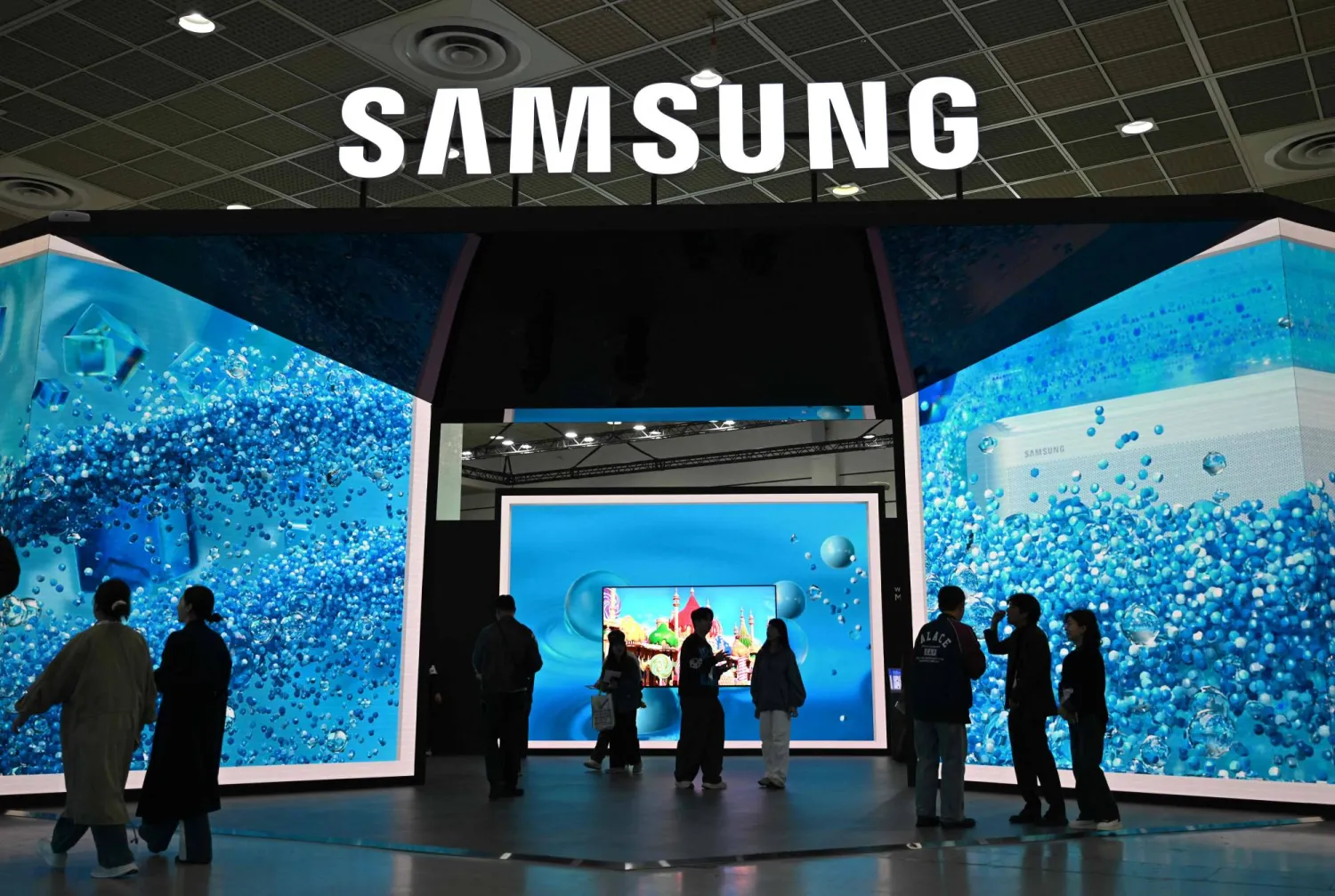

Samsung's Galaxy XR Headset to Take on Apple with Help from Google and Qualcomm 

Visitors walk past the Samsung Electronics booth during the Korea Electronics Show 2025 at the COEX convention and exhibition center in Seoul on October 22, 2025. (AFP)
TT

Samsung's Galaxy XR Headset to Take on Apple with Help from Google and Qualcomm 

Visitors walk past the Samsung Electronics booth during the Korea Electronics Show 2025 at the COEX convention and exhibition center in Seoul on October 22, 2025. (AFP)

Samsung Electronics released its Galaxy XR extended reality headset on Tuesday, counting on AI features from Google to propel it into the nascent and uncertain market of computing-on-your-face that is dominated by Meta and Apple.

The headset, resembling those made by others such as Meta, will cost $1,799, or about half of what Apple charges for its Vision Pro headset.

It is the first of a family of new devices, powered by the Android XR operating system and artificial intelligence, in a long-term partnership with Alphabet's Google and Qualcomm.

"There's a whole journey ahead of us in terms of other devices and form factors," said Google's vice president of AR/XR Sharham Izadi in an interview ahead of the launch.

Up next will be the release of lighter eyeglasses, executives said, declining to elaborate. Samsung has announced partnerships with Warby Parker and South Korea's Gentle Monster luxury eyewear.

The race to find new form factors for entertainment and computing, underpinned by AI, has fueled a battle among the biggest technology companies. Instagram-owner Meta overwhelmingly dominates the VR headset industry with about an 80% market share, with Apple trailing behind.

ChatGPT-maker OpenAI is also diving into the market and spent $6.5 billion to buy iPhone designer Jony Ive's hardware startup io Products in May to figure out devices in the AI age.

Samsung has studied the extended reality segment for the past 10 years, and it was not until about four years ago that the company approached Google to jointly develop the project, codenamed "Moohan," meaning "infinite" in Korean, said Jay Kim, executive vice president at Samsung's mobile division.

"We have been agonizing over when to bring the product to the market, and considering various factors such as technology evolution and market situation, we believe that now is the best timing," he said at a briefing in Seoul on Wednesday.

USING GOOGLE AI STRENGTH

The long-awaited Samsung Galaxy XR, first demonstrated last year, combines virtual reality and mixed reality features. The goggles immerse users watching videos, such as on Alphabet's YouTube, or playing games and viewing pictures, while also allowing users to interact with their surroundings.

The latter feature takes advantage of Google's Gemini service, which can analyze what users are seeing and offer directions or information about real-world objects by looking and circling objects with their fingers.

In an interview last week, executives from Google and Samsung discussed how they believe extended reality headsets, which have yet to ignite mass consumer interest, would benefit greatly from the application of Google's powerful multimodal AI features throughout the device that can process information from different types of data such as text, photos and videos.

It's a set of software capabilities that Apple has yet to demonstrate, despite rolling out an updated Vision Pro with a more powerful chip.

"Google entering the fray again changes the dynamic in the ecosystem," said Anshel Sag, principal analyst at Moor Insights & Strategy, noting that Google's software added $1,000 in value to the device by some estimates. "Google really wants people to get the full experience of Gemini when using this headset."

Customers who buy the device this year will receive a bundle of free services including 12 months of access to Google AI Pro, YouTube Premium, Google Play Pass and other specialized XR content, the companies said.

The prototype for AI-enhanced goggles was ready by the time Apple had launched its Vision Pro headset in 2024, executives said, as they sought to enhance existing applications like YouTube and Google Photos and Google Maps, while creating new immersive experiences.

Like many first generation technologies, it attempts to do multiple things that could have consumer and enterprise applications.

Qualcomm is providing its Snapdragon XR2+ Gen 2 chip to power the headset.

DIFFICULT MARKET

Many tech CEOs have been seduced by what they say is the next big thing in personal computing, but the market remains tiny by tech standards.

Research firm Gartner estimated the global Head-Mounted Display market is expected to rise by 2.6% from this year to $7.27 billion next year. Lighter, eyeglass-type AI devices such as Meta's smartglasses made in collaboration with EssilorLuxottica Ray-Bans are expected to drive most of this growth.

Despite the expanding competitive landscape, the global virtual reality market, which includes so-called "mixed reality" headsets launching more recently, has faced three consecutive years of decline. Weakening again, shipments in 2025 are expected to fall 20% year on year, according to research firm Counterpoint.

"With a potentially more competitive price point than Apple’s Vision Pro, Samsung’s Project Moohan headset could emerge as a strong contender in the premium VR segment, particularly within the enterprise market," Counterpoint senior analyst Flora Tang.

The Galaxy XR is the first Android XR device. But Samsung has dabbled with face-mounted computing devices dating back a decade, involving slipping a smartphone into a headset, called the Gear VR, in partnership with VR headset maker Oculus. Meta acquired Oculus in 2014.



AI Bubble to Be Short-lived, Rebound Stronger, NTT DATA Chief Says

FILE PHOTO: Figurines with computers and smartphones are seen in front of the words "Artificial Intelligence AI" in this illustration taken, February 19, 2024. REUTERS/Dado Ruvic/Illustration/File Photo
TT

AI Bubble to Be Short-lived, Rebound Stronger, NTT DATA Chief Says

FILE PHOTO: Figurines with computers and smartphones are seen in front of the words "Artificial Intelligence AI" in this illustration taken, February 19, 2024. REUTERS/Dado Ruvic/Illustration/File Photo

A potential artificial intelligence bubble will deflate faster than past tech cycles but give way to an even stronger rebound as corporate adoption catches up with infrastructure spending, the head of Japanese IT company NTT DATA Inc. said.

Despite worries around supply chains, the direction of travel is clear, CEO Abhijit Dubey said in an interview with the Reuters Global Markets Forum.

"There is absolutely no doubt that in the medium- to long-term, AI is a massive secular trend," he said.

"Over the next 12 months, I think we're going to have a bit of a normalization ... It'll be a short-lived bubble, and (AI) will come out of it stronger."

With demand for compute still running ahead of supply, "supply chains are almost spoken for" over the next two to three years, he said. Pricing power is already tilting toward chipmakers and hyperscalers, mirroring their stretched valuations in public markets, he added.

AI has triggered the biggest technological shake-up since the advent of the internet, fueling trillions of dollars of investment and eye-watering equity gains. But it has caused shortages of memory chips, drawn regulatory scrutiny, and created growing unease over the future of work.

Dubey, who is also the firm's chief AI officer, said his company has begun rethinking recruitment strategies as AI reshapes labor markets.

"There will clearly be an impact ... Over a five- to 25-year horizon, there will likely be dislocation," he said. However, he added that NTT DATA continues to hire across locations.

Speakers at the Reuters NEXT conference in New York discussed how AI may upend work and job growth.

AI startup Writer Inc.'s CEO May Habib said customers are focused on slowing headcount growth.

"You close a customer, you get on the phone with the CEO to kick off the project, and it's like, 'Great, how soon can I whack 30% of my team?'," she said.

Still, a PwC survey of the global workforce released in November suggests the reality of generative AI usage has yet to match boardroom expectations.

Daily use of GenAI remains "significantly lower" than widely touted by executives, PwC said, even as workers with AI skills commanded an average wage premium of 56% — more than double last year's figure.

PwC also flagged a widening skills gap, with about half of non-managers reporting access to training resources, compared with roughly three-quarters of senior executives.


EU Launches Antitrust Probe into Meta over Use of AI in WhatsApp

FILE - Attendees visit the Meta booth at the Game Developers Conference 2023 in San Francisco on March 22, 2023. (AP Photo/Jeff Chiu, File)
TT

EU Launches Antitrust Probe into Meta over Use of AI in WhatsApp

FILE - Attendees visit the Meta booth at the Game Developers Conference 2023 in San Francisco on March 22, 2023. (AP Photo/Jeff Chiu, File)

Brussels has opened a new antitrust investigation into Meta Platforms over its rollout of artificial intelligence features in WhatsApp, the European Commission said on Thursday, reflecting rising scrutiny of Big Tech's use of generative AI.

The move, reported earlier by Reuters and the Financial Times, marks the latest action by European regulators against large technology firms as the bloc seeks to balance support for the sector with efforts to curb its expanding influence.

The European Commission opened the investigation into "Meta's new policy regarding AI providers' access to WhatsApp" after the California-based company integrated its Meta AI system into the messaging service earlier this year.

A WhatsApp spokesperson said that "the claims are baseless", adding that the emergence of chatbots on its platforms "puts a strain on our systems that they were not designed to support".

"Even still, the AI space is highly competitive and people have access to the services of their choice in any number of ways, including app stores, search engines, email services, partnership integrations, and operating systems."

Meta AI, a chatbot and virtual assistant, has been built into WhatsApp's interface since March 2025 across European markets.

Italy's antitrust watchdog opened a parallel investigation in July into allegations that Meta leveraged its market power by integrating an AI tool into WhatsApp. The probe was expanded in November to examine whether Meta further abused its dominance by blocking rival AI chatbots from the messaging platform.

The FT, citing officials, said that the EU probe will be conducted under traditional antitrust rules rather than the EU's Digital Markets Act, the bloc's landmark legislation currently used to scrutinize Amazon and Microsoft's cloud services for potential curbs.


Nintendo Launches Long-awaited 'Metroid Prime 4' Sci-fi Blaster

The 'Metroid' series's unique look has garnered many fans since it began in 1986. Ina FASSBENDER / AFP/File
TT

Nintendo Launches Long-awaited 'Metroid Prime 4' Sci-fi Blaster

The 'Metroid' series's unique look has garnered many fans since it began in 1986. Ina FASSBENDER / AFP/File

Fans of Nintendo's "Metroid" science-fiction saga have reason to celebrate Thursday as the latest instalment in the series is released after an eight-year wait and a bumpy road through development.

Drawing loose inspiration from the "Alien" movies since its first title in 1986, the game series has followed the adventures of space bounty hunter Samus Aran in her battle with the extraterrestrial Metroid, said AFP.

Over 15 instalments, the saga evolved from 2D platforming and exploration into a first-person action-adventure format from 2002, when the first "Metroid Prime" appeared on the Gamecube console.

Now "Metroid Prime 4: Beyond" will take players on Switch 1 or 2 to a distant planet they can explore on foot or by motorbike in Samus's distinctive armored suit.

Equipped with an arm-mounted cannon and a suite of psychic powers to overcome different challenges, players must blaze a trail through jungles or deserts as they battle enemies.

In a novelty for this instalment, players can use the Switch 2's detachable controller handset like a computer mouse to look around the environment -- making the game more comfortable for people used to gaming on a PC setup.

Critics have largely welcomed the new game, with a score of 81 out of 100 based on 71 reviews aggregated by the Metacritic website.

That's a relief for Nintendo after its painful and rare decision to restart development from scratch in 2019 -- 18 months after the title's initial unveiling.

The Japanese giant's first take had "not reached the standards we seek", Nintendo development lead Shinya Takahashi said at the time in a YouTube video.

Nintendo instead handed the job to its US-based development house Retro Studios, which created the first three "Metroid Prime" titles.

The years flying under the radar for "Prime 4" meant it joined longed-for future titles like "Half-Life 3" from Valve or "Beyond Good and Evil 2" from Ubisoft among game fans' white whales.