


Police Say Louvre Defenses Lagged as Jewel-Heist Suspects Near Custody Cutoff 

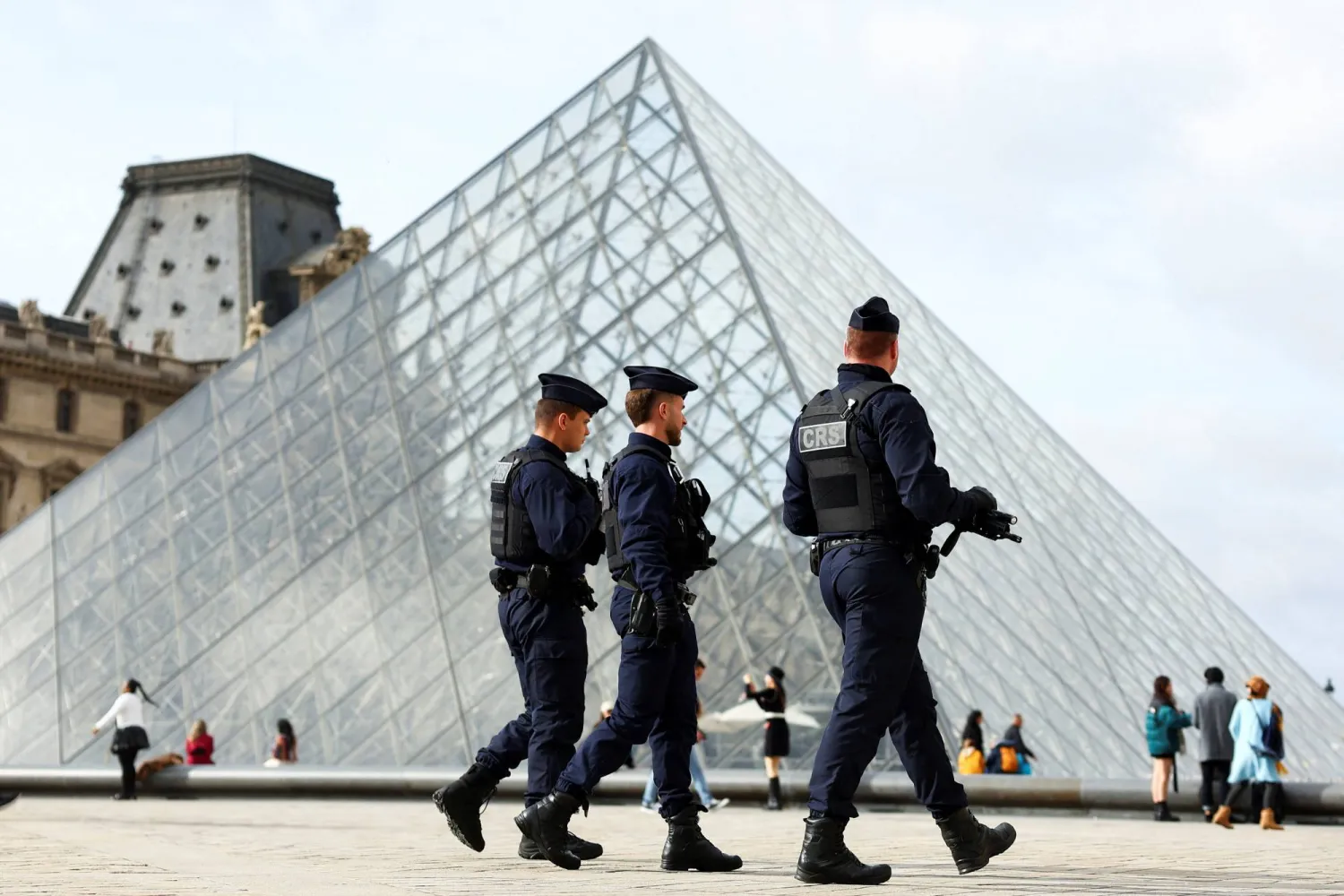
French CRS riot police officers walk near the glass Pyramid of the Louvre Museum, after French police arrested suspects in the Louvre heist case, in Paris, France October 27, 2025. (Reuters)
TT

Police Say Louvre Defenses Lagged as Jewel-Heist Suspects Near Custody Cutoff 

French CRS riot police officers walk near the glass Pyramid of the Louvre Museum, after French police arrested suspects in the Louvre heist case, in Paris, France October 27, 2025. (Reuters)

Paris police acknowledged major gaps in the Louvre’s defenses on Wednesday, turning this month's dazzling daylight theft into a national reckoning over how France protects its treasures.

Paris Police Chief Patrice Faure told Senate lawmakers that aging systems and slow-moving fixes left weak seams in the world’s most-visited museum.

“A technological step has not been taken,” he told lawmakers, noting parts of the video network are even still analog, producing lower-quality images that are slow to share in real time.

A long-promised revamp — a $93 million project requiring roughly 60 kilometers (37 miles) of new cabling — “will not be finished before 2029–2030,” he said.

Faure also disclosed that the Louvre’s authorization to operate its security cameras quietly expired in July and wasn’t renewed — a paperwork lapse that some see as a symbol of broader negligence after thieves forced a window to the Apollo Gallery, cut into cases with power tools and fled with eight pieces of the French crown jewels within minutes while tourists were inside.

“Officers arrived extremely fast,” Faure said, but he added the lag occurred earlier in the chain — from first detection, to museum security, to the emergency line, to police command.

Faure and his team said the first alert to police came not from the Louvre’s alarms, but from a cyclist outside who dialed the emergency line after seeing helmeted men with a basket lift.

Suspects' custody expiring

Officials say two suspects were arrested over the weekend, including one stopped at Charles-de-Gaulle Airport as he tried to leave France.

Under French rules for organized theft, custody can run up to 96 hours; that limit expires late Wednesday, when prosecutors must charge the suspects, release them, or seek a judge’s extension.

The Louvre values the eight stolen pieces at about $102 million. None has been confirmed recovered.

The theft has also exposed an insurance blind spot: officials say the jewels were not privately insured. The French state self-insures its national museums, because premiums for covering priceless heritage are astronomically high, meaning the Louvre will receive no payout for the loss. The financial blow, like the cultural wound, is total.

Faure pushed back on quick fixes. He rejected calls for a permanent police post inside the palace-museum, warning it would set an unworkable precedent and do little against fast, mobile crews. “I am firmly opposed,” he said. “The issue is not a guard at a door; it is speeding the chain of alert.”

He urged lawmakers to authorize tools currently off-limits: AI-based anomaly detection and object tracking (not facial recognition) to flag suspicious movements and follow scooters or gear across city cameras in real time.

The Oct. 19 heist was swift and simple. In the morning rush, thieves reached the jewel gallery near streetside windows, cut through reinforced cases and vanished in minutes. Former bank robber David Desclos told the AP the operation was textbook and vulnerabilities were glaringly obvious in the layout of the gallery.

Museum and culture officials under pressure

Culture Minister Rachida Dati, under pressure, has stayed defensive, refusing the Louvre director’s resignation and insisting alarms worked while acknowledging “security gaps did exist.” She has kept details to a minimum, citing ongoing investigations.

The reckoning lands at a museum already under strain. In June, the Louvre shut in a spontaneous staff strike, including security agents, over unmanageable crowds, chronic understaffing and “untenable” conditions.

Unions say mass tourism and construction pinch points create blind spots, a vulnerability underscored by thieves who rolled a basket lift to the Seine-facing façade and reached a hall displaying the crown jewels.

Faure said police will now track surveillance-permit deadlines across institutions to prevent repeats of the July lapse. But he stressed the larger fix is disruptive and slow: ripping out and rebuilding core systems while the palace stays open, and updating the law so police can act on suspicious movement in real time - before a scooter disappears into Paris traffic and diamonds into history.

For Desclos, the practical answer is unsentimental: vault the originals and display perfect replicas. Romance aside, he argues, the point is that the real objects survive.

Experts fear the stolen pieces may already be broken down and stones recut to erase their past - a prospect that adds urgency to France’s debate over how it guards what the world comes to see.



Saudi Arabia, Syria Underline Depth of their Cultural Ties

Syrian President al-Sharaa receives the Saudi minister of culture and the accompanying delegation at the Conference Palace in Damascus on Thursday. (SPA)
TT

Saudi Arabia, Syria Underline Depth of their Cultural Ties

Syrian President al-Sharaa receives the Saudi minister of culture and the accompanying delegation at the Conference Palace in Damascus on Thursday. (SPA)

Saudi Arabia and Syria underlined the strength of their cultural relationship during high-level meetings held in Damascus on Thursday, on the sidelines of the opening of the Damascus International Book Fair 2026, where the Kingdom is participating as guest of honor.

Syrian President Ahmad al-Sharaa received Saudi Minister of Culture Prince Badr bin Abdullah bin Farhan at the Conference Palace in the capital.

Earlier the same day, Prince Badr met with his Syrian counterpart, Minister of Culture Mohammad Yassin Saleh, during an official visit to attend the fair. T

he Saudi minister congratulated Syria on hosting the exhibition and expressed his wishes for continued prosperity, progress, and stability for the Syrian government and people.

Both meetings highlighted the depth of cultural relations between the two countries, the importance of expanding joint cultural cooperation across various fields, and the alignment of positions on issues of mutual interest in a way that serves both nations.

The Saudi delegation included senior officials and advisers, among them representatives from the Royal Court, the Ministry of Culture, and the King Abdulaziz Public Library, reflecting broad institutional engagement in the visit.

In the evening, Prince Badr attended the opening ceremony of the fair’s special session, held under the patronage and in the presence of al-Sharaa. The event drew wide official and cultural participation, including Arab ministers, political and intellectual figures, and a distinguished group of writers and cultural figures.

In a post on the X platform, Prince Badr thanked “our brothers in Syria for their generous hospitality and their efforts in organizing the Damascus International Book Fair.”

The minister also inaugurated the Kingdom’s pavilion at the fair in the presence of the Syrian minister of culture and the Qatari minister of culture.

Saudi Arabia’s guest-of-honor participation continues until Feb. 16 and reflects its growing prominence and leadership in the Arab and global cultural landscape.

This participation aligns with Saudi Vision 2030, which places culture at the heart of national development, viewing it as a space for dialogue, a bridge for civilizational communication, and a tool for strengthening ties among Arab peoples.

The Saudi Literature, Publishing and Translation Commission is leading the Kingdom’s participation, highlighting the development of the cultural sector and reaffirming the central role of books as carriers of knowledge and awareness.

The Saudi pavilion boasts a comprehensive cultural program featuring intellectual seminars, poetry evenings, a manuscript exhibition, traditional Saudi fashion displays, hospitality corners, archaeological replicas, and performing arts that express the depth of the Kingdom’s cultural heritage.

On the sidelines of the visit, Prince Badr, accompanied by Minister Saleh, toured the National Museum of Damascus, which houses rare artifacts spanning prehistoric eras, ancient Syrian civilizations, classical and Islamic periods, as well as traditional and modern art.


UNESCO Honors Al-Bisht Al-Hasawi as Thousands Flock to Al-Ahsa Festival

Visitors can explore interactive displays, participate in live workshops, and witness the meticulous process of tailoring this iconic symbol of prestige - SPA
TT

UNESCO Honors Al-Bisht Al-Hasawi as Thousands Flock to Al-Ahsa Festival

Visitors can explore interactive displays, participate in live workshops, and witness the meticulous process of tailoring this iconic symbol of prestige - SPA

The third edition of Al-Bisht Al-Hasawi Festival is drawing thousands of regional and international visitors to Ibrahim Palace in historic Al-Hofuf.

Organized by the Heritage Commission, this year’s festival celebrates the inscription of the Bisht on UNESCO’s Representative List of the Intangible Cultural Heritage of Humanity.

The event showcases Al-Ahsa’s centuries-old tradition of hand-weaving and gold embroidery, a craft passed down through generations of local families, SPA reported.

Visitors can explore interactive displays, participate in live workshops, and witness the meticulous process of tailoring this iconic symbol of prestige.

With UNESCO's participation and representatives from six countries, the festival has evolved into a global platform for cultural dialogue, cementing the Bisht’s status as a world-class cultural treasure.


Saudi, Syrian Culture Ministers Tour National Museum of Damascus

The ministers observed the museum’s extensive collections spanning prehistoric eras to modern art. SPA
TT

Saudi, Syrian Culture Ministers Tour National Museum of Damascus

The ministers observed the museum’s extensive collections spanning prehistoric eras to modern art. SPA

Saudi Minister of Culture Prince Badr bin Abdullah bin Farhan and his Syrian counterpart, Mohammed Yassin Saleh, have toured the National Museum of Damascus during the Kingdom’s participation as guest of honor at the 2026 Damascus International Book Fair.

The ministers observed on Thursday the museum’s extensive collections spanning prehistoric eras to modern art.

A particular focus was placed on the Arab-Islamic wing, featuring significant artifacts from the Umayyad period.

The Kingdom's participation as guest of honor at the 2026 Damascus International Book Fair, which runs until February 16, stems from the role culture plays within Saudi Vision 2030.