


Egypt Unveils the World's Largest Museum Dedicated to a Single Civilization

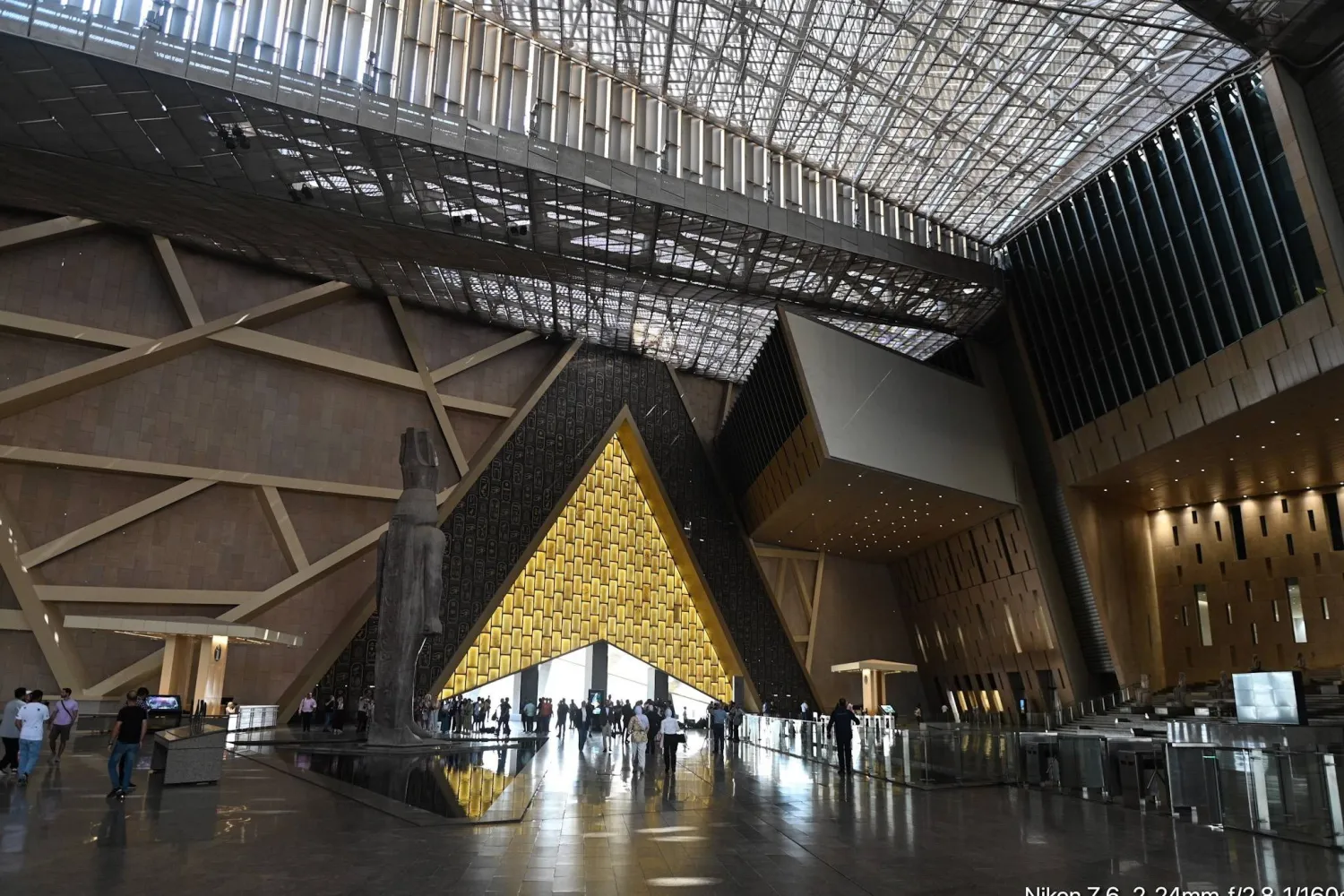
(FILE) - A view of the Grand Egyptian Museum during partial trial operation in Giza, Egypt, 15 October 2024 (reissued 31 October 2025). EPA/MOHAMED HOSSAM
TT

Egypt Unveils the World's Largest Museum Dedicated to a Single Civilization

(FILE) - A view of the Grand Egyptian Museum during partial trial operation in Giza, Egypt, 15 October 2024 (reissued 31 October 2025). EPA/MOHAMED HOSSAM

Egypt is inaugurating on Saturday the Grand Egyptian Museum, two decades in the making, with the aim of drawing more visitors to revitalize the country's tourist industry.

Located just outside Cairo on the Giza Plateau which also includes the three pyramids and the Sphinx, the museum will be the world’s largest dedicated to a single civilization. It will display over 50,000 artifacts detailing life in ancient Egypt.

World leaders, including monarchs, heads of states and governments, are set to attend the grand opening ceremony, according to the Egyptian presidency which touted the museum as “an exceptional event in the history of human culture and civilization.”

The museum is one of the megaprojects championed by President Abdel-Fattah al-Sisi since he took office in 2014. He has embarked on massive investments in infrastructure with the aim of reviving an economy weakened by decades of stagnation and battered by the unrest that followed the 2011 Arab Spring uprising.

Preparations for the grand reveal have been shrouded in secrecy. The museum, which was opened for limited visits in recent years, has been closed for the past two weeks.

The government has revamped the areas around the museum and the nearby Giza Pyramids. Roads were paved and a metro station is being constructed outside the museum gates to improve access. An airport, Sphinx International Airport, has also opened west of Cairo — 40 minutes from the museum.

The $1 billion facility had faced multiple delays, with construction beginning in 2005 but interrupted due to political instability.

The museum, known as GEM, boasts a towering, triangular glass façade imitating the nearby pyramids, with 24,000 square meters (258,000 square feet) of permanent exhibition space.

From the atrium, a grand six-story staircase lined with ancient statues leads up to the main galleries and a view of the nearby pyramids. A bridge links the museum to the pyramids, allowing tourists to move between them either on foot or via electric vehicles, according to museum officials.

The museum’s 12 main galleries, which opened last year, exhibit antiquities spanning from prehistoric times to the Roman era, organized by era and by themes.

Two halls are dedicated to the 5,000 artifacts from the collection of King Tutankhamun, which will be displayed in its entirely for the first time since British archaeologist Howard Carter discovered King Tut’s tomb in 1922 in the southern city of Luxor.

Zahi Hawass, Egypt’s most renowned archaeologist and former minister of antiquities, said the collection of Tutankhamun is the masterpiece of the museum.

“Why this museum is so important, and everyone is waiting for the opening?” he told The Associated Press. “Because of Tutankhamun.”

The collection includes the boy pharaoh’s three funeral beds and six chariots, his golden throne, his gold-covered sarcophagus and his burial mask, made of gold, quartzite, lapis lazuli and colored glass.

The government’s aim is that the museum will draw more tourists who will stay for a while and provide the foreign currency Egypt needs to shore up its economy.

The tourism sector has suffered during years of political turmoil and violence following the 2011 Arab Spring uprising. In recent years, the sector has started to recover from the coronavirus pandemic and the effects of Russia’s war on Ukraine — both countries are major sources of tourists visiting Egypt.

A record number of about 15.7 million tourists visited Egypt in 2024, contributing about 8% of the country's GDP, according to official figures. The government aims to attract 30 million visitors annually by 2032.

The museum will be open to the public starting Tuesday, authorities said.


Saudi Arabia, Syria Underline Depth of their Cultural Ties

Syrian President al-Sharaa receives the Saudi minister of culture and the accompanying delegation at the Conference Palace in Damascus on Thursday. (SPA)
TT

Saudi Arabia, Syria Underline Depth of their Cultural Ties

Syrian President al-Sharaa receives the Saudi minister of culture and the accompanying delegation at the Conference Palace in Damascus on Thursday. (SPA)

Saudi Arabia and Syria underlined the strength of their cultural relationship during high-level meetings held in Damascus on Thursday, on the sidelines of the opening of the Damascus International Book Fair 2026, where the Kingdom is participating as guest of honor.

Syrian President Ahmad al-Sharaa received Saudi Minister of Culture Prince Badr bin Abdullah bin Farhan at the Conference Palace in the capital.

Earlier the same day, Prince Badr met with his Syrian counterpart, Minister of Culture Mohammad Yassin Saleh, during an official visit to attend the fair. T

he Saudi minister congratulated Syria on hosting the exhibition and expressed his wishes for continued prosperity, progress, and stability for the Syrian government and people.

Both meetings highlighted the depth of cultural relations between the two countries, the importance of expanding joint cultural cooperation across various fields, and the alignment of positions on issues of mutual interest in a way that serves both nations.

The Saudi delegation included senior officials and advisers, among them representatives from the Royal Court, the Ministry of Culture, and the King Abdulaziz Public Library, reflecting broad institutional engagement in the visit.

In the evening, Prince Badr attended the opening ceremony of the fair’s special session, held under the patronage and in the presence of al-Sharaa. The event drew wide official and cultural participation, including Arab ministers, political and intellectual figures, and a distinguished group of writers and cultural figures.

In a post on the X platform, Prince Badr thanked “our brothers in Syria for their generous hospitality and their efforts in organizing the Damascus International Book Fair.”

The minister also inaugurated the Kingdom’s pavilion at the fair in the presence of the Syrian minister of culture and the Qatari minister of culture.

Saudi Arabia’s guest-of-honor participation continues until Feb. 16 and reflects its growing prominence and leadership in the Arab and global cultural landscape.

This participation aligns with Saudi Vision 2030, which places culture at the heart of national development, viewing it as a space for dialogue, a bridge for civilizational communication, and a tool for strengthening ties among Arab peoples.

The Saudi Literature, Publishing and Translation Commission is leading the Kingdom’s participation, highlighting the development of the cultural sector and reaffirming the central role of books as carriers of knowledge and awareness.

The Saudi pavilion boasts a comprehensive cultural program featuring intellectual seminars, poetry evenings, a manuscript exhibition, traditional Saudi fashion displays, hospitality corners, archaeological replicas, and performing arts that express the depth of the Kingdom’s cultural heritage.

On the sidelines of the visit, Prince Badr, accompanied by Minister Saleh, toured the National Museum of Damascus, which houses rare artifacts spanning prehistoric eras, ancient Syrian civilizations, classical and Islamic periods, as well as traditional and modern art.


UNESCO Honors Al-Bisht Al-Hasawi as Thousands Flock to Al-Ahsa Festival

Visitors can explore interactive displays, participate in live workshops, and witness the meticulous process of tailoring this iconic symbol of prestige - SPA
TT

UNESCO Honors Al-Bisht Al-Hasawi as Thousands Flock to Al-Ahsa Festival

Visitors can explore interactive displays, participate in live workshops, and witness the meticulous process of tailoring this iconic symbol of prestige - SPA

The third edition of Al-Bisht Al-Hasawi Festival is drawing thousands of regional and international visitors to Ibrahim Palace in historic Al-Hofuf.

Organized by the Heritage Commission, this year’s festival celebrates the inscription of the Bisht on UNESCO’s Representative List of the Intangible Cultural Heritage of Humanity.

The event showcases Al-Ahsa’s centuries-old tradition of hand-weaving and gold embroidery, a craft passed down through generations of local families, SPA reported.

Visitors can explore interactive displays, participate in live workshops, and witness the meticulous process of tailoring this iconic symbol of prestige.

With UNESCO's participation and representatives from six countries, the festival has evolved into a global platform for cultural dialogue, cementing the Bisht’s status as a world-class cultural treasure.


Saudi, Syrian Culture Ministers Tour National Museum of Damascus

The ministers observed the museum’s extensive collections spanning prehistoric eras to modern art. SPA
TT

Saudi, Syrian Culture Ministers Tour National Museum of Damascus

The ministers observed the museum’s extensive collections spanning prehistoric eras to modern art. SPA

Saudi Minister of Culture Prince Badr bin Abdullah bin Farhan and his Syrian counterpart, Mohammed Yassin Saleh, have toured the National Museum of Damascus during the Kingdom’s participation as guest of honor at the 2026 Damascus International Book Fair.

The ministers observed on Thursday the museum’s extensive collections spanning prehistoric eras to modern art.

A particular focus was placed on the Arab-Islamic wing, featuring significant artifacts from the Umayyad period.

The Kingdom's participation as guest of honor at the 2026 Damascus International Book Fair, which runs until February 16, stems from the role culture plays within Saudi Vision 2030.
