


Floods Strand People on Roofs as Typhoon Pounds Philippines

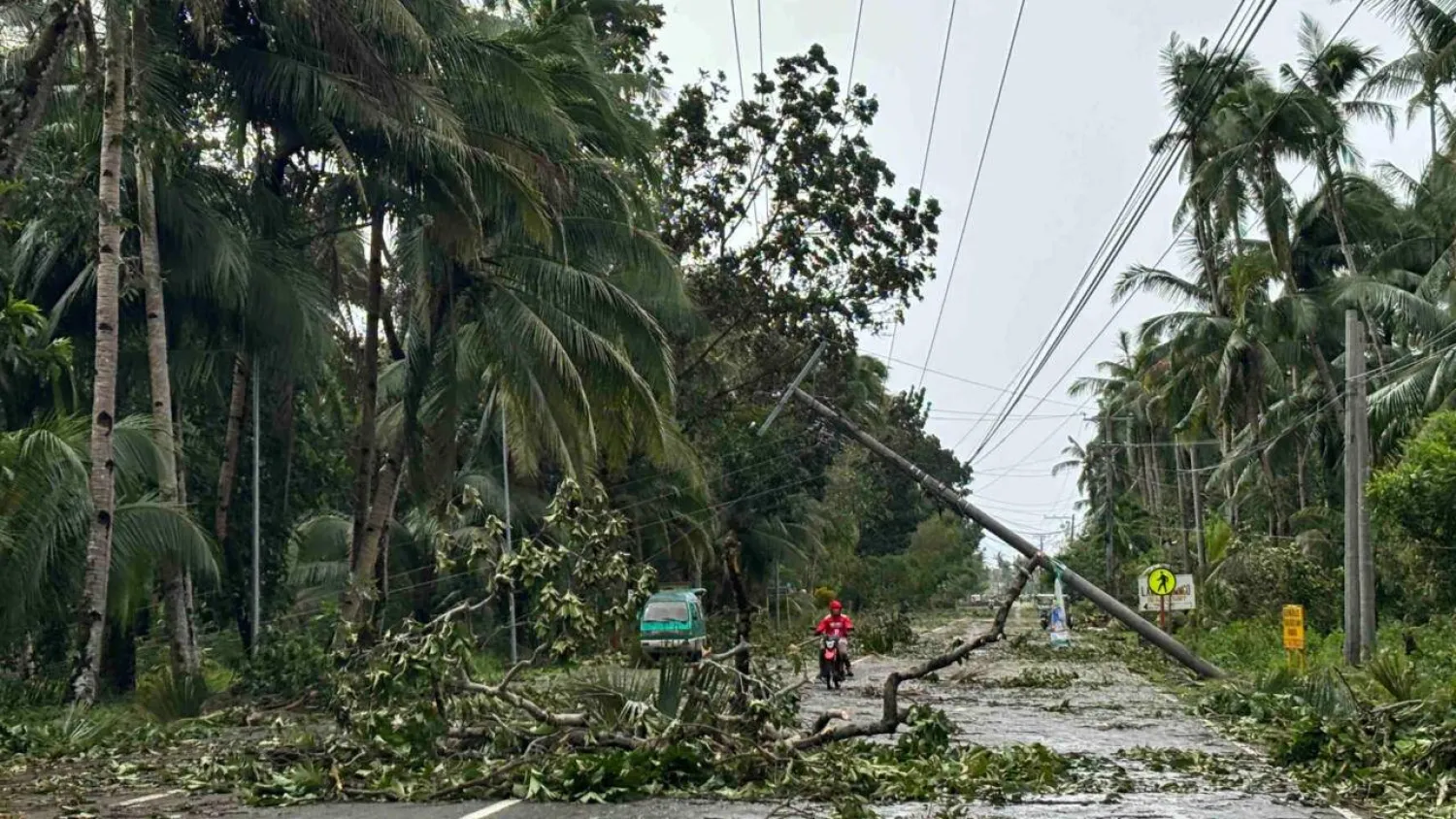
A motorist drives past a fallen electric post and trees on a highway in the aftermath of Typhoon Kalmaegi in Mayorga, Leyte province. AFP
TT

Floods Strand People on Roofs as Typhoon Pounds Philippines

A motorist drives past a fallen electric post and trees on a highway in the aftermath of Typhoon Kalmaegi in Mayorga, Leyte province. AFP

Residents sought refuge on rooftops and cars floated through flooded streets on Tuesday as Typhoon Kalmaegi battered the central Philippines, leaving at least two people dead.

Hundreds of thousands have been displaced by the powerful storm, which made landfall shortly before midnight, said AFP.

As of 8:00 am (0000 GMT), the typhoon was moving westwards across the islands of Cebu and Negros, with winds of 150 kilometers (93 miles) per hour and gusts of 185 kph toppling trees and downing power lines.

"People marooned on rooftops are asking to be rescued," Cebu information officer Rhon Ramos told AFP by phone, adding that even some evacuation centers had been flooded.

Don del Rosario, 28, was among those in Cebu City who sought refuge on an upper floor as the storm raged.

"The water rose so fast. From what I've been told, the flooding started around 3:00 am. By 4:00 am, it was already uncontrollable -- people couldn't get out (of their houses)," he said.

"I've been here for 28 years, and this is by far the worst we've experienced."

Hundreds still living in tent cities after a 6.9-magnitude quake rocked the island in late September were also "forcibly evacuated for their own safety", Ramos said.

Rafaelito Alejandro, deputy administrator at the Office of Civil Defense, told local radio that 387,000 people had been moved from the typhoon's path, while one man was killed by a falling tree in Bohol province.

Disaster official Danilo Atienza said an elderly person had also died by drowning in southern Leyte province.

"The senior citizen was trapped on an upper floor... and unable to get assistance," he told radio outlet DZMM.

The Philippines is hit by an average of 20 storms and typhoons each year, routinely striking disaster-prone areas where millions live in poverty.

With Kalmaegi, the archipelagic country has already reached that average, state weather service specialist Charmagne Varilla told AFP on Monday, adding at least "three to five more" storms could be expected by December's end.

Scientists warn that storms are becoming more frequent and more powerful due to human-driven climate change.

Praying in the dark

In Dinagat Islands province, where Kalmaegi first made landfall, 34-year-old Miriam Vargas sat with her children in the dark on Monday night, praying as the winds slammed against the walls of her home.

"There is strong rain and winds starting. We're sitting on the stairs and praying while trying to gauge the typhoon's strength," the single mother told AFP.

"The wind is whistling and there are sounds of things falling. The electricity went out about an hour ago, and we cannot see anything."

On nearby Leyte Island, disaster official Roel Montesa said evacuations were "ongoing in Palo and Tanauan" on Monday, naming two of the towns hardest hit by storm surges in 2013, when Super Typhoon Haiyan killed more than 6,000 people there.

The Philippines was hit by two major storms in September, including Super Typhoon Ragasa, which toppled trees and tore the roofs off buildings on its way to killing 14 people in nearby Taiwan.

The weather service's Varilla said that higher numbers of cyclones typically accompany La Nina, a naturally occurring climate pattern that cools surface temperatures in the central and eastern equatorial Pacific Ocean.



IAEA Raises 'Proliferation' Fears Over Iran Sites

Director General of the International Atomic Energy Agency (IAEA) Rafael Mariano Grossi speaks during a press conference in Abu Dhabi, United Arab Emirates, June 2, 2026. REUTERS/Amr Alfiky
TT

IAEA Raises 'Proliferation' Fears Over Iran Sites

Director General of the International Atomic Energy Agency (IAEA) Rafael Mariano Grossi speaks during a press conference in Abu Dhabi, United Arab Emirates, June 2, 2026. REUTERS/Amr Alfiky

The UN nuclear agency reaffirmed in a confidential report on Thursday that a lack of access to verify nuclear material in Iran posed a "proliferation concern,” calling on the country to "engage the agency constructively.”

The International Atomic Energy Agency (IAEA) has not had access to some key nuclear facilities in Iran since Israel and the United States launched a 12-day conflict in June 2025 that saw strikes on nuclear sites.

Nuclear sites have also been struck in the war that erupted on February 28. The IAEA has repeatedly urged access.

"While the agency acknowledged that the military attacks on Iran's nuclear facilities and sites have created an unprecedented situation, it is critical for the agency to conduct verification activities in Iran without delay," the IAEA said in the report.

The report is to be discussed at an IAEA board of governors' meeting next week.

Prior to US strikes in June 2025, the IAEA calculated that Iran possessed approximately 440 kilograms of uranium enriched to 60 percent, which is close to the 90 percent needed to make a bomb and well above the 3.67-percent limit set by a 2015 now-defunct agreement with Iran.

Since June 2025, the fate of this stockpile has remained uncertain, with Tehran refusing access to IAEA inspectors at sites ravaged by US and Israeli strikes.

"The agency's lack of access to verify the previously declared highly enriched uranium and low enriched uranium for nearly a year -- which is long overdue according to standard safeguard practices -- is a matter of proliferation concern," it added.

"The director general (Rafael Grossi) calls on Iran to engage the agency constructively in order to facilitate the full and effective implementation of safeguards in Iran," it added.

Grossi has also emphasized to Iran that “it is indispensable and urgent to implement effectively the NPT (Non-Proliferation Treaty) Safeguards ⁠Agreement ... ⁠and that its implementation cannot be suspended by Iran under any circumstances," the confidential report seen by Reuters and AFP said.


Trump Says He will Nominate Todd Blanche as US Attorney General

FILED - 03 March 2026, US, Washington: FILE PHOTO - US President Donald Trump speaks during a meeting in the White House. Photo: Kay Nietfeld/dpa
TT

Trump Says He will Nominate Todd Blanche as US Attorney General

FILED - 03 March 2026, US, Washington: FILE PHOTO - US President Donald Trump speaks during a meeting in the White House. Photo: Kay Nietfeld/dpa

President Donald Trump said he would move to nominate acting US Attorney General Todd Blanche on Thursday to permanently lead the Justice Department, which would make his former personal lawyer the nation's top law enforcement officer.

"He's acting attorney general. Tomorrow. I'm instructing Dan (Scavino) and everybody else that's involved in that very complicated process - which is going to go, I think, very quickly - that we are going to make him permanent attorney general," Trump said at a White House event, according to a video posted on X late on Wednesday by his aide Scavino, Reuters reported.

Blanche, 51, took over leadership of the Justice Department after Trump fired Pam Bondi in April amid tension over the agency's release of files related to convicted child sex offender Jeffrey Epstein and frustration that the department was not moving forcefully enough against the White House's supposed political enemies.

Blanche has faced backlash from Republican senators, and even some White House aides, over the Justice Department's now-scuttled plan to create a $1.8 billion fund for victims of alleged government "weaponization."

To be confirmed, Blanche would need near-unanimous Republican support in the Senate, which Republicans control by a narrow 53-47 margin. He said on Tuesday that the DOJ would not be moving forward with the plan, which sparked fierce bipartisan opposition and threatened to derail a $72 billion funding package for Trump's immigration crackdown.

But Trump on Wednesday would not say whether the fund had been terminated or was on hold, saying, "I'd have to ask the lawyers. I don't know."

"I love it. I think it's so important," Trump told reporters at the White House. "The weaponization fund, as far as I'm concerned, was a beautiful thing."

Some lawmakers have called for a ban on the fund to be documented in writing or codified into law. Blanche told members of Congress this week that he would not commit to putting anything into writing. Trump said in an interview broadcast on Wednesday that he was likely to nominate Blanche to the permanent position.

Blanche has moved quickly as acting attorney general to ingratiate himself to Trump and his political movement. In addition to the fund, the DOJ under Blanche has removed press releases detailing cases arising from the January 6, 2021, attack on the US Capitol, released a report condemning past prosecutions of anti-abortion activists and secured criminal charges against the Southern Poverty Law Center civil rights group and former FBI Director James Comey, a longtime Trump foe.


Norway Aid Group: Sudan, DR Congo Top World's Most Neglected Crises

Sudanese refugees from Al-Fashir, displaced by ongoing conflict in Sudan, gather at sunset at the Tine transit camp in eastern Chad, November 23, 2025. REUTERS/Amr Abdallah Dalsh
TT

Norway Aid Group: Sudan, DR Congo Top World's Most Neglected Crises

Sudanese refugees from Al-Fashir, displaced by ongoing conflict in Sudan, gather at sunset at the Tine transit camp in eastern Chad, November 23, 2025. REUTERS/Amr Abdallah Dalsh

Sudan, the Democratic Republic of Congo and Colombia top the list of the world's most neglected displacement crises, the Norwegian Refugee Council aid group said on Thursday.

Sudan, which since 2023 has been ravaged by a bloody conflict between two rival generals competing for power, has more than nine million internally displaced people, the prominent aid organization said in a statement.

A further four million Sudanese have fled to neighboring countries and nearly 19.5 million people there are also suffering from hunger, the NRC said.

"It is incomprehensible that a displacement crisis of similar proportions to the crises in Syria and Ukraine at their peak can continue to worsen almost unnoticed," NRC chief Jan Egeland said.

"Countries have become much more inward-looking, more nationalist.

Rearmament is now an absolute priority because we have to ensure our own security in Europe. There is Putin threatening us, and so on," Egeland said in comments to the NRK broadcaster.

"But people then forget that there will be pandemics, migratory movements, and enormous loss of human life if we don't invest in hope on other continents."

"Africa is just across the Mediterranean, where we go on holiday. And if the continent collapses, we will also suffer the consequences."

Relatives mourn during the funeral of a person who died of Ebola in Bunia, Ituri Province, Democratic Republic of the Congo, 03 June 2026. EPA/DIEUDONNE DIROLE

The Democratic Republic of Congo, where an Ebola epidemic has added turmoil to the east of the country ravaged by decades of conflict, appears on NRC's list for the 10th year in a row.

In 2025, only 27.4 percent of the funding needed for DR Congo has been secured, leaving more than 21 million people in need, according to the NRC.

"This is a testament to the world's failure to respond to crises that are not regarded as strategically important for rich countries," Egeland said in the NRC statement.

"Millions of people are being abandoned because we have chosen not to act, not because we cannot."

The NGO's list is based on three criteria: lack of humanitarian funding, lack of media coverage, and lack of political will within the international community.

Several African countries -- Burkina Faso, Cameroon, Central African Republic, Mali and Nigeria -- have featured on NRC's list six or more times, pointing to "a systemic pattern of deliberate neglect", NRC said.

The 10 most neglected crises for 2025 are Sudan, the Democratic Republic of Congo, Colombia, Yemen, Afghanistan, Honduras, Ecuador, Cameroon, Nigeria and Mozambique, spanning three continents and tens of millions of people.
